How To Become More Self-Sufficient Without Starting a Full-Blown Farm…
Want to start preserving your harvest, making your own soap, or building a backyard root cellar — but not sure where to begin? “Homesteading Advice” gives you instant lifetime access to 35+ practical homesteading books on food preservation, veggie gardening, DIY natural cleaning products (save over $250 per year with this skill alone), brewing, off-grid energy, and a whole lot more…
Click Here To Check It Out Now!
Why settle for just electricity when you can have shade, water, and food from the exact same square footage? Standard solar installs turn your yard into a heat island, but ‘Agrivoltaics’ turns your energy source into a life-support system. By raising your panels, you create a perfect microclimate for shade-loving crops, collect every drop of rain for irrigation, and generate power for your well—all on the same footprint. It is time to stop treating your solar array like a roof decoration and start treating it like a living, breathing part of your homestead.
Traditional energy wisdom tells us to clear the land, scrape it bare, and bolt down rows of glass and silicon. This scorched-earth approach ignores the natural synergy between sun, soil, and water. A modern homestead requires more than just a monthly offset on a utility bill; it demands a resilient, multi-functional landscape that feeds the family as reliably as it powers the lights.
Agrivoltaics is the art and science of co-locating agricultural production with solar photovoltaic systems. Instead of fighting the sun, we use it twice. The panels capture the high-energy photons to produce current, while the dappled shade beneath protects delicate life from the brutal midday heat. This creates a balanced ecosystem where technology supports biology rather than displacing it.
Agrivoltaic Solar Garden Design
An agrivoltaic solar garden is a deliberate marriage of energy infrastructure and organic cultivation. Most folks see solar panels as static objects, but in this design, they act as an artificial canopy. They mimic the behavior of a high-altitude forest, breaking the intensity of the sun and creating a “light-managed” environment for the soil below.
This concept exists because plants have a “light saturation point.” Most garden crops can only process a certain amount of sunlight before they stop growing and start trying to survive the heat. When a plant hits this limit, it closes its stomata to save water, essentially hitting a biological “pause” button. Agrivoltaic designs keep plants just below that stress threshold, allowing for steady growth even during the hottest parts of July.
Real-world applications range from massive utility-scale sheep pastures to intensive market gardens. On the homestead, this often looks like a “solar pergola” or a raised racking system. You aren’t just building a power plant; you are building a temperature-controlled sanctuary for your food supply. This dual-use strategy maximizes every inch of your soil, proving that self-reliance doesn’t require a hundred acres—it just requires smarter design.
How to Design and Build Your Solar Garden
Building a functional agrivoltaic system requires shifting your perspective on height and spacing. Standard ground-mounts are usually low to the earth to save on steel. For a garden, you must elevate the “dripping edge” of the panels. A height of 7 to 10 feet is common for small-scale gardens to allow for comfortable human movement and hand-tool use.
Spacing between the rows is your primary lever for light management. If you pack the panels too tightly, the ground becomes a dark, damp cave where only moss will thrive. A “land equivalent ratio” (LER) study often suggests a 50% to 70% coverage ratio. This ensures that as the sun moves across the sky, every part of the garden bed receives a rotating “slice” of direct light followed by a period of cooling shade.
Orientation plays a massive role in your harvest. While south-facing panels maximize energy, an east-west vertical orientation using bifacial panels can provide more uniform light distribution for the plants. Bifacial modules are glass on both sides, catching direct sun on the front and reflected light from the garden on the back. This increases energy yield by up to 15% while preventing the “permanent shadow” effect that can stunt crop growth.
Foundation choices matter deeply for soil health. Heavy concrete footings can compact the earth and disrupt local drainage. Screw piles or ground anchors are often preferred because they have a smaller footprint and cause minimal disturbance to the mycelial networks in your garden beds. Think of these as the “roots” of your energy system—they should be strong but non-invasive.
The Tangible Benefits of Dual-Use Solar
The most immediate benefit is water conservation. In an open field, the sun bakes the moisture right out of the dirt. Under a solar canopy, soil evaporation rates can drop by as much as 14% to 50%. This means you spend less time hauling hoses and more time tending to the health of your plants. The microclimate remains humid and cool, which is a godsend for moisture-loving greens.
Crop quality often improves under the glass. Research has shown that leafy greens like spinach and kale grow larger, more tender leaves when they aren’t battling UV stress. Even root vegetables like carrots and beets benefit from the stabilized soil temperatures. They don’t “bolt” or go to seed as quickly, extending your harvest window deep into the summer months.
Energy efficiency actually goes up when you put plants under your panels. Solar modules are like humans—they lose efficiency when they get too hot. As plants breathe, they release moisture through a process called evapotranspiration. This natural “misting” effect can cool the panels by several degrees, boosting their electrical output during the peak of summer. It is a perfect feedback loop: the panels protect the plants, and the plants cool the panels.
Common Mistakes and Pitfalls
One of the most frequent errors is ignoring the “drip line” of the solar array. When rain hits a massive row of panels, it doesn’t fall evenly. It concentrates into a heavy sheet of water that slams into the soil at the bottom edge. This creates “trenching” and soil erosion. You must design a gravel splash pad or, better yet, a gutter system to catch and redirect this concentrated energy.
Neglecting airflow is another silent killer. If you surround your raised garden with solid fencing and low-hanging panels, you create a stagnant “heat trap.” Fungal diseases love warm, still air. Ensure your design allows for prevailing winds to move through the rows. Height isn’t just for your head; it is for the breath of the garden.
Improper wiring placement can turn a garden into a maintenance nightmare. Never run exposed conduits where a rogue shovel or a rototiller might strike them. All electrical runs should be buried to code or integrated into the racking structure itself. A homestead is a working environment; your energy system must be tough enough to survive a busy morning of chores.
Limitations and Reality Checks
Agrivoltaics is not a “set it and forget it” solution for every crop. Sun-loving heavy hitters like corn, sunflowers, and peppers will struggle if they are tucked too far under the canopy. These “C4” plants require high light intensity to thrive. If your goal is a field of grain, a standard open-sky approach is still superior. Agrivoltaics is a specialist tool, best suited for market gardening and cool-season crops.
Initial costs are undeniably higher. You are spending more on steel to lift those panels into the air. Engineering a structure that can withstand wind loads at 8 feet high is more complex than bolting something to a roof. You must weigh the long-term gains in food security and water savings against the upfront “pioneer tax” of the construction phase.
Maintenance access is a non-negotiable constraint. If your racking is too low for a tractor or even a wheelbarrow, you have effectively paralyzed your farm. You must plan the “turning radius” of your equipment before the first post goes into the ground. A beautiful solar garden that you cannot weed or harvest is nothing more than an expensive obstacle course.
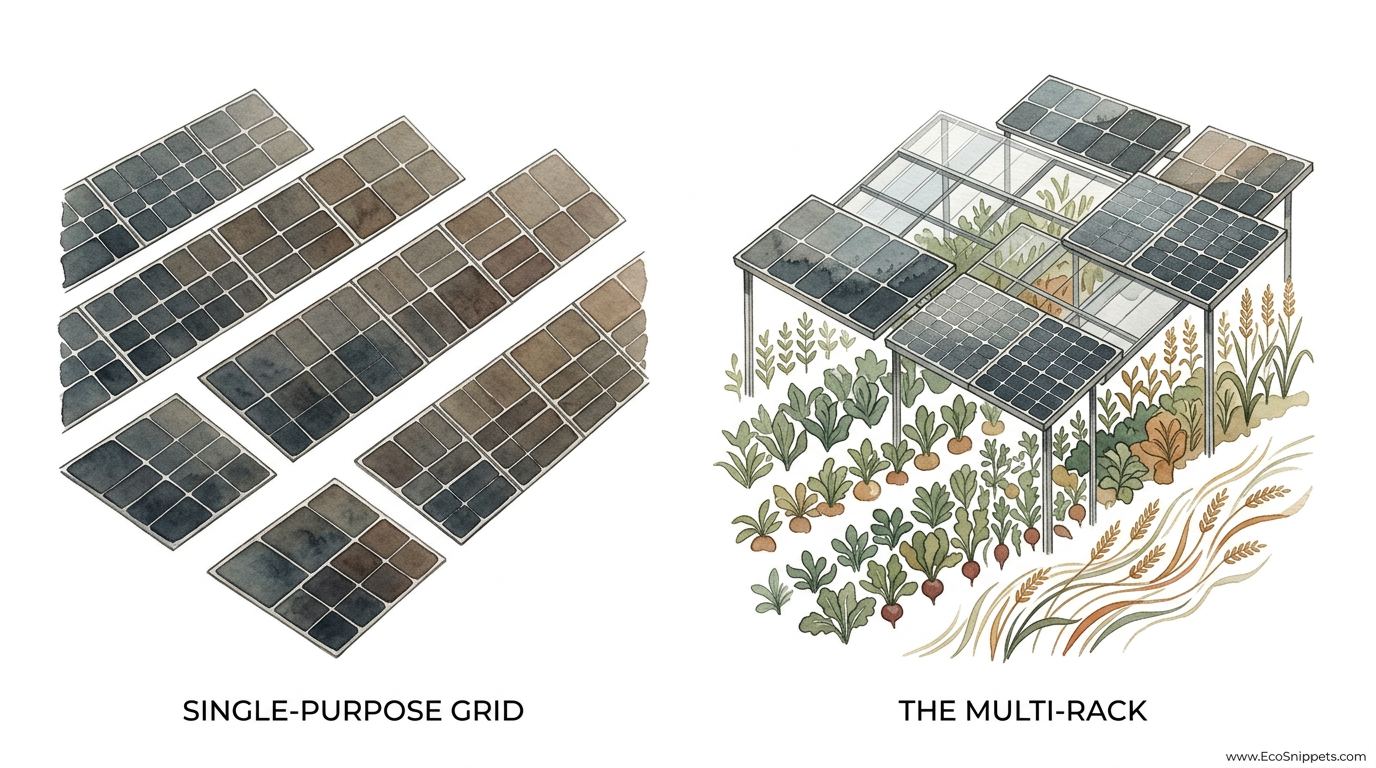
The Multi-Rack vs. Standard Ground Mount
| Feature | Standard Ground Mount | Agrivoltaic “Multi-Rack” |
|---|---|---|
| Land Use | Single-purpose (Energy) | Dual-purpose (Food & Energy) |
| Water Need | High (Open evaporation) | Low (Shade retention) |
| Installation Cost | Baseline | 20% – 40% Higher |
| Soil Health | Often degraded/compacted | Maintained or improved |
| Panel Cooling | Passive air only | Active crop transpiration |
Practical Tips for the Aspiring Agrisolarist
Start with a small pilot bed before committing your entire acreage. Observe how the shadow moves across your specific terrain. Use “shadow mapping” apps or simply place a few tall stakes in the ground to visualize where the darkness will fall at 10:00 AM versus 2:00 PM. Every homestead has its own unique solar rhythm.
Select your “Under-Panel All-Stars” carefully. Focus on high-value crops that wilt easily in direct sun. Lettuce, arugula, cilantro, and parsley are the “low-hanging fruit” of this system. Brassicas like broccoli and cauliflower also perform exceptionally well because the shade prevents the heads from “sun-scald” or discoloring.
Integrate your irrigation directly into the solar racking. The vertical posts make excellent mounting points for drip lines or overhead micro-sprinklers. This keeps the hoses off the ground and protects them from UV damage. It also simplifies your workflow—everything the garden needs, from light to water to power, is centralized in one structural unit.
Advanced Considerations: Rainwater and Bifacials
Serious practitioners should look into V-shaped racking designs. This “butterfly” configuration tilts panels toward a central gutter. This isn’t just for aesthetics; it turns your entire solar array into a massive rainwater catchment surface. A 1,000-square-foot array can harvest over 600 gallons of water from a single inch of rain. This water can be stored in tanks and gravity-fed back to the crops below.
Bifacial technology is the “gold standard” for agrivoltaics. Because these panels have clear backsheets, they allow some diffused light to pass through, reducing the “harshness” of the shadow. They also harvest the albedo—the light bouncing off your light-colored mulch or reflective greenhouse plastic. This creates a much more energetic environment for the plants while squeezing every possible watt out of the sky.
Consider the “grazing” potential if you aren’t a vegetable gardener. Small livestock like sheep or poultry thrive under solar canopies. The panels provide essential shade that reduces animal heat stress, which leads to better weight gain and higher-quality wool or eggs. This is “Solar Grazing,” and it is the fastest-growing sector of the agrivoltaic movement because it reduces the need for mowing and herbicide use.
The Scenario: A 10kW Berry and Broccoli Patch
Imagine a homestead in a high-desert environment. The sun is relentless, and the wind dries out the soil in hours. The owner installs a 10kW solar array raised 8 feet off the ground, with rows spaced 12 feet apart. Beneath the panels, they plant three rows of strawberries and two rows of broccoli.
During a heatwave, the neighbor’s garden begins to scorch and wither. In the agrivoltaic garden, the temperature is 10 degrees cooler. The soil moisture remains stable because the panels have broken the wind and blocked the direct thermal radiation. The solar energy is diverted to a deep-well pump, which provides a steady drip of water to the roots.
By the end of the season, the strawberries are larger and have a higher sugar content because they weren’t stressed by UV damage. The broccoli heads are tight and vibrant green. The solar system has produced 14,000 kWh of electricity, covering the entire home’s needs and powering the farm equipment. This is not just a garden; it is a self-sustaining energy and food hub.
Final Thoughts
The marriage of solar technology and traditional agriculture is a return to a more sensible way of living. We are moving away from the “single-use” mindset of the industrial age and toward a “multi-stack” approach that values every resource. Agrivoltaics proves that we do not have to choose between a clean grid and a full plate. We can, and must, have both.
Stepping into this path requires a bit of pioneer grit. You will have to design, test, and occasionally fail as you learn the language of your specific land. But the reward is a homestead that feels less like a series of disconnected chores and more like a unified, life-supporting system. You are no longer just a consumer of energy or a grower of food; you are a manager of a complex, beautiful synergy.
Start small, build high, and keep your eyes on the horizon. Whether you are protecting a few beds of salad greens or managing a multi-kilowatt sheep pasture, you are participating in the next great evolution of self-reliance. The sun is giving us everything we need—it is simply up to us to catch it twice.
