How To Become More Self-Sufficient Without Starting a Full-Blown Farm…
Want to start preserving your harvest, making your own soap, or building a backyard root cellar — but not sure where to begin? “Homesteading Advice” gives you instant lifetime access to 35+ practical homesteading books on food preservation, veggie gardening, DIY natural cleaning products (save over $250 per year with this skill alone), brewing, off-grid energy, and a whole lot more…
Click Here To Check It Out Now!
Most restaurants pay to get rid of this toxic sludge, but on our homestead, it’s the secret to $0 fuel costs. I stopped at the local diner today, not for a burger, but for their trash. While everyone else is complaining about fuel prices at the pump, we’re converting used vegetable oil into high-grade biodiesel for our tractors. It’s cleaner, smells like french fries, and most importantly—it’s absolutely free.
The era of cheap energy might be fading for the rest of the world, but for the self-reliant homesteader, energy is everywhere. You just have to know how to harvest it. That sticky, used grease sitting in a drum behind your local greasy spoon is actually a dense store of solar energy.
The plants grew in the sun, the oil was pressed from the seeds, and after it’s served its purpose frying potatoes, it still contains nearly the same BTU value as diesel fuel. We aren’t just recycling; we are reclaiming our independence. Transitioning from being a consumer to a producer changes your perspective on “waste” forever.
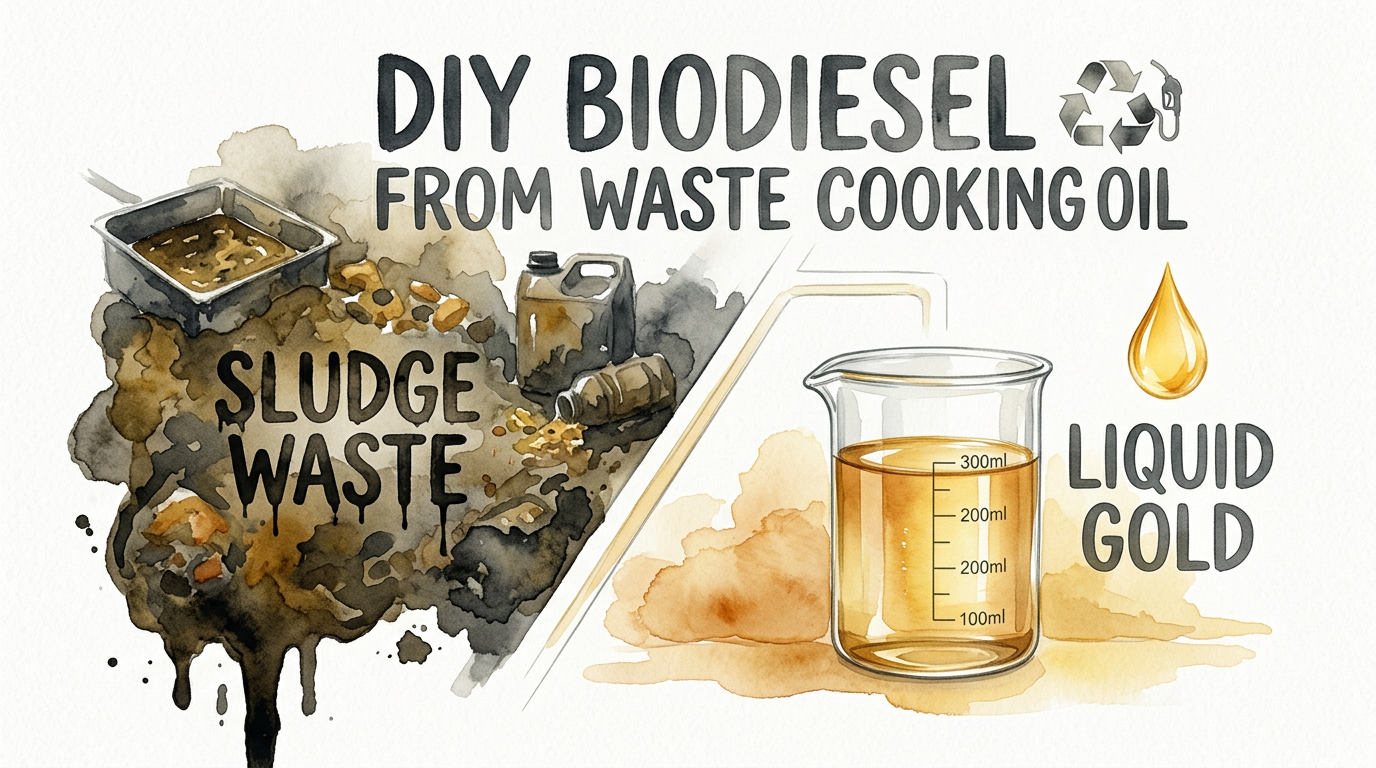
To a casual observer, that drum of fryer oil looks like a liability. To a prepared pioneer, that sludge waste is liquid gold. With a bit of chemistry and some hardware store components, you can stop being a slave to the global oil market.
DIY Biodiesel From Waste Cooking Oil
Biodiesel is a renewable, clean-burning replacement for petroleum diesel. It is produced through a chemical process called transesterification. This sounds complicated, but it is simply the process of separating glycerin from the vegetable oil.
When you look at used vegetable oil (WVO), you are looking at triglycerides. These are heavy, thick molecules that are too viscous to run through a modern diesel injector without causing problems. By reacting the oil with an alcohol and a catalyst, we break those heavy molecules apart.
The result is two distinct products: methyl esters (which we call biodiesel) and glycerin. The glycerin sinks to the bottom, leaving a clear, amber liquid on top that is ready to power your machines. This isn’t a new “green” fad; Rudolf Diesel actually designed his original engine to run on peanut oil back in the late 1800s.
In the real world, biodiesel is used in everything from school buses to heavy freight trucks. On the homestead, it powers the tractors that plow the fields, the generators that keep the lights on, and the trucks that haul the harvest. It is a proven technology that rewards the diligent.
How the Conversion Process Works
Creating fuel at home requires a disciplined approach to chemistry and safety. You are essentially running a small-scale refinery. The process can be broken down into five major phases: collection, dewatering, titration, processing, and washing.
First, you must source your oil. Look for “yellow grease,” which is relatively clean oil used for frying. Avoid “brown grease” from grease traps, as it is too acidic and contaminated for easy processing. Once you have the oil, you must filter out the food particles. A simple bucket filter or a 400-micron screen is a good starting point.
Water is the enemy of biodiesel. If there is water in your oil when you start the chemical reaction, you will end up with a giant tank of useless soap instead of fuel. We dewater the oil by heating it to around 120 degrees Fahrenheit and letting it settle, or by heating it past the boiling point of water to “cook” the moisture out.
Titration is the most critical step for a successful batch. Since used oil has been heated and used for cooking, it contains Free Fatty Acids (FFAs). These acids neutralize your catalyst. You must perform a small-scale test to determine exactly how much extra catalyst is needed to neutralize the acids in your specific batch of oil.
The actual “processing” happens in a closed reactor. You mix methanol with a catalyst—usually lye (sodium hydroxide) or caustic potash (potassium hydroxide)—to create sodium methoxide. This is a dangerous, volatile chemical. Once mixed, you add it to your heated oil and circulate it for several hours.
Benefits of Making Your Own Fuel
The most obvious benefit is the massive reduction in operating costs. When your fuel cost drops to near zero, the economics of your homestead change overnight. Suddenly, projects that were too expensive because of fuel usage become viable.
Beyond the money, there is the matter of engine longevity. Biodiesel has significantly higher lubricity than modern Ultra-Low Sulfur Diesel (ULSD). Petroleum companies actually have to add lubricants back into their fuel to keep engines from wearing out. Biodiesel provides that protection naturally, extending the life of your fuel pumps and injectors.
There is also a significant environmental advantage. Biodiesel is biodegradable and far less toxic than petroleum. If you spill a gallon of biodiesel on your soil, it’s gone in weeks. If you spill a gallon of petroleum diesel, you have a long-term contamination issue.
Finally, there is the smell. Running a tractor on biodiesel eliminates the acrid, black smoke associated with diesel engines. Instead, the exhaust smells vaguely like popcorn or french fries. It makes a long day in the field much more pleasant for the operator and the neighbors.
Challenges and Common Mistakes
The biggest challenge is consistency. Because every batch of waste oil is different, you cannot use a “one size fits all” recipe. If the restaurant changed their oil brand or fried a different type of food, your titration will change. Failing to titrate every single batch is the fastest way to fail.
Another common pitfall is poor temperature control. The transesterification reaction happens best between 120 and 130 degrees Fahrenheit. If the oil is too cold, the reaction won’t complete. If it’s too hot (above 148 degrees), the methanol will boil off, potentially causing a fire or halting the chemical process.
Safety is often overlooked by beginners. Methanol is a powerful solvent and a neurotoxin. Lye is a caustic base that can cause severe chemical burns. Mixing them creates a heat-generating reaction. You must wear protective gear, including respirators and gloves, and work in a well-ventilated area away from open flames.
Soap formation is the “boogeyman” of biodiesel makers. If you have too much water in your oil or if you use too much catalyst, the entire batch can turn into a thick, snot-like jelly. This is nearly impossible to fix and requires a messy clean-up of your processor.
Limitations and Practical Boundaries
Biodiesel is not a “magic bullet” without constraints. One of the primary limitations is the “cloud point.” Biodiesel tends to gel at higher temperatures than petroleum diesel. Depending on the type of oil used (animal fats gel sooner than vegetable oils), your fuel might turn into wax at 40 or 50 degrees Fahrenheit.
If you live in a cold climate, you cannot run 100% biodiesel (B100) in the winter without a fuel heater. Most people in northern climates switch to a blend, like B20 (20% biodiesel, 80% petroleum), or stop using it during the coldest months to avoid clogged fuel filters.
Vehicle compatibility is another factor. Most diesel engines built before 2007 can run biodiesel with almost no modifications. However, engines with modern emissions systems, specifically Diesel Particulate Filters (DPF), can have issues with oil dilution if they use a post-injection regeneration cycle.
Furthermore, biodiesel is a powerful solvent. It will dissolve the natural rubber seals and hoses found in older engines (pre-1994). If you are running an older machine, you may need to replace your fuel lines with synthetic Viton hoses to prevent leaks.
Comparing Biodiesel vs. Straight Vegetable Oil (SVO)
There are two main ways to use vegetable oil as fuel. You can convert the oil into biodiesel, or you can modify the engine to run on straight vegetable oil. Both have their place on the homestead.
| Factor | DIY Biodiesel | Straight Vegetable Oil (SVO) |
|---|---|---|
| Engine Modification | None (plug and play) | Extensive (dual tanks/heaters) |
| Fuel Processing | Chemical reaction required | Filtering and dewatering only |
| Cold Start | Starts like regular diesel | Must start/stop on petroleum |
| Complexity | Medium (Chemistry heavy) | Medium (Mechanical heavy) |
| Lubricity | Excellent | Good |
Biodiesel is generally the better choice for those with multiple machines. It allows you to process a large batch of fuel and use it in tractors, trucks, and heaters without changing any of the equipment. SVO is better for a dedicated “grease car” that does long-distance driving.
Practical Tips for Success
Start small. Don’t try to build a 100-gallon processor for your first batch. Use a 2-liter soda bottle to perform a “test batch.” This allows you to see the reaction and the separation without wasting a huge amount of material if something goes wrong.
Build a “dry wash” system. Traditional biodiesel making involves washing the fuel with water to remove excess soap and methanol. This takes time and creates wastewater. Using an ion-exchange resin or magnesium silicate (Magnesol) can clean your fuel faster and without the mess of water.
Keep a logbook. Record the source of the oil, the titration results, the amount of catalyst used, and the quality of the finished fuel. Over time, you will start to see patterns. You’ll learn which restaurants have the “cleanest” oil and how the seasons affect your yields.
Test your finished fuel using the “3/27 test.” Take 3ml of your finished biodiesel and add it to 27ml of methanol. If the fuel is completely converted, it will dissolve perfectly. If there are undissolved droplets at the bottom, your reaction was incomplete, and the fuel needs further processing before it goes into an engine.
Advanced Considerations for the Serious Practitioner
Once you master the basic “batch” process, you might consider scaling up or increasing efficiency. A centrifuge is one of the best investments an advanced fuel maker can make. It uses G-force to strip contaminants and water out of the oil much faster than gravity ever could.
You may also want to explore using Potassium Hydroxide (KOH) instead of Sodium Hydroxide (NaOH). While KOH is slightly more expensive and you need more of it, the resulting glycerin is liquid rather than a solid block. This makes it much easier to drain from your processor and easier to compost or process into soap.
Methanol recovery is another advanced step. During the reaction, you use an excess of methanol to ensure full conversion. A significant portion of that methanol remains in the fuel. By adding a condenser to your reactor, you can boil off the excess methanol and reuse it, further lowering your costs and improving the safety of the finished fuel.
Consider the “Pre-Step” for high-acid oil. If you come across oil that titrates very high (meaning it’s very rancid or used), you can perform an acid-esterification step using sulfuric acid. This converts the free fatty acids into biodiesel before the main reaction, significantly increasing your yield.
Real-World Example: The 50-Gallon Batch
Imagine you have gathered 50 gallons of used soy oil from a local fish fry. You filter it through a screen and heat it to 130 degrees in your converted water heater tank. You perform a titration and find that you need 5 grams of NaOH per liter, plus a 3.5-gram base.
You calculate that for your 190 liters (roughly 50 gallons), you need 1,615 grams of NaOH. You mix this with 38 liters (20%) of methanol. You pump the oil through a venturi injector to mix in the methoxide, circulating the tank for two hours.
After sitting overnight, you drain 10 gallons of dark, thick glycerin from the bottom valve. You are left with 40-45 gallons of raw biodiesel. You run it through a dry-wash tower filled with hardwood sawdust or resin, and it comes out crystal clear. You just made $150 worth of fuel for the cost of a few pounds of lye and a few jugs of methanol.
This fuel goes into your 1950s Ford tractor. The engine purrs, the smoke clears, and you spend the afternoon mowing the back pasture. Your only cost was your time and a bit of chemistry. That is the essence of homestead independence.
Final Thoughts
Mastering the art of DIY biodiesel is a transformative skill for any homesteader or prepper. It takes a waste product that society views as a burden and turns it into the lifeblood of a productive farm. It moves you one step closer to a closed-loop system where nothing is wasted.
The learning curve is real, and the work can be messy, but the rewards are undeniable. There is a profound sense of satisfaction that comes from hearing your engine roar to life on fuel you refined yourself. It is a middle finger to the fragility of modern supply chains.
Start by finding a steady source of oil and building a small, safe test rig. Respect the chemicals, follow the math, and keep your fuel dry. Soon enough, you’ll find yourself looking at every restaurant grease bin not as trash, but as a golden opportunity to power your future. Encouraging this kind of ancestral wisdom combined with modern chemistry is the key to a resilient homestead.
