How To Become More Self-Sufficient Without Starting a Full-Blown Farm…
Want to start preserving your harvest, making your own soap, or building a backyard root cellar — but not sure where to begin? “Homesteading Advice” gives you instant lifetime access to 35+ practical homesteading books on food preservation, veggie gardening, DIY natural cleaning products (save over $250 per year with this skill alone), brewing, off-grid energy, and a whole lot more…
Click Here To Check It Out Now!
The Earth as Your Battery
The ground beneath your feet stays 55 degrees year-round; here is how to pump that free heat into your home. Stop fighting the seasons with expensive heaters and fans. Burying intake pipes deep enough allows the Earth to act as a massive thermal battery, cooling your air in the summer and warming it in the winter. It is silent, free, and works even when the grid goes down.
Modern living has made us forget the wisdom of our ancestors who built into the hills and dug deep into the soil to escape the biting frost. We have traded self-reliance for a thermostat and a monthly bill that grows heavier every year. Reclaiming this knowledge means looking at the dirt not just as a place to plant seeds, but as a source of constant, reliable energy.
Earth tubes, often called ground-to-air heat exchangers, are a simple solution to a complex problem. They utilize the steady temperature of the subsurface to temper the air entering a building. Whether you are building a new homestead or retrofitting a shop, understanding this system is a step toward true independence from the modern power grid.
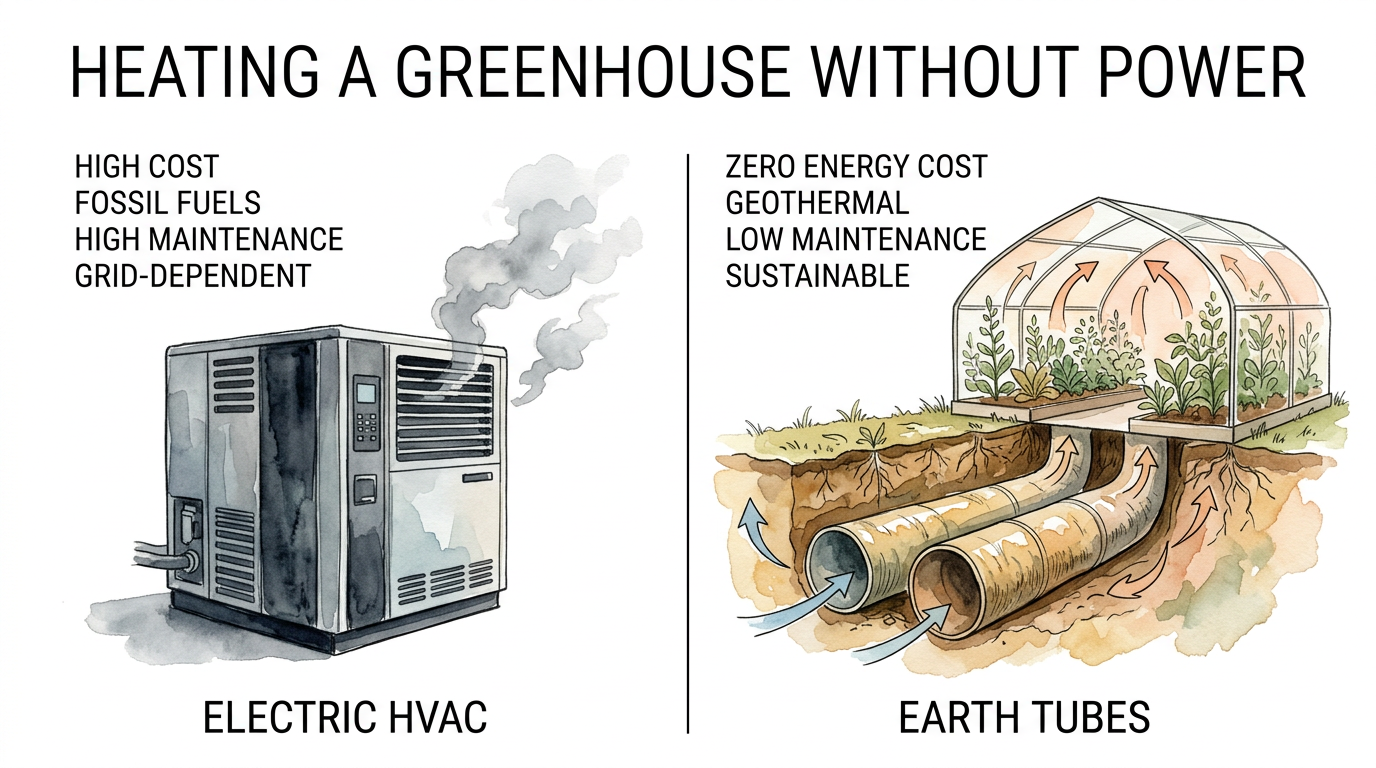
This technology does not rely on complex chemical refrigerants or fragile computer boards. It relies on physics and the steady heartbeat of the planet. While ELECTRIC HVAC vs EARTH TUBES is a common debate for modern builders, the earth tube offers a level of permanence and reliability that a mechanical box simply cannot match.
Heating A Greenhouse Without Power
Growing food throughout the winter usually requires a heavy investment in propane or electricity. Most people find that their greenhouse becomes a freezer at night and an oven during the day. Heating a greenhouse without power is the ultimate test of a homesteader’s ingenuity, and earth tubes are the most effective way to pass that test.
The concept is simple: you use a small fan—or even just natural convection—to pull air through a network of pipes buried six to ten feet underground. At that depth, the soil is shielded from the surface weather. Even if it is ten degrees below zero outside, the air moving through those pipes is being warmed by the surrounding earth before it ever enters your growing space.
This system acts as a biological thermostat for your plants. It prevents the rapid temperature swings that kill tender greens or stunt the growth of citrus trees. Many successful high-altitude growers use this method to grow Mediterranean fruits in climates where snow sits on the ground for months.
You can visualize this as a lung for your greenhouse. It inhales the harsh outdoor air, warms it in the “chest” of the earth, and exhales life-sustaining warmth into the structure. This is how the famous “citrus in the snow” greenhouses in Nebraska operate, maintaining tropical temperatures with almost zero energy input.
How Earth Tubes Work
The core principle is thermal inertia. Soil is a poor conductor of heat, which means it takes a long time for surface temperatures to penetrate deep into the ground. When the summer sun beats down, the heat only travels a few inches per day. The ground at eight feet deep is actually feeling the “echo” of the previous season’s temperature.
Air travels through a long run of pipe, usually 100 to 200 feet in length. As the air moves, it rubs against the walls of the pipe, which are in direct contact with the cool or warm soil. This friction and surface area contact allow for a heat exchange to occur. If the outside air is 95 degrees and the soil is 55 degrees, the air loses its heat to the ground and enters the house at a comfortable 65 or 70 degrees.
Achieving this requires a careful balance of pipe diameter and airflow speed. If the air moves too fast, it doesn’t have enough time to exchange heat with the soil. If it moves too slow, you won’t move enough volume to actually change the temperature of the room. Most systems use 4-inch to 6-inch diameter pipes to balance these needs.
Moisture management is the most critical technical detail. Warm air holds more moisture than cool air. When warm summer air enters a cool earth tube, the moisture will condense into liquid water. Designing the system with a slight slope—usually one inch of drop for every ten feet of run—allows this condensation to flow toward a central drain or “dry well” where it can be absorbed back into the earth.
The Benefits of Living with the Earth
The primary advantage of this system is the drastic reduction in operating costs. Once the pipes are in the ground, the only moving part is a small intake or exhaust fan. These fans often pull less power than a single traditional light bulb, making them easy to run on a small solar setup or even a battery backup.
Reliability is another major factor. Mechanical air conditioners have life cycles of 10 to 15 years and require regular servicing by expensive technicians. A properly installed earth tube system, made from high-density polyethylene or similar durable materials, can last for 50 years or more with almost no maintenance.
- Reduced Carbon Footprint: You are using the thermal mass of the planet instead of burning fossil fuels.
- Air Quality: Earth tubes provide a constant stream of fresh, filtered air rather than recirculating the same stale air inside the house.
- Silence: There are no loud compressors kicking on and off in the middle of the night.
- Dehumidification: In the summer, the condensation process naturally dries the air before it reaches your living space.
This approach also increases your home’s resilience. If a winter storm knocks out the power lines, your earth tube continues to provide 55-degree air. While 55 degrees might feel chilly, it is a life-saving baseline that prevents your pipes from freezing and keeps you out of the danger zone for hypothermia.
Common Pitfalls and Mistakes
Many people fail with earth tubes because they treat them like a standard plumbing project. One of the biggest mistakes is using the wrong type of pipe. Thin-walled PVC or corrugated drainage pipe can collapse under the weight of six feet of soil. Using heavy-duty, smooth-walled pipe is essential for longevity and airflow efficiency.
Improper drainage is the leading cause of “smelly” earth tubes. If water pools in a low spot in the pipe, it becomes a breeding ground for mold and bacteria. This can lead to a musty odor or, in worse cases, respiratory issues for the inhabitants. Every inch of the pipe must have a consistent downward slope toward a collection point.
Neglecting the intake design is another frequent error. An intake that is too close to the ground will suck in dust, lawn clippings, and insects. Building a “snorkel” intake that stands at least three feet off the ground, equipped with a high-quality filter and a fine mesh screen, is the only way to ensure the air entering your home is clean.
Underestimating the length of the run often leads to disappointing results. A 20-foot pipe is not enough to exchange significant heat. You need volume and time. Skimping on the trenching phase is the most common reason these systems are written off as “ineffective” by those who didn’t follow the proper math.
Limitations of the System
Earth tubes are not a universal solution for every climate or property. Areas with a very high water table are often unsuitable. If your trench fills with water as soon as you dig it, your pipes will eventually float, shift, or leak. In these cases, the system becomes a liability rather than an asset.
Soil type also plays a major role in efficiency. Heavy, moist clay is an excellent conductor of heat and works very well with earth tubes. Dry, sandy soil acts more like an insulator, making it much harder for the heat to move from the pipe to the earth. If you live in a desert with sandy soil, you may need much longer pipe runs to achieve the same effect.
Radon gas is a concern in certain geographic regions. Since the pipes are buried in the earth, any small crack or unsealed joint could allow radon to seep into the air stream. Testing the soil for radon before installation and ensuring all joints are airtight and sealed with food-grade silicone is mandatory for safety.
Urban lots rarely have the space required for a full-scale earth tube system. You need a significant amount of open land to dig 100-foot trenches. For those on small city lots, alternative methods like vertical geothermal wells may be necessary, though they come with a much higher price tag.
Comparing Systems: Earth Tubes vs. Electric HVAC
When deciding how to climate-control your space, it helps to look at the differences in cost, complexity, and longevity. While modern electric systems are efficient, they are inherently fragile compared to a passive earth system.
| Feature | Earth Tubes | Electric HVAC |
|---|---|---|
| Upfront Cost | Moderate (Excavation) | High (Unit + Ducting) |
| Operating Cost | Near Zero | High Monthly Bills |
| Maintenance | Minimal (Filters/Cleaning) | Annual Servicing Required |
| Lifespan | 50+ Years | 10–15 Years |
| Grid Independence | Excellent | Poor |
Electric HVAC systems are excellent at reaching a specific, precise temperature within minutes. Earth tubes are slower and act more as a “tempering” system. They take the edge off the extreme cold or heat, making it much easier for a secondary heat source—like a wood stove—to do its job.
Practical Tips for Best Results
Choosing the right fan is critical. You want a fan rated for continuous use that can handle the “static pressure” of a long pipe run. Inline duct fans, often used in hydroponics, are usually the best choice. They are quiet and can be adjusted with a simple speed controller to match the weather conditions.
Installing a “bypass” valve in your ductwork allows you to shut off the earth tube when the outside air is already at a perfect temperature. This is common in the spring and fall. Sending air through the earth during these times might actually cool the house when you don’t want it to, so a simple flapper valve gives you manual control.
Filter the air at both ends. Putting a coarse filter at the intake prevents large debris and insects from entering. A finer HEPA filter at the exit, where the air enters your room, ensures that no dust or spores are introduced into your living environment. Checking these filters every three months will keep the system running efficiently.
Consider the “thermal “charge” of the soil. If you run the system at full blast all summer, you might eventually warm up the soil immediately surrounding the pipe. Giving the system a rest during the night—if the air is cool enough—allows the earth to dissipate that heat and “recharge” its cooling potential for the next day.
Advanced Considerations for the Serious Practitioner
Serious builders often look into “closed-loop” vs “open-loop” systems. An open-loop system, which we have focused on, pulls in fresh outside air. A closed-loop system recirculates the air from inside the house through the buried pipes. Closed-loop systems eliminate the risk of outdoor pollutants but do not provide fresh air exchange.
The material of the pipe matters more than you might think. While plastic is common and easy to work with, some high-end systems use antimicrobial-coated pipes or even concrete tiles. These materials can have better thermal conductivity than thick plastic, though they are much more difficult to seal and install correctly.
Calculating the “dwell time” of the air is an advanced technique. You want the air to remain in the pipe for at least 10 to 15 seconds to achieve maximum heat transfer. If your pipe is 150 feet long, you need to adjust your fan speed so that the air moves at roughly 10 to 15 feet per second. This precision turns a decent system into an incredible one.
Integrating earth tubes with a solar chimney can create a completely passive system. A solar chimney uses the sun’s heat to create an upward draft inside the house. This draft creates a vacuum that pulls air through the earth tubes automatically, eliminating the need for an electric fan entirely. This is the gold standard for off-grid climate control.
Real-World Example: The Winter Orchard
Imagine a homestead in the high plains of Wyoming, where winter temperatures frequently drop to -20 degrees. A gardener there built a 20×40 foot greenhouse using earth tubes as the primary climate control. They buried four parallel runs of 6-inch HDPE pipe, each 120 feet long, at a depth of 8 feet.
During a week-long cold snap where the mercury never rose above zero, the greenhouse stayed at a constant 48 degrees. No propane was burned, and no electric heaters were used. A small 40-watt fan moved the air through the tubes, powered by a single solar panel and a deep-cycle battery.
The soil at 8 feet deep provided enough thermal energy to keep the plants from freezing. Because the air was being pulled from the earth, it also had a higher relative humidity than the bone-dry winter air outside, which kept the leaves of the citrus trees from drying out. This success demonstrates that the earth is more than enough to sustain life if we simply use its natural properties.
Final Thoughts
The ground beneath us is a silent, powerful ally in our quest for self-reliance. Using earth tubes is more than just a clever engineering trick; it is a way of aligning our homes with the natural rhythms of the planet. It requires a bit of sweat and some careful planning, but the reward is a lifetime of comfort that is independent of the fluctuating prices of the energy market.
Starting small with a single run for a workshop or a greenhouse is a great way to learn the nuances of your specific soil and climate. You will quickly see how effective even a basic system can be. The peace of mind that comes from knowing your home can stay temperate without a power cord is a feeling every homesteader should experience.
As you move forward with your projects, remember to respect the earth and its power. Dig deep, seal your joints well, and let the soil do the heavy lifting. The wisdom of the past, combined with the materials of the present, provides a clear path to a more resilient and sustainable future. Experiment, observe, and let the 55-degree earth keep you steady through the changing seasons.
