How To Become More Self-Sufficient Without Starting a Full-Blown Farm…
Want to start preserving your harvest, making your own soap, or building a backyard root cellar — but not sure where to begin? “Homesteading Advice” gives you instant lifetime access to 35+ practical homesteading books on food preservation, veggie gardening, DIY natural cleaning products (save over $250 per year with this skill alone), brewing, off-grid energy, and a whole lot more…
Click Here To Check It Out Now!
Most generators throw away 70% of the energy you pay for—here is how to catch it. A standalone generator is one of the most inefficient tools on a homestead. It creates noise and electricity, but it throws away the most valuable byproduct: heat. Integrating your power and water systems allows you to turn a single gallon of fuel into both light and a hot shower. That’s real resource mastery.
When you run a standard internal combustion engine, only about 30% of the fuel’s energy actually turns the shaft to create electricity. The rest escapes into the atmosphere through the exhaust pipe and the cooling fins or radiator. This discarded thermal energy is not “waste” unless you choose to waste it. Capturing it transforms a simple backup tool into a micro-cogeneration plant, or what engineers call a Combined Heat and Power (CHP) system.
Efficiency on the homestead is about more than just saving a few cents on fuel. It is about stewardship and sovereignty. Modern systems are often isolated, with one machine doing one job while wasting the potential for three others. An integrated approach mirrors the wisdom of the old-world hearth, where a single fire provided light, cooked the meal, and warmed the bones of the family.
How To Harvest Waste Heat From Generators
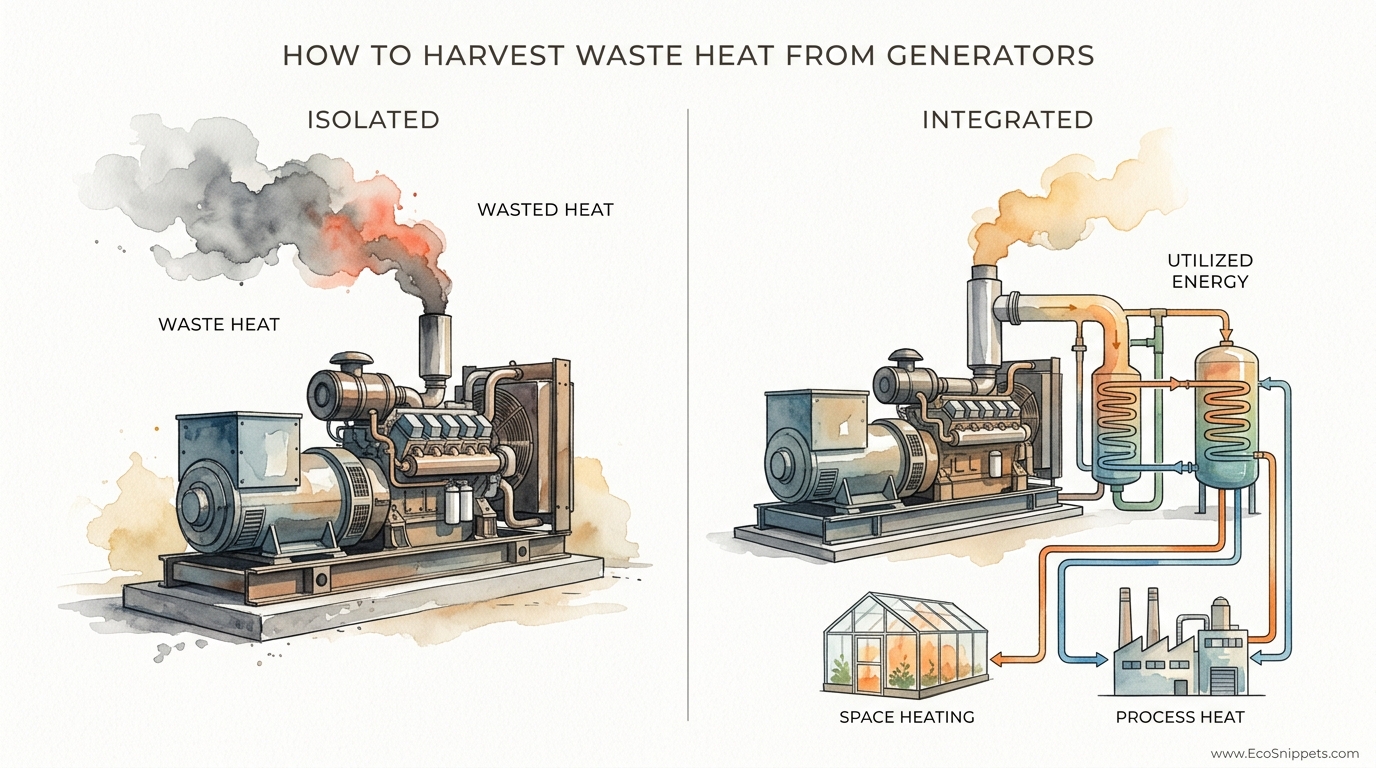
Harvesting waste heat involves capturing the thermal energy normally rejected by an engine’s cooling system and exhaust stream and redirecting it into a useful medium, usually water. In a standard setup, this heat is a nuisance that must be managed to prevent engine failure. In a recovery setup, that same heat becomes a primary product.
This concept is widely used in large-scale industrial plants and hospitals to maintain high efficiency and reliability. On a homestead or off-grid site, the scale is smaller, but the principles remain identical. You are essentially intercepting the heat before it hits the open air and moving it into a “thermal battery”—an insulated storage tank—where it can be used for domestic hot water, radiant floor heating, or even greenhouse climate control.
Visualizing this requires looking at the two main exit points for heat in a generator. The first is the engine block itself, which is cooled by either air or liquid. The second is the exhaust gas, which can reach temperatures between 600°F and 1,000°F. Capturing energy from both sources can push the total efficiency of your fuel from 30% to nearly 90%.
The Mechanics of Cogeneration: From Engine to Tank
Recovery starts at the cooling system. If you have a liquid-cooled generator, the process is straightforward. You replace the standard radiator with a liquid-to-liquid heat exchanger. Instead of a fan blowing heat into the wind, the engine’s hot coolant flows through a series of plates or tubes, transferring its energy to a separate loop of fresh water. This fresh water then carries the heat to your storage tank.
Air-cooled generators require a bit more ingenuity but offer a lower barrier to entry for the DIY builder. You can construct a shroud around the engine to capture the hot air blown off the cooling fins. This air is then ducted through an air-to-water heat exchanger—often a repurposed car radiator or a custom copper coil—to heat your water supply. While less efficient than liquid-cooled setups, it still recovers a significant portion of what would otherwise be lost.
The exhaust stream is the high-value target for heat recovery. Because exhaust temperatures are so high, they can provide “high-grade” heat capable of bringing water to a boil or generating steam. A shell-and-tube heat exchanger made of stainless steel is typically used here. The hot gases pass through the internal tubes while water circulates in the surrounding shell. This is where the most significant gains in efficiency are made, as nearly one-third of the fuel’s total energy is trapped in these gases.
Benefits of an Integrated Power and Heat System
Fuel independence is the primary advantage of this approach. When you utilize the waste heat, you effectively double or triple the work you get out of every drop of diesel, propane, or gasoline. This means you need to store less fuel and run your generator for fewer hours to meet your total energy needs. For an off-grid homestead, this reduces the logistical burden of fuel transport and extends the life of the machine.
Lowering the mechanical run-time of your system also decreases maintenance intervals. If your generator provides both your daily electricity and your daily hot water in a single two-hour run, you avoid the need for separate water heaters or long, inefficient charging cycles. This “stacking of functions” is a core principle of permaculture and efficient homestead design.
Resilience in extreme weather cannot be overstated. During a winter power outage, a generator-based CHP system provides the electricity needed to keep the lights on while simultaneously pumping hot water through radiant floor loops. This keeps the home habitable without relying on a fragile grid or a separate, fuel-hungry furnace. The system becomes a self-contained life-support module for the homestead.
Challenges and Common Pitfalls to Avoid
Backpressure is the silent killer of many DIY exhaust recovery systems. Engines are designed to breathe; if your heat exchanger is too restrictive, it creates pressure that pushes back into the cylinders. This leads to carbon buildup, overheating, and eventual engine failure. Always ensure the internal diameter of your heat exchanger is larger than the original exhaust pipe to account for the turbulence of the gas.
Corrosion is another major hurdle, particularly in the exhaust loop. When exhaust gases cool down below the dew point—the temperature at which water vapor turns to liquid—they form an acidic condensate. This liquid can eat through mild steel in a single season. Using high-quality stainless steel (SS304 or SS316) for any component touching exhaust gases is a non-negotiable requirement for a long-lasting system.
Thermal expansion can cause leaks or even structural failure if the system is too rigid. Metal expands when it gets hot. If your plumbing is bolted down tight without any room to move, the stresses of daily heating and cooling cycles will eventually crack a weld or a fitting. Incorporating flexible couplings or expansion loops into your design is essential for managing these physical realities.
Limitations and Realistic Boundaries
Intermittency is the greatest constraint of a generator-based heat system. You only get heat when the generator is running. If your batteries are full and your electrical demand is zero, the generator won’t run, and you won’t get any hot water. This necessitates a large, well-insulated storage tank to hold the heat from the morning run until the evening shower.
Scale also matters. Small 2,000-watt portable “suitcase” generators produce relatively little recoverable heat compared to a 10kW or 20kW stationary unit. While you can still capture some energy from a small unit, the cost and complexity of the heat exchangers might not be justified for the small amount of hot water produced. Cogeneration makes the most sense for homesteads with a consistent daily electrical load.
Summer operation presents a unique challenge. In the winter, you can use every BTU the generator creates. In the summer, you may have more heat than you can use. Without a “dump load”—a way to reject excess heat once your storage tank is full—the system can overheat. This usually requires a secondary radiator with a fan to blow off excess thermal energy safely.
Comparison: Air-Cooled vs. Liquid-Cooled Recovery
Choosing the right base for your system depends on your skill level and your energy goals. Liquid-cooled engines are the gold standard for CHP, but they are significantly more expensive up front.
| Feature | Air-Cooled Generators | Liquid-Cooled Generators |
|---|---|---|
| Heat Recovery Potential | Medium (Exhaust + Air Shroud) | High (Exhaust + Coolant Jacket) |
| Installation Complexity | Lower (DIY-friendly) | Higher (Requires plumbing/pumps) |
| Initial Cost | $500 – $3,000 | $5,000 – $15,000+ |
| Longevity | Moderate | Very High |
Practical Best Practices for Homestead Heat Recovery
Insulation is your best friend. Every foot of pipe between the generator and the storage tank is a place where your hard-earned heat can escape. Use high-temperature foam or fiberglass wrap on all lines. The storage tank itself should be “over-insulated” beyond standard residential requirements; adding an extra layer of mineral wool around a standard water heater can significantly increase your thermal retention overnight.
Loading the generator is key to heat production. Diesel engines, in particular, do not like to run with light loads; they “slobber” or develop carbon buildup if they don’t get hot enough. By adding a heat recovery system, you are actually helping the engine stay at a stable, efficient operating temperature. If your electrical load is low, you can use an electric immersion heater in your water tank as a “load bank” to force the generator to work harder, creating more heat for both the water and the exhaust.
Safety must always come first. When you are plumbing water lines near an engine and exhaust, you must ensure there is no risk of water leaking onto electrical components. Use high-quality brass or stainless steel fittings, and always install a pressure relief valve on your water tank. Carbon monoxide remains the deadliest threat; ensure all exhaust-side heat exchangers are perfectly sealed and that the generator is housed in a properly ventilated space or outdoors.
Advanced Considerations for Serious Practitioners
Integrating a Stirling engine or Thermoelectric Generators (TEGs) can push the boundaries of waste heat recovery even further. TEGs are solid-state devices that convert a temperature difference directly into a small amount of DC electricity. While their efficiency is low, mounting them on an exhaust manifold can provide enough power to run the circulation pumps for your heat recovery loop, making the thermal side of the system self-powered.
Scaling for district heating is another option for those with multiple buildings. A larger central generator can provide heat for a workshop, a greenhouse, and a main house simultaneously. This requires an underground “district” pipe—a pre-insulated PEX line designed to be buried. While the initial digging is a chore, the result is a homestead where a single engine run provides utility to every corner of the property.
Automated controls can turn a manual chore into a seamless system. Using a simple thermostat to trigger the circulation pump only when the engine block is hot prevents you from pumping cold water through your home. More advanced systems can use a logic controller to start the generator based on the temperature of the water tank rather than just the state of the batteries, ensuring you never run out of either power or warmth.
Example Scenario: The Winter Morning Run
Imagine a snowy morning on a remote homestead. The solar panels are buried under six inches of powder, and the battery bank is sitting at 50%. You head out to the generator shed and fire up a 6kW liquid-cooled diesel unit. As the engine warms up, a 12-volt pump kicks on, circulating water through a heat exchanger on the engine’s coolant loop.
Within twenty minutes, the water returning from the shed to the house is at 160°F. This water flows into a 120-gallon insulated buffer tank. Simultaneously, the exhaust gases are screaming through a stainless steel shell-and-tube exchanger, boosting that return water temperature even higher. While the generator is pushing 5,000 watts into the batteries and running the laundry, it is also putting nearly 40,000 BTUs of heat into your water storage.
Two hours later, the batteries are full, and the generator shuts down. You now have a tank full of scalding hot water. This thermal energy will provide four hot showers, wash the dishes, and keep the radiant floor in the kitchen warm for the next twelve hours. You have accomplished with two gallons of fuel what would normally take five.
Final Thoughts
Mastering waste heat recovery is a defining step in moving from a consumer of energy to a steward of it. Most people see a puff of smoke and a roar of noise when a generator runs; the resourceful homesteader sees a missed opportunity for a hot bath and a warm home. Integrating these systems requires a bit of plumbing grit and a solid understanding of thermodynamics, but the rewards are measured in independence.
Capturing what others throw away is the essence of the pioneer spirit. Whether you are building a simple shroud for a portable unit or a sophisticated liquid-cooled CHP plant, the goal is the same: to get the most out of every resource you bring onto your land. This approach doesn’t just save money; it deepens your connection to the physical realities of your survival and comfort.
Start small if you must, perhaps by simply ducting air or wrapping a copper coil around an exhaust pipe. As you see the temperature rise in your tank, the logic of integrated systems will become undeniable. There is a profound satisfaction in hearing a generator run and knowing that every vibration and every spark is working twice as hard for your family as it did the day before.
