How To Become More Self-Sufficient Without Starting a Full-Blown Farm…
Want to start preserving your harvest, making your own soap, or building a backyard root cellar — but not sure where to begin? “Homesteading Advice” gives you instant lifetime access to 35+ practical homesteading books on food preservation, veggie gardening, DIY natural cleaning products (save over $250 per year with this skill alone), brewing, off-grid energy, and a whole lot more…
Click Here To Check It Out Now!
One of these systems drains your battery bank in two hours, while the other keeps you warm for two days after the sun goes down. Are you wasting your precious off-grid electricity trying to heat the air? Air loses heat the second a door opens. Thermal mass systems like hydronic floors store energy in the ground beneath your feet, turning your house into a giant battery that never needs a replacement.
Living off the grid is about more than just solar panels and lithium batteries. It is about understanding the flow of energy and the wisdom of the earth itself. When the winter wind howls against your cabin walls, you do not want to be staring at a flickering battery monitor, wondering if your electric heater will leave you in the dark before midnight. True self-reliance comes from building systems that work with the laws of physics, not against them.
Choosing between hydronic slab heating and electric radiators is one of the most critical decisions an off-gridder will make. One relies on the brute force of electricity, while the other leans on the ancient principle of thermal mass. This guide will walk you through the grit and the glory of both, helping you build a fortress of warmth that stands the test of time.
Hydronic Floor Heating Vs Electric Heaters For Off Grid
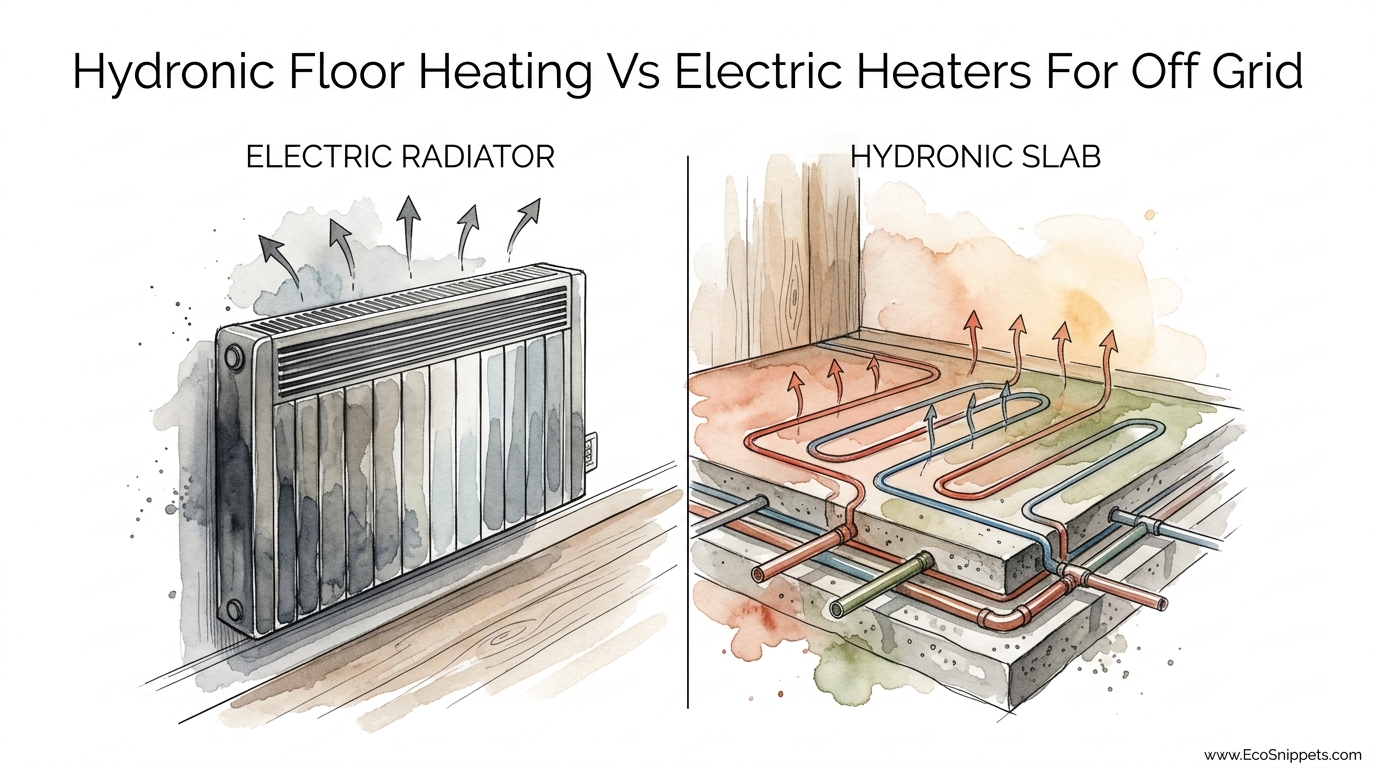
Hydronic floor heating is a system that circulates warm fluid—usually water or a glycol mix—through a network of flexible PEX tubing embedded deep within a concrete slab or subfloor. This fluid is heated by a central source, such as a wood-fired boiler, a solar thermal collector, or a high-efficiency heat pump. Once the slab is warm, it radiates that heat upward, warming the objects and people in the room rather than just the air.
Electric heaters, on the other hand, use resistive wire to convert electricity directly into heat. These can take the form of wall-mounted radiators, baseboard heaters, or even electric radiant mats under the floor. While they are incredibly simple to install, they represent a massive, constant draw on an electrical system. In an off-grid scenario, every watt-hour used for heat is a watt-hour taken away from your lights, your tools, and your communication.
The fundamental difference lies in energy density and storage. A concrete slab acts as a “thermal battery,” capable of holding onto heat for hours or even days. An electric radiator provides “instant” heat, but the moment you cut the power, the warmth vanishes. For the pioneer seeking long-term resilience, the choice often comes down to how much work you want your batteries to do versus how much work you want your house to do.
How Thermal Mass Becomes Your Silent Battery
Understanding how a hydronic slab works requires a shift in how you view “storage.” Most off-gridders obsess over their amp-hour capacity in lithium or lead-acid batteries. While those are vital for keeping the lights on, they are an expensive and inefficient way to store heat. Concrete is a far more robust medium for storing the energy you need to survive a cold snap.
Thermal mass is the ability of a material to absorb, store, and slowly release heat. A standard four-inch concrete slab in a 1,000-square-foot cabin weighs roughly 50,000 pounds. When you pump heat into that mass using hydronic tubes, you are “charging” the floor. Because concrete has high thermal inertia, it does not fluctuate wildly in temperature. It stays warm long after the sun sets or the wood stove goes out.
The process of installing these systems begins during the foundation pour. You lay down high-density rigid foam insulation—at least R-10, though R-20 is better for the backcountry—to ensure the heat goes into the house and not into the frozen earth. You then zip-tie PEX-AL-PEX or oxygen-barrier PEX tubing to the rebar or wire mesh. Once the concrete is poured over it, those tubes are protected for a lifetime.
The Efficiency Gap: COP vs Resistive Heat
Electric resistive heaters have a Coefficient of Performance (COP) of 1.0. This means for every 1,000 watts of electricity you pull from your batteries, you get exactly 1,000 watts of heat. It is a perfect conversion, but it is a losing game when your “fuel” is stored sunlight. A single 1,500-watt space heater running for ten hours will consume 15 kilowatt-hours of energy. That is more than the total capacity of a standard Tesla Powerwall.
Hydronic systems can be paired with air-to-water heat pumps that boast a COP of 3.0 or even 4.0. These units “move” heat from the outside air into your floor fluid. For every 1,000 watts of electricity used, you get 3,000 to 4,000 watts of heat delivered to your slab. This 300% to 400% efficiency makes it possible to heat a whole home on a modest solar array that would otherwise be crushed by the load of electric radiators.
If electricity is scarce, hydronic systems offer the ultimate “Plan B”: wood. A wood-fired boiler can be integrated into the same manifold that handles your solar or heat pump inputs. When the clouds roll in for a week, you don’t need more panels; you just need a sharp axe and a dry woodpile. The fire heats the water, the water heats the slab, and the slab keeps your family warm until morning.
Benefits of the Hydronic Slab Approach
The primary benefit is the unparalleled level of comfort. Forced-air systems and electric radiators create “hot spots” and “cold spots.” They also stir up dust and allergens, which can be a nuisance in the tight quarters of an off-grid home. Radiant heat is silent and invisible. It warms your feet first, which is the biological key to feeling truly “cozy.”
Energy security is another massive advantage. By decoupling your heating source from your electrical storage, you create a redundant system. If your inverter fails, you can still circulate water through your floor using a tiny 12-volt DC pump powered by a single dedicated panel. Your house remains a livable sanctuary while you wait for parts to arrive from the civilized world.
Furthermore, hydronic systems have incredible longevity. While an electric heater might last a decade before the coils burn out, a well-maintained hydronic system can last 50 years or more. The PEX tubing is protected inside the concrete, away from UV light and mechanical damage. Only the mechanical components—the pumps and the boiler—need occasional maintenance, much like a reliable old tractor.
Challenges and Common Pitfalls
The most significant challenge with a hydronic slab is “thermal lag.” Because it takes so much energy to warm up 50,000 pounds of concrete, you cannot simply turn the thermostat up and expect results in twenty minutes. It can take four to eight hours for a slab to reach its operating temperature. This makes it a poor choice for a weekend cabin that you only visit occasionally, as the floor will finally be warm just as you are packing up to leave.
Another pitfall is poor insulation beneath the slab. If you neglect the rigid foam during construction, your floor will act as a giant heat sink for the earth. You will find yourself burning through wood or electricity just to keep the ground beneath your house from freezing. This is an irreversible mistake once the concrete is cured, so you must get the insulation right the first time.
Installation complexity is also a hurdle. A hydronic system requires a manifold, expansion tanks, pressure relief valves, and a thorough understanding of fluid dynamics. It is not as simple as plugging a radiator into a wall. For the DIY pioneer, this means a steeper learning curve and the potential for leaks if the PEX connections are not crimped or pressed with precision.
Limitations of Electric Radiators Off-Grid
The most glaring limitation of electric radiators is the sheer scale of the battery bank required to support them. In a grid-tied home, electricity is an infinite resource. Off-grid, it is a finite harvest. Using high-wattage resistive heaters at night pulls directly from your stored reserves when your panels are dormant. This often leads to “cycling” your batteries too deeply, which drastically shortens their lifespan.
Electric radiators are also poorly suited for high-ceiling or drafty spaces. Because they rely heavily on convection—warming the air so it rises—the most valuable heat ends up trapped at the ceiling. In a lofted cabin, your feet will be freezing while the top of the room is sweltering. This inefficiency is amplified off-grid, where every lost BTU is a wasted resource.
Finally, electric heaters offer zero redundancy. If the power goes out or your battery management system (BMS) trips, your heat is gone instantly. You are entirely dependent on a complex chain of electronics. In the ancestral way of living, we prefer systems that fail gracefully—like a floor that stays warm for twelve hours after the pump stops.
Comparing the Systems for the Long Haul
| Feature | Hydronic Slab | Electric Radiators |
|---|---|---|
| Upfront Cost | High (Boiler, PEX, Manifold) | Low (Plug-and-play units) |
| Operating Cost | Low (Efficient, can use wood) | Extreme (Heavy battery drain) |
| Energy Efficiency | Very High (COP 3.0+) | Standard (COP 1.0) |
| Energy Storage | Massive (Thermal Mass) | None (Instant release) |
| Lifespan | 50+ Years | 10–25 Years |
| Maintenance | Moderate (Annual checks) | Very Low |
Best Practices for Off-Grid Thermal Systems
Maximize your “solar harvest” by timing your heating cycles. If you are using an air-to-water heat pump, run it during the peak of the day when your solar panels are producing excess energy. Instead of sending that power to batteries that are already full, send it into your floor. By “overheating” the slab by a few degrees during the day, you can coast through the night without drawing a single watt for heat.
Zoning is another essential practice. You do not need the guest room or the storage pantry at 70 degrees. A hydronic manifold allows you to adjust the flow to each loop, focusing the heat in the kitchen and living area where it is needed most. This granular control is the key to stretching your energy resources through a long, dark winter.
Use a “buffer tank” if your system includes multiple heat sources. A buffer tank is a large, insulated vessel of water that sits between your boiler and your floor. It prevents your heat source from “short-cycling” and provides a reservoir of hot water that can be drawn upon even when the wood fire has died down to embers. It is the liquid equivalent of a capacitor in an electrical circuit.
Advanced Considerations for the Serious Practitioner
For those looking to achieve the pinnacle of self-reliance, consider a Hybrid PVT (Photovoltaic-Thermal) system. These panels generate electricity and hot water simultaneously. By circulating fluid through the back of the solar cells, the system cools the panels—which increases their electrical efficiency—while capturing the waste heat for your floor. It is a closed-loop system that extracts every possible ounce of energy from the sun.
Coupling your hydronic slab with passive solar design is another master-level strategy. Large south-facing windows allow the low winter sun to hit the floor directly. The concrete absorbs the sun’s radiation without any mechanical intervention at all. In this scenario, your hydronic tubes only act as a “top-off” system, moving heat from the sunny side of the house to the shady side via the manifold.
Do not overlook the importance of the circulating fluid itself. In cold climates where the house might be left unattended, using a food-grade propylene glycol mix is a must. This prevents the pipes from freezing and bursting if the heat source fails. While it slightly reduces the heat-carrying capacity compared to pure water, the “insurance” it provides against a catastrophic slab failure is well worth the trade-off.
A Tale of Two Cabins
Imagine two identical 1,200-square-foot cabins in the mountains of Montana. The first cabin relies on four 1,500-watt electric radiators. To keep the space at 68 degrees during a blizzard, these heaters run nearly 50% of the time. This cabin requires a massive 60kWh battery bank and a 15kW solar array just to keep from freezing. The cost of the electrical infrastructure alone exceeds $40,000.
The second cabin uses a hydronic slab paired with a small 5kW air-to-water heat pump and a wood-fired backup. During the day, the solar panels power the heat pump, “charging” the 60,000-pound floor. At night, the heat pump shuts off. The thermal mass releases 120,000 BTUs of heat over the next twelve hours, keeping the cabin cozy. This cabin only needs a 15kWh battery bank and a 5kW solar array, saving the owner $25,000 in electrical costs.
When the blizzard lasts for three days and the panels are covered in snow, the first cabin’s lights go out and the pipes freeze. In the second cabin, the owner throws three logs into the wood boiler. The floor stays warm, the lights stay on (because the batteries weren’t drained by heaters), and the family drinks coffee in comfort. This is the difference between surviving and thriving off the grid.
Final Thoughts
Building a home off the grid is an act of defiance against a fragile world. It requires us to look back at how our ancestors used the earth’s mass and forward to how modern technology can refine that wisdom. Electric radiators are a tempting shortcut, but they often lead to a dead end of expensive batteries and energy anxiety.
Hydronic floor heating is more than just a luxury; it is a strategy for long-term resilience. By turning your foundation into a giant thermal battery, you gain the freedom to choose your fuel and the security of knowing that warmth is stored beneath your feet. It is a system that demands more work upfront but rewards you with a lifetime of silent, steady comfort.
Whether you are pouring your first slab or retrofitting a homestead, remember that the most efficient energy is the energy you don’t have to move. Let the mass of the earth hold your heat, and let your batteries hold your light. That is the path to a house that doesn’t just sit on the land, but belongs to it.
