How To Become More Self-Sufficient Without Starting a Full-Blown Farm…
Want to start preserving your harvest, making your own soap, or building a backyard root cellar — but not sure where to begin? “Homesteading Advice” gives you instant lifetime access to 35+ practical homesteading books on food preservation, veggie gardening, DIY natural cleaning products (save over $250 per year with this skill alone), brewing, off-grid energy, and a whole lot more…
Click Here To Check It Out Now!
When the power grid fails, the wind still blows—ensure your water supply doesn’t depend on a wire. We traded mechanical reliability for electronic convenience, and now we’re one storm away from a dry well. Traditional water-pumping windmills have worked for centuries because they don’t need a computer or a power plant. They just need a breeze. It’s time to bring back the ‘Ancestral’ tech that never breaks.
Modern homesteading often leans heavily on solar panels and lithium batteries. While these technologies are impressive, they involve complex circuits that can fail during an electromagnetic pulse or simply succumb to a fried motherboard after a lightning strike. Mechanical windmills represent a different philosophy of survival. They are the iron giants of the prairie, turning thin air into the pressure needed to pull life-sustaining water from deep underground.
Choosing between a mechanical windmill and a modern electric pump isn’t just a matter of budget. It is a decision about your relationship with the land and your level of independence. If you want a system that your grandchildren can still use fifty years from now, you have to look past the “smart” features of the 21st century and return to the grit of the 19th.
This guide explores the mechanics, the costs, and the hard-won wisdom of wind-powered water systems. Whether you are looking to secure water for livestock or ensure your family never goes thirsty during a blackout, understanding the “Wind Wisdom” of the past is your first step toward a truly resilient future.
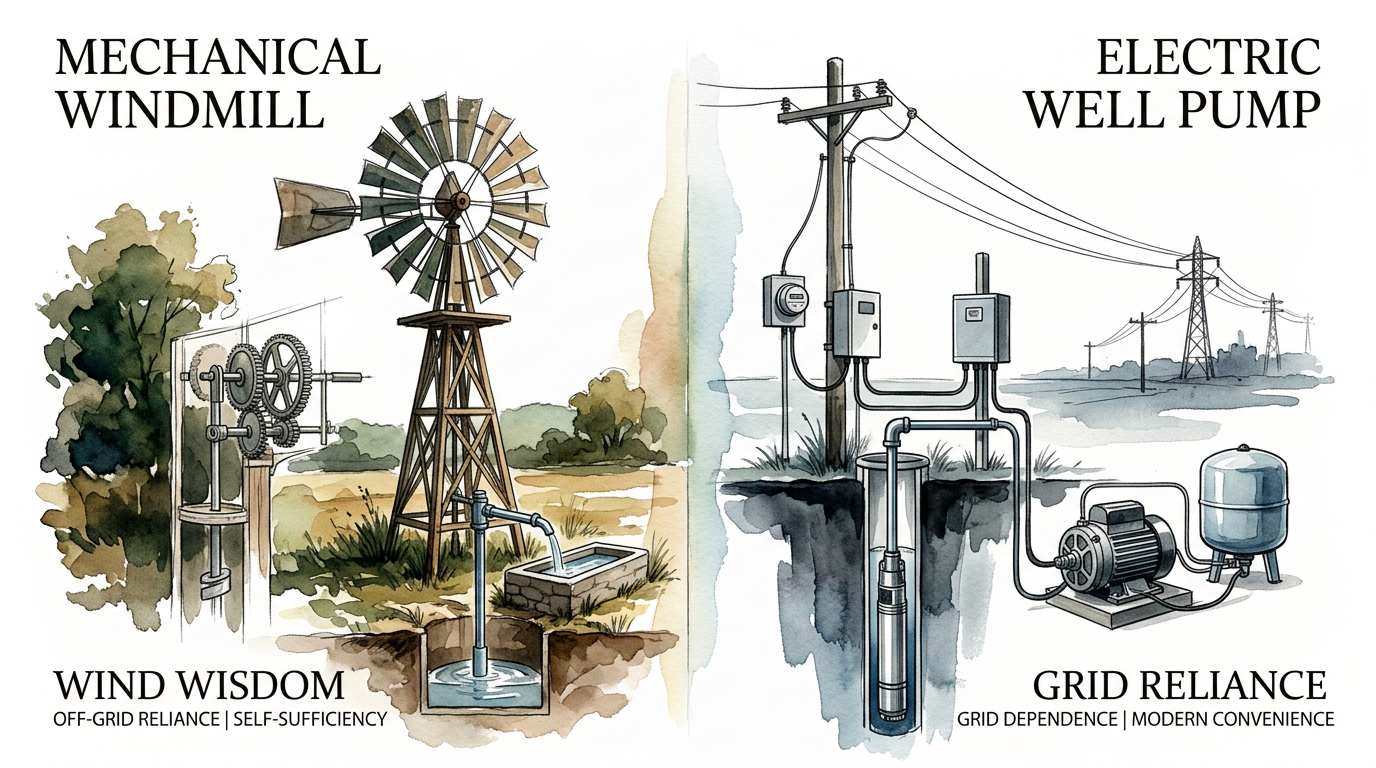
Mechanical Windmill Vs Electric Well Pump
The fundamental difference between these two systems lies in their energy conversion process. An electric well pump relies on a distant power plant or a local solar array to generate electricity, which then travels through wires to a motor submerged hundreds of feet below the surface. If any part of that chain—the grid, the inverter, the wiring, or the motor—fails, the water stops flowing. Mechanical windmills skip the “middleman” of electricity entirely, converting the kinetic energy of the wind directly into a physical up-and-down motion that lifts water.
Mechanical windmills are most commonly seen on ranches and remote homesteads where running power lines would cost tens of thousands of dollars. They are the ultimate “set it and forget it” machines, designed to operate in isolation for decades. In contrast, electric pumps are the standard for suburban and modern rural homes because they provide high pressure on demand, allowing for luxuries like power showers and automatic dishwashers without the need for a massive storage tank.
Real-world application of the windmill focuses on steady, slow accumulation. A windmill doesn’t provide the “instant” high-volume burst of an electric pump. Instead, it works like a tireless laborer, pumping a few gallons every minute that the wind blows, slowly filling a large cistern or pond. This makes it ideal for livestock watering and large-scale gardening where a consistent supply is more important than immediate high pressure.
Visualizing the two side-by-side helps clarify the trade-off. Imagine an electric pump as a high-performance sports car—fast, powerful, but requiring a complex supply chain of fuel and parts. The mechanical windmill is the heavy-duty tractor—slower, noisier, and made of heavy iron, but capable of running on whatever the environment provides and repairable with basic hand tools.
How It Works: The Anatomy of Wind Wisdom
Understanding the mechanical windmill requires looking at it as a series of simple machines working in harmony. The process begins at the “wheel,” the large circular array of blades—often called sails—that captures the wind. Unlike high-speed wind turbines used for electricity, water-pumping windmills have many blades (usually 15 to 18) to create high torque at low speeds. This allows the mill to start pumping even in a light breeze of 5 to 10 miles per hour.
The rotation of the wheel turns a main shaft inside a gearbox sitting atop the tower. This gearbox contains a set of gears—typically a smaller drive gear meshed with a larger “bull gear”—that slows down the rotation and increases the force. Connected to the bull gear is a “pitman arm,” which functions much like the piston rod in a car engine. This arm converts the circular spinning of the gears into a vertical, reciprocating (up-and-down) stroke.
That vertical movement is transferred down the center of the tower via the “sucker rod.” This rod, often made of wood or fiberglass to reduce weight and resist corrosion, extends all the way down into the well casing. At the bottom of the well, submerged in the water, sits the “pump cylinder.” This is the heart of the system where the actual lifting happens.
The pump cylinder contains two one-way valves: the “check valve” (or foot valve) at the bottom and the “plunger valve” attached to the sucker rod. On the upstroke, the plunger valve closes, creating a vacuum that pulls water into the cylinder through the bottom check valve while simultaneously lifting the column of water above it toward the surface. On the downstroke, the bottom check valve closes to prevent water from falling back out, while the plunger valve opens to let the rod move back through the water to the bottom of the cylinder, ready for the next lift.
Regulation is handled by the “tail vane.” This large metal fin keeps the wheel pointed into the wind. However, when the wind becomes too strong (usually over 30 mph), a spring-loaded mechanism allows the wheel to “furl” or turn sideways to the wind. This prevents the mill from spinning so fast that it tears itself apart, a critical safety feature that allows the system to survive major storms without human intervention.
Benefits of the Mechanical Approach
The primary advantage of a mechanical windmill is its sheer longevity. While a high-quality submersible electric pump might last 10 to 15 years before the motor seals fail or the windings burn out, a well-maintained Aermotor-style windmill can easily last 50 to 80 years. There are many “rebuilt” windmills in operation today that were originally forged in the 1920s or 30s. This “Ancestral” tech doesn’t just work; it outlasts the people who install it.
Operational costs are another massive benefit. Once the initial investment is made, the “fuel” (wind) is free. There are no monthly electricity bills and no need to buy expensive replacement batteries every few years. For a remote property, the savings on infrastructure are even more significant. Bringing grid power to a remote well site can cost upwards of $10,000 per mile; a windmill can be installed exactly where the water is, regardless of where the wires end.
Reliability during crises is the hallmark of the mechanical system. During a prolonged grid failure or a fuel shortage, the windmill continues to provide water. It is immune to electromagnetic interference and doesn’t require a complex startup sequence. If the wind is blowing, you have water. This makes it a foundational tool for anyone pursuing a “GRID RELIANCE vs WIND WISDOM” strategy, where the goal is to eliminate single points of failure in your survival plan.
Environmental harmony is a subtle but real benefit. Windmills are quiet, save for the occasional rhythmic “clack” of the gears and the whir of the blades. They don’t leak oil into the groundwater like old diesel-powered pumps might, and they provide a visual landmark that many find beautiful and nostalgic. They serve as a constant reminder of the renewable energy flowing all around us, waiting to be harnessed by simple, honest machines.
Challenges and Common Mistakes
The most significant challenge is the upfront cost. A new 8-foot Aermotor windmill with a 33-foot tower and the necessary pump components can cost between $8,000 and $15,000. While this pays for itself over decades, it is a much steeper entry price than a $600 submersible pump and a few hundred dollars in wire. Many beginners make the mistake of buying “decorative” windmills from garden centers, thinking they can be converted for pumping. These lightweight units will collapse under the physical stress of lifting a 200-foot column of water.
Maintenance is another area where people stumble. While windmills don’t need much, they do need an annual oil change. This requires someone to climb the tower, which can be 30, 40, or even 50 feet high. For those with a fear of heights or physical limitations, this is a serious hurdle. Neglecting the oil is the fastest way to kill a windmill; the gears are tough, but they cannot survive metal-on-metal friction for long.
Proper sizing is a complex task that many DIYers get wrong. You must match the diameter of the windmill wheel to the depth of the well and the diameter of the pump cylinder. If you use a cylinder that is too large for your wheel size at a given depth, the windmill won’t have the torque to start the upstroke in anything less than a gale. Conversely, a cylinder that is too small will pump very little water even in high winds. You have to balance the physics of “Head” (the vertical distance the water is lifted) against the “Torque” the wheel can generate.
Foundation failure is a common, and often catastrophic, mistake. A windmill tower acts like a giant sail in a storm. If the concrete footings aren’t deep enough or the “stub posts” aren’t perfectly level, the vibration of the pumping action will eventually loosen the structure. A leaning tower will cause the sucker rod to rub against the drop pipe, leading to premature wear and eventually a snapped rod or a collapsed tower.
Limitations and Environmental Constraints
The most obvious limitation is wind dependency. If the air is dead calm for three days, no water will move. This necessitates a large storage capacity. A standard rule of thumb is to have at least three to seven days’ worth of water stored in a tank or cistern. Relying on “on-demand” water from a windmill is a recipe for frustration. You must change your mindset from “just-in-time” delivery to “accumulation and storage.”
Depth constraints are also a factor. While large 16-foot windmills can lift water from over 1,000 feet deep, the cost increases exponentially with wheel size. For most homesteaders using 8-foot or 10-foot wheels, the practical limit is usually between 150 and 300 feet. If your water table is at 600 feet, a mechanical windmill might not be the most cost-effective solution compared to a high-voltage solar submersible pump.
Obstructions can ruin a windmill’s efficiency. To work properly, the wheel should be at least 15 to 20 feet higher than any obstacle (trees, barns, hills) within a 400-foot radius. Turbulent air caused by nearby structures doesn’t just reduce pumping power; it causes the windmill to “hunt” or swivel back and forth rapidly, which puts immense stress on the swivel bearings and the gearbox. You cannot hide a windmill in a wooded hollow; it needs to stand tall on the high ground.
Water quality can also affect the mechanical components. Very “sandy” wells will quickly erode the leather or rubber cups inside the pump cylinder. While these are replaceable, it requires “pulling the well”—literally winching up hundreds of feet of pipe and rod to reach the cylinder at the bottom. In areas with high mineral content, scale can build up on the sucker rod, increasing friction and weight, which may eventually require a larger windmill wheel to compensate for the added load.
Optional Comparison: Wind vs. Solar vs. Grid
To help you decide which system fits your needs, the following table compares the three most common off-grid and semi-off-grid water solutions based on a standard 200-foot well depth.
| Feature | Mechanical Windmill | Solar Submersible | Grid-Tied Electric |
|---|---|---|---|
| Expected Lifespan | 50 – 80+ Years | 10 – 15 Years | 10 – 15 Years |
| Power Source | Kinetic Wind | Photovoltaic (Sun) | Public Utility |
| Maintenance Level | Annual Oiling (Manual) | Low (Electronic) | Low (Until Failure) |
| Initial Cost | High ($8k – $15k) | Moderate ($3k – $6k) | Low ($1k – $3k*) |
| Drought/Calm Risk | High (Need Storage) | Moderate (Need Storage) | Low (If Grid is Up) |
*Excludes the cost of running power lines to the site, which can be massive.
Comparing these systems shows that the windmill is a “marathon” investment. It costs the most today but is the only one guaranteed to be working for your grandchildren. Solar is a fantastic middle-ground but relies on electronics that eventually degrade. Grid-tied is the cheapest and easiest, but leaves you entirely vulnerable to external factors beyond your control.
Practical Tips and Best Practices
If you decide to install a windmill, your first priority is the site. Use a topographic map or a drone to find the “clearest” air on your property. Remember that wind speed increases with height; a 40-foot tower will often catch significantly more consistent wind than a 20-foot tower, even in the same location. The extra investment in a taller tower often pays for itself in higher water yields during the summer months when breezes are light.
Lubrication is the lifeblood of the machine. Only use 10-weight non-detergent motor oil. Do not use modern synthetic detergent oils. Detergent oils are designed to keep contaminants in suspension so a filter can catch them. Since windmills don’t have oil filters, you want a non-detergent oil that allows dust and metal filings to settle harmlessly to the bottom of the gearbox (the sump) where they won’t circulate through the gears. A common tradition is to “oil the mill on your birthday”—it’s a simple way to ensure the task never gets forgotten.
Always install a “leak-back” hole in your drop pipe if you live in a freezing climate. By drilling a tiny 1/8-inch hole in the pipe about five feet below the ground level, you allow the water in the vertical pipe to slowly drain back into the well when the pump isn’t moving. This prevents the water from freezing and bursting your pipes during a cold snap. The windmill will have to “re-prime” the pipe for a few strokes when it starts again, but it saves you from a catastrophic repair in January.
Use a “weighted” sucker rod if you are pumping from great depths. On the downstroke, gravity has to push the rod and the plunger valve back through the water. If the rod is too light, it may “float” or buckle on the downstroke, especially if the windmill is spinning fast. Adding a few feet of heavy iron rod just above the cylinder ensures a crisp, reliable downstroke, which protects the gearbox from “shock loading” caused by a slack rod suddenly snapping tight.
Advanced Considerations: Pressure and Gravity
Serious practitioners often want more than just a full stock tank; they want pressurized water in their cabin. The most reliable way to achieve this without electricity is through a gravity-fed system. By pumping water into a large tank situated on a hill or a high stand, you create natural pressure. Every 2.31 feet of elevation gain provides 1 pound per square inch (PSI) of pressure. A tank 50 feet above your house will provide roughly 21 PSI—enough for functional sinks and toilets.
If you lack a hill, you can use a “pressure cylinder” setup. This involves a specialized windmill pump that can push water against resistance into a standard bladder-style pressure tank. However, this adds significant stress to the windmill’s gears and sucker rod. You must ensure your windmill is sized up (e.g., using a 10-foot wheel where an 8-foot would normally suffice) to handle the extra work of overcoming the tank’s internal pressure.
Integration with other systems is also possible. Some modern homesteaders use a windmill to pump water into a large “header” pond, which then feeds a solar-powered pump for high-pressure irrigation. This “hybrid” approach uses the windmill for the heavy lifting (the “Head”) and the solar pump for the distribution. It balances the best of both worlds: the infinite reliability of mechanical lift and the convenience of modern delivery.
Example Scenario: The 8-Foot Aermotor
Let’s look at a realistic setup for a small family homestead. You have a well with a “static water level” (the depth to the top of the water) of 100 feet. You decide on a standard 8-foot wheel Aermotor on a 33-foot tower.
With a 1.75-inch diameter pump cylinder, this setup will pump approximately 150 gallons per hour in a 15-20 mph wind. In a typical “windy” region where you get 6 to 8 hours of good breeze a day, you are looking at roughly 900 to 1,200 gallons of water per day. This is more than enough for a family of four (who typically use 300-400 gallons) plus a small garden and a few dozen head of livestock.
The total cost for this system, including the well drilling, the windmill, the tower, and the storage tank, might land around $18,000. While the “payback period” against a $100/month electric bill is 15 years, the true value is realized in year 16, and year 30, and year 50—when the electric pump would have been replaced four times over, but the windmill is still turning on its original gears.
Final Thoughts
Bringing a mechanical windmill onto your land is a commitment to a different pace of life. It requires you to look up at the sky, to listen to the rhythm of the gears, and to plan your water usage around the natural cycles of the environment. It is the ultimate expression of “Wind Wisdom,” proving that the most advanced solution isn’t always the one with the most microchips.
Securing your water supply with mechanical tech removes the “anxiety of the wire.” You no longer have to worry about power outages, soaring energy prices, or planned obsolescence. You are trading a bit of modern convenience for a lifetime of rugged reliability. It is a trade that our ancestors made for centuries, and it is one that still makes perfect sense for the modern pioneer.
Start by assessing your wind resources and your daily needs. If you have the space and the breeze, consider making the leap. The iron giants are ready to go back to work, ensuring that as long as the wind blows, your well will never run dry. Experiment with gravity storage, learn the art of the oil change, and take pride in owning a machine that doesn’t need the world’s permission to run.
