How To Become More Self-Sufficient Without Starting a Full-Blown Farm…
Want to start preserving your harvest, making your own soap, or building a backyard root cellar — but not sure where to begin? “Homesteading Advice” gives you instant lifetime access to 35+ practical homesteading books on food preservation, veggie gardening, DIY natural cleaning products (save over $250 per year with this skill alone), brewing, off-grid energy, and a whole lot more…
Click Here To Check It Out Now!
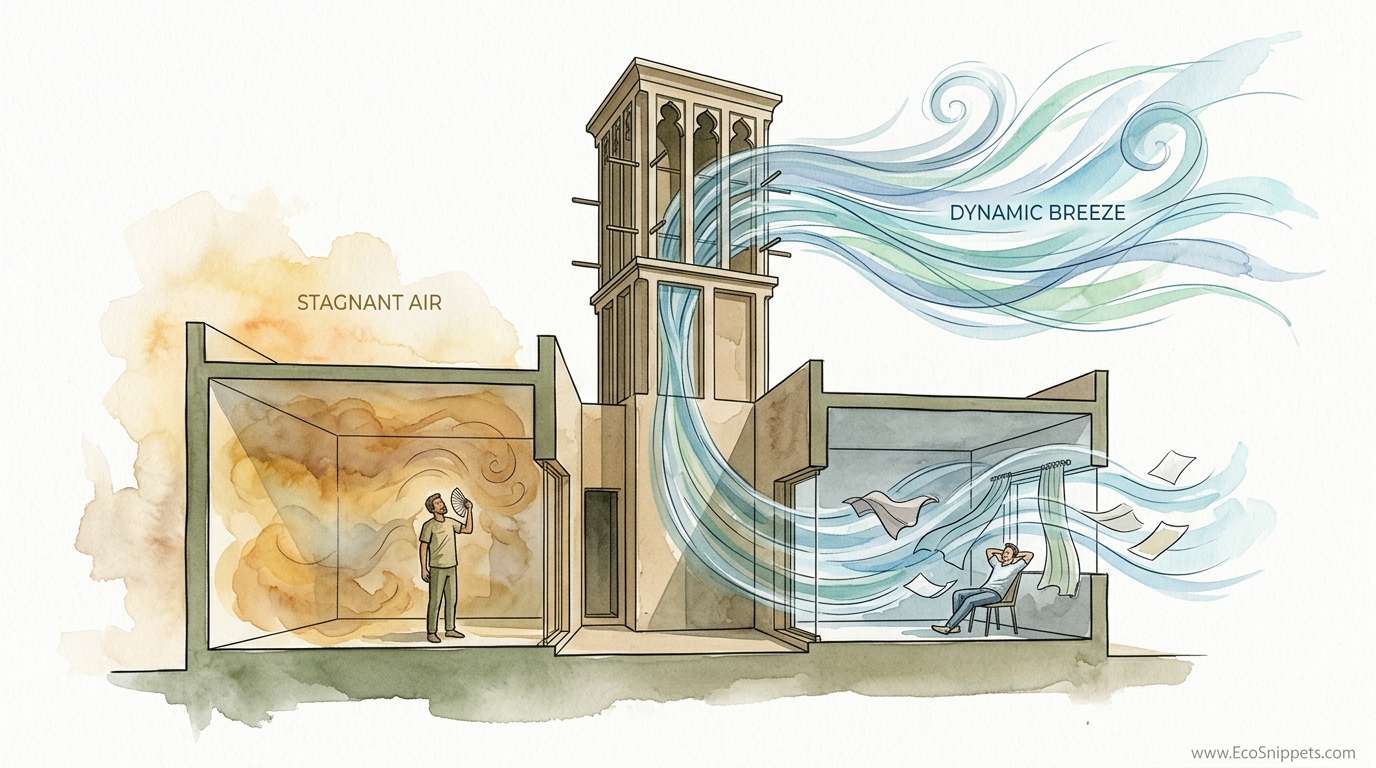
Why pay for AC when you can force the wind to cool your home for free? Static homes trap heat like an oven. Dynamic systems use the architecture itself to create airflow. This ‘Malqaf’ or Windcatcher is a 3,000-year-old hack that catches high-altitude breezes and pulls them through a subterranean cooling chamber. No motors, no noise, no bill.
Modern living has made us soft and dependent on a humming box of chemicals and copper coils. We have forgotten that our ancestors mastered the desert heat with nothing more than mud, stone, and an intimate understanding of the sky. Reclaiming this wisdom isn’t just about saving money; it is about building a home that breathes with the earth.
Stagnant air is the enemy of comfort and health. When you rely solely on insulation, you are essentially living in a thermos. Eventually, that thermos warms up, and the heat has nowhere to go. A dynamic breeze, however, carries the heat away and replaces it with the crispness of the upper atmosphere.
Passive Cooling Without Electricity: The Malqaf
The Malqaf is a traditional architectural element, a vertical shaft rising above the roofline designed specifically to intercept the wind. Historically rooted in the vernacular architecture of Egypt and the wider Middle East, it serves as a lung for the building. While modern homes fight the environment with sealed windows and heavy insulation, the Malqaf invites the environment in—on our terms.
Ancient Egyptians as far back as 1300 B.C. understood that air at ground level is often stagnant, dusty, and hot. However, just thirty feet up, the wind is stronger, cleaner, and several degrees cooler. The Malqaf acts as a scoop, reaching into that superior air stream and funneling it directly into the living spaces below. It is a testament to pioneer grit—using the very elements that challenge us to provide our own relief.
In the blistering heat of the Nile Valley or the Persian deserts, these structures were the difference between a habitable home and an unbearable furnace. They vary in design from the uni-directional Egyptian Malqaf, which faces a single prevailing wind, to the multi-sided Persian Badgir, which can catch a breeze from any direction. Regardless of the form, the purpose remains the same: a zero-energy commitment to thermal comfort.
How the System Breathes: Physics and Construction
The operation of a windcatcher is a masterclass in fluid dynamics. It relies on two primary physical forces: pressure differentials and the stack effect. When the wind hits the opening of the Malqaf, it creates a zone of high pressure. This pressure forces the cool air down the shaft. Simultaneously, the leeward side of the building—or a separate exhaust vent—experiences low pressure, which sucks the stale, warm air out of the house.
Construction of a traditional Malqaf involves building a sturdy masonry or wood-framed chimney that extends well above the highest point of the roof. The internal shaft must be smooth to minimize friction as the air descends. In many ancestral designs, the air is not just moved; it is conditioned. This is where the subterranean cooling chamber comes into play.
By routing the incoming air through a “Qanat” (an underground water canal) or over a series of damp ceramic jars, the system employs evaporative cooling. As the dry desert air passes over the water, it absorbs moisture. This phase change consumes heat, causing the air temperature to drop significantly before it ever enters the room. This is not a fragile electronic process; it is a physical law that works as long as the wind blows and the water stays cool.
To build a functional unit today, you must consider the following components:
- The Intake Scoop: This must be oriented toward the prevailing summer winds. In many regions, this is the North or Northwest.
- The Vertical Shaft: A larger cross-section allows for more volume, but a narrower shaft can increase the velocity of the air via the Venturi effect.
- The Internal Dampers: Heavy wooden or metal flaps are necessary to close the system during winter or during dust storms.
- The Cooling Chamber: This can be a simple basement room with high thermal mass or a more complex series of earth tubes buried six feet underground.
The Benefits of Living with the Wind
Choosing a passive system over mechanical refrigeration offers more than just financial relief. The most immediate benefit is the quality of the air itself. Air conditioners recirculate the same stale air, often leading to “sick building syndrome” where CO2 levels rise and pollutants settle. A Malqaf ensures a constant supply of fresh, oxygen-rich air from the high atmosphere.
Silence is another overlooked advantage. Modern AC units are loud, vibrating machines that disrupt the peace of a home. A windcatcher operates in near-total silence, with only the occasional soft whistle of a high-altitude gust. This connection to the natural sounds of the environment fosters a sense of tranquility that a machine can never replicate.
Longevity and reliability are where the Malqaf truly shines. A mechanical AC unit has a lifespan of 10 to 15 years and requires frequent maintenance, refrigerant refills, and part replacements. A well-built masonry windcatcher can last for centuries. It has no moving parts to break, no filters to clog with plastic fibers, and it will never fail during a power outage. It is the ultimate insurance policy for a self-reliant household.
Challenges and Common Pitfalls
Designing a passive cooling system requires more foresight than simply installing a thermostat. The most common mistake is failing to account for the “exhaust” of the system. For air to enter through the Malqaf, an equal volume of air must be able to escape. If the house is sealed tight, the air will simply pool in the shaft and the cooling effect will stall.
Dust and debris are constant battles in arid environments. Traditional builders solved this by creating a “dust pocket” at the base of the shaft—a small recessed area where the air is forced to make a sharp turn. Because dust is heavier than air, the momentum carries the particles into the pocket while the clean air continues into the living space. Neglecting this feature in a modern build will result in a home covered in a fine layer of silt after every breeze.
Pests and insects also find these shafts attractive. Without a properly sized mesh screen at the intake, the Malqaf becomes a highway for birds, bats, and mosquitoes. However, the mesh must be cleaned regularly; a screen clogged with spiderwebs and leaves will choke the airflow and render the system useless. Sturdy, galvanized hardware cloth is the best defense for a long-term installation.
Limitations of the Ancestral Hack
While the Malqaf is a powerful tool, it is not a universal solution for every climate. Its effectiveness is heavily dependent on two factors: low ambient humidity and consistent wind. In “hot and dry” climates, the system is nearly flawless. In “hot and humid” climates, such as the American South or Southeast Asia, adding moisture to the air through evaporative cooling can actually decrease comfort levels.
In humid regions, the Malqaf must rely purely on air movement (sensible cooling) rather than evaporative cooling. While moving air still feels cooler on the skin, it will not lower the actual thermometer reading of the room as effectively as it does in the desert. Furthermore, in areas with very low wind speeds, the pressure differential might not be enough to overcome the friction of the shaft.
Urban density presents another hurdle. A windcatcher needs a clear “fetch”—an unobstructed path for the wind to travel before hitting the scoop. If your home is surrounded by taller buildings or dense trees, the wind at roof level may be turbulent and weak. In these scenarios, the tower must be built significantly higher to reach the “laminar flow” of the upper air currents, which can raise architectural and zoning challenges.
Comparison: Passive Malqaf vs. Modern Air Conditioning
| Feature | Malqaf (Passive) | Modern AC (Active) |
|---|---|---|
| Operational Cost | $0 / Month | $150 – $400 / Month |
| Maintenance | Clean mesh, sweep dust pocket | Compressor repair, coolant, filters |
| Lifespan | 50 – 100+ Years | 10 – 15 Years |
| Air Quality | 100% Fresh Outdoor Air | Recirculated Indoor Air |
| Complexity | Low (Architectural) | High (Electromechanical) |
Practical Tips for the Modern Pioneer
If you are considering integrating a windcatcher into a new build or a major renovation, start with a wind rose for your specific GPS coordinates. You need to know exactly where the wind comes from during the hottest months of the year. A Malqaf facing the wrong way is just a very expensive skylight.
Internal thermal mass is the secret partner of the windcatcher. The walls of your home should be made of heavy materials like stone, brick, or cob. During the night, the windcatcher can be left fully open to “flush” the house with cold night air. This chills the heavy walls, which then act as a thermal battery, soaking up heat throughout the following day and keeping the interior cool even when the wind dies down.
Optimization of the outlet is just as critical as the inlet. Use a “shuksheika” or a roof lantern vent at the highest point of the ceiling. This allows the hot air that naturally rises to the top of the room to escape, creating a constant “chimney effect” that pulls the cooler air from the Malqaf across the living space. This is often called “cross-ventilation,” and it is the most effective way to ensure every corner of the room stays fresh.
Advanced Considerations: Hybrid Systems
For those who want to push the boundaries of passive cooling, the integration of modern materials can solve ancient problems. Using smooth PVC or aluminum liners inside the shaft can reduce air friction, allowing for smaller, more discreet towers. Adding a low-wattage solar fan at the top of the shaft can provide a “boost” on those rare days when the air is completely still.
Automated dampers are another high-level upgrade. By using a simple temperature sensor and a small actuator, the windcatcher can automatically close itself if the outdoor temperature exceeds the indoor temperature. This prevents the system from accidentally pumping hot afternoon air into a house that has been successfully cooled overnight.
Phase Change Materials (PCMs) can also be lined inside the cooling chamber. These materials absorb vast amounts of heat as they melt and release it as they solidify. By lining the Malqaf shaft with PCMs, the air is stripped of its heat as it passes through, providing a level of temperature control that rivals traditional AC without the need for a compressor.
The Architecture of Resilience: Real-World Scenarios
In the city of Yazd, Iran, windcatchers have been functioning for centuries, keeping homes at a comfortable 75°F even when the outside desert temperature exceeds 100°F. These are not museum pieces; they are the primary cooling systems for thousands of residents. The towers often integrate with “Ab-Anbars,” which are vaulted cold-water cisterns. The air passes over the water, cools down, and then flows into the house, providing both cooling and much-needed humidity.
A modern example can be found in the Visitor Center at Zion National Park in Utah. The architects used “cool towers” based on these exact ancient principles. Water is sprayed at the top of the tower, and as it evaporates, it creates a heavy, cool downdraft that naturally falls into the building. This system provides a massive reduction in energy costs while handling the high foot traffic of a public building in a harsh environment.
Building a Malqaf is a statement of independence. It says that you are not beholden to the local utility grid or the supply chain for complex electronic parts. It shows a respect for the physics of the planet and a willingness to learn from those who came before us. Whether you are building an off-grid cabin or a sustainable suburban home, the wind is a resource that is currently going to waste.
Final Thoughts
The Malqaf is more than just a chimney that catches the wind; it is a symbol of a more resilient way of living. We have spent the last century trying to seal ourselves away from nature, using brute-force electricity to correct the mistakes of poor architectural design. Returning to passive cooling is an admission that the ancients knew something we have forgotten: how to live in harmony with the climate.
Embracing this technology requires a shift in mindset. You must learn to read the wind and understand the thermal cycles of your home. It turns the act of cooling into a ritual of engagement with the world around you. Opening the dampers at dusk and feeling the first rush of high-altitude air into a warm room is a sensory experience that no remote-controlled AC can match.
Start small by experimenting with window-mounted scoops or temporary “wind-catchers” on outbuildings. Once you feel the power of a natural pressure differential, you will never look at a stagnant, hot room the same way again. The wind is always blowing; you just need to reach up and catch it.
