How To Become More Self-Sufficient Without Starting a Full-Blown Farm…
Want to start preserving your harvest, making your own soap, or building a backyard root cellar — but not sure where to begin? “Homesteading Advice” gives you instant lifetime access to 35+ practical homesteading books on food preservation, veggie gardening, DIY natural cleaning products (save over $250 per year with this skill alone), brewing, off-grid energy, and a whole lot more…
Click Here To Check It Out Now!
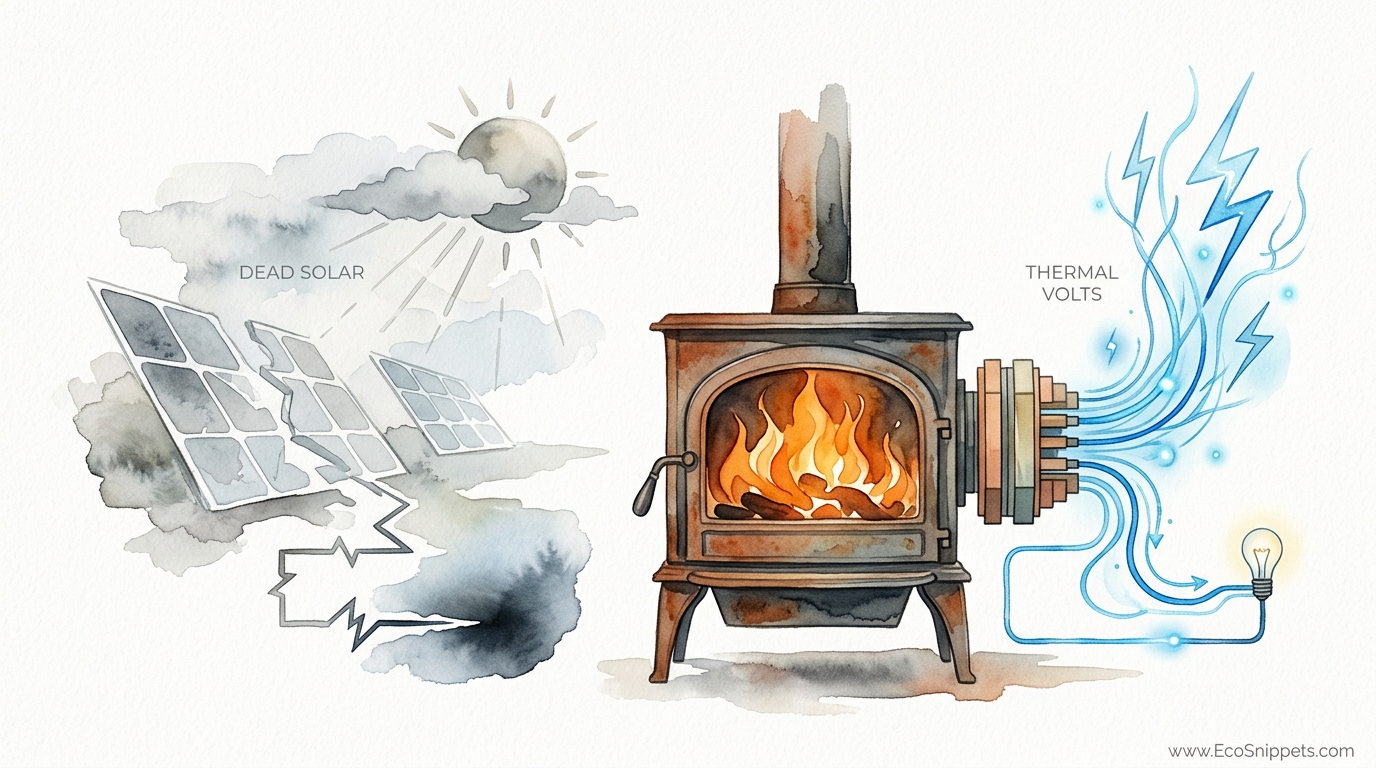
Solar panels fail when the sun goes down, but this 1821 invention thrives in the dark. When the sun goes down and the blizzard hits, your solar panels are just expensive roof ornaments. But that wood stove you’re already running? It’s a hidden power plant. Utilizing the 200-year-old Seebeck effect, we’ve turned our winter heat into a 24/7 charging station that doesn’t care if the grid is down or the sky is black.
Reliance on the modern grid is a fragile gamble. When the temperature drops and the wind begins to howl, the very infrastructure we depend on often buckles under the strain. For those of us who prefer the self-reliance of the homestead, the wood stove has always been the heart of the home. It provides warmth and a place to cook, but it has historically been a silent partner in the electrical realm.
Thermoelectric generators, or TEGs, change that dynamic entirely. These solid-state devices convert the raw heat of your fire directly into a stream of electrons. There are no moving parts to break, no fuel to buy other than the cordwood already stacked in your shed, and no dependence on the fickle appearance of the sun. It is a technology born of 19th-century observation, refined by 21st-century materials.
Every ember that glows in your hearth is a potential watt of power. Learning to harvest this energy is more than just a neat trick; it is a fundamental shift toward true energy independence. Whether you are looking to keep your communications open during a week-long outage or simply want to light your cabin with the same fire that keeps your toes warm, the path begins with understanding the thermal gradient.
Thermoelectric Wood Stove Generator Guide
A Thermoelectric Wood Stove Generator is a device that harvests the heat flux moving through the walls of a wood-burning stove and converts it into direct current (DC) electricity. This process relies on a semiconductor module sandwiched between the hot surface of the stove and a cooling mechanism, such as a metal heat sink or a water block. This arrangement creates a “thermal bridge” that forces energy to flow through the module, generating power as a byproduct of the temperature difference.
In the real world, these systems are often found in remote cabins, off-grid homesteads, and emergency survival kits. They provide a critical bridge for low-power electronics. While you won’t be running an electric oven or a central air conditioning unit off a stovetop generator, you can easily power LED lighting, charge smartphones, run small DC fans to circulate heat, and keep rechargeable radio batteries topped off. It is the ultimate “slow and steady” power source.
Thomas Johann Seebeck first noticed this phenomenon in 1821 when he observed a compass needle deflect near a circuit made of two different metals with junctions at different temperatures. He didn’t realize he had discovered a way to generate electricity; he thought it was a magnetic effect. It took later scientists to realize that the heat was actually moving electrons. Today, we use advanced materials like Bismuth Telluride (Bi2Te3) to make this process efficient enough for practical use on the homestead.
Visualizing a TEG is best done by comparing it to a waterwheel. Just as a waterwheel requires a height difference (the drop of a waterfall) to spin and create power, a thermoelectric module requires a temperature difference (the “delta-T”) to move electrons. The fire provides the “high” energy, and the ambient air or a cooling tank provides the “low” energy. The module sits right in the middle, catching the flow.
How the Seebeck Effect Turns Heat Into Volts
Modern thermoelectric modules are marvels of material science. Inside that small, ceramic-covered square are dozens of small “legs” made of semiconductor material. These legs are doped to be either P-type (positive) or N-type (negative). They are arranged in a series-parallel circuit that allows the small voltage generated by each pair to add up into something useful, like 5 or 12 volts.
Heat applied to one side of the module causes the charge carriers (electrons in the N-type and “holes” in the P-type) to migrate toward the cold side. This diffusion of charge creates an electrical potential. Maintaining a large temperature difference is the secret to success. If the “cold” side of the module gets too hot, the electrons stop moving because there is no longer a gradient to follow. This is why cooling is just as important as the fire itself.
Installing a TEG on your wood stove requires a few essential steps to ensure the heat transfer is efficient.
- Surface Preparation: The top or side of a cast iron stove might look flat, but at a microscopic level, it is full of pits and peaks. These air gaps act as insulators. You must use high-quality thermal interface material, like graphite sheets or thermal paste, to fill these gaps.
- Compression: The module must be clamped firmly between the stove surface and the heat sink. This pressure ensures the best possible thermal contact. However, too much pressure can crack the ceramic plates, so a balanced, spring-loaded clamping system is often best.
- Voltage Regulation: The power coming off a TEG varies wildly depending on how hot your fire is. To safely charge a phone or a battery, you must run the wires through a DC-DC buck-boost converter. This device takes the fluctuating voltage and stabilizes it to a steady 5V or 12V.
Practical application usually involves a “sandwich” design. The bottom layer is the stove, the middle is the TEG module, and the top is a large aluminum heat sink. For those seeking more power, water-cooling is an advanced option. By circulating water through a block on the cold side, you can keep the temperature difference much higher than air cooling ever could, often doubling or tripling the power output.
The Advantages of Thermal Volts Over Dead Solar
Resilience is the primary benefit of a wood stove generator. Solar energy is essentially a “fair weather” friend. It works beautifully when the skies are clear and the days are long. But in the middle of a northern winter, when you might only get six hours of weak, angled light—or no light at all during a storm—your batteries will quickly run dry. A TEG thrives in the exact conditions that defeat solar panels.
Durability is another hallmark of this 1821 technology. Because a TEG module is a solid-state device with no moving parts, there is very little that can wear out. Unlike a portable gasoline generator that requires oil changes, spark plugs, and fresh fuel, a TEG simply sits on your stove. As long as the fire is burning and the cooling side is functioning, it will produce power for decades. It is a “set it and forget it” system for the rugged individualist.
Total system efficiency is a hidden advantage that critics often overlook. While the electrical efficiency of a TEG module is low—usually between 5% and 8%—you have to look at the big picture. You are already burning that wood to keep your family warm. The 92% of the energy that doesn’t become electricity simply continues on as heat into your room. In this context, the electricity is essentially “free” energy harvested from a process that was happening anyway.
Silence is a luxury in a grid-down situation. Running a gas generator announces your presence and your resources to the entire neighborhood. A thermoelectric generator is completely silent. It allows you to maintain a low profile while still having the power needed to run a small radio for news or a light to read by during the long winter nights.
Challenges and Common Pitfalls to Avoid
Overheating is the number one killer of thermoelectric modules. Most common Bismuth Telluride modules have a maximum operating temperature of around 250°C (about 480°F). While that sounds hot, the surface of a roaring wood stove can easily exceed 300°C or 400°C. If the module gets too hot, the internal solder junctions will melt, and the device will be permanently destroyed. Using a thermometer to monitor your stove’s surface temperature is not optional; it is a requirement.
Poor thermal contact is the second most frequent error. Many beginners simply set a heat sink on top of a module and wonder why they are only getting a fraction of a watt. Without proper clamping force and thermal paste, the heat won’t flow through the module. Instead, it will just bake the module from the bottom while the heat sink stays relatively cool. The heat must be “forced” through the semiconductor legs to generate electricity.
Ignoring the “Cold Side” leads to rapid power drops. If you use a heat sink that is too small, it will eventually heat up until it is nearly as hot as the stove. When this happens, the delta-T disappears, and your power output drops to zero. A large, high-surface-area aluminum heat sink is necessary. In some cases, adding a small, low-power DC fan to blow air across the fins can actually produce more net power because it keeps the cold side significantly cooler.
Wiring mistakes can also hamper your efforts. If you are using multiple modules, you have to decide whether to wire them in series or parallel. Series wiring increases the voltage, which is helpful if your fire is low, but if one module fails, the whole string goes down. Parallel wiring increases the current (amps) but requires a higher temperature to reach a usable voltage. Most homesteaders find a mix of both—often called a “string”—provides the best balance for varying fire intensities.
Limitations of Stovetop Power
Managing expectations is crucial when dealing with thermoelectricity. You are not going to power a refrigerator or a microwave with a couple of modules on a wood stove. The energy density of these devices is relatively low. A typical high-quality module might produce 5 to 10 watts under ideal conditions. To put that in perspective, a modern smartphone requires about 5 to 10 watts to charge at a decent speed. This is a system for “micro-power” needs.
Environmental factors also play a role. If your house is already very warm, your heat sink will have a harder time staying cool, which reduces efficiency. These systems actually work better in a cold room where the ambient air can effectively strip heat away from the cooling fins. In a way, the TEG is a true child of winter; it performs best when the contrast between the fire and the frost is at its peak.
Cost per watt is significantly higher for TEGs than for solar panels. A 100-watt solar panel can be found for a relatively low price today. Achieving 100 watts with thermoelectric modules would require dozens of modules, massive heat sinks, and a complex water-cooling system, likely costing five to ten times as much as the solar equivalent. Therefore, TEGs should be viewed as a supplemental or emergency system rather than a primary power source for a modern home.
Dependence on the fire is the final limitation. When the fire goes out in the spring, your power source disappears. This is why a hybrid approach is often the smartest move for the self-reliant pioneer. Use solar when the sun is high and the stove is cold, then switch to the TEG when the snow starts to fall and the hearth is lit. This ensures a 365-day power cycle that doesn’t rely on any external utility.
Practical Comparison: Solar vs. Thermal
| Feature | Solar PV (Dead Solar) | Stovetop TEG (Thermal Volts) |
|---|---|---|
| Availability | Daylight only; weather dependent. | 24/7 as long as fire is burning. |
| Efficiency | 15% to 22% (Average). | 5% to 8% (Electrical only). |
| Moving Parts | None. | None (unless using a pump/fan). |
| Best Use Case | Bulk energy, battery banks. | Winter backup, emergency charging. |
| Maintenance | Cleaning snow/dust off panels. | Monitoring stove temps. |
Comparing these two technologies reveals that they are not competitors but partners. Solar panels provide high-wattage power that can run heavy appliances during the day. However, once the “Dead Solar” period of winter arrives, the panels often become useless under layers of snow or during weeks of overcast skies. This is where “Thermal Volts” take over, providing the critical, low-wattage life support needed to stay connected and illuminated.
Cost-wise, solar is much more efficient for the money. But you cannot put a price on a phone that stays charged during a blizzard when the power lines are down and the sun hasn’t been seen in three days. The TEG is an insurance policy. It is the backup for your backup, ensuring that the ancient wisdom of the hearth remains compatible with the needs of the modern world.
Practical Tips for Maximizing Stovetop Power
Optimization is the difference between a toy and a tool. To get the most out of your setup, start with the placement of your modules. Don’t just stick them anywhere; use an infrared thermometer to find the “sweet spot” on your stove where the temperature is high but stable. Usually, this is not directly over the firebox, but slightly to the side or on a flat portion of the flue pipe, depending on your stove’s design.
Thermal paste should be applied as thin as possible while still covering the entire surface. Many people make the mistake of globbing it on. In reality, thermal paste is less conductive than metal; its only job is to replace the air in the microscopic gaps. A thin, translucent layer is often more effective than a thick one. If you can use a graphite pad, they are often easier to manage and less messy than paste, though slightly less efficient.
Experimenting with different cooling methods can yield surprising results.
- Passive Air: Uses large fins and relies on natural convection. Best for simplicity and reliability.
- Active Air: Uses a small fan powered by the TEG itself. This “parasitic load” usually pays for itself by significantly increasing the temperature delta.
- Water Cooling: The gold standard. Circulating water through a block can maintain the cold side at near-ambient temperatures, maximizing the power output of the module.
Monitoring your output with a simple USB multi-meter is a great way to learn. You will start to see how different wood types (oak vs. pine) and different damper settings affect your power production. Over time, you’ll develop a “pioneer’s feel” for the relationship between the roar of the fire and the flow of the electrons.
Advanced Considerations for the Serious Practitioner
Stepping beyond a single module requires an understanding of system integration. If you want to build a truly robust power station, you should look into water-jacketed TEGs. These systems use the cold side of the module to pre-heat water for your home. Not only do you get electricity, but you also improve the efficiency of your hot water system. This is true co-generation, where every bit of energy is used twice.
Selecting the right semiconductor material is also vital for high-performance builds. While Bismuth Telluride is the standard, it is limited by its melting point. Advanced practitioners sometimes look at materials like Lead Telluride (PbTe) or Skutterudites for higher-temperature applications, though these are harder to find and much more expensive. For most homestead applications, sticking with high-grade Bi2Te3 modules and focusing on superior cooling is the most cost-effective path.
Storage is the final piece of the puzzle. Since a wood stove often cycles between hot and cold, you need a way to buffer that power. A small Lithium Iron Phosphate (LiFePO4) battery bank is ideal. These batteries are safer to keep indoors and can handle the slow, trickle-charge nature of a TEG much better than older lead-acid designs. Pair your TEG with a high-quality charge controller to ensure you don’t overcharge your storage when the fire is at its peak.
Example Scenario: The Great Freeze of 2024
Imagine a scenario where a sudden ice storm knocks out power across three states. The temperature is -10°F, and the sky is a thick, gray blanket of clouds. For a homesteader with only solar panels, the “Dead Solar” effect is in full swing; the panels are covered in a two-inch layer of ice and there is no light to penetrate it anyway. The house is getting cold, and the phone battery is at 4%.
The homesteader with a TEG setup doesn’t panic. They simply light the wood stove with a dry stack of seasoned maple. Within 15 minutes, the stove surface hits 200°C. The thermal gradient across the TEG modules begins to flow. A small LED light above the hearth flickers to life, illuminating the room. They plug their phone into the stabilized USB port on the side of the stove, and the charging icon appears.
By the time the sun would have been setting—if it were even visible—the homesteader has charged their phone, topped off a portable radio, and is running a small 12V fan that is pushing the stove’s heat into the back bedrooms. They haven’t used a drop of gasoline or a single ray of sunlight. They are living on the “Thermal Volts” of the 1821 Seebeck effect, turning a survival situation into a cozy evening by the fire.
Final Thoughts on Harvesting Fire
The wood stove is more than just a relic of the past; it is a gateway to a resilient future. By adding a thermoelectric generator, you bridge the gap between ancestral wisdom and modern necessity. This technology respects the laws of thermodynamics while giving you a tangible edge when the modern world’s infrastructure fails. It is the ultimate expression of pioneer grit: taking what you have and making it do more.
Starting with a simple stovetop fan is a great way to get your feet wet. These small devices use a tiny TEG to spin a blade, demonstrating the principle in a practical, useful way. From there, you can move to building your own charging stations, experimenting with heat sinks, and eventually integrating a full co-generation system into your homestead. The energy is already there, radiating off your stove every winter; all you have to do is catch it.
True independence is found in diversification. Don’t throw away your solar panels, but don’t trust them to save you in the dark of January. Build a system that respects the seasons—sun in the summer, fire in the winter. Utilizing the Seebeck effect ensures that as long as you have wood to burn, you will never be left in the dark. Experiment, build, and reclaim the power of the hearth.
