How To Become More Self-Sufficient Without Starting a Full-Blown Farm…
Want to start preserving your harvest, making your own soap, or building a backyard root cellar — but not sure where to begin? “Homesteading Advice” gives you instant lifetime access to 35+ practical homesteading books on food preservation, veggie gardening, DIY natural cleaning products (save over $250 per year with this skill alone), brewing, off-grid energy, and a whole lot more…
Click Here To Check It Out Now!
Our ancestors didn’t have chemical fertilizers, so they used the gravitational pull of the moon to supercharge their soil. Modern farming tells us to plant whenever we have a free Saturday. Ancestral wisdom tells us the moon moves more than just the tides—it moves the water inside your soil. Timing your sowing with the lunar cycle allows you to tap into a natural ‘pump’ that pulls moisture toward the surface right when your seeds need it most. It’s not magic; it’s the oldest rhythm on Earth.
Working with the land requires more than just sweat and seeds; it requires a deep understanding of the environment around you. Many modern growers treat the garden like a factory, expecting results through sheer force of input. However, those who look to the sky find a more efficient path. Lunar gardening is a practice of patience and observation that aligns human effort with celestial mechanics.
This guide explores the transition from haphazard planting to a disciplined, rhythm-based approach. You will learn how to read the lunar calendar not as a set of superstitions, but as a biological clock. Understanding these cycles helps ensure that every seed you press into the dirt has the best possible chance of thriving.
Ancestral Moon Phase Gardening Guide
Ancestral moon phase gardening is the ancient practice of timing agricultural tasks—such as sowing, transplanting, and harvesting—to the specific phases of the lunar cycle. This method rests on the observation that the moon’s gravitational pull influences the movement of water on Earth. While we clearly see this in the ocean tides, the same forces act upon the moisture within the soil and the sap inside living plants.
Historically, civilizations from the Egyptians to the Maya relied on these rhythms to sustain their populations. They recognized that the world operates in cycles of rest and activity. In the modern context, this practice is often called “planting by the signs” or “lunar gardening.” It remains a staple for homesteaders and organic farmers who prioritize self-reliance over industrial shortcuts.
The lunar cycle lasts approximately 29.5 days and is divided into four distinct quarters. Each quarter provides a different environment for plant development. During certain times, the “upward” pull of the moon encourages leafy growth and seed germination. During others, the energy shifts “downward,” favoring root development and the strengthening of perennials.
Think of the moon as a massive, celestial conductor. When the conductor raises the baton, the moisture rises, and the garden prepares for a crescendo of growth. When the baton lowers, the plants focus on their foundations, anchoring themselves deep into the earth. Following this guide means learning the language of the conductor so you can play your part in the symphony of the seasons.
The Mechanics of Lunar Influence
Understanding the science behind the tradition is essential for any serious practitioner. The primary driver of this system is gravity. Just as the moon’s pull creates a “bulge” in the Earth’s oceans, it creates a similar effect on the water table beneath your feet. During a New Moon and a Full Moon, the Sun and Moon align their gravitational forces, pulling moisture closer to the surface.
This subterranean surge of water is exactly what a dormant seed needs. Seeds require moisture to swell and break through their hulls. Sowing during a period of high soil moisture ensures that the germination process begins immediately and with greater vigor. Plants that germinate quickly are often more resilient against pests and early-season diseases.
Light also plays a significant role in this ancestral system. The amount of moonlight increases during the waxing phases, which influences the growth of foliage and stems. Some studies suggest that certain plants have “photoreceptors” sensitive enough to respond to lunar light, even if it is far dimmer than the sun. This subtle illumination provides a secondary signal to the plant that it is time to expand upward.
Geotropism is another concept to consider. This is the way a plant grows in response to gravity—roots growing down (positive geotropism) and stems growing up (negative geotropism). The shifting intensity of the moon’s pull can subtly affect these biological leanings. Modern science may call it folklore, but for the pioneer with a spade in hand, the results in the harvest basket are the only evidence that truly matters.
How to Do It: Sowing by the Four Quarters
Successfully implementing this system requires a basic understanding of the four lunar quarters. You must track the moon from its dark phase to its fullest peak and back again. Each phase has a specific job to do.
The First Quarter: New Moon to First Quarter
The First Quarter begins at the New Moon when the sky is dark. This is the time of the greatest gravitational pull. Moisture is rising, and the moonlight is beginning to increase. This combination creates the perfect environment for plants that produce their yield above the ground, particularly those that we value for their leaves or stems.
Focus on leafy annuals during this phase. Common examples include lettuce, spinach, celery, and cabbage. These plants respond well to the “upward” energy. Sowing seeds now allows them to take advantage of the peak moisture levels for germination.
The Second Quarter: First Quarter to Full Moon
The Second Quarter sees the moon growing from a half-shape to a full circle. Gravitational pull is slightly less intense than the New Moon phase, but the moonlight is at its peak. This phase is ideal for above-ground crops that produce seeds inside a fruit.
Plant your tomatoes, beans, peas, peppers, and squash during this window. These crops benefit from the strong leaf growth initiated in the first quarter, but they need the extra light of the second quarter to develop their fruiting bodies. Cereals and grains also perform exceptionally well when sown during this time.
The Third Quarter: Full Moon to Last Quarter
The Third Quarter begins immediately after the Full Moon. As the light begins to fade, the energy of the Earth shifts. The gravitational pull remains strong, but it is now pulling “downward” toward the roots. This makes it the premier time for anything that grows beneath the soil.
Prioritize root crops like carrots, potatoes, beets, and onions. This is also the best time for transplanting established plants. Moving a plant during this phase encourages it to focus on root establishment rather than foliage growth, which reduces transplant shock and builds a sturdier foundation.
The Fourth Quarter: Last Quarter to New Moon
The Fourth Quarter is the waning crescent, leading back to the dark of the New Moon. This is a period of rest. The gravitational pull is at its lowest, and the light is nearly gone. Most traditional guides advise against planting or sowing during this time.
Use this phase for maintenance. It is the perfect time for weeding, as the plants have less “will” to recover from being pulled or cut. It is also an excellent window for tilling the soil, turning the compost pile, or harvesting crops intended for long-term storage. Fruits and vegetables picked during the “dark” of the moon often have lower moisture content, which can help prevent rot during the winter months.
Benefits of Lunar-Based Gardening
Adopting this rhythm offers several practical advantages that go beyond simple tradition. One of the most immediate benefits is improved organization. Gardening can often feel like a chaotic race against the weather. Having a lunar schedule provides a structured framework that tells you exactly what to prioritize each week.
Improved germination rates are frequently reported by those who follow the moon. Seeds that are sown when moisture is being pulled to the surface do not sit dormant in dry soil. They get the hydration they need the moment they hit the dirt. This leads to a more uniform stand of plants in your garden beds.
Increased plant vitality is another significant factor. Plants that are started during their ideal lunar window tend to grow more balanced systems. A tomato plant started during the waxing moon has the “upward” momentum to build a strong stem, while a potato planted during the waning moon has the “downward” focus to develop heavy tubers.
Mindfulness and observation are perhaps the most profound benefits. Using the moon forces you to look at your garden and the sky more closely. You become more in tune with the subtle changes in your local ecosystem. This heightened awareness often leads to better decision-making regarding water, pests, and soil health, regardless of the lunar phase.
Challenges and Common Mistakes
The transition to lunar gardening is not without its hurdles. One common mistake is ignoring the local environment in favor of the lunar calendar. If the moon says it is time to plant tomatoes, but your soil is still frozen or a frost is predicted for tomorrow, you must prioritize the climate. The moon is a guide, not a dictator.
Misidentifying the moon phases is another frequent error. With modern light pollution, it can be difficult to tell the difference between a waxing and waning gibbous just by looking up. Relying on a reliable lunar calendar or an almanac is essential for accuracy. Guessing can lead to planting root crops when you should be planting greens, which undermines the entire system.
Failing to prepare the soil is a pitfall that even the best lunar timing cannot fix. The moon’s pull works on the moisture in the soil, but if your soil is compacted or devoid of organic matter, that moisture cannot move effectively. Lunar gardening is a supplement to good soil management, not a replacement for it.
Rigidity can also be a problem. Sometimes life gets in the way, and you miss a three-day planting window. Do not let this paralyze your gardening efforts. It is better to plant slightly out of phase than to not plant at all. The goal is to align with the rhythm as often as possible, not to achieve perfection at the cost of productivity.
Limitations of the Lunar Method
While powerful, the lunar method has realistic boundaries. In regions with extreme weather patterns or very short growing seasons, the window of opportunity for certain crops might be too small to strictly wait for the “correct” moon phase. In these cases, soil temperature and frost dates must take precedence.
Commercial-scale farming often finds it difficult to implement lunar timing due to the sheer volume of work. Large operations require consistent labor and machinery schedules that do not always align with a 29-day cycle. For the small-scale homesteader or hobbyist, however, these constraints are much easier to manage.
Artificial environments like greenhouses also diminish the moon’s impact. If you are growing in a climate-controlled room with high-intensity grow lights and automated irrigation, the subtle influence of moonlight and natural soil moisture surges is largely drowned out. The lunar method is most effective when the plants are in direct contact with the Earth and the open sky.
Scientific skepticism is also worth noting. While anecdotal evidence is vast, rigorous double-blind studies on lunar gardening often yield conflicting results. This does not mean the practice is invalid, but it does mean you should approach it as a craft rather than a laboratory science. Success in the garden is a blend of hard data and ancestral intuition.
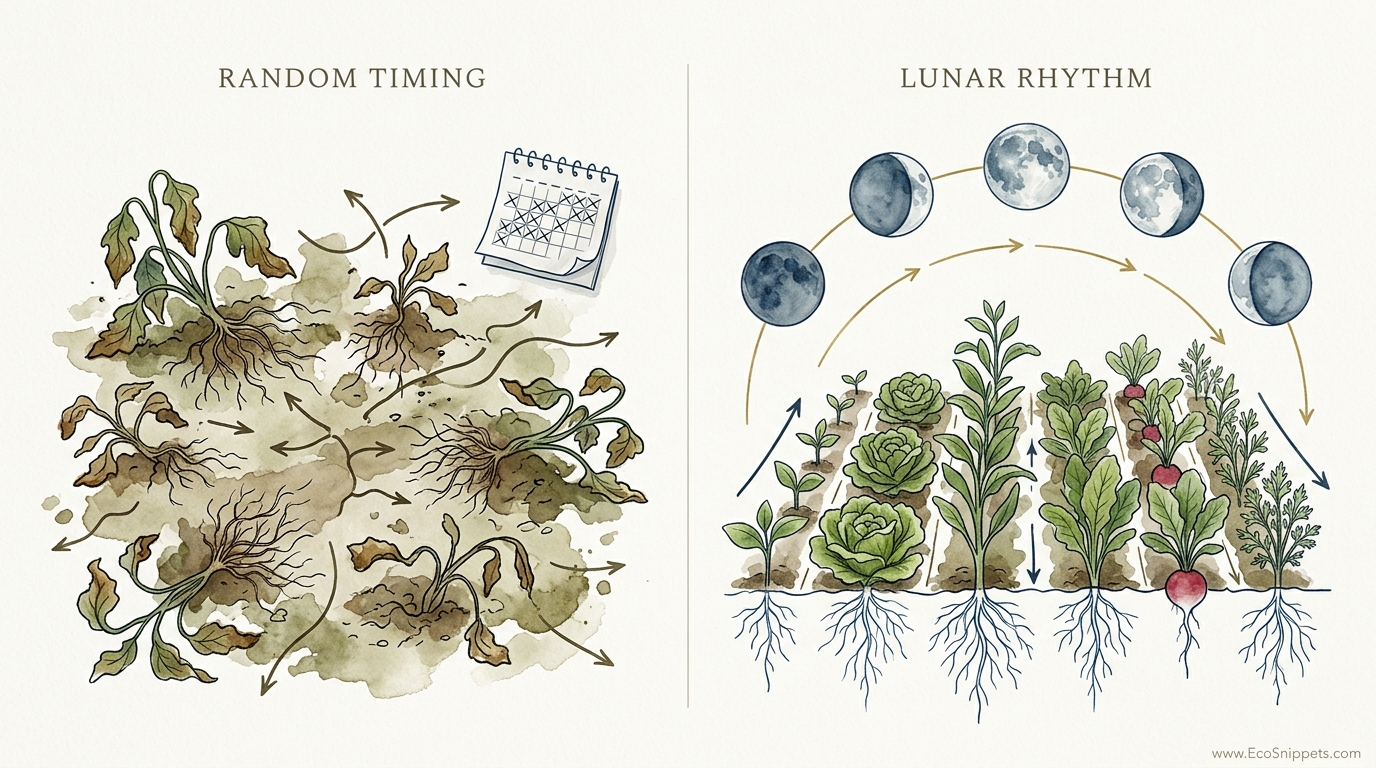
Comparison: Random Timing vs. Lunar Rhythm
Understanding the difference between a reactive garden and a rhythmic garden helps clarify why this approach matters. The following table illustrates how these two methods differ across key practical factors.
| Feature | Random Timing (Reactive) | Lunar Rhythm (Proactive) |
|---|---|---|
| Germination | Variable; dependent on immediate watering. | Often faster due to natural moisture peaks. |
| Maintenance | Done when time permits; often feels like a chore. | Scheduled by phases; feels like a partnership. |
| Plant Structure | Can be leggy or root-bound if timed poorly. | Balanced growth between foliage and roots. |
| Pest Resistance | Reactive spraying and intervention. | Natural vigor often reduces early-season loss. |
| Harvest Quality | Inconsistent moisture levels in crops. | Optimized for immediate use or long storage. |
Practical Tips for the Modern Pioneer
Starting your lunar gardening journey requires a few simple adjustments to your routine. Following these tips will help you integrate the practice without feeling overwhelmed.
- Keep a Gardening Journal: Document your planting dates, the moon phase at the time, and the results. Over two or three seasons, you will start to see patterns unique to your specific soil and microclimate.
- Use a Reliable Almanac: The Old Farmer’s Almanac or a specialized lunar planting calendar takes the guesswork out of the process. These resources often include regional adjustments for frost dates.
- Prioritize Soil Health: Ensure your soil is rich in organic matter. Well-structured soil responds much better to the gravitational pull of the moon than dead, sandy, or clay-heavy earth.
- Observe the Weeds: Notice how weeds respond to the phases. You will often find they are much easier to pull during the waning crescent when their energy is low.
- Start Small: Do not try to convert your entire garden at once. Pick one bed and follow the lunar cycle strictly, then compare its yield to your other beds.
Advanced Considerations: The Soil Connection
Experienced practitioners often look beyond the simple four-quarter system. They consider the “Signs of the Zodiac,” which is an even older layer of agricultural wisdom. This involves tracking which constellation the moon is passing through. Each sign is associated with an element: Earth, Air, Fire, or Water.
Water signs (Cancer, Scorpio, Pisces) are traditionally considered the most fertile and are ideal for planting almost anything. Earth signs (Taurus, Virgo, Capricorn) are productive and great for root crops. Air signs are often seen as “dry” and are better for harvesting or tilling. Fire signs are the least fertile and are typically reserved for destroying weeds or clearing land.
Scaling this system for a larger homestead requires planning the “rest periods” as carefully as the “planting windows.” During the fourth quarter, you should focus on infrastructure. Fix fences, sharpen tools, and prep the beds for the next New Moon. This prevents the “pioneer burnout” that comes from trying to do everything at once.
Consider also the relationship between the moon and soil biology. Some practitioners believe that the surge in soil moisture during the Full Moon also increases the activity of beneficial bacteria and fungi. Applying compost teas or liquid fertilizers during these peaks can maximize nutrient uptake as the biological “engine” of the soil is running at full speed.
Examples of Lunar Planting in Practice
Visualizing how this works in a real-world scenario helps solidify the concept. Let us look at two different crops: corn and carrots.
Scenario A: Planting Corn
Corn is an above-ground, heavy-feeding crop that produces seeds inside a husk. To maximize success, you would wait for the New Moon. On the day of the New Moon, you prepare your rows. During the First Quarter, as the light begins to increase, you sow the seeds. The rising moisture helps the corn germinate quickly. As the moon moves into the Second Quarter, the increasing light supports the rapid development of the tall stalks and the formation of the ears.
Scenario B: Planting Carrots
Carrots are a root crop that requires deep, steady growth. You would ignore the waxing moon entirely for this task. Instead, you wait for the Full Moon to pass. Two or three days after the Full Moon, when the energy is clearly shifting “downward,” you sow your carrot seeds. The waning light signals the plant to put its resources into the taproot. This leads to longer, straighter, and sweeter carrots because the plant isn’t wasting energy on excessive top-growth.
Final Thoughts
Embracing ancestral moon phase gardening is about more than just better vegetables. It is about reclaiming a connection to the natural world that modern society has largely forgotten. It forces us to slow down, look up, and realize that we are part of a much larger, ancient system.
Using the moon as your guide provides a sense of order and purpose in the garden. It turns the manual labor of farming into a rhythmic ritual. While the science may still be catching up to the folklore, the generations of pioneers who came before us knew that the sky holds the keys to the earth.
Experiment with these cycles in your own backyard. Start with a few simple crops and watch how they respond to the shifting light and gravity. You may find that the oldest rhythm on Earth is exactly what your modern garden has been missing. Deepening your understanding of these natural pulses will not only improve your harvest but also your resolve as a self-reliant grower.
