How To Become More Self-Sufficient Without Starting a Full-Blown Farm…
Want to start preserving your harvest, making your own soap, or building a backyard root cellar — but not sure where to begin? “Homesteading Advice” gives you instant lifetime access to 35+ practical homesteading books on food preservation, veggie gardening, DIY natural cleaning products (save over $250 per year with this skill alone), brewing, off-grid energy, and a whole lot more…
Click Here To Check It Out Now!
Why are you hauling heavy waste to a plastic box when your animals and garden can process it for you? Most people treat composting like a chore that happens ‘over there.’ But true self-sufficiency means integrating your waste streams. When you combine your chickens, your garden, and your kitchen, the work disappears and the fertility explodes. Stop managing a pile and start managing a system.
For generations, the homestead was a closed loop where nothing was wasted and every creature had a job. The modern obsession with tidy, isolated compost bins has disconnected us from the natural rhythm of decay and regrowth. By bringing the composting process directly into the chicken run, you are tapping into an ancient synergy that benefits the soil, the birds, and your own weary back.
This approach transforms a potentially smelly, muddy mess into a biological engine of fertility. It requires a shift in perspective from seeing chicken manure as a problem to seeing it as the high-octane fuel for your garden. When you get this right, you stop being a janitor for your livestock and start being a manager of a thriving ecosystem.
Chicken Run Composting Benefits
Chicken run composting is the practice of using the natural scratching behavior of poultry to aerate and mix organic matter, such as kitchen scraps and carbon-rich bedding. In a standard run, manure often accumulates on the surface, leading to odors, flies, and nitrogen loss. In an integrated system, this nitrogen is immediately captured by carbon materials and processed by microbes.
One of the primary benefits is the drastic reduction in labor for the homesteader. Instead of you turning a heavy compost pile with a pitchfork, the chickens do it for you while searching for seeds and insects. Their constant activity ensures the pile stays oxygenated, which is the key to aerobic decomposition and a smell-free environment.
The health of your flock also sees a significant boost in a composting run. A mature deep-litter system develops a diverse community of beneficial microbes that can actually outcompete harmful pathogens like Coccidia. Furthermore, these microbes produce metabolites like vitamins K and B12, which chickens ingest as they peck through the litter, supplementing their diet with natural nutrition.
From a garden perspective, this method produces what many call “black gold.” Because the manure is mixed with carbon sources like straw or wood chips and allowed to age, the resulting compost is far more stable than raw manure. It provides a slow-release source of nitrogen, phosphorus, and potassium that improves soil structure and water retention without the risk of burning sensitive plant roots.
How to Set Up Your Composting Run
Building an integrated system starts with the floor of your run. If you have a dirt floor, you are already halfway there, as this allows soil microbes and earthworms to migrate up into your compost. If your run has a wooden or concrete floor, you must be more diligent about adding a thick “starter” layer of carbon to protect the structure and jumpstart the biology.
The first step is to clear any existing matted manure and lay down a 6-to-12-inch base of high-carbon material. Good options include shredded autumn leaves, pine shavings, or straw. This base acts as a sponge, soaking up moisture and nitrogen while providing the physical structure needed for airflow.
Once your base is in place, you can begin adding “greens” or nitrogen-rich materials. This includes all your kitchen scraps, garden weeds that haven’t gone to seed, and the daily deposits from the birds themselves. The secret is to keep the ratio balanced so the system doesn’t become a wet, anaerobic mess.
As the chickens scratch through the new additions, they will naturally incorporate them into the carbon base. If you notice the pile getting thin or if you start to catch a whiff of ammonia, it is time to add another layer of carbon. Over a few months, the floor of your run will rise as you build a deep, spongy mattress of decomposing organic matter.
Choosing Your Carbon Sources
Not all carbon is created equal, and variety is your friend in a composting run. Wood chips are excellent for permanent runs because they take longer to break down, providing a sturdy footing that prevents mud even in heavy rain. Straw is a classic choice, but it can sometimes mat down if it gets too wet, requiring a bit more intervention from you to keep it loose.
Autumn leaves are perhaps the best free resource available to the homesteader. They are packed with minerals pulled from deep in the earth by tree roots and have a high surface area for microbes to colonize. If you can, shred them with a lawnmower before adding them to the run to speed up the breakdown and prevent them from forming a slick, impermeable layer.
Hemp bedding is a newer alternative that is gaining popularity for its incredible absorbency. It can hold several times its weight in moisture without becoming soggy, which is a major advantage in humid climates. While it may be more expensive than wood shavings, its ability to suppress odors and last longer in the run often justifies the cost for small-scale keepers.
The Science of Carbon and Nitrogen Ratios
To keep the system moving, you need to understand the chemistry of the pile. Microbes need a diet that is roughly 30 parts carbon to 1 part nitrogen. Chicken manure is very high in nitrogen, with a ratio of about 10:1. This means for every bucket of manure or kitchen scraps, you need to provide significantly more carbon to keep the balance.
When there is too much nitrogen and not enough carbon, the excess nitrogen is converted into ammonia gas. This isn’t just a smell issue; it is a loss of valuable fertility and a respiratory hazard for your birds. If your eyes sting or your nose crinkles when you enter the coop, you are witnessing nitrogen escaping into the atmosphere instead of staying in your soil.
Carbon materials like wood shavings (500:1) or straw (80:1) act as the “brown” buffer. They provide the energy for the bacteria that process the nitrogen. By maintaining a deep layer of these browns, you create a “bank” of carbon that is ready to absorb the daily “deposits” from your flock.
A simple way to manage this without a calculator is the visual and olfactory test. The run should look like a forest floor—dark, crumbly, and slightly damp. It should smell like rich earth or nothing at all. If it looks like a barnyard or smells like a sewer, you need more carbon, more air, or both.
Challenges and Common Mistakes
The biggest mistake beginners make is letting the run get too wet. Moisture is necessary for life, but too much of it fills the air pockets in your litter, killing off the aerobic bacteria. This leads to anaerobic decomposition, which produces foul odors and can harbor pathogens that thrive in slimy, low-oxygen environments.
If your run isn’t covered, a week of heavy rain can turn your compost engine into a mud pit. A simple roof or even a heavy-duty tarp over a portion of the run can make management much easier. This allows you to control the moisture levels manually by adding water during dry spells and keeping the “soup” at bay during the winter.
Another pitfall is “capping,” where a layer of manure dries on top of the bedding and forms a hard crust. This prevents oxygen from reaching the lower layers and stops the chickens from scratching. You can prevent this by throwing a handful of scratch grains or sunflower seeds over the run every morning, which motivates the birds to dig deep and break up any surface crust.
Be careful about what you toss into the run from the kitchen. While chickens are great at processing most scraps, avoid giving them large amounts of citrus, salty foods, or anything moldy. Moldy feed or scraps can contain mycotoxins that are dangerous for poultry, so if it is too fuzzy for the kitchen, it is too fuzzy for the run—put those items in a separate, isolated bin if you must.
Limitations and Practical Boundaries
Chicken run composting is a powerful tool, but it is not a universal solution. If you are keeping a large number of birds in a very small space, the sheer volume of manure will eventually overwhelm the system’s ability to process it. Overcrowding leads to “hot” spots of raw manure that can cause foot pad issues like bumblefoot in your flock.
Environmental factors also play a role. In extremely arid climates, the litter may dry out so quickly that decomposition stops entirely, leaving you with a pile of preserved manure and dry straw. Conversely, in very cold climates, the microbial activity may slow down significantly in the winter, though a well-managed deep pile can actually generate enough internal heat to keep the coop floor from freezing.
You must also consider the structural integrity of your coop. Deep-litter composting involves moisture and biological activity, which can rot untreated wood floors over time. If you aren’t composting on bare earth, ensure your floor is protected with a durable liner or a heavy-duty sealant to prevent the biology from “eating” your building.
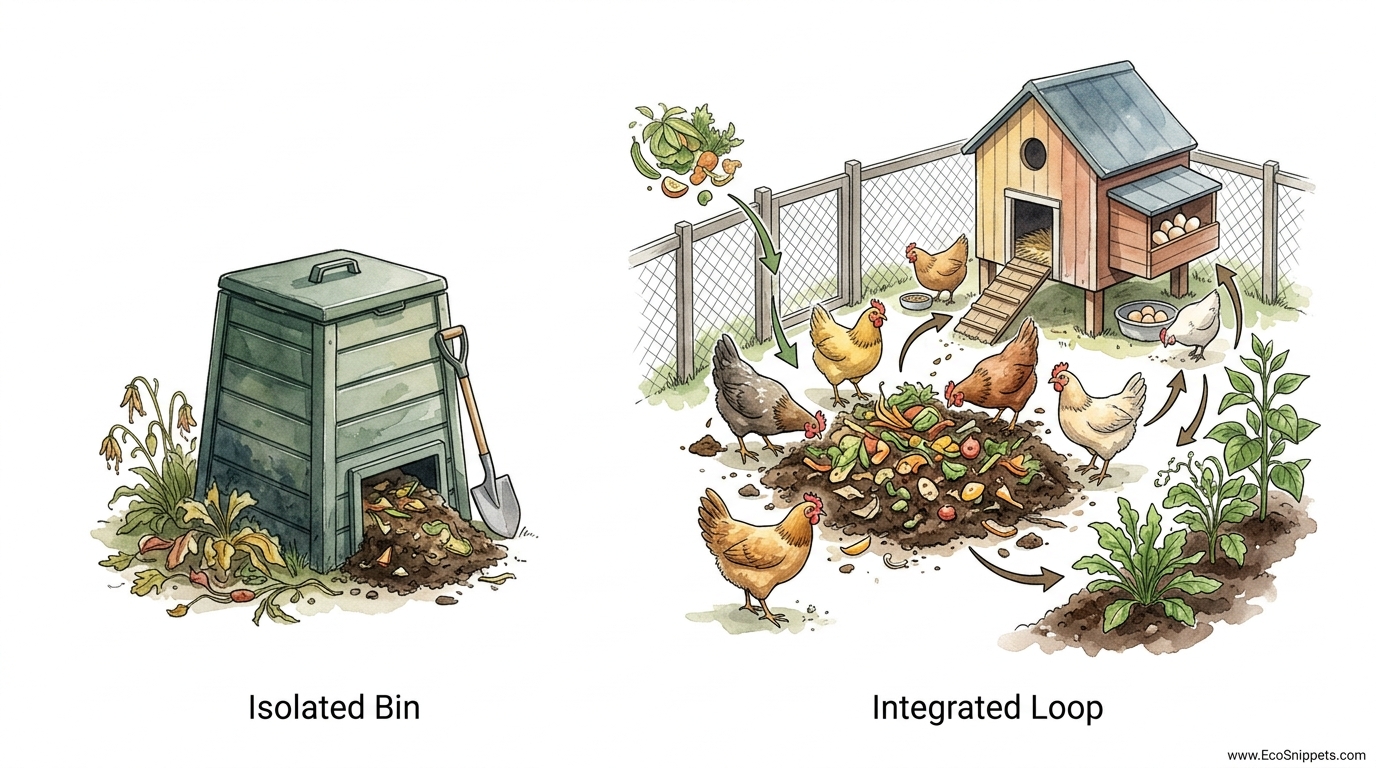
Comparing Systems: Isolated Bin vs. Integrated Loop
Traditional composting usually happens in a plastic bin or a wooden pallet structure tucked in a corner of the yard. This “isolated bin” method is clean and contained, but it requires you to do all the heavy lifting. You must haul the waste to the bin, turn it manually with a fork, and eventually haul the finished product to the garden.
The “integrated loop” of a chicken run system removes those middle steps. The waste goes directly to the processing center (the run), the “machinery” (the chickens) turns it daily, and the fertility stays concentrated in one place. This creates a much higher efficiency of both time and nutrient retention.
| Feature | Isolated Bin | Integrated Chicken Run |
|---|---|---|
| Labor Level | High (Manual turning) | Low (Birds do the work) |
| Processing Speed | Slow to Moderate | Fast (Constant aeration) |
| Pest Control | Attracts flies/rodents | Birds eat fly larvae |
| Winter Function | Usually freezes solid | Internal heat prevents freezing |
Practical Tips for Success
To get the most out of your system, think like a farmer, not a scientist. You don’t need a thermometer to know if things are working; you just need to observe. If the chickens are happy and digging, and the ground feels “springy” under your boots, you are on the right track.
- Use wood ash: Sprinkle a bit of wood ash from your fireplace into the run. It provides minerals and helps neutralize acidity, but don’t overdo it or you’ll make the pile too alkaline.
- Keep a carbon pile nearby: Always have a bale of straw or a bag of shavings ready. The “whiff test” is your signal to act immediately—if you smell ammonia, toss a few flakes of straw down.
- Water in dry spells: If you live in a dry area, give the run a light misting with the garden hose once a week to keep the microbes alive.
- Harvest in sections: You don’t have to clean the whole run at once. Dig out a few wheelbarrows from one corner for your spring planting and replace it with fresh carbon.
The “inoculation” of your system is also important. When you do a major harvest of the finished compost, never strip the run down to the bare dirt. Leave an inch or two of the old, dark material behind. This acts as a starter culture, full of the microbes needed to begin breaking down the next batch of fresh bedding.
Advanced Considerations: The Dueling Gardens
For those with a bit more space, you can take integration to the next level with a rotational system often called “dueling gardens.” This involves having two fenced areas of equal size with the chicken coop sitting between them. One year, area A is your vegetable garden and area B is the chicken run.
In the chicken run, you pile up all your weeds, leaves, and scraps. The birds spend the entire year tilling that organic matter into the soil and fertilizing it with their manure. Meanwhile, you harvest your vegetables from area A. Because the chickens are confined to area B, you don’t have to worry about them eating your tomatoes or scratching up your seedlings.
At the end of the season, you simply flip the gates. You plant your next garden in the hyper-fertile ground of area B, and the chickens move into area A to clean up the garden remains and begin the composting cycle for the following year. This method eliminates the need to haul compost entirely, as the fertility is created exactly where it will be used.
Example Scenario: The One-Year Cycle
Imagine a small homestead with six hens and a 100-square-foot run. In October, the owner clears the run and lays down 10 inches of shredded oak leaves. Throughout the winter, all kitchen scraps and the daily manure from the coop are added. The owner tosses a handful of corn into the leaves every morning, keeping the hens busy and the pile turned.
By March, the 10 inches of leaves have been compressed and decomposed into 4 inches of dark, crumbly matter. It looks like potting soil and smells like the forest. The internal temperature of the pile stayed at 50 degrees all winter, keeping the hens’ feet warm and their spirits high.
In April, the homesteader shovels out half of the material and moves it to a curing pile near the garden. It sits for 60 days to ensure any remaining pathogens are neutralized by the summer sun. By June, this “black gold” is spread around the base of heavy feeders like pumpkins and corn, resulting in a harvest that is twice as large as the year before. The loop is closed, and the only input was some fallen leaves and a little bit of chicken feed.
Final Thoughts
Chicken run composting is more than just a waste management strategy; it is a return to a way of life that values the inherent wisdom of nature. By allowing your animals to do what they were born to do—scratch, peck, and forage—you turn a chore into a self-sustaining cycle of abundance. The soil becomes richer, the birds become healthier, and the homesteader becomes a partner in the landscape rather than a master over it.
Don’t be afraid to experiment with different materials and ratios. Every climate and every flock is unique, and you will soon develop an intuition for what your system needs. Start small with a thick layer of carbon today, and by next spring, your garden will thank you for the transformation.
True self-reliance isn’t about working harder; it’s about working smarter by letting the biological world carry the load. Once you see the power of an integrated waste stream, you’ll never go back to hauling heavy bags to a plastic bin again. The fertility of your land is right under your feet—or rather, under your chickens’ feet.
