How To Become More Self-Sufficient Without Starting a Full-Blown Farm…
Want to start preserving your harvest, making your own soap, or building a backyard root cellar — but not sure where to begin? “Homesteading Advice” gives you instant lifetime access to 35+ practical homesteading books on food preservation, veggie gardening, DIY natural cleaning products (save over $250 per year with this skill alone), brewing, off-grid energy, and a whole lot more…
Click Here To Check It Out Now!
If you have to put on boots to grab a sprig of rosemary, your garden is designed to fail. The biggest reason people quit backyard farming isn’t the soil—it’s the friction. If your daily salad is 100 yards away, you’ll reach for the fridge instead. Permaculture ‘Zone 1’ is about placing your most-needed resources within a few steps of your kitchen door. Turn your chores into a 30-second stroll and watch your self-sufficiency skyrocket.
Modern life has taught us to separate where we live from where we produce. We drive miles to a grocery store and walk across manicured, useless lawns to reach a hidden garden patch in the far corner of the lot. This separation creates a barrier that ancestral wisdom never tolerated. Our predecessors kept the herbs by the door and the chickens within earshot because survival depended on efficiency.
Adopting a Zone 1 mindset means auditing your movements. It requires looking at your land not as a collection of ornaments, but as a living system that should serve your daily needs with minimal effort. When you align your backyard layout with your natural habits, you stop “working” the garden and start living with it.
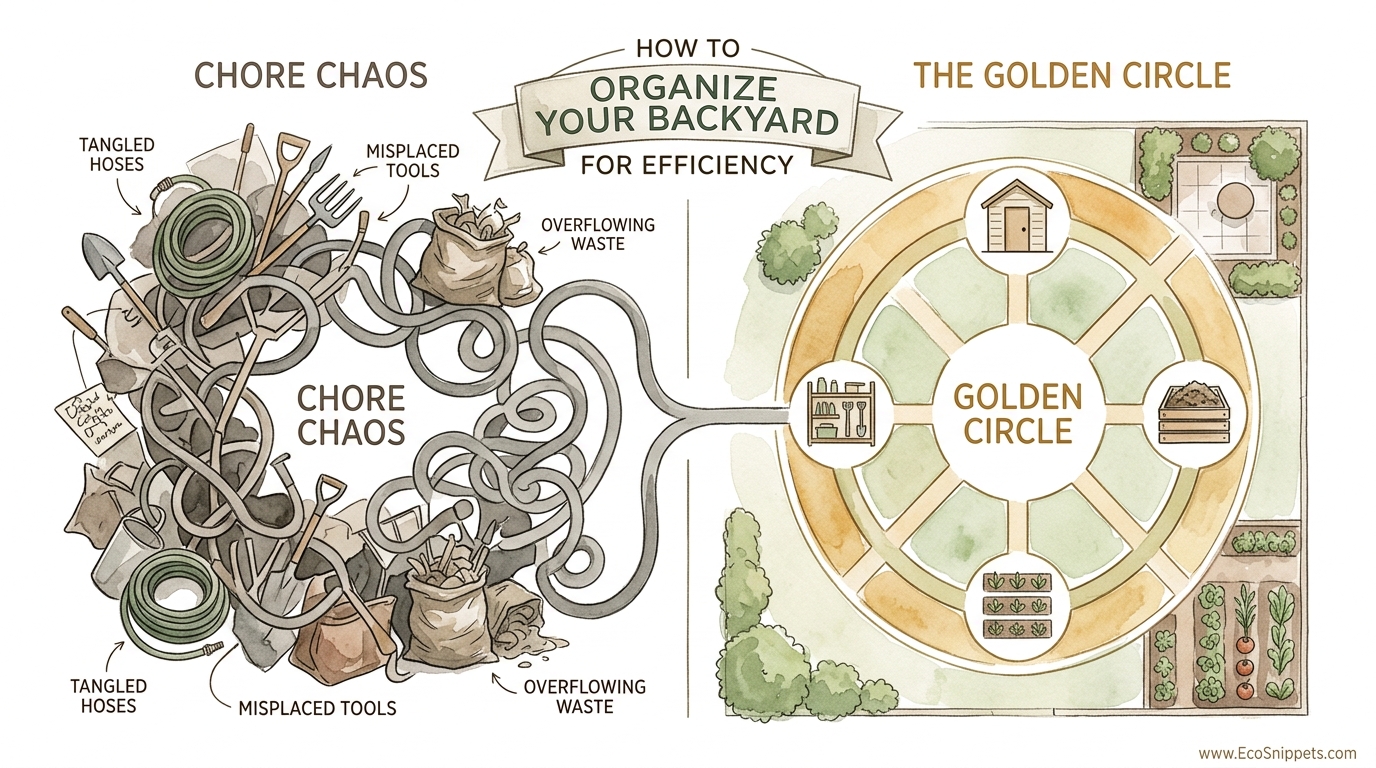
How To Organize Your Backyard For Efficiency
Efficiency in a backyard setting is the art of minimizing human energy expenditure while maximizing biological yield. In permaculture design, this concept is formalized through “Zoning.” Zone 1 is the immediate area surrounding your home—the “Golden Circle” of your homestead. It encompasses the land you walk past or through multiple times every single day.
This zone is reserved for elements that require frequent observation and intensive care. Seedling nurseries, culinary herbs, salad greens, and even small livestock like quail or rabbits belong here. These are the components of your system that might die if you ignore them for 48 hours. By placing them in your direct line of sight, you naturally notice when a plant is wilting or when a pest has arrived, allowing you to intervene before a small problem becomes a harvest-ending disaster.
Think of Zone 1 as the high-intensity engine of your property. It requires the most inputs—such as regular watering, mulching, and compost—but it offers the highest return per square foot. While a distant orchard in Zone 3 might provide a massive harvest once a year, the kitchen garden in Zone 1 provides dinner every single night.
Mapping Your Footsteps: How the Zone System Works
Organizing your space begins with a cold, hard look at where you actually walk. Most people design their gardens based on where they think a garden “should” go, often tucked away to maintain a clean aesthetic for the neighbors. Effective design does the opposite; it follows the path of least resistance.
The Pathway Audit
Start by mapping your primary routes. These are the paths from your door to the car, the mailbox, or the trash bins. These “desire lines” represent the most efficient flow of energy on your property. Any garden bed placed along these paths will receive ten times more attention than a bed located at the back of the fence. This is how you avoid the “Chore Chaos” that leaves many beginners exhausted and overwhelmed.
Sector Analysis and Microclimates
Understanding where the sun hits and where the wind bites is crucial. In Zone 1, you want to harness every available resource. A south-facing wall can act as a “thermal mass,” absorbing heat during the day and radiating it at night to protect sensitive herbs. Conversely, a drafty corner might be the perfect spot for a small tool shed or a potting bench that doesn’t need much light.
The “Rain Test” for Layout
A classic design tool is the “Rain Test.” Imagine it is pouring rain and you are halfway through cooking a stew. If you are willing to step outside in your socks to grab a handful of thyme, that herb is in Zone 1. If you find yourself thinking, “I’ll just use the dried stuff from the pantry,” your design has failed. True self-reliance is built on the convenience of fresh abundance.
Essential Elements of a High-Yield Zone 1
Your kitchen garden should be a dense tapestry of production. Because space is often limited near the house, every square inch must pull its weight.
- Herb Spirals: This vertical design packs 20 to 30 feet of planting space into a 5-foot diameter. It creates various microclimates—dry and sunny at the top for rosemary and thyme, moist and shaded at the bottom for mint and parsley.
- Keyhole Beds: These circular beds with a central “notch” or path allow you to reach every plant without ever stepping on the soil. Compacting the soil by walking on it is a cardinal sin; it kills the aerobic life your plants need to thrive.
- Seedling Nurseries: Young plants are fragile. Keeping your propagation tables near the back door ensures they stay watered and protected from sudden temperature shifts.
- Small-Scale Composting: A small worm farm or a kitchen scrap bucket should be within a few steps of the door. This “closes the loop,” turning dinner prep waste back into soil fertility without a cross-property trek.
Benefits of Proximity and Intensive Management
The primary advantage of a well-organized Zone 1 is the reduction of “friction.” When the barrier to entry is low, the frequency of care increases. This proximity leads to several measurable benefits for the backyard farmer.
Reduced Waste: You are far less likely to let a head of lettuce go to seed or a cucumber grow into a bitter, oversized club when you see them every time you walk to the car. Frequent, small-scale harvesting keeps plants in their most productive vegetative state.
Real-Time Pest Control: In an intensive kitchen garden, you aren’t spraying chemicals. You are simply noticing a cabbage moth or a cluster of aphids while you pick herbs for breakfast. Hand-picking a few bugs takes seconds; treating a full-blown infestation in a distant field takes hours of grueling labor.
Nutritional Superiority: The vitamin content of leafy greens begins to degrade the moment they are harvested. By shortening the “farm-to-table” distance to thirty feet, you ensure your family is eating the most nutrient-dense food possible.
Challenges and Common Design Mistakes
Even with the best intentions, it is easy to clutter Zone 1 until it becomes a tangled mess that is difficult to navigate. Avoid these common pitfalls to keep your system running smoothly.
Overplanting and Crowding
Beginners often ignore the mature size of plants. A tiny rosemary bush in a four-inch pot will eventually become a four-foot-wide woody shrub. If you plant it too close to a walkway, you’ll find yourself constantly hacking it back or, worse, tripping over it. Proper spacing is essential for airflow and ease of movement.
Neglecting the “Edge”
The “edge” is where two environments meet—like the space between a garden bed and a pathway. This is often the most productive area of a garden. Many people leave these edges as bare dirt or grass. Instead, use them for “step-over” herbs like creeping thyme or low-growing flowers that attract pollinators.
Poor Water Placement
Running a 100-foot hose every morning is a chore that will eventually lead to neglected plants. Zone 1 should ideally be served by rainwater catchment barrels located right at the corner of the house. Gravity-fed irrigation or a simple watering can should be all you need for your daily rounds.
Limitations of the Intensive Kitchen Garden
While Zone 1 is the heart of production, it cannot do everything. Understanding its boundaries is just as important as knowing its strengths.
Large-scale crops like corn, wheat, or potatoes require too much space and have too long a growing season for the prime real estate near the house. These “staple crops” belong in Zone 2 or 3, where they can grow undisturbed for months. If you try to cram a pumpkin patch into your kitchen garden, it will quickly swallow your pathways and shade out your delicate salad greens.
Sunlight is another major constraint. Homes often cast deep shadows on the northern and eastern sides. If your kitchen door opens into a permanent shadow, you cannot force a sun-loving tomato to grow there. In these cases, Zone 1 might need to “stretch” along a sunny path rather than hugging the walls of the house.
Comparing High-Touch vs. Low-Touch Management
To truly appreciate the efficiency of Zone 1, you must see how it differs from the rest of the homestead. The following table illustrates the shift in management style as you move away from the “Golden Circle.”
| Feature | Zone 1 (Kitchen Garden) | Zone 2 (Orchards/Staples) |
|---|---|---|
| Visit Frequency | Multiple times daily | Once a day or every few days |
| Typical Plants | Herbs, salads, tomatoes, berries | Squash, fruit trees, beans, potatoes |
| Management Style | Intensive (hand weeding/picking) | Semi-intensive (mulch/drip lines) |
| Watering | Hand-watering or daily timers | Deep, infrequent irrigation |
Practical Tips for a Resilience-First Layout
Moving from theory to practice requires a few tactical adjustments to your daily environment. Use these strategies to harden your backyard against laziness and logistical failures.
- The “One-Trip” Rule: Place your compost bin along the path to your chicken coop or your tool shed. This allows you to empty the kitchen scraps, check for eggs, and grab a trowel in a single loop, eliminating redundant walking.
- Vertical Integration: Use your fences and walls. A trellis on a south-facing wall can support pole beans or grapes, providing food while also cooling the house in the summer.
- Tool Caches: Don’t keep every tool in a distant garage. Stash a pair of pruners and a hand-weeder in a weatherproof box right next to your kitchen garden. If the tool is at your fingertips, you will use it.
- Sheet Mulching: Start your Zone 1 beds by layering cardboard and thick organic matter (the “lasagna” method). This suppresses weeds without tilling and builds the rich, friable soil necessary for high-intensity planting.
Advanced Considerations for Serious Practitioners
Once you have mastered the basic layout, you can begin to integrate more complex biological systems into your immediate surroundings.
Micro-Livestock Integration: Placing a rabbit hutch or a quail coop above a worm farm creates a high-speed nutrient factory. The animal droppings feed the worms, which in turn create vermicompost that is piped directly into your kitchen garden beds. Because these animals are in Zone 1, they receive the daily interaction they need for health and safety.
Season Extension: Because Zone 1 is near the house, it is the easiest place to monitor cold frames or “caterpillar tunnels.” The residual heat from the building’s foundation can keep soil temperatures several degrees higher than the rest of the property, allowing you to harvest fresh greens well into the winter.
Greywater Harvesting: Serious designers look for ways to use household water twice. With proper plumbing and non-toxic soaps, water from your kitchen sink or laundry can be diverted to irrigate non-edible landscape plants or fruit trees on the edge of Zone 1, further reducing your reliance on municipal water or wells.
Example Scenarios: Design in Action
Consider two different properties and how they might apply these principles to achieve maximum efficiency.
The Urban Lot
On a standard quarter-acre suburban lot, Zone 1 might encompass almost the entire backyard. The design focuses on “stacking functions.” A small patio serves as a social space but is surrounded by raised beds full of kale and chard. A dwarf lemon tree sits in a large pot near the grill. Every time the homeowner lets the dog out, they pass their herb spiral, picking a few leaves of mint for tea. There is no “garden chore” time—there is only the flow of daily life.
The Rural Acreage
On a five-acre homestead, the temptation is to spread out. However, a wise designer still clusters the intensity. The area within 30 feet of the farmhouse is packed with productivity. A “nursery” greenhouse sits on the sunny side of the house. Behind it, a small fenced “kitchen garden” protects high-value greens from deer. Beyond this fence, the landscape shifts to larger orchards (Zone 2) and pastures (Zone 3). The farmer spends 80% of their maintenance time in that first 30-foot circle, ensuring that the most vital foods are never neglected.
Final Thoughts
Designing for efficiency is not about being lazy; it is about being strategic with your most limited resource—time. By embracing the principles of Zone 1, you remove the mental and physical barriers that lead to burnout. You transform the “work” of gardening into a series of small, rewarding interactions that happen naturally throughout your day.
The land responds to the presence of the gardener. When you are constantly “in” your garden because it is your front porch or your back path, the plants flourish under your observation. You catch the first sign of drought, the first appearance of a beetle, and the first moment of perfect ripeness.
Start small. Focus on the five feet outside your door. Clear the useless lawn, lay down some mulch, and plant the herbs you use every day. Once you experience the ease of a 30-second harvest, you will never want to put on boots to grab a sprig of rosemary again. Turn your backyard into a tool for self-reliance and let your footsteps be the most important fertilizer you own.
