How To Become More Self-Sufficient Without Starting a Full-Blown Farm…
Want to start preserving your harvest, making your own soap, or building a backyard root cellar — but not sure where to begin? “Homesteading Advice” gives you instant lifetime access to 35+ practical homesteading books on food preservation, veggie gardening, DIY natural cleaning products (save over $250 per year with this skill alone), brewing, off-grid energy, and a whole lot more…
Click Here To Check It Out Now!
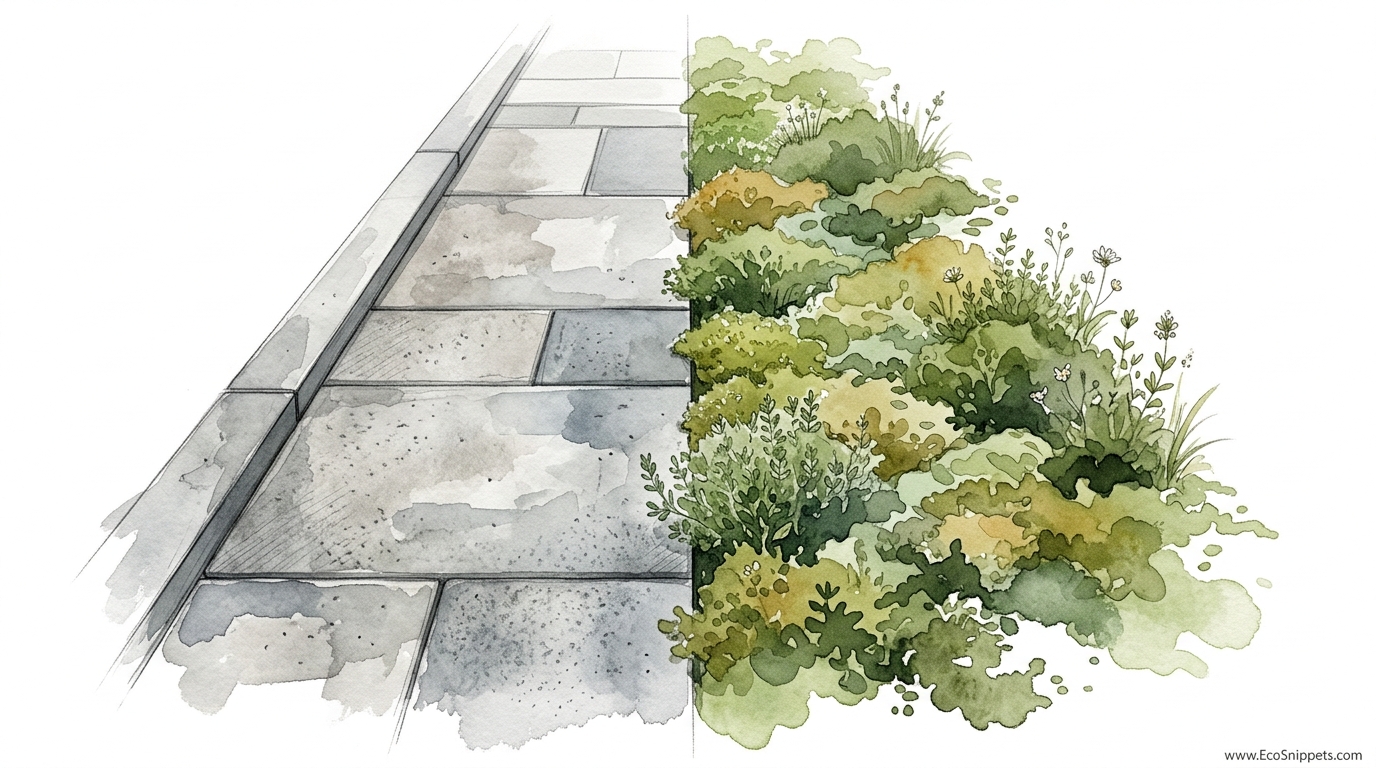
Your garden paths are either a heat-island or a biological battery – choose wisely. We were taught that paths should be sterile and ‘clean,’ but that creates a heat desert in your backyard. Using native groundcovers and nitrogen-fixing clover, your walkways actually feed your garden while keeping the soil cool and the bees happy.
Modern landscaping has a fixation on the sterile. We pour concrete, lay down thick plastic, and dump bags of dyed wood chips to keep the earth at bay. This approach treats the soil like a nuisance rather than a partner. Every square inch of sealed surface in your yard contributes to a micro-climate of rising temperatures and dying soil biology. Natural wisdom suggests a different path—one that breathes, heals, and grows.
Living Garden Path Ideas
A living garden path is a transition from the rigid, dead structures of modern paving to a “Living Carpet.” This concept utilizes low-growing, durable plants that can withstand foot traffic while simultaneously performing ecological work. Unlike gravel or concrete, these paths are active participants in your garden’s ecosystem. They act as “biological batteries,” storing solar energy through photosynthesis and converting it into soil nutrients.
Living paths are not a new invention. Ancestral gardeners often allowed clover and creeping herbs to fill the spaces between stones, knowing that these plants kept the soil moist and the “good bugs” nearby. In a modern setting, these ideas take the form of tapestry lawns, “steppable” herb paths, and nitrogen-fixing clover tracks. They serve as the circulatory system of the homestead, moving you through your rows without the heat-radiating side effects of stone.
Real-world applications range from simple white clover paths between vegetable beds to intricate “scented walkways” made of creeping thyme and Roman chamomile. These paths function as permeable surfaces, allowing every drop of rain to soak into the aquifer rather than running off into the street. They are the ultimate expression of self-reliance, turning a maintenance headache into a self-fertilizing asset.
How Living Paths Work: The Biology of the Battery
Success with a living path requires an understanding of how plants interact with the soil under pressure. Traditional turf grass often fails in paths because it grows from the crown; if the crown is crushed by a boot, the plant dies. Living path candidates, however, often utilize “stoloniferous” or “rhizomatous” growth. These plants send out runners that creep along or just under the surface, allowing them to repair patches of wear automatically.
The “battery” effect comes from the relationship between these plants and the subterranean world. Legumes like clover house specialized bacteria in their root nodules that pull nitrogen from the air and “fix” it into the soil. As you walk on these plants and occasionally trim them, the roots and leaves break down, releasing that nitrogen to the neighboring vegetable beds. This creates a closed-loop fertility system that costs nothing but a bit of sunlight.
The cooling effect is equally mechanical. Transpiration—the process where plants release water vapor through their leaves—acts like a natural air conditioner. Research indicates that a living green surface can be as much as 32°C (90°F) cooler than a concrete surface in direct summer sun. Concrete and asphalt act as thermal masses, absorbing heat all day and radiating it back out at night. A living path does the opposite, shielding the soil from the sun’s intensity and keeping the surrounding garden beds hydrated.
Installing Your Living Carpet: Step by Step
The transition from a sterile path to a living one starts with soil preparation. You cannot simply throw seed onto hard-packed clay and expect a lush result.
1. **Clearing the Deck:** Remove any existing plastic liners or thick layers of old mulch. If you have a gravel path, you don’t necessarily need to remove the gravel, but you will need to add a thin layer of compost (about 1-2 inches) to provide a seedbed.
2. **Selecting the Species:** Choose your “workhorse” plant based on sun exposure. White Dutch Clover (Trifolium repens) is the pioneer’s choice for sun, while varieties of sedge or Corsican mint handle the shadows.
3. **Seeding and Timing:** The best time to sow is early spring or early fall. Broadcast the seed at a rate of roughly 1-2 pounds per 1,000 square feet. Lightly rake the seed into the top 1/8 inch of soil to ensure good contact.
4. **The Critical Watering Phase:** For the first three to six months, the soil must remain consistently moist. Use a gentle spray to avoid washing away the tiny seeds. Once established, these plants will develop deep roots and require significantly less water than a traditional lawn.
5. **Integrating Hardscapes:** For high-traffic areas, place flat stepping stones within the greenery. This protects the plant “crowns” from the heaviest weight while still allowing the biological battery to function in the gaps.
Benefits of the Living Path Approach
Switching to a living walkway offers measurable advantages for both the gardener and the environment. These benefits go beyond simple aesthetics.
– **Microclimate Cooling:** By eliminating “heat islands,” you lower the ambient temperature around your sensitive crops. This reduces heat stress on tomatoes, peppers, and greens, potentially extending your harvest season.
– **Nitrogen Fixation:** Clover paths act as a slow-release fertilizer factory. The nitrogen fixed by the roots travels through the soil to reach your garden beds, reducing the need for bagged amendments.
– **Erosion Control:** The dense mat of roots holds the soil in place during heavy rains. This prevents the “washout” common with mulch or gravel paths.
– **Pollinator Support:** Flowering groundcovers like thyme and clover provide a steady food source for honeybees and native pollinators, ensuring your fruit trees and vegetables get the visitation they need.
– **Self-Healing Properties:** Unlike concrete that cracks or gravel that migrates, a living path grows back. Foot traffic actually stimulates some species to grow thicker and more resilient.
Challenges and Common Mistakes
The transition is not without its hurdles. The most frequent error is selecting a plant that is too aggressive for the space.
– **The “Creep” Factor:** Some groundcovers do not know where the path ends and the garden bed begins. White clover and mint are notorious for “leaking” into your rows. You must be prepared to edge your paths twice a season or use physical borders like wood or stone to contain the runners.
– **Traffic Overload:** No plant can survive a tractor or a daily parade of heavy machinery. If you must drive vehicles over the area, a living path is not the right choice. These are intended for human and pet foot traffic.
– **Seeding Failures:** Planting too deep is a common mistake. Most groundcover seeds are microscopic; burying them under an inch of soil is a death sentence. They need light and surface-level warmth to trigger germination.
– **Neglect During Establishment:** People often assume “low maintenance” means “no maintenance.” While the path will eventually take care of itself, it needs your protection during the first season of growth.
Limitations: When This May Not Be Ideal
Living paths are not a universal solution for every corner of the property. Certain environmental constraints and practical needs may dictate a different approach.
High-traffic commercial zones or wheelchair access points often require the absolute stability of a solid, engineered surface. While some “steppable” plants handle light wheelchair use, they do not provide the same level of consistent, flat friction that a ADA-compliant concrete path offers.
Deep, permanent shade under dense evergreen canopies also presents a challenge. Most nitrogen-fixing groundcovers require at least partial sun to perform their biological work. In these “dead zones,” a breathable mulch or a native sedge is a better choice than a flowering clover mix. Furthermore, if you live in a region with extreme, multi-year drought and strict water rationing, even the most resilient groundcover may struggle to establish without a baseline of moisture.
STERILE CONCRETE vs. LIVING CARPET
To understand the long-term impact, look at how these materials perform over a ten-year cycle.
| Feature | Sterile Concrete | Living Carpet |
|---|---|---|
| Initial Cost | High (Material + Labor) | Low (Seeds + Compost) |
| Surface Temp | Can exceed 140°F (60°C) | Stays near ambient air temp |
| Maintenance | Power washing, sealing, cracking | Mowing 2-4 times a year, edging |
| Soil Impact | Smothers biology, creates runoff | Feeds biology, recharges groundwater |
| Longevity | 20-30 years (then requires demo) | Indefinite (self-renewing) |
Practical Tips and Best Practices
– **The “Mow-High” Rule:** If you use a mower on your clover paths, set the blades to at least 3 or 4 inches. Cutting too low can scalp the plants and open the door for opportunistic weeds.
– **Scented Footsteps:** Mix in aromatic herbs like Roman Chamomile or Creeping Thyme. Every time you walk to the compost pile, you’ll release a cloud of calming, herbal fragrance.
– **Use “Plugs” for Speed:** If you don’t want to wait for seeds, buy “plugs”—small, established starts—and plant them in a grid. They will fill in the gaps much faster than a broadcast seeding.
– **The Mulch Buffer:** Use a 6-inch buffer of wood chips between your living path and your vegetable rows. This acts as a “DMZ” where you can easily spot and pull any runners trying to invade the crops.
– **Observe the Native “Weeds”:** Sometimes the best groundcover is already growing in your yard. Native violets or wild strawberries are often more resilient than anything you can buy in a packet.
Advanced Considerations: The Mycelial Bridge
Serious practitioners of regenerative gardening look beyond the surface. A living path does more than fix nitrogen; it creates a fungal network. The roots of your groundcovers connect with mycorrhizal fungi that stretch into your vegetable beds. This network acts like a subterranean internet, transporting phosphorus and water between different plant species.
A concrete path acts as a firewall, severing these connections and isolating your garden beds. By keeping the path “alive,” you allow the mycelium to weave the entire garden into a single, cohesive organism. This shared network increases the overall resilience of your backyard, allowing plants to “warn” each other of pest attacks through chemical signals sent through the fungal bridge.
Scenario: The Homestead Kitchen Garden
Imagine a standard 20×40 foot garden with three long beds. Traditionally, the paths between these beds are bare dirt or gravel. In July, the bare dirt reaches 120°F, baking the roots of the nearby lettuce and causing it to bolt. The gardener spends two hours a week pulling weeds that thrive in the disturbed soil.
Now, imagine that same garden with White Dutch Clover paths. The soil temperature stays at a cool 75°F. The clover suppresses the weeds, and the gardener mows the path only once a month with a manual reel mower, tossing the nitrogen-rich clippings directly onto the beds as a free “green manure.” The honeybees are constant visitors, ensuring every blossom on the squash plants turns into fruit. This is the difference between fighting nature and riding its momentum.
Final Thoughts
The choice to move away from sterile, hardscaped paths is a return to a more resilient way of living. It requires a shift in perspective—viewing a “weed” like clover as a valued employee rather than an intruder. These living carpets represent a commitment to the long-term health of your land, providing a cooling sanctuary for both the soil and the soul.
Building a living path is an act of stewardship. It acknowledges that every part of the garden, even the spaces we walk on, has the potential to produce life and fertility. Start small, perhaps with a single walkway, and watch how the birds, bees, and soil microbes respond to the change.
As you move through your garden on a soft, fragrant carpet of thyme or a lush bed of clover, you will feel the physical difference in the air and under your feet. The heat desert is gone, replaced by a biological battery that will power your harvests for years to come. Experiment with native species, trust the ancestral wisdom of the “living floor,” and let your garden breathe again.
