How To Become More Self-Sufficient Without Starting a Full-Blown Farm…
Want to start preserving your harvest, making your own soap, or building a backyard root cellar — but not sure where to begin? “Homesteading Advice” gives you instant lifetime access to 35+ practical homesteading books on food preservation, veggie gardening, DIY natural cleaning products (save over $250 per year with this skill alone), brewing, off-grid energy, and a whole lot more…
Click Here To Check It Out Now!
The winter sun is secretly the biggest threat to your young trees, but the fix costs less than a gallon of milk. Most homesteaders think the cold kills their orchard. They’re half right. It’s actually the rapid swing from the warm afternoon sun to the freezing night air that causes ‘sunscald’—literally exploding the bark. Here is how to shield your legacy before the first deep freeze.
When you plant a fruit tree, you aren’t just putting a stick in the ground; you are anchoring a promise for the next generation. That sapling represents years of future harvests, cider pressings, and the quiet satisfaction of self-reliance. However, that promise is fragile. While we worry about the biting northern winds and the weight of heavy snow, the most insidious predator in the winter orchard is the sun itself.
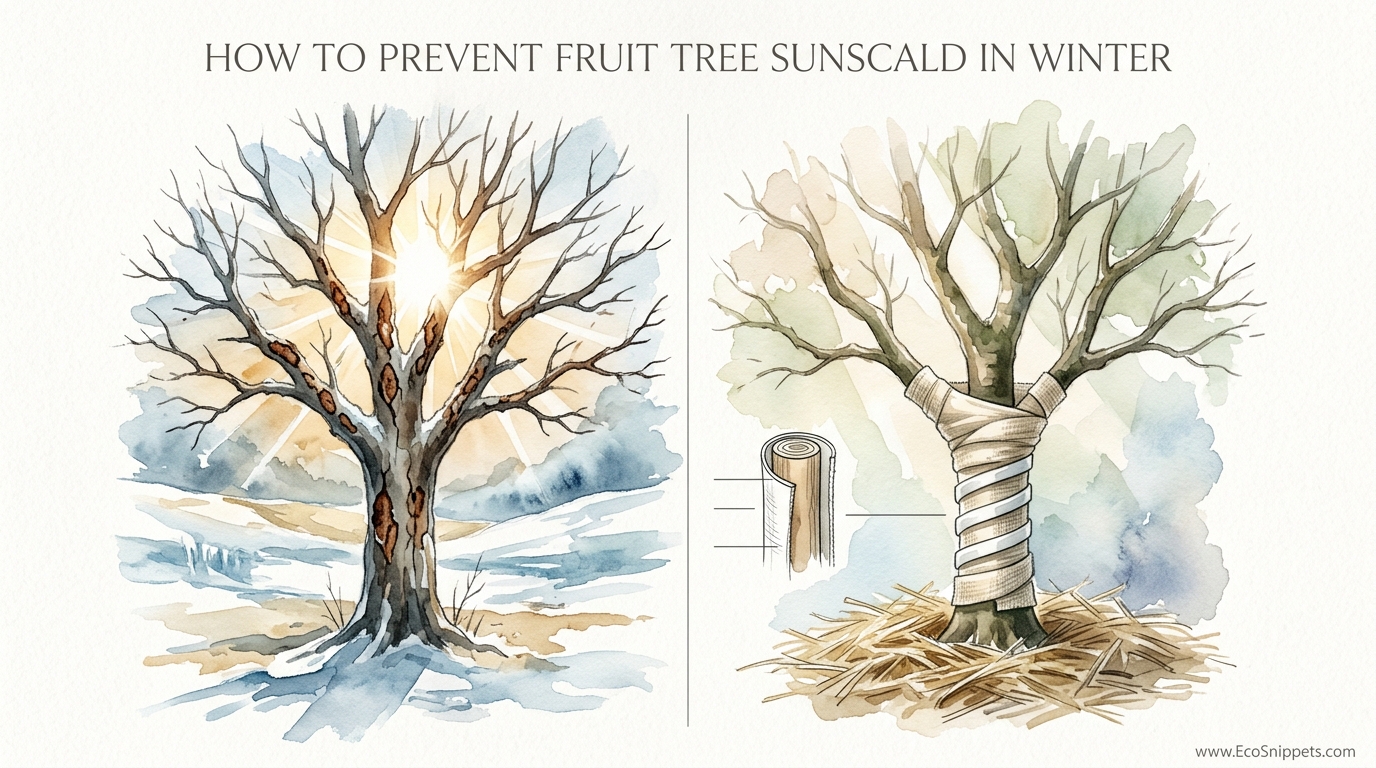
The phenomenon is known as sunscald, or “southwest injury.” It happens when the low winter sun strikes the dark bark of a dormant tree, tricking the internal cells into thinking spring has arrived early. These cells wake up, lose their winter hardiness, and then die instantly when the sun slips behind the horizon and the temperature plunges back below freezing. This guide will teach you the ancestral wisdom and modern grit needed to keep your orchard standing through the harshest months.
How To Prevent Fruit Tree Sunscald In Winter
Preventing sunscald is primarily a battle of physics and biology. You must interrupt the sun’s ability to heat the trunk while ensuring the tree remains in a deep, undisturbed dormancy. In the world of the homestead, this is most effectively achieved through “whitewashing”—the practice of coating the tree’s trunk in a reflective, light-colored barrier.
Sunscald isn’t a disease; it is a physiological injury. Imagine the cambium layer—the thin, living tissue just beneath the bark—as the tree’s circulatory system. During a bright January afternoon, the sun can heat that dark bark to 70°F or higher, even if the air temperature is a measly 20°F. This localized heat tells the cambium to “wake up” and begin moving moisture. When the sun sets, that moisture freezes, expands, and shatters the cellular structure of the bark. This leaves behind sunken, blackened, or peeling patches that invite borers and rot in the spring.
You find this damage almost exclusively on the south and southwest sides of the tree, where the afternoon sun is most intense. By applying a reflective coating, you bounce those solar rays away from the trunk, keeping the bark temperature consistent with the ambient air. This simple act of reflection prevents the “thaw-freeze” cycle that ruins young orchards.
How It Works: The Whitewashing Process
The most time-tested method for protecting a legacy orchard is the application of white latex paint. This isn’t about aesthetics; it’s about survival. You want a coating that is breathable, reflective, and durable enough to last until the spring rains. Follow these steps to ensure your trees are properly shielded.
First, select the right material. You must use a white, water-based interior latex paint. Avoid exterior paints if possible, as many contain antimicrobial or antifungal additives that can be too harsh for young bark. Never use oil-based paints, as they will seal the bark completely, preventing the tree from “breathing” and potentially killing it through suffocation.
Mix your paint solution. A standard 50/50 ratio of white interior latex paint to water is the gold standard for most homesteaders. If you are dealing with a high-pressure pest environment, some old-timers recommend a “thick” mix: one-third paint, one-third water, and one-third drywall joint compound. This creates a gritty, thick barrier that discourages borers and rodents while providing maximum solar reflection.
Apply the paint with a brush or a sponge. Start at the soil line and work your way up to the first set of scaffold branches. Pay special attention to the base of the tree, often the most vulnerable spot. If you live in an area with heavy snow, paint even higher; sunlight reflecting off the white snow can double the heat intensity on the upper trunk. Ensure the paint gets into every nook and cranny of the bark to prevent “hot spots” where the sun could still penetrate.
Benefits of Proper Winter Protection
The advantages of shielding your trees go far beyond preventing bark cracks. A protected tree is a resilient tree, and in the homesteading life, resilience is the only currency that matters. When you prevent sunscald, you are also protecting the tree from a cascade of secondary issues.
One primary benefit is the deterrence of wood-boring insects. Borers are opportunistic; they look for stressed or damaged bark to lay their eggs. A sunscald wound is like an open door for these pests. By keeping the bark intact and healthy through the winter, you deny these insects a foothold in your orchard. The white paint also makes it much easier to spot any early-season pest activity once the weather warms.
Furthermore, white paint acts as a visual marker for other orchard tasks. If you are applying herbicides or using a string trimmer in the spring, the white trunks provide a clear “no-go” zone, preventing accidental mechanical damage to the sensitive base of the tree. It also serves as a mild deterrent for rabbits and voles, who often find the taste of the paint-laden bark less palatable than raw, tender sapwood.
Finally, a whitewashed orchard reflects a level of stewardship and pride. It shows that the land is being tended by someone who understands the cycles of nature and is willing to put in the work to protect their investment. This “pioneer grit” is what separates a hobbyist from a true producer.
Challenges and Common Mistakes
Even with the best intentions, things can go wrong if you ignore the nuances of tree biology. One of the most common mistakes is the use of dark-colored tree wraps. Many beginners buy black plastic or brown paper wraps thinking they are helping. In reality, these dark materials absorb more heat, actually worsening the sunscald effect rather than preventing it. Always stick to white or silver reflective materials.
Another pitfall is the “moisture trap.” If you use plastic spiral wraps or tight-fitting paper, moisture can become trapped against the bark. This creates a humid microclimate that is perfect for fungal cankers and bacterial rot. If you choose wraps over paint, you must be diligent about removing them in the early spring as soon as the threat of deep freezes has passed. Leaving them on year-round is a death sentence for many thin-barked trees.
Neglecting the “soil line” is also a frequent error. Sunscald often starts right at the base where the sun reflects off the ground or snow. If you don’t paint or wrap all the way down to the dirt, you leave the most critical part of the trunk—the area just above the graft union—completely exposed. A tree can survive a small scar higher up, but if the base is girdled by sunscald or voles, the whole tree is lost.
Limitations and Environmental Constraints
While whitewashing and wrapping are powerful tools, they are not a “set it and forget it” solution. You must understand the limitations of these methods to avoid a false sense of security. Protection against sunscald does not protect against “root freeze” or extreme cold stress.
If your soil is bone-dry going into winter, the tree’s bark becomes less elastic and more prone to cracking regardless of how much paint you apply. Winter desiccation—where the wind sucks the moisture out of the branches—cannot be stopped by trunk paint. You must still ensure your trees are deeply watered before the ground freezes solid. The paint helps the trunk, but the roots still need the insulation of wood chips and the hydration of autumn rains.
Additionally, some tree species are simply “marginal” for certain climates. No amount of white paint will save a peach tree in Zone 3 if the absolute minimum temperature drops to -40°F. Protection methods are designed to mitigate the *fluctuations* of temperature, not to change the fundamental hardiness of the plant. Always choose varieties suited for your specific hardiness zone first, then use these techniques to ensure they survive the “edge cases” of winter weather.
Comparing Protection Methods: Paint vs. Wraps
Homesteaders often debate whether to use white latex paint or commercial tree wraps. Both have their place, but they serve different needs depending on the age of your trees and your local environment.
| Feature | White Latex Paint | Plastic Spiral Wraps |
|---|---|---|
| Reflectivity | Excellent; stays cool. | Good (if white). |
| Breathability | High (water-based only). | Low; can trap moisture. |
| Pest Protection | Prevents borers. | Prevents rabbits/rodents. |
| Maintenance | Apply once per year. | Must be removed in spring. |
| Longevity | Wears off naturally. | Can girdle if forgotten. |
If you are dealing with EXPOSED young trees in a windy, open field, a combination is often best. Use the paint for solar protection and a wire mesh guard (not a tight plastic one) to keep the rabbits away. For SHELTERED backyard trees, paint alone is usually sufficient and presents fewer risks of moisture rot.
Practical Tips and Best Practices
Success in the orchard is found in the details. Here are a few actionable tips to ensure your winterization efforts are effective and efficient.
- Check the weather: Apply your whitewash on a dry, sunny day when the temperature is above 50°F. This ensures the paint dries and bonds to the bark before the cold sets in at night.
- Don’t forget the crotches: Sunscald can occur in the crotches of branches where sunlight pools. Paint a few inches into the main structural branches, especially those facing south.
- Scrape gently: If you are painting an older tree with slightly flaky bark, use a soft brush to remove loose pieces first. Do not use a metal scraper; you don’t want to wound the tree before you protect it.
- Add a sticker: If you live in an area with extremely wet winters, add a tablespoon of linseed oil to your paint mix. This acts as a “sticker,” helping the paint stay on through heavy rains without sealing the bark completely.
- Monitor after snow: After a heavy snowfall, check your trees. If the snow has piled up, it might be covering your protection, or the reflection off the new snow surface might be hitting a previously unpainted part of the trunk.
Consistency is key. Make “Orchard Painting Day” a late-autumn tradition, ideally right after the last leaves have fallen and the trees have entered full dormancy. This ensures you aren’t interfering with the tree’s natural hardening-off process.
Advanced Considerations: The Role of Microclimates
For the serious practitioner, understanding the microclimate of your land is the next level of mastery. Not every tree needs the same level of protection. Trees planted on a southern slope or near white-sided buildings are in a “high-glare” environment and are significantly more susceptible to sunscald than those on a northern slope.
Think about “reflected heat.” Concrete pads, gravel driveways, and even large bodies of water can reflect intense winter sunlight back onto your trees. If you have a young apple tree near a south-facing barn wall, that tree is experiencing a much harsher temperature swing than a tree in the middle of a woodlot. These “hot spots” require thicker paint applications and perhaps even temporary physical shade boards during the peak of January.
Furthermore, consider the soil health. Trees in well-mulched, biologically active soil tend to have more robust cellular structures. High levels of organic matter in the soil act as a battery, holding onto thermal energy and releasing it slowly, which can help moderate the soil temperature around the roots. This doesn’t replace the need for trunk paint, but it provides the tree with the internal strength to recover from minor stresses.
Example Scenario: Protecting a Young Honeycrisp
Let’s look at how this works in practice. Imagine you have a two-year-old Honeycrisp apple tree in a northern climate. It’s thin-barked and roughly four feet tall. In mid-November, you notice the ground is starting to crust with frost.
First, you give the tree five gallons of water to ensure its cells are hydrated. Next, you mix a quart of white interior latex paint with a quart of water. Using an old four-inch brush, you paint the trunk from the soil line up to the first set of branches, which are about 18 inches off the ground. You make sure the paint is thick on the southwest side.
To prevent rabbit damage, you then place a cylinder of hardware cloth (metal mesh) around the trunk, making sure it doesn’t touch the bark. You sink the bottom of the mesh two inches into the soil to stop voles. Because you used paint for the sun protection and mesh for the animals, the bark can still breathe, and no moisture will get trapped. Your Honeycrisp is now ready to sleep through the winter, safe from the exploding bark of sunscald and the hungry teeth of winter pests.
Final Thoughts
Protecting your orchard from sunscald is one of the highest-leverage tasks on the homestead. It requires very little in the way of expensive tools or complex chemistry, yet it saves years of growth and preserves the legacy of your land. The “pioneer grit” required to spend a chilly afternoon tending to your trees is a small price to pay for the bounty of the years to come.
By understanding the biological triggers of the cambium layer and the simple physics of solar reflection, you move from being a victim of the seasons to a steward of them. Your trees cannot move to find shade or warmth; they are at the mercy of the environment you have placed them in. Taking these steps ensures that when the spring thaw finally arrives, your trees will wake up naturally, whole and healthy, ready to burst into bloom.
Do not wait for the first deep freeze to realize your trees are vulnerable. Grab a bucket of paint, a brush, and a bit of determination. Shield your legacy today, and the orchard will reward your foresight for decades to come.
