How To Become More Self-Sufficient Without Starting a Full-Blown Farm…
Want to start preserving your harvest, making your own soap, or building a backyard root cellar — but not sure where to begin? “Homesteading Advice” gives you instant lifetime access to 35+ practical homesteading books on food preservation, veggie gardening, DIY natural cleaning products (save over $250 per year with this skill alone), brewing, off-grid energy, and a whole lot more…
Click Here To Check It Out Now!
When the power goes out, the incubator fails, but the broody hen never misses a beat. True autonomy means your livestock can reproduce without a power grid. A broody hen is more than a mother; she’s a predator-aware teacher that raises the most resilient birds you’ll ever own.
Modern agriculture has spent decades trying to breed the “broodiness” out of chickens. They wanted machines that never stopped laying eggs. But on a self-reliant homestead, that lost instinct is exactly what we want to reclaim. Relying on an plastic box and an electrical socket is a fragile way to build a flock. When you let a mother hen take the lead, you are tapping into an ancient, proven system that has worked for thousands of years.
Broody Hen Vs Incubator Pros And Cons
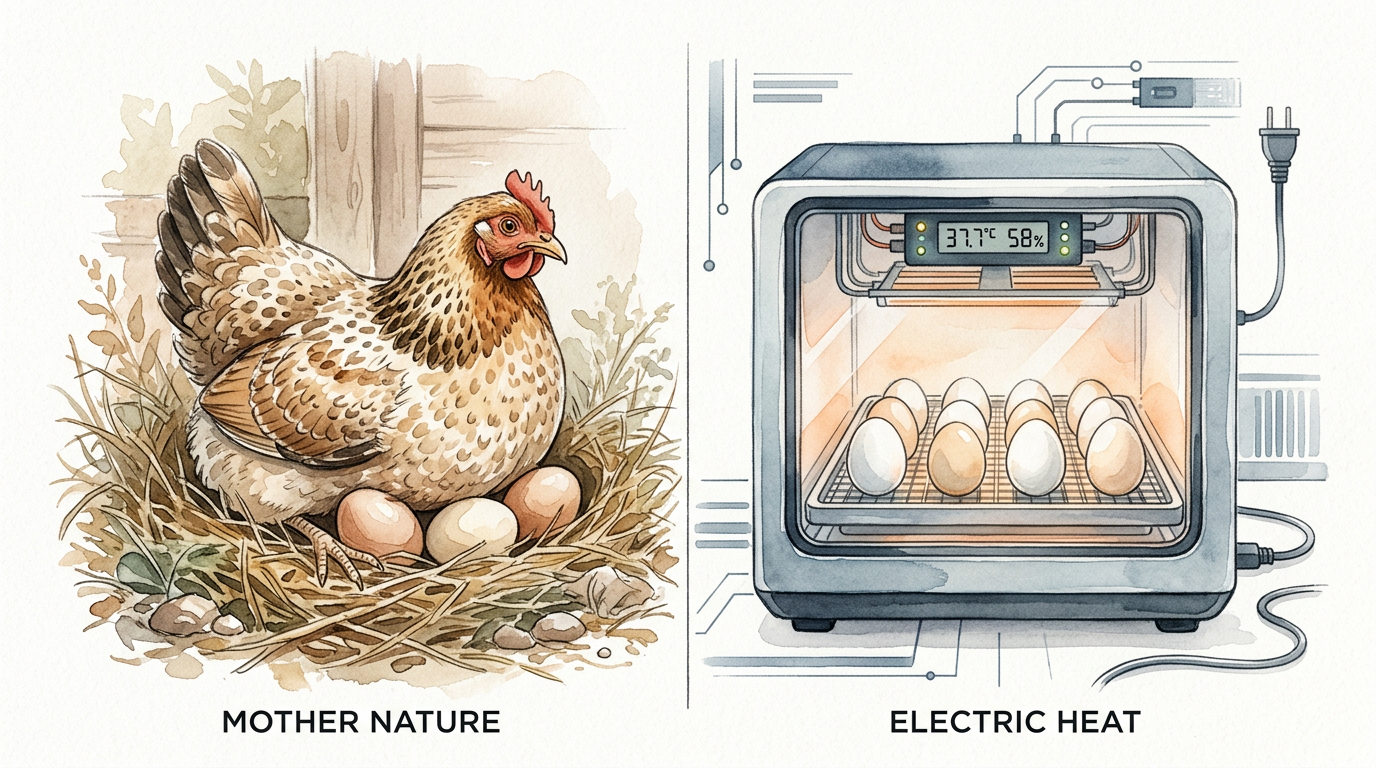
Hatching eggs is a fork in the road for every poultry keeper. On one path, you have the mechanical precision of an incubator. On the other, you have the hormonal drive of a broody hen. Both methods can put fluffy chicks in your hands, but the philosophies behind them are worlds apart.
A broody hen is a female chicken whose hormones have shifted, triggering a deep-seated desire to sit on a clutch of eggs until they hatch. She stops laying eggs and dedicates her entire existence to the nest. In real-world homesteading, she is your free labor. She provides the heat, she regulates the humidity with her own body moisture, and she turns the eggs dozens of times a day with her beak and feet.
The incubator, conversely, is a controlled environment. It is a tool for the manager who wants 50 chicks on a specific Tuesday in March. It offers a higher volume of offspring but requires constant monitoring. If the heating element burns out or the local transformer blows during a storm, your entire investment can go cold in hours. The hen is a self-regulating, feathered life-support system that operates on calories, not kilowatts.
Choosing between them often comes down to your goals for the season. If you are looking to sell hundreds of day-old chicks, the incubator is your primary tool. If you are looking to build a sustainable, “closed” flock that requires almost zero human intervention, the broody hen is the gold standard.
How to Manage a Natural Hatch: A Step-by-Step Guide
Working with a broody hen requires a mix of patience and observation. You cannot force a hen to go broody; you can only provide the environment that encourages her instincts to take over.
Identifying the Broody State
Recognizing the signs early prevents wasted eggs. A broody hen will stay on the nest long after the other hens have finished laying. She fluffs her feathers to look twice her size and emits a low, rhythmic growl if you approach. If you try to move her, she might peck with surprising intensity. This is the hormone prolactin at work, overriding her usual social behaviors.
The Test Phase with Dummy Eggs
Do not give a hen expensive fertile eggs the moment she looks sleepy in a nesting box. Many hens “play at” being broody for a day or two and then give up. Place three or four golf balls or ceramic nest eggs under her. If she stays committed for three consecutive nights—even sleeping there through the dark—she is likely ready for the real thing.
Setting the Clutch
Once she is committed, wait until nightfall to swap the dummy eggs for fertile ones. Darkness keeps her calm and reduces the risk of her abandoning the nest during the transition. Most standard-sized hens can comfortably cover 10 to 12 eggs. Bantam breeds might only handle 5 or 6. Ensure the eggs are all set on the same day so they hatch within the same 24-hour window.
The Maternity Ward Setup
While some hens hatch successfully in the main coop, it is rarely ideal. Other hens may try to lay their eggs in her nest, leading to a “staggered hatch” where the mother abandons the developing embryos to care for the first chick that pips. Move your broody hen to a dedicated “broody box” or a small, predator-proof partition. This space should have its own food and water within inches of the nest so she doesn’t have to leave her eggs for long.
The Practical Benefits of Natural Incubation
The primary advantage of the broody hen is the “set it and forget it” nature of the process. While you must still check on her, the level of technical skill required is significantly lower than operating a high-end incubator.
Superior Social Integration
Chicks raised by a hen are “flock savvy” from day one. They learn how to forage, which bugs are tasty, and where to hide when a hawk silhouette passes overhead. Incubator chicks are often socially awkward when introduced to the main flock at six weeks old. Hen-raised chicks are protected by their mother’s status, making the integration process almost seamless.
Health and Resilience
A mother hen provides a variable environment that strengthens a chick’s immune system. Unlike the sterile environment of an artificial brooder, chicks under a hen are exposed to the natural microflora of the coop in small, manageable doses. They also benefit from the hen’s “broody patch”—a bare area of skin on her breast that provides direct, humid heat that no heat lamp can perfectly replicate.
Zero Energy Costs
In an era of rising utility prices, the cost to run an incubator and a 250-watt heat lamp for six weeks adds up. A broody hen requires only a bit of extra high-protein feed. She is the most energy-efficient tool on the farm, turning grain and forage into the next generation of livestock.
Challenges and Common Pitfalls to Avoid
Even though nature is efficient, things can go wrong. Understanding these risks is part of becoming a seasoned practitioner.
The Danger of Nest Abandonment
A young or “flighty” hen might decide on day 15 that she is bored. If she leaves the nest, the embryos will cool and die. This often happens if the nesting area is too noisy, too hot, or if she is plagued by mites. Always check your broody hen for external parasites before setting her; a hen crawling with mites is far more likely to quit.
Egg Breakage and Hygiene
If a hen is too heavy or clumsy, she may accidentally crack an egg. A broken egg in a nest is a disaster. The yolk coats the other eggs, sealing their pores and suffocating the developing chicks. If an egg breaks, you must carefully clean the remaining eggs with a damp (not soaking) warm cloth to ensure they can still “breathe” through their shells.
The “Staggered Hatch” Trap
As mentioned earlier, if other hens have access to the broody nest, they will add fresh eggs to the pile. You might end up with eggs that are 10 days apart in development. When the first eggs hatch, the mother’s instinct shifts from “incubation” to “brooding.” She will leave the nest to lead her new chicks to food, leaving the remaining half-developed eggs to die. Marking your “official” eggs with a pencil or marker allows you to quickly remove any new additions.
Limitations: When the Incubator Wins
There are times when Mother Nature isn’t the right choice for the job. Recognizing these constraints will save you a lot of heartache.
Timing and Availability
You cannot make a hen go broody on a schedule. If you need to replace your entire laying flock by May 1st, and none of your hens feel like sitting until June, you are out of luck. The incubator provides a level of logistical control that the biological clock cannot match.
Climate Extremes
In very late autumn or dead of winter, a broody hen faces an uphill battle. While she can keep the eggs warm, the newly hatched chicks may struggle if the ambient temperature in the coop is sub-zero. Most hens naturally go broody in the spring for a reason; trying to fight that seasonality requires the controlled environment of an indoor incubator.
Breed Specificity
If you keep high-production breeds like Leghorns or ISA Browns, you may never see a broody hen. These birds have had the maternal instinct almost entirely selected out of them. If you don’t have the right “heritage” genetics in your coop, natural incubation isn’t even an option without buying a “designated mother” from a different breed.
Comparing the Two Methods
To help you decide which path fits your current homesteading needs, consider this comparison of the two systems.
| Feature | Broody Hen | Electric Incubator |
|---|---|---|
| Initial Cost | Zero (if you own the hen) | $100 – $500+ |
| Power Requirement | None | Constant Electricity |
| Chick Raising | Automatic (Hen does it) | Manual (You are the mother) |
| Success Rate | High (with experienced hens) | High (with precise management) |
| Scaling Potential | Limited (8-12 chicks per hen) | High (Dozens to thousands) |
Practical Tips for Success
If you are ready to let a hen take the lead, these tips will improve your “hatch-to-brood” ratio significantly.
- The Red Light Secret: Chickens cannot see red light well. Use a red-lens headlamp when checking the nest at night to avoid startling the hen.
- Feed for the Marathon: A sitting hen barely eats. Provide her with calorie-dense “chick starter” or a mix of grains and sunflower seeds while she sits. She needs the fat to maintain her body temperature.
- Dust Baths: Ensure she has access to a dust bath of wood ash or dry dirt. This is her only defense against mites while she is stationary for three weeks.
- Egg Marking: Always use a pencil to mark the date on the eggs. Ink from some markers can penetrate the shell and harm the embryo.
Advanced Considerations for the Serious Practitioner
Once you have mastered the basics of one hen and one clutch, you can begin to use “grafting” and “multi-brooding” to maximize your efficiency.
Grafting Incubator Chicks
If you have an incubator running at the same time as a broody hen, you can often “graft” the incubator chicks onto the hen at night. If she is already brooding a few of her own, she will usually accept “strangers” if they are slipped under her wings in total darkness. This eliminates the need for a mechanical brooder for those incubator-hatched chicks.
Breaking a “Dry” Broody
Sometimes a hen goes broody when you don’t want her to, or when you have no fertile eggs. This is hard on her health as she will continue to starve herself for a phantom hatch. To “break” her, you must cool her underside. Placing her in a wire-bottomed cage (a “chicken jail”) suspended off the ground for 48 hours allows cool air to circulate under her breast, which usually resets her hormones.
Scenario: The Thanksgiving Surprise
Imagine a scenario where a small Bantam hen, perhaps a Silkie or a Cochin, disappears into the tall grass in late October. You assume the worst—a fox or a hawk. Then, twenty-one days later, she marches back into the barnyard with six tiny, vibrant puffs of feathers trailing behind her.
This is the power of predator awareness. That hen found a spot you didn’t know existed, kept those eggs at a perfect 99.5 degrees through rain and wind, and defended her brood against nighttime prowlers without a single watt of electricity. She didn’t need a thermometer or a hygrometer. She used an instinct that is hard-coded into her DNA.
Final Thoughts
Embracing the broody hen is an act of trust in the natural world. It requires you to step back and admit that, for all our technology, a five-pound bird often knows more about raising a healthy chicken than we do. The resilience you gain by cultivating a broody-capable flock is a cornerstone of true homesteading.
As you move forward, look for heritage breeds that still value motherhood. Silkies, Sussex, and Orpingtons are fantastic places to start. When you see that first hen fluff her feathers and growl at you, don’t see it as an inconvenience. See it as the ultimate sign of a self-sustaining farm.
Experiment with different nesting locations and observe which hens make the best mothers. Over time, you will develop a “line” of birds that are not only productive layers but also fierce protectors and teachers. That is where the real magic of the barnyard lives.
