How To Become More Self-Sufficient Without Starting a Full-Blown Farm…
Want to start preserving your harvest, making your own soap, or building a backyard root cellar — but not sure where to begin? “Homesteading Advice” gives you instant lifetime access to 35+ practical homesteading books on food preservation, veggie gardening, DIY natural cleaning products (save over $250 per year with this skill alone), brewing, off-grid energy, and a whole lot more…
Click Here To Check It Out Now!
The Wisdom of the Mound
Nature never grows in straight lines. Why are you trying to force it? When you isolate plants, you create work for yourself. When you integrate them, they work for each other. The Three Sisters (Corn, Beans, Squash) is the ultimate blueprint for high-yield, low-input farming.
Our ancestors understood something that modern industrial agriculture has forgotten. They saw the garden not as a factory, but as a community. In a world obsessed with monoculture and chemical inputs, the Three Sisters stands as a testament to biological synergy. This ancient method allows three distinct crops to thrive in a single space, sharing resources and protecting one another from the elements.
Walking through a traditional guild garden feels different than walking through a modern farm. Instead of sterile, naked soil between rigid rows, you see a lush carpet of green leaves and sturdy stalks reaching for the sun. This is gardening with the grain of nature rather than against it. It is about working smarter, relying on the inherent traits of the plants to do the heavy lifting of fertilizing and weeding.
Learning this system is more than just a gardening tip; it is a return to a more resilient way of living. Whether you are tending a small backyard plot or a larger homestead, the principles of the Three Sisters can transform your harvest. This guide will walk you through the grit and the glory of this ancestral planting method, ensuring you have the knowledge to feed your family using the wisdom of those who came before us.
The Three Sisters: Ancient Companion Planting Vs Rows
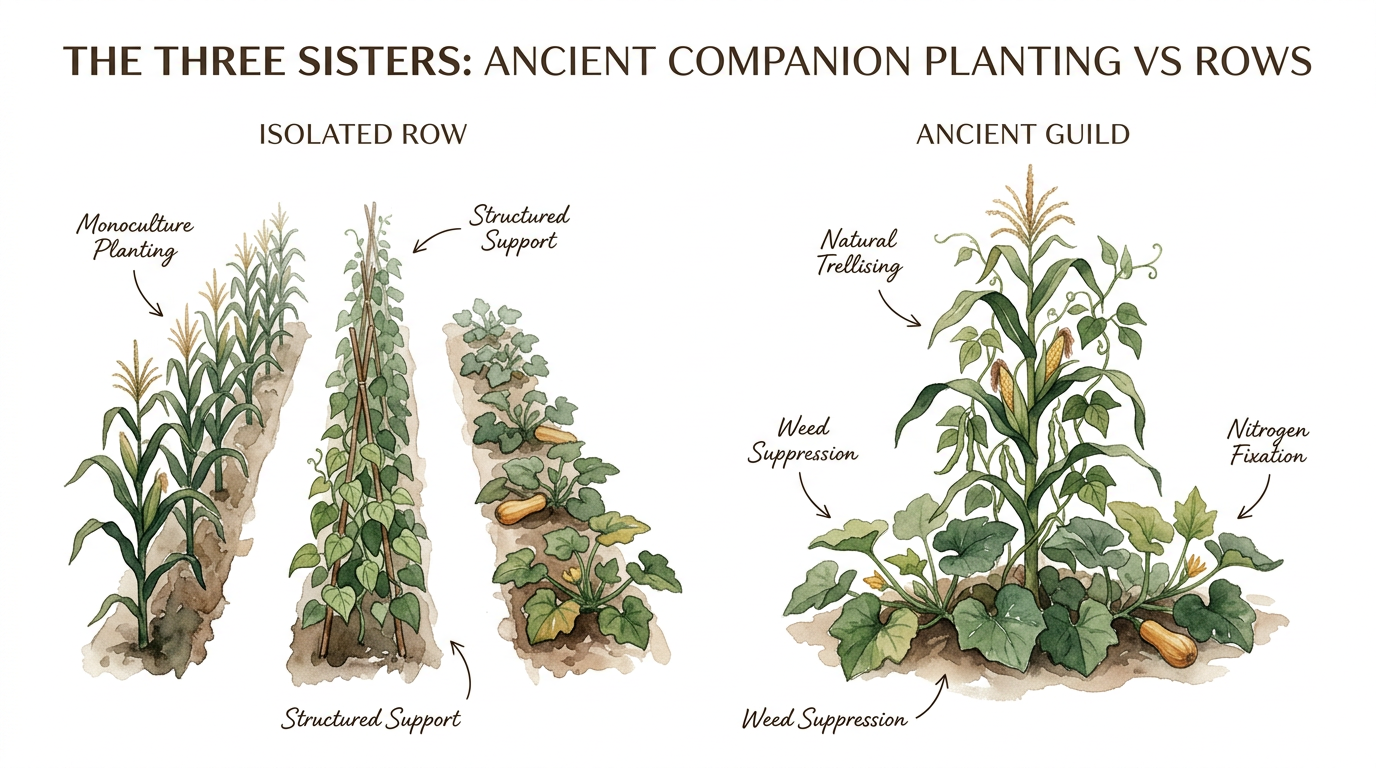
The Three Sisters is a system of intercropping that originated with the indigenous peoples of North America, most notably the Haudenosaunee (Iroquois). It represents a departure from the “Isolated Row” mentality that dominates modern thinking. In a row-based system, corn is grown in one block, beans in another, and squash in a third. This separation forces the gardener to manage each crop’s needs individually, often leading to increased water waste and weed competition.
In the Three Sisters guild, these three plants are grown together in mounds. The corn provides a living trellis for the beans to climb. The beans, through a symbiotic relationship with soil bacteria, pull nitrogen from the air and “fix” it into the soil to feed the corn and squash. The squash grows low to the ground, its massive leaves acting as a “living mulch” that shades the soil, retains moisture, and prevents weed seeds from germinating. Even the prickly hairs on the squash vines serve a purpose, deterring pests like raccoons and deer who dislike walking through the dense, scratchy foliage.
This system exists because it solves the fundamental problems of survival. It maximizes the use of vertical and horizontal space, ensuring that every square inch of soil is productive. In real-world homesteading, this means you spend less time hauling water and more time preparing for the winter. It is a biological machine where each part supports the whole, creating a self-sustaining ecosystem that mimics the complexity of the natural world.
Contrast this with the modern “Ancient Guild” approach, which focuses on polyculture. While modern rows rely on heavy machinery and synthetic fertilizers to overcome the weaknesses of monoculture, the Three Sisters utilizes the strengths of diversity. It is a philosophy of cooperation. When you plant these three together, you are not just growing food; you are building a resilient foundation for your soil’s future health.
How to Build Your Own Three Sisters Guild
Success in this system starts with the soil and the timing. You cannot simply throw seeds into a flat bed and hope for the best. The structure of the mound is critical for drainage and heat retention, which these heat-loving crops require. Start by choosing a site that receives at least six to eight hours of full sunlight and has well-draining soil.
Create mounds that are roughly four feet apart from center to center. Each mound should be about a foot high and three feet across at the base. Flatten the top of the mound so it looks like a small plateau. This shape prevents water from running off too quickly and gives the seeds a stable place to take root. Mixing in a healthy dose of aged compost or well-rotted manure into each mound before planting will give your corn the jumpstart it needs.
The timing of your planting is a delicate choreography. Plant the corn first. If you plant the beans at the same time, they will grow faster than the corn and eventually pull the young stalks to the ground. Wait until the corn is about six inches tall—usually two to three weeks after germination—before you tuck the bean seeds into the soil around the base of the stalks. This head start ensures the corn is sturdy enough to act as a permanent anchor for the climbing vines.
Squash seeds follow the beans. Plant them around the perimeter of the mound or in the spaces between the mounds. As the squash grows, guide the vines to circle the mounds. This creates the protective canopy that the guild relies on. Always keep an eye on the weather; these are frost-sensitive plants. Ensure the soil has warmed to at least 60 degrees Fahrenheit before the first seed touches the earth.
Recommended Varieties for Success
Not all varieties of these three plants are suited for this guild. You need “pioneer-grit” varieties that can handle the competition. For corn, look for tall, sturdy heirloom varieties like “Stowell’s Evergreen” or “Glass Gem.” Avoid modern “supersweet” varieties that stay short, as the beans will easily overwhelm them.
Choose pole beans rather than bush beans. Varieties like “Kentucky Wonder” or “Scarlet Runner” are excellent because they naturally seek out vertical support. For the squash, “Hubbard,” “Butternut,” or “Connecticut Field Pumpkin” are ideal because they produce large leaves and long vines that cover a significant amount of ground. Avoid “bush” varieties of squash, as they will not spread enough to provide the necessary ground cover.
Benefits of the Three Sisters System
The most immediate benefit of the Three Sisters is the drastic reduction in manual labor. Because the squash leaves shade the soil so effectively, weed growth is suppressed naturally. You will find yourself spending far less time with a hoe in your hand. This “living mulch” also preserves soil moisture, which is a godsend during the sweltering heat of mid-summer when traditional rows would be cracking and drying out.
Nutritional density is another major advantage. Together, these three crops provide a complete human diet. Corn provides carbohydrates, beans provide protein and fiber, and squash provides essential vitamins and minerals like Vitamin A. Historically, this combination allowed civilizations to thrive through long winters. Growing them together ensures that your garden is producing a balanced harvest that can sustain a family through the toughest times.
From a soil perspective, the benefits are long-term. Beans are nitrogen-fixers. They house bacteria on their roots that convert atmospheric nitrogen into a form the corn—a heavy feeder—can use. While the beans won’t provide all the nitrogen the corn needs in the first year, leaving the roots in the ground after harvest builds a legacy of fertility for the following season. This cyclical feeding reduces the need for external fertilizers, making your homestead more self-reliant.
Efficiency of space cannot be overstated. By stacking these plants vertically and horizontally, you can achieve yields that would require nearly double the space if grown separately. For the small-scale homesteader, this means more food per square foot and less land to manage, fence, and protect from pests.
Challenges and Common Mistakes
The most frequent error is planting the beans too early. It is tempting to get everything in the ground at once, but patience is your best tool. If the beans outpace the corn, they will wind around the tender stalks and choke them out or pull them into the dirt. A corn stalk needs to be thick and well-anchored before it can bear the weight of a heavy bean vine laden with pods.
Another common mistake is overcrowding the mounds. While the goal is density, you must still allow for airflow. If the squash vines become a tangled, impenetrable mess without any air circulation, you are inviting powdery mildew and other fungal diseases. Space your mounds far enough apart that you can still walk between them to harvest without crushing the vines underfoot.
Neglecting the corn’s early needs can also lead to failure. Corn is a grass and requires a significant amount of nitrogen early in its life cycle. If your soil is poor, the corn will be stunted, and the entire guild will collapse. Supplementing with a nitrogen-rich tea or fish emulsion during the first month can provide the boost necessary to ensure the corn reaches the height required to support its sisters.
Watering can be tricky once the squash leaves cover the ground. Overhead watering can lead to leaf diseases and may not reach the roots of the corn at the center of the mound. Using a soaker hose beneath the squash canopy or carefully watering at the base of the mounds ensures the moisture goes where it is needed most. Avoid getting the leaves wet during the heat of the day to prevent sun-scald and fungal growth.
Limitations and Environmental Constraints
This system is not a universal “magic bullet.” It was designed for specific climates and may require adjustments in yours. In regions with very short growing seasons, the corn may not get a large enough head start for the beans to mature before the first frost. If you live in the far north, you may need to start your corn in biodegradable pots indoors to give the system enough time to complete its cycle.
Very windy locations can also pose a threat. While the corn supports the beans, a heavy load of beans makes the corn more susceptible to “lodging” or blowing over during a summer storm. In these areas, planting your mounds in a diamond pattern or providing a windbreak of sunflowers can help protect the guild from being flattened by a sudden gust.
Pest pressure varies by region. While the squash vines deter some animals, they can also provide cover for others. Voles and mice may find the cool, shaded ground beneath the squash leaves to be a perfect home, where they can nibble on the corn stalks or bean roots undisturbed. Regular inspection is necessary to ensure your living mulch hasn’t become a sanctuary for rodents.
Soil type plays a massive role in how you construct your mounds. In heavy clay soil, mounds are essential for drainage, but they can dry out too quickly in sandy soil. If you are gardening in sand, you might actually find more success with a “sunken bed” or “waffle garden” style, which is a variation of the Three Sisters used by the Zuni people in the arid Southwest. Understanding your local environment is the first step toward successful adaptation.
Comparing Systems: Rows vs. The Three Sisters Guild
Comparing the traditional isolated row method with the Three Sisters guild reveals significant differences in management and output. The following table breaks down the primary factors for a typical homestead setting.
| Feature | Isolated Rows | Three Sisters Guild |
|---|---|---|
| Labor Intensity | High (Constant weeding and tilling) | Low (Natural weed suppression) |
| Water Usage | High (Evaporation from bare soil) | Low (Living mulch retains moisture) |
| Fertilizer Needs | High (Synthetic or heavy organic) | Low (Nitrogen-fixing beans) |
| Space Efficiency | Moderate (Requires paths between crops) | High (Stacked vertical growth) |
| Resilience | Low (One pest can wipe out a row) | High (Diversity confuses pests) |
Choosing the guild system requires a shift in mindset. You are trading the neat, linear appearance of a modern garden for the wild, productive abundance of an ecosystem. While rows are easier to harvest with large machinery, the guild is vastly superior for the manual harvester who values long-term soil health and resource conservation.
Practical Tips and Best Practices
Success is often found in the small details. When planting your corn, place four to six seeds in a small circle at the top of the mound. Once they are a few inches tall, thin them to the three strongest plants. This ensures that the “pole” for your beans is robust and healthy. If the corn is too thin, it won’t be able to handle the weight of the climbing vines.
Pollination is a critical factor often overlooked. Corn is wind-pollinated. For the ears to fill out with kernels, the pollen from the tassels must fall onto the silks below. In a Three Sisters garden, planting your mounds in a block rather than a single long line ensures better pollination rates. If you only have space for a few mounds, you can hand-pollinate by shaking the tassels over the silks in the morning when the air is still.
- Select Heirloom Seeds: Use varieties that have been grown together for centuries. They are physically adapted to this system.
- Mulch the Paths: While the squash covers the mounds, use straw or wood chips in the walking paths between them to keep the entire area weed-free.
- Don’t Clean Up Too Fast: In the fall, leave the stalks and vines on the ground. They will protect the soil over winter and return nutrients as they decompose.
- Balance the Nitrogen: If the squash leaves look yellow, they may be competing with the corn for nitrogen. A side-dressing of compost tea can help.
Pay close attention to the variety of bean you choose. While pole beans are required, some are more aggressive than others. If you notice a bean vine starting to reach for a neighboring mound, gently untangle it and guide it back to its own corn stalks. This keeps the garden organized and prevents one mound from being completely smothered by its neighbor’s beans.
Advanced Considerations: The Fourth Sister and Beyond
Experienced practitioners often add a “Fourth Sister” to the mix. Traditionally, this is often a Sunflower or Bee Balm (Monarda). Sunflowers can be planted on the north side of the mounds to provide even more vertical support and to attract pollinators with their bright blooms. They also serve as a “trap crop,” drawing aphids away from the more delicate vegetables.
Another advanced technique involves managing the nitrogen cycle more precisely. Some gardeners will “crimped” the bean vines just as they start to flower, which forces the plant to release the nitrogen stored in its root nodules back into the soil for the corn. However, this means you won’t get a bean harvest. Most homesteaders prefer to harvest the beans and let the roots decay naturally after the season is over.
Scaling this system requires careful planning of the “footprint.” For a large-scale field, you can transition from mounds to a more fluid “inter-row” system where the squash is planted every third row of corn. This allows for some mechanical cultivation while still maintaining the benefits of the guild. However, for the purest form of the Three Sisters, the mound remains the most effective structure for managing the micro-climate of the plants.
Seed saving is the ultimate goal for the serious practitioner. By saving the seeds from the strongest plants in your guild each year, you are essentially breeding a sub-variety that is perfectly adapted to your specific soil, pests, and weather. Over several generations, your “Three Sisters” will become a unique heirloom of your own homestead, carrying the biological memory of your land.
Real-World Scenarios: A Backyard Transformation
Consider a typical 20×20 foot backyard plot. In a traditional row garden, you might plant four rows of corn, two rows of beans, and a small patch of squash. This would leave significant bare soil, requiring hours of weeding and daily watering. The total yield would be limited by the space between the rows and the competition for nutrients in the unprotected soil.
By switching to the Three Sisters, you could fit approximately 16 to 20 mounds in that same space. Each mound would host three corn plants, three to four bean vines, and two squash plants. The result is a dense, lush forest of food. In a successful year, this small plot could produce upwards of 60 ears of corn, 30 pounds of beans, and 40 large squashes—enough to provide a significant portion of a family’s winter caloric needs.
One homesteader in a dry climate reported that after switching to the Three Sisters, their water usage dropped by nearly 40%. The squash leaves created such a thick canopy that the soil remained damp to the touch even three days after a heavy watering, whereas the previous year’s rows would be bone-dry by the next afternoon. This is the practical power of ancestral wisdom in action.
In another scenario, a gardener facing heavy pressure from raccoons found that the “squash barrier” worked wonders. The raccoons, who previously treated the corn rows like an all-you-can-eat buffet, were deterred by the prickly, dense squash vines. They simply didn’t like the feeling on their paws and moved on to easier targets. This biological defense saved the harvest without the need for expensive fencing or traps.
Final Thoughts
The Three Sisters is more than just a gardening method; it is a philosophy of connection and self-reliance. It reminds us that when we work with nature’s inherent design, we find abundance rather than scarcity. The corn, the beans, and the squash do not just grow alongside each other; they thrive because of each other. This is the pioneer spirit—recognizing the strength in diversity and the value of ancestral knowledge.
As you plan your next growing season, step away from the rigid lines of the industrial mindset. Embrace the mound, the vine, and the stalk. You will find that your garden becomes more than a source of food; it becomes a classroom where you learn the true meaning of synergy. The grit required to set it up is repaid tenfold by the ease of the harvest and the health of your soil.
Start small if you must, but start. Plant a few mounds and watch how the plants interact. Observe the bees as they move from the squash blossoms to the bean flowers. Feel the cool moisture beneath the heavy leaves on a hot July afternoon. Once you have seen the Three Sisters work together, you will never want to go back to the lonely struggle of the isolated row again.
