How To Become More Self-Sufficient Without Starting a Full-Blown Farm…
Want to start preserving your harvest, making your own soap, or building a backyard root cellar — but not sure where to begin? “Homesteading Advice” gives you instant lifetime access to 35+ practical homesteading books on food preservation, veggie gardening, DIY natural cleaning products (save over $250 per year with this skill alone), brewing, off-grid energy, and a whole lot more…
Click Here To Check It Out Now!
Most people pay a monthly bill to hide their wastewater, but smart homesteaders are using it to grow a lifetime of free peaches. Every gallon of water you send down the drain is a missed opportunity for your garden. While the city treats water as a ‘problem’ to be hidden in a sterile tomb, we treat it as the lifeblood of our food forest. Turn your daily shower into a biological engine.
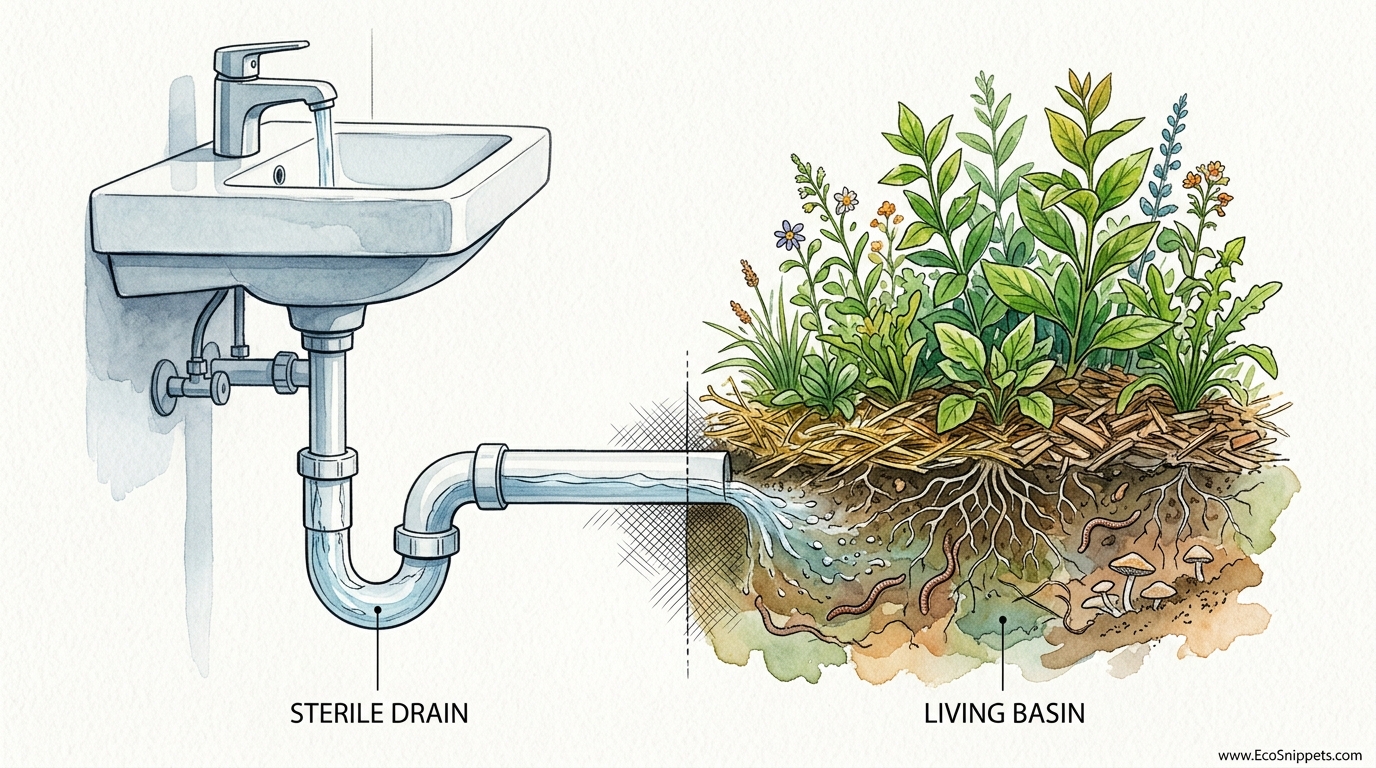
Water is the most precious currency on any homestead. In the old days, every drop was accounted for, carried in buckets from the well and reused until the earth itself took it back. Somewhere along the line, we traded that wisdom for the convenience of the “sterile drain”—a system designed to whisk away “waste” as fast as possible, mixing clean rinse water with raw sewage. This approach is a failure of imagination. By separating your graywater from your blackwater, you reclaim the power to drought-proof your land and feed your family.
Establishing a graywater system is not about high-tech filters or expensive pumps. It is about understanding the simple relationship between gravity, biology, and wood chips. It is about moving from a mindset of consumption to one of stewardship. When you build a living basin, you are not just disposing of water; you are creating a localized ecosystem that thrives on the very activities that used to drain your bank account.
DIY Graywater Mulch Basin Guide
A graywater mulch basin is a purposefully designed depression in the earth, filled with coarse organic material, that receives and infiltrates untreated household wastewater. Unlike a septic leach field that buries water deep where plants cannot reach it, a mulch basin keeps that moisture in the “active” layer of the soil. This is where the magic happens. It is the bridge between your plumbing and your produce.
In the real world, graywater includes water from your clothes washer, bathtub, shower, and bathroom sinks. It does not include water from toilets or urinals (blackwater), nor should it include water used to wash diapers or anything contaminated with hazardous chemicals. For the modern pioneer, the mulch basin is the primary tool for subsurface irrigation. It allows you to deliver water directly to the root zones of trees and large perennials without the risk of surface pooling or human contact.
The beauty of the mulch basin lies in its simplicity. It consists of three main components: the excavation (the hole), the mulch (the filter), and the distribution plumbing (the delivery). This setup mimics the forest floor. In nature, heavy rains are caught by layers of leaf litter and wood, which slow the water down and allow it to soak in slowly. By mimicking this with a basin, you create a sponge that stays moist long after the faucet is turned off.
How the System Works: From Drain to Root
The physics of a graywater system are rooted in the basic law of gravity. Unless you are using a “Laundry-to-Landscape” (L2L) system that utilizes the washing machine’s internal pump, your graywater must flow “down and out.” This means your garden must be lower than your drains. If you have a flat lot, you may need to focus on laundry water, which can be pushed uphill slightly by the machine, or shower water if your house is built on a pier-and-beam foundation.
Step one is the “Source Separation.” You must install a 3-way valve (often called a diverter valve) on your drain line. This valve is the heart of the system. It allows you to choose exactly where your water goes. If you are washing oily rags or using bleach, you flip the handle to send that water to the sewer or septic. On a normal day, you flip it the other way to feed your peach trees. This level of control is essential for safety and soil health.
Step two involves the “Distribution Plumbing.” For gravity-fed systems, practitioners often use 1.5-inch or 2-inch PVC or ABS pipe. These pipes lead from the house to the garden. Because graywater contains lint, hair, and soap scum, you avoid small emitters or “drip” lines which would clog in a matter of hours. Instead, use “branched drains” or simple open-ended pipes that spill into a “mulch shield”—usually a plastic valve box with the bottom cut out—to prevent the pipe from getting buried in dirt.
Step three is the “Sizing and Digging.” You cannot simply dump water on the ground and hope for the best. You must calculate your “Infiltration Area.” This is the amount of square footage needed to absorb your daily water output based on your soil type. Sandy soil absorbs water quickly and requires smaller basins, while heavy clay requires a much larger surface area to prevent the water from “ponding” on the surface.
Calculating Your Water Budget
Precision is the hallmark of a master homesteader. To size your basins, you first need to know how much water you produce. A standard top-loading washing machine might use 30 to 40 gallons per load, while a high-efficiency (HE) front-loader uses only 15 to 25 gallons. A typical shower lasts 8 minutes and uses about 15 to 20 gallons.
If a household of four people takes four showers and runs two loads of laundry a day, you are looking at roughly 120 to 160 gallons of water. In medium-loam soil, you generally need about 0.4 square feet of basin area for every gallon of water per day. That means you need roughly 50 to 65 square feet of total basin space. Distributing this across five or six fruit trees makes the system manageable and ensures no single tree gets “drowned.”
The Practical Benefits of Reclaiming Water
The most immediate benefit is resilience. When the county declares a drought and bans outdoor watering, your trees continue to thrive because they are being “watered” every time you take a shower. This is not just about saving money on the utility bill; it is about protecting the years of labor and growth you have invested in your orchard. A dead fruit tree takes five years to replace; a graywater system prevents that loss entirely.
Beyond water savings, there is a profound benefit to soil biology. Graywater, particularly from kitchen sinks (where legal) and laundry, contains small amounts of organic matter, nitrogen, and phosphorus. In a sterile septic tank, these are problems. In a mulch basin, they are fertilizer. The mulch acts as a biological filter, where specialized bacteria break down soap and organic bits into plant-available nutrients. Over time, the soil under a mulch basin becomes incredibly dark, rich, and full of earthworms.
Mulch basins also reduce the “heat island” effect around your home. By keeping the ground moist and supporting a lush canopy of trees, you naturally cool the air. This “biological air conditioning” can lower the temperature in your immediate yard by 10 degrees or more during the height of summer, making the homestead a more pleasant place to work and live.
Common Pitfalls and How to Avoid Them
The most frequent mistake beginners make is using the wrong soap. Most commercial detergents are loaded with sodium (salt) and boron. While these make your clothes bright and white, they are “soil killers.” Sodium destroys soil structure, turning it into a hard, impermeable crust that prevents water from reaching roots. Boron, while a micronutrient in tiny amounts, becomes toxic to plants very quickly.
To avoid this, you must switch to biocompatible soaps. Look for products that use potassium-based salts rather than sodium-based ones. Potassium is a primary plant nutrient (the ‘K’ in N-P-K fertilizer), so instead of poisoning your soil, you are actually feeding it. Brands like Oasis or Dr. Bronner’s (for sinks and showers) are the gold standard for graywater systems. Never use “powdered” detergents, as they are almost universally high in salt and fillers.
Another pitfall is “The 24-Hour Rule.” Graywater is not meant to be stored. If you put graywater in a tank and let it sit, the bacteria will consume the available oxygen and the water will go “anaerobic.” It will smell like a swamp and become a breeding ground for pathogens. A proper mulch basin system is a “surge-and-sink” setup. The water enters the basin, spreads out through the mulch, and soaks into the earth immediately. There should never be standing water in your basins 24 hours after a discharge.
Managing Clogs and Gophers
Maintenance is the price of freedom. Gophers and other burrowing rodents love the moist soil of a mulch basin. They will often push dirt into your emitters, causing the water to back up into the house. To prevent this, check your “mulch shields” once a month. Ensure the end of the pipe is at least two inches above the mulch level. This “air gap” is a safety requirement that prevents back-siphoning and helps you see if the water is flowing correctly.
Environmental and Legal Limitations
Graywater is a powerful tool, but it is not a universal solution. If your property has a high water table—meaning the groundwater is within three feet of the surface—you should not use a graywater system. The risk of untreated water reaching the groundwater and contaminating local wells is too high. In these cases, it is better to stick to rainwater harvesting and surface mulching.
Climate also plays a role. In areas where the ground freezes solid in the winter, graywater pipes can burst or freeze. During the “deep freeze” months, you must use your diverter valve to send all water to the sewer or septic. A frozen mulch basin cannot absorb water, and the resulting runoff can create dangerous ice patches in your yard.
Legally, graywater regulations vary wildly. In states like Arizona and California, “Laundry-to-Landscape” systems are often permitted “by right,” meaning you don’t need a permit as long as you follow basic safety rules (no pooling, no contact with edible parts of plants, etc.). In other states, graywater is still treated exactly like sewage, and installing a system could lead to fines. Always check your local plumbing codes before you start cutting pipes.
Comparing Graywater Strategies
| Feature | Laundry-to-Landscape (L2L) | Branched Drain (Gravity) |
|---|---|---|
| Installation Difficulty | Moderate (uses existing pump) | High (requires specific pipe slope) |
| Cost | $150 – $300 | $200 – $500 |
| Maintenance | Low (flush lines annually) | Moderate (clean out lint/hair) |
| Ideal Use | Flat lots or uphill gardens | Sloped lots, showers/sinks |
Practical Tips for a Thriving Basin
Focus your efforts on wood chips. Not all mulch is created equal. For a graywater basin, you want “arborist chips”—the coarse, irregular mix of bark, wood, and leaves produced by tree-trimming crews. These large pieces create big air spaces (macro-pores) that allow water to move through easily. Avoid fine, shredded mulch or “bark nuggets,” which can mat down and prevent oxygen from reaching the soil.
Plant on the “Perimeter.” Never plant a tree directly in the middle of a mulch basin. The excess moisture can lead to “root rot” or fungal issues at the crown of the tree. Instead, plant the tree on the “high ground” next to the basin. The roots will naturally find their way to the moisture “plume” beneath the mulch. This encourages a deep, resilient root system and keeps the sensitive trunk of the tree dry.
Seasonally “Flush” the soil. Even with the best soaps, some salts will eventually accumulate in the basin. Every winter, or after a heavy rain, ensure your rainwater downspouts are directed into your mulch basins. Fresh rainwater is the best way to “leach” any accumulated salts deeper into the soil profile where they won’t harm your plants.
Advanced Considerations: The Living Soil Filter
Serious practitioners eventually look at their mulch basins as more than just water holes; they are “biological filters.” As the wood chips break down, they create a humic layer that is exceptionally good at binding heavy metals and neutralizing pathogens. If you want to take your system to the next level, you can “inoculate” your mulch with beneficial fungi like Wine Cap mushrooms (Stropharia rugosoannulata). These fungi accelerate the breakdown of mulch and help transport water and nutrients to nearby trees via their mycelial network.
Think about “Surge Capacity.” If you have a large family and several people shower in a row, the volume of water can overwhelm a small basin. For advanced setups, you might include a “surge tank”—an unpressurized tank that catches the rush of water and releases it slowly through a smaller pipe over several hours. This prevents the “swamp effect” during peak usage times.
Scaling your system is best done through “zones.” Use a series of valves to rotate which trees get water on which days. For instance, send Monday’s laundry to the north orchard and Tuesday’s laundry to the south orchard. This prevents any single area from becoming oversaturated and ensures the whole homestead stays hydrated.
Example Scenario: The Peach Tree Project
Imagine a homestead in a dry climate where water costs are high. The owner wants to grow four peach trees but doesn’t have the budget for irrigation. By installing a “Laundry-to-Landscape” system, they tap into the washer in the garage.
The washer produces 25 gallons per load, and the family runs 6 loads a week—a total of 150 gallons. They dig four mulch basins, each 3 feet long, 2 feet wide, and 12 inches deep, located 4 feet away from each peach tree. These basins are filled with 10 inches of coarse wood chips.
The 1-inch HDPE tubing from the washer is split into four “emitters,” one for each basin. Every time a load of laundry runs, each peach tree gets about 6 gallons of water. This consistent, low-volume “deep soak” is exactly what peaches need to produce juicy, sweet fruit. By the end of the first season, the trees have doubled in size compared to the “control” trees watered by hand with a hose.
Final Thoughts
The transition from a “sterile drain” to a “living basin” is one of the most rewarding projects a homesteader can undertake. It reconnects you with the cycles of your own home, turning a mundane chore like laundry into an act of regeneration. You stop being a consumer of resources and start being a producer of life.
Building these systems requires a bit of grit and a willingness to get your hands in the dirt, but the payoff is measured in buckets of fruit and a landscape that stays green while the neighbors’ lawns turn brown. It is a return to a more sensible, ancestral way of living—one where nothing is wasted and every drop counts.
Start small, perhaps with just your washing machine, and watch how the earth responds. You will soon find that the “wastewater” you once paid to hide is actually the most valuable tool in your gardening arsenal. Experiment with different mulches, observe your soil’s drainage, and let the results speak for themselves. The future of the homestead is hydrated, and it starts at the drain.
