How To Become More Self-Sufficient Without Starting a Full-Blown Farm…
Want to start preserving your harvest, making your own soap, or building a backyard root cellar — but not sure where to begin? “Homesteading Advice” gives you instant lifetime access to 35+ practical homesteading books on food preservation, veggie gardening, DIY natural cleaning products (save over $250 per year with this skill alone), brewing, off-grid energy, and a whole lot more…
Click Here To Check It Out Now!
Why are we throwing away the very materials our grandparents used to keep their floors warm and their beds cozy for fifty years? We have been conditioned to think a hole in a shirt means it is ‘trash.’ But on a resilient homestead, that ‘trash’ is the raw material for a rug that will outlast your house. Learn how to shift from the cycle of disposable fibers to the legacy of durable, hand-woven utility.
Modern living has severed our connection to the objects that surround us. We buy cheaply made textiles that fall apart after a few washes, and when they do, we simply buy more. This cycle is a far cry from the ancestral wisdom of the homestead, where every scrap of wool, linen, and cotton was treated as a precious resource. Reclaiming these materials is not just about saving money; it is about reclaiming a sense of self-reliance and honor for the labor that went into making the original fiber.
Traditional rag rugs and woven textiles represent a bridge between the past and a sustainable future. When you take a pile of worn-out denim or faded flannel sheets and transform them into a heavy, insulating floor covering, you are performing a small act of rebellion against the “throwaway” culture. This guide will walk you through the practical, gritty reality of textile reclamation and the art of the heirloom weave.
Sustainable Textile Waste Reduction Hacks
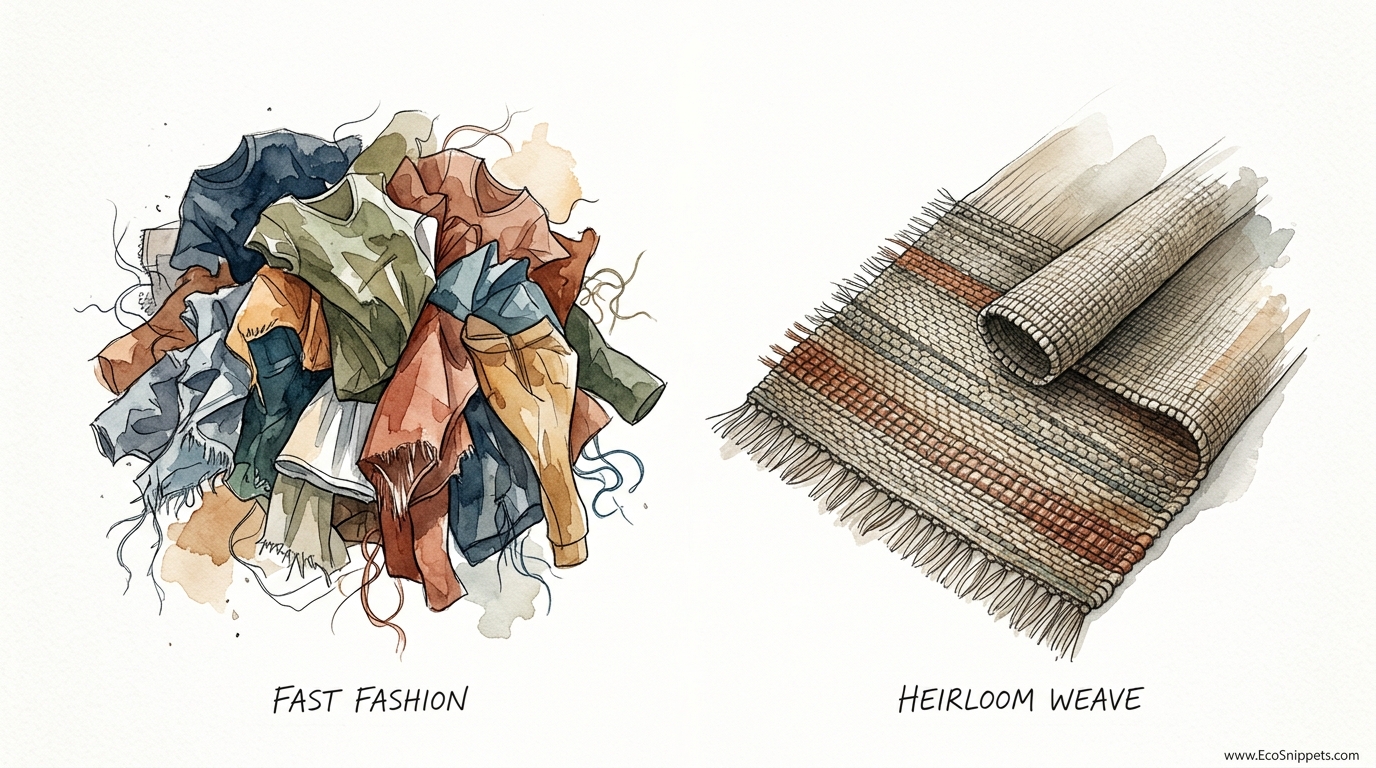
Textile waste has reached a crisis point in the modern era. In 2024 alone, the world generated approximately 120 million metric tons of textile waste, with 80% of it destined for landfills or incinerators. This “fast fashion” model relies on fibers that are designed to fail, often composed of synthetic blends that shed microplastics and take centuries to decompose.
Sustainable textile waste reduction is the practice of diverting these materials from the waste stream by repurposing them into high-utility items. Historically, this wasn’t called a “hack”; it was called survival. Homesteaders in the 19th century and during the resource-scarce years of the World War II era used “thrift rugs” or “clootie mats” to insulate drafty cabins. They understood that the energy already embedded in a garment—the water used to grow the cotton, the labor of the weaver, the transport of the goods—should not be discarded lightly.
In a real-world homesteading context, these “hacks” involve collecting every bit of fabric that enters your home. Cotton sheets that have worn thin in the middle are cut down to their sturdy edges. Wool coats with moth holes are dismantled for their heavy panels. Even the smallest scraps can be used for stuffing or “prodded” rugs. By viewing your closet as a raw material quarry rather than a graveyard of old trends, you shift your household toward a circular economy.
How to Process and Prepare Your Rags
The secret to a rug that lasts decades lies in the preparation of the material. You cannot simply throw old clothes into a loom and expect a professional result. The process requires a methodical approach to sorting, cleaning, and cutting.
First, sort your materials by fiber type. Keep 100% cottons together, group your wools, and separate your synthetics. Mixing fibers can lead to uneven wear and unpredictable shrinkage when the final piece is washed. Wool is the gold standard for floor rugs because of its natural durability and dirt-repelling lanolin. Cotton is excellent for bath mats and kitchen runners due to its absorbency.
Once sorted, you must transform the garments into “yarn.” There are two primary ways to do this without a sewing machine:
- The Continuous Spiral Cut: For items like t-shirts or sheets, cut in a spiral around the body of the garment. This allows you to create one long, unbroken strip of fabric, which reduces the number of knots in your weaving.
- The Hobo Knot (Slit-and-Loop): If you have shorter scraps, cut a small vertical slit about half an inch from the end of two strips. Thread the end of strip B through the slit in strip A, then pull the tail of strip B back through its own slit. This creates a flat, secure join that won’t come apart under tension.
After joining your strips, wind them into “rag balls.” Aim for the size of a grapefruit. This keeps your materials organized and prevents tangling as you work. For a standard 2×3 foot rug, you will typically need about 10 large t-shirts or two queen-sized bed sheets.
Benefits of Heirloom Weaving
Choosing the heirloom weave over store-bought alternatives provides measurable advantages for the homesteader. The most immediate benefit is durability. A hand-braided or woven rag rug is significantly denser than a machine-made carpet. Because you are using multiple layers of fabric twisted or woven together, the resulting textile can handle heavy foot traffic and the rough-and-tumble life of a farm.
Environmental impact is the second major benefit. By repurposing textiles at home, you are directly offsetting the carbon footprint of new production. Manufacturing a single fast-fashion garment can generate up to 10kg of CO2 and require thousands of liters of water. When you multiply that by the 120 million tons of waste currently being produced, the scale of the problem becomes clear. Homesteading “hacks” like rag rugging are a direct antidote to this environmental degradation.
There is also the “nostalgia factor” which carries practical weight. These rugs often contain the history of a family. A rug might contain strips from a child’s first pair of overalls, a father’s work shirt, and a grandmother’s apron. This emotional value ensures the item is cared for, mended, and passed down, rather than treated as a disposable commodity.
Challenges and Common Mistakes
The most frequent error beginners make is cutting their strips too thin. While it might seem like you are getting more “yarn” out of a garment, thin strips lead to a flimsy rug that won’t stay flat on the floor. A good rule of thumb is to cut cotton and lightweight fabrics 1.5 to 2 inches wide. Heavier fabrics like denim or wool can be cut narrower, around 1 inch, to keep the bulk consistent.
Another common pitfall is failing to account for “draw-in.” When you weave or crochet rags, the tension of your work naturally pulls the edges toward the center. If you don’t keep your tension consistent or consciously “add” extra slack at the turns of a braided rug, your project will begin to “bowl” or curl up at the edges. A rug that doesn’t lie flat is a tripping hazard and will wear out unevenly.
Mixing fabric weights is also a challenge. If you weave a row of heavy denim next to a row of thin silk, the structure of the rug will be compromised. Always try to match the weight and “give” of your materials within a single project. If you must use different fabrics, double up the thinner strips to match the thickness of the heavier ones.
Limitations of Recycled Textiles
While the “pioneer grit” approach is powerful, it does have realistic constraints. The primary limitation is time. Hand-making a rug is a slow process that can take anywhere from 10 to 40 hours depending on the size and technique used. In a modern world where a cheap rug can be bought for twenty dollars, the “cost” of your labor is high. This is why rag rugging is often a winter project or a social activity done while listening to the radio or sitting by the fire.
There are also environmental limitations to certain repurposed fabrics. Many modern garments contain spandex or elastane. These synthetic fibers do not age as well as natural ones and can become “crispy” or lose their stretch over time when exposed to sunlight. If you are building an heirloom that you want to last fifty years, you should prioritize 100% natural fibers like wool and cotton.
Lastly, the scale of production is limited by your access to waste. While most households have enough rags to make a few small rugs a year, larger projects like wall-to-wall coverings require a massive amount of material preparation that may be beyond the capacity of a single person without a community-based “rag drive.”
Heirloom Weave vs. Fast Fashion
To understand why this work matters, it is helpful to look at the measurable differences between what you can make and what you can buy.
| Factor | Fast Fashion/Store Rug | Heirloom Rag Rug |
|---|---|---|
| Lifespan | 1–3 years before fraying | 20–50+ years with care |
| Material | Synthetic blends/Polyester | Repurposed natural fibers | Maintenance | Hard to clean; prone to shedding | Machine washable (cotton) or shake-out (wool) |
| Cost | Low upfront, high replacement cost | Free materials, high labor time |
| Carbon Footprint | High (Global supply chain) | Near zero (Closed-loop) |
Practical Tips for Success
If you are ready to start your first project, follow these best practices to ensure a professional finish. Start with a “Frame Loom.” You don’t need a thousand-dollar floor loom to weave a rug. A sturdy wooden picture frame or a simple DIY frame made from 2x4s with nails spaced 1 inch apart at the top and bottom will work perfectly.
When choosing your “warp” (the vertical threads that hold the rug together), use a strong, non-stretchy material like cotton twine or heavy carpet thread. If your warp stretches, the rug will lose its shape the moment you take it off the loom. The “weft” (your fabric strips) provides the bulk, but the warp provides the skeleton.
Color theory is your friend. Even a rug made of “ugly” scraps can look beautiful if you organize your colors. Try a “hit-or-miss” pattern where you mix all colors randomly, or create a “tri-color” design where you alternate rows of dark, medium, and light tones. This creates a rhythmic, professional appearance that belies the humble origins of the material.
Advanced Considerations for Practitioners
For those who have mastered the basic braided or woven rug, advanced techniques like “Krokbragd” weaving offer a way to create intricate, pictorial designs. Krokbragd is a traditional Scandinavian weft-faced weave that produces a very thick, durable fabric. It allows you to create geometric patterns that look like they were made on a high-end industrial machine, yet it can be done on a simple multi-shaft loom using recycled fabric strips.
You might also consider “dyeing the rags.” If you have a large amount of white cotton sheets but want a forest-green rug, you can use natural dyes like walnut hulls or indigo to over-dye your strips before weaving. This creates a more cohesive look while still utilizing waste materials.
Scaling your production for the homestead might involve building a “Peg Loom.” This is one of the oldest and simplest forms of weaving. It uses wooden pegs to hold the warp, allowing you to weave extremely thick materials—like unspun wool or very wide fabric strips—into heavy-duty mats and even saddle blankets.
Example: The Kitchen Hearth Runner
Imagine you have three pairs of worn-out blue jeans, two faded flannel shirts, and an old set of white cotton curtains. Here is how you would translate that theory into a practical 2×5 foot kitchen runner.
First, you would dismantle the jeans, removing the heavy seams and pockets. You would cut the denim into 1-inch strips. The flannel shirts, being lighter, would be cut into 2-inch strips to match the denim’s weight. The curtains would also be cut into 2-inch strips.
Using a simple frame loom, you would warp the frame with cotton twine. You would begin by weaving 4 inches of the heavy denim to create a sturdy “header.” Then, you would alternate: two rows of flannel, one row of white curtain, two rows of flannel, and one row of denim. Repeating this pattern creates a striped, professional-looking runner that is heavy enough to stay put on a hardwood floor and durable enough to catch every spill at the kitchen sink.
Final Thoughts
The transition from a consumer of disposable textiles to a creator of heirloom weaves is a journey toward true resilience. It requires us to look at the world differently—to see the potential in a frayed cuff and the value in a rainy afternoon spent cutting strips. The 120 million tons of textile waste we produce annually is not a trash problem; it is a resource management opportunity.
By practicing these sustainable textile waste reduction hacks, you are doing more than just making a rug. You are honoring the materials that keep us warm, reducing the burden on our planet, and creating something that tells a story. Whether you choose to braid, hook, or weave, you are participating in a tradition of “pioneer grit” that has sustained humanity for generations.
Start small. Take that one shirt you were going to throw away and turn it into a ball of rag yarn. Once you feel the weight of a hand-woven rug in your hands, you will never look at a “hole in a shirt” the same way again. Experiment with your fibers, play with your colors, and build a legacy that will sit under the feet of your grandchildren.
