How To Become More Self-Sufficient Without Starting a Full-Blown Farm…
Want to start preserving your harvest, making your own soap, or building a backyard root cellar — but not sure where to begin? “Homesteading Advice” gives you instant lifetime access to 35+ practical homesteading books on food preservation, veggie gardening, DIY natural cleaning products (save over $250 per year with this skill alone), brewing, off-grid energy, and a whole lot more…
Click Here To Check It Out Now!
A Return to the Living Tool
There is a reason your ancestors never used buckets—and your harvest is paying the price for modern ‘convenience’. We traded 5,000 years of harvest wisdom for a $5 plastic bucket. Plastic traps heat and ethylene gas, causing your fruits to bruise and rot before they even reach the kitchen. Traditional woven baskets are a ‘living’ tool that allows your harvest to breathe and stay cool. It’s time to return to gear that lasts generations, not one season in the sun.
For millennia, the relationship between the harvester and the land was mediated by natural fibers. Whether it was willow in Europe, sweetgrass in the Americas, or bamboo in Asia, the container was as vital as the tool used to prune the branch. Today, the average homesteader reaches for a high-density polyethylene (HDPE) bucket because it is cheap and easily hosed out. However, this convenience comes at a hidden cost: the rapid degradation of your hard-earned yield.
The shift away from woven vessels toward solid-walled plastic has fundamentally changed the chemistry of the harvest. When you drop a sun-warmed tomato or a crisp apple into a plastic bucket, you aren’t just storing it; you are placing it in an oven. Understanding the physics of the harvest is the first step toward reclaiming the self-reliance that our ancestors took for granted.
Why Your Harvest Rots In Plastic Containers
Plastic is a synthetic insulator designed to keep things out, but in the garden, it effectively traps everything in. When a fruit or vegetable is harvested, it does not immediately “die.” It continues to respire, taking in oxygen and releasing carbon dioxide, water vapor, and heat. In a solid-walled plastic container, there is nowhere for this metabolic energy to go. The temperature inside the bucket quickly rises above the ambient air temperature, creating a localized “greenhouse effect” that accelerates cellular breakdown.
This heat is the primary catalyst for rot. Bacteria and fungi thrive in warm, stagnant environments. A plastic bucket acts as a petri dish, incubating the very spores that turn a firm harvest into a mushy mess. Furthermore, the smooth, hard surface of plastic provides no “give.” When produce is piled high, the weight of the top layer presses the bottom layer against an unforgiving surface, leading to internal bruising that you might not even see until you slice the fruit open.
Beyond heat, plastic containers are notorious for trapping ethylene gas. Ethylene is a natural plant hormone that triggers ripening. While this is useful on the vine, an accumulation of ethylene in a confined space causes “over-ripening” in minutes. One bruised apple in a plastic bucket will release enough gas to spoil the entire batch by the time you walk from the orchard to the cellar. The lack of ventilation means the gas lingers, forcing the produce to consume its own sugars and acids at an unsustainable rate.
Finally, there is the issue of moisture. Transpiration continues after harvest, and in a plastic bucket, that moisture condenses on the walls. This standing water creates “wet spots” on the produce skin, leading to skin slip and fungal infections like botrytis or sour rot. Our ancestors avoided these issues not through complex chemistry, but through the simple, mechanical design of the woven basket.
The Science of Airflow: How Woven Fibers Protect Your Yield
Woven baskets function as a passive cooling system. Because the walls are porous, air is allowed to circulate freely around every individual piece of produce. This constant exchange of air removes the heat generated by respiration, keeping the harvest at or below the ambient temperature. In many cases, the evaporation of surface moisture from the basket fibers actually creates a slight cooling effect, similar to how an earthenware crock keeps water cold.
The geometry of a basket is its greatest asset. The thousands of small gaps between the willow, ash, or hazel weavers allow ethylene gas to dissipate instantly. Instead of concentrating and triggering a ripening chain reaction, the gas is carried away by the slightest breeze. This effectively “pauses” the ripening process, giving you hours or even days of extra shelf life compared to plastic-stored goods.
Traditional materials like willow also possess natural chemical advantages. Willow bark contains salicin, a precursor to salicylic acid, which has mild antimicrobial properties. While it won’t replace proper hygiene, the presence of these natural tannins and compounds creates an environment that is far less hospitable to mold than the sterile, but often contaminated, surface of a plastic pail.
Furthermore, the “flex” of a woven basket acts as a shock absorber. Unlike the rigid walls of a bucket, a basket moves with the load. When you set a heavy basket down, the fibers shift slightly, redistributing the pressure. This reduces the mechanical stress on the produce at the bottom, ensuring that your most delicate heirloom tomatoes or soft peaches reach the kitchen intact.
Benefits of Traditional Woven Baskets
The primary benefit of a woven basket is the preservation of nutritional density. Because the harvest stays cooler and respires more slowly, it retains more of its vitamins and sugars. Every degree of heat gained in a plastic bucket represents a loss of flavor and nutrition. By using a breathable vessel, you are ensuring that the food you put on your table is as close to “vine-fresh” as possible.
Longevity and sustainability are also major factors. A well-made willow basket can last forty to fifty years with minimal care. When it finally does reach the end of its life, it can be composted, returning its nutrients to the soil. Plastic buckets, conversely, become brittle under UV exposure, crack within a few seasons, and eventually break down into microplastics that contaminate the very soil you are trying to cultivate.
Ergonomics play a significant role in the field. Most plastic buckets have thin wire handles that cut into the hand when under load. Traditional baskets are designed with thick, integrated wooden handles or wide “trug” grips that distribute weight across the palm. This allows for longer harvesting sessions with less physical fatigue. The shape of a basket—often wider and shallower than a bucket—also makes it easier to layer produce correctly, preventing the “crush” effect of deep containers.
Finally, there is the psychological benefit of using a tool that connects you to a lineage of land stewards. Harvesting is a ritual. Doing so with a tool made from the earth, shaped by human hands, changes the way you interact with your garden. It encourages a slower, more mindful approach that often leads to better observation and less waste.
Challenges and Common Mistakes
The most common mistake beginners make is overloading the basket. Just because a basket is breathable doesn’t mean it can defy gravity. Piling soft fruits too deep will still cause bruising, regardless of the container material. It is better to use two shallow baskets than one deep one when harvesting items like berries, stone fruits, or ripe tomatoes.
Another pitfall is failing to clean and dry the basket properly. While baskets are breathable, they are also organic. If you harvest damp greens and then leave the basket in a dark, humid shed without airflow, the fibers themselves can develop mold. Always allow your baskets to air dry in the sun for an hour or two after a day of heavy use before storing them in a dry, well-ventilated area.
Choosing the wrong weave for the crop is a frequent error. A wide-spaced “open” weave is excellent for large tubers like potatoes or thick-skinned squash, as it provides maximum airflow. However, if you try to harvest small currants or cherry tomatoes in an open-weave basket, they will either fall through the gaps or get pinched and sliced by the weavers. Matching the basket style to the specific crop is essential for success.
Many modern homesteaders also neglect the “seasoning” of their baskets. New willow or wood-splint baskets can sometimes be a bit stiff. Over time, they develop a patina and a certain flexibility. Trying to force a stiff, new basket to hold a heavy, awkward load can lead to snapped weavers. Break your baskets in gradually with lighter loads until the fibers have settled into their shapes.
Limitations of Woven Containers
Woven baskets are not a “set it and forget it” solution. They require more maintenance than plastic. You cannot simply leave a willow basket out in the rain or buried in the mud for a week and expect it to survive. They are vulnerable to pests; wood-boring insects or rodents may find the fibers attractive if the basket is stored improperly. If you live in an extremely arid climate, the fibers can become brittle and may require an occasional light misting or “dunking” to maintain their suppleness.
Cost is the most immediate barrier. A high-quality, hand-woven basket can cost five to ten times as much as a plastic bucket. For a commercial operation, the initial investment can be daunting. However, when viewed through the lens of “cost per year of service,” the basket often wins. You are buying a tool once, rather than replacing a plastic bucket every three years.
Weight is another consideration. A sturdy wooden basket has a higher “tare weight” than a thin plastic pail. If you are trekking long distances, those extra few pounds can add up. However, many find that the superior ergonomics and weight distribution of a well-balanced basket offset the actual weight of the material.
Finally, baskets are not ideal for “wet” harvests. If you are washing greens in the field or carrying liquid fertilizers, a basket is obviously the wrong tool. They are specialized instruments for the dry collection and transport of produce. Attempting to use them as a universal “bucket” will lead to frustration and a shortened lifespan for the tool.
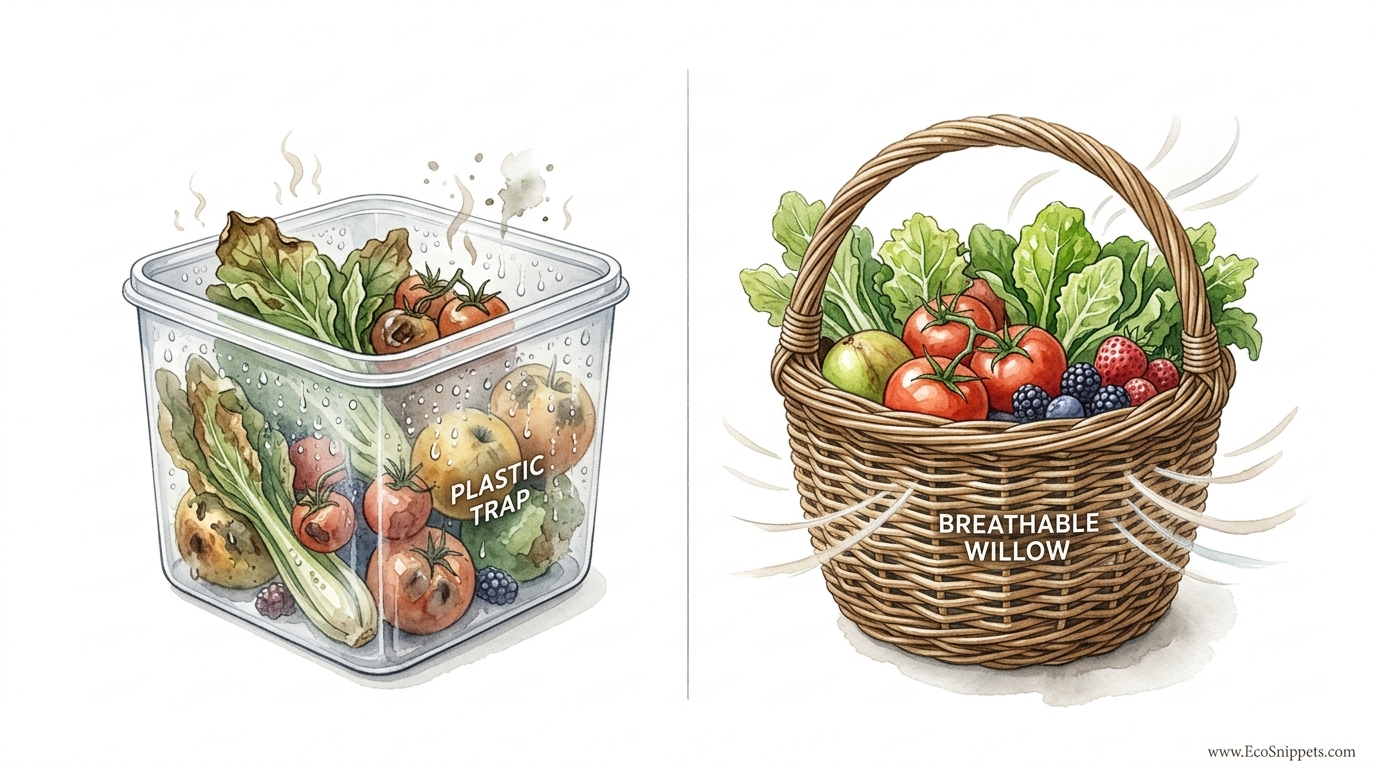
MODERN PLASTIC TRAP vs BREATHABLE WILLOW
To understand why the transition back to weaving is happening, it helps to see the measurable differences in performance. The following table highlights the key areas where these two containers diverge during a standard harvest day.
| Feature | Modern Plastic Bucket | Traditional Woven Basket |
|---|---|---|
| Airflow | None (Zero lateral ventilation) | High (360-degree ventilation) |
| Heat Retention | High (Acts as an insulator) | Low (Permits evaporative cooling) |
| Gas Management | Traps Ethylene (Accelerates rot) | Dissipates Ethylene (Extends freshness) |
| Physical Impact | Rigid (Causes pressure bruising) | Flexible (Absorbs shocks) |
| Lifespan | 2–5 years (UV degradation) | 30–50+ years (Natural durability) |
| End of Life | Landfill (Microplastics) | Compost (Soil enrichment) |
Practical Tips for Using Woven Baskets
When you head out to the garden, grade your harvest as you go. Place the heaviest, most durable items (like carrots or onions) at the bottom and the delicate items (like herbs or soft fruit) on top. In a basket, the airflow will still reach those bottom layers, unlike in a bucket where the bottom layer is effectively sealed off from the world.
For very small or delicate items, consider lining your basket with a linen cloth or burlap. This provides the best of both worlds: the fabric prevents small items from slipping through the weave, but because the fabric is breathable, it doesn’t trap heat like a plastic liner would. This is particularly effective for harvesting loose salad greens or berries.
- Always carry the basket close to your body to utilize your core strength and minimize swinging.
- Avoid setting baskets directly on wet soil for extended periods; use a “resting stone” or a dry patch of grass.
- If a weaver breaks, repair it immediately with a bit of twine or a fresh willow shoot to prevent the hole from “unraveling” the rest of the structure.
- Store baskets hanging from rafters to keep them away from rodents and to ensure air circulates around the entire vessel.
If you are harvesting in the heat of the day, you can occasionally dunk an empty basket in cool water before you start. The moisture absorbed by the fibers will evaporate as you work, creating a “refrigerated” micro-environment for your produce. This is an old shepherd’s trick that works wonders for keeping sensitive greens from wilting in the sun.
Advanced Considerations for the Serious Practitioner
For those looking to fully integrate traditional vessels into their homestead, understanding material properties is key. Willow (Salix) is the gold standard because of its flexibility and natural tannins. However, ash-splint baskets are incredibly strong and lightweight, making them ideal for heavy harvests like potatoes or apples. Hazel is often used for “hedgerow” baskets—stiff, rugged containers that can handle the abuse of dense brush.
Consider the weave density. A “randed” weave (single weavers going over and under) is generally more flexible and breathable. A “waled” weave (multiple weavers twisted together) is much stronger and used for structural ribs or the base. For root crops that might still have soil clinging to them, an open “lattice” weave allows the dirt to fall through the bottom before you ever reach the house, saving you cleaning time later.
Serious practitioners should also look into the ergonomics of the “Creel” vs. the “Trug.” A creel is designed to be worn on the back or side, freeing up both hands for picking—essential for orchard work or berry foraging. A trug is a shallow, boat-shaped basket with a fixed handle, perfect for “cut and come again” garden harvesting where you want to see everything you’ve picked at a glance to avoid over-harvesting.
Lastly, pay attention to the taper of the basket. A basket that is wider at the top than the bottom (flared) allows for better air circulation in the center of the pile. This flared design also allows baskets to be “nested” when empty, saving valuable space in the tool shed or cellar. It is a design born of necessity and perfected over centuries of practical use.
Example Scenario: The Apple Harvest Test
Imagine two homesteaders, John and Sarah. Both have a small orchard of five heirloom apple trees. On a warm September afternoon, John fills four 5-gallon plastic buckets with his harvest. Sarah uses four large, hand-woven willow baskets. They both move their harvest into the garage to be processed the following morning.
Inside John’s plastic buckets, the apples at the bottom are sitting in a pocket of air that is nearly 10 degrees warmer than the garage air. The ethylene gas released by a few slightly overripe apples is trapped, triggering the starch-to-sugar conversion in the rest of the batch prematurely. By morning, the bottom layer of apples feels slightly greasy—a sign of skin breakdown—and two apples have already begun to develop soft spots where they pressed against the rigid plastic.
In Sarah’s willow baskets, the air has circulated through the weavers all night. The heat from the afternoon sun dissipated within an hour of being brought indoors. The ethylene gas has drifted away into the rafters of the garage. When she begins her canning the next morning, every apple is as crisp as it was when it left the tree. She has zero “culls” to toss to the pigs, while John finds himself losing 5% of his harvest to avoidable bruising and heat-scald.
This is not a hypothetical situation; it is the reality of post-harvest physiology. The “convenience” of John’s $5 buckets cost him several pounds of high-quality fruit and hours of potential shelf life. Sarah’s investment in her baskets paid a dividend in the form of a higher quality, more stable yield.
Final Thoughts
The move away from plastic and back to woven fibers is not merely a matter of “pioneer aesthetics.” It is a return to a scientifically superior method of food preservation. By understanding that your harvest is a living, breathing entity, you can provide it with the environment it needs to stay nutritious and delicious. The woven basket is a masterpiece of low-tech engineering, solving the problems of heat, gas, and pressure with nothing more than harvested sticks and human ingenuity.
Transitioning back to these tools requires a shift in mindset. It asks you to value the long-term health of your harvest over the short-term convenience of a disposable bucket. It encourages you to learn the rhythms of the seasons—not just for planting and picking, but for maintaining the tools that make the harvest possible. Whether you buy a basket from a local craftsman or learn to weave your own from the willow growing in your ditch, you are reclaiming a vital piece of human heritage.
Start small. Replace your most-used harvest bucket with a single, high-quality woven trug. Observe the difference in how your greens stay crisp and your tomatoes stay firm. Once you see the “living tool” in action, the cold, suffocating walls of a plastic bucket will never look the same again. Your ancestors knew what they were doing; it’s time we followed their lead and gave our harvests the room they need to breathe.
