How To Become More Self-Sufficient Without Starting a Full-Blown Farm…
Want to start preserving your harvest, making your own soap, or building a backyard root cellar — but not sure where to begin? “Homesteading Advice” gives you instant lifetime access to 35+ practical homesteading books on food preservation, veggie gardening, DIY natural cleaning products (save over $250 per year with this skill alone), brewing, off-grid energy, and a whole lot more…
Click Here To Check It Out Now!
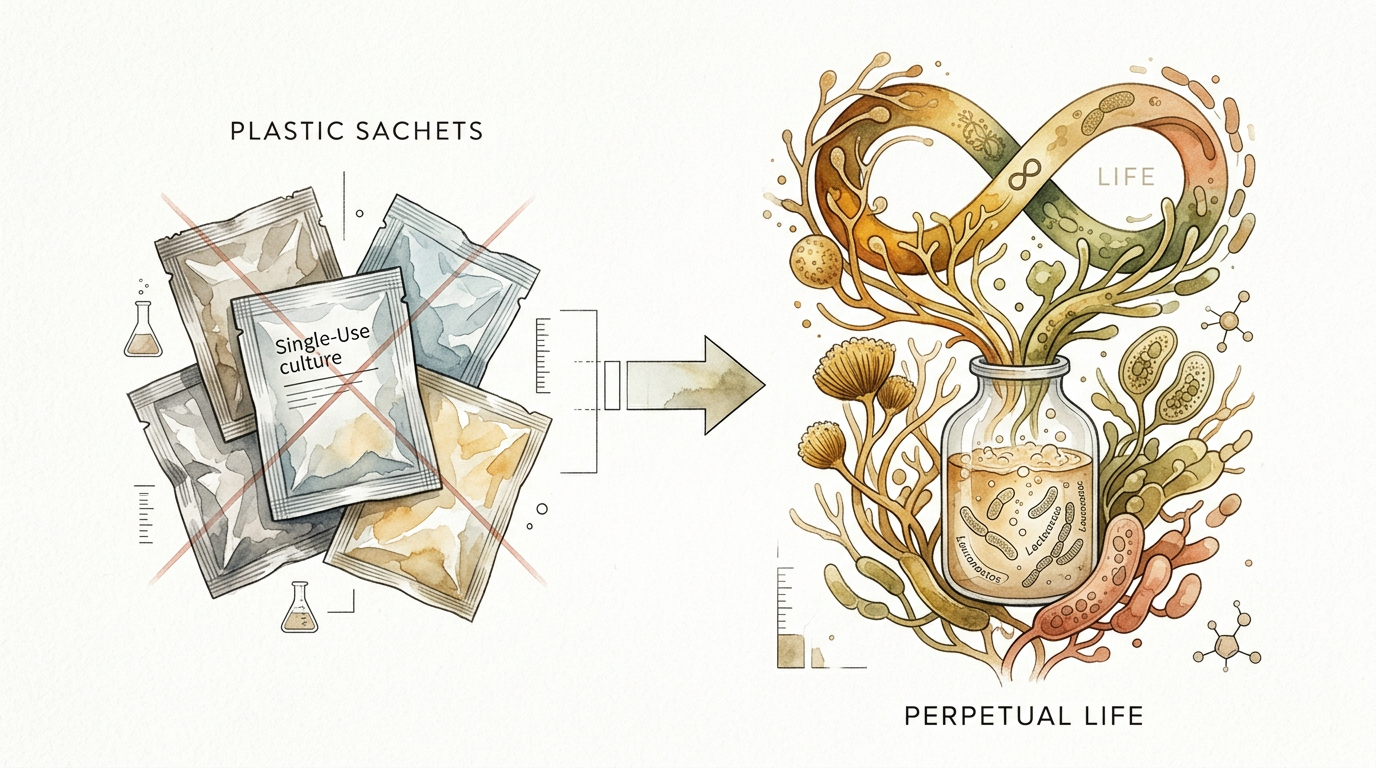
Stop buying cheese cultures for every batch – this one jar can last a lifetime. Modern cheesemaking relies on lab-grown DVI packets that create a ‘one and done’ system. Ancestral cheesemakers kept a ‘mother culture’ alive, much like a sourdough starter, creating a unique regional flavor profile that evolves with every batch.
The shift toward freeze-dried, direct-vat inoculation (DVI) packets changed the accessibility of cheesemaking, but it also tethered the home dairy to a supply chain. Relying on plastic sachets means you are only ever as self-reliant as the nearest shipping carrier. Breaking that cycle requires looking backward to the wisdom of the old-world dairy.
A perpetual cheese starter, or mother culture, is a living colony of lactic acid bacteria that you cultivate and propagate yourself. Instead of opening a new packet every time you heat a vat of milk, you simply “feed” a portion of your existing culture into fresh milk. This process not only saves money but allows a specific microbial terroir to develop on your farm or in your kitchen.
Establishing this system requires a shift in mindset from sterility to stewardship. You are no longer just a cook; you are a shepherd of microscopic life. Understanding how these bacteria thrive, compete, and stabilize is the key to consistent, high-quality cheese that tastes like nowhere else in the world.
How To Make A Perpetual Cheese Starter
A perpetual cheese starter is a concentrated bacterial culture grown in milk that serves as the “seed” for future batches of cheese. In the commercial world, these are often called “bulk starters,” but to the artisan, they are known as mother cultures. Think of it as a biological bank account where you only spend the interest and keep the principal protected.
This starter exists to convert lactose into lactic acid, which is the foundational chemical reaction of nearly all cheesemaking. This acidification is what allows the rennet to work efficiently and prevents spoilage organisms from taking hold. While a DVI packet is a dormant, frozen snapshot of bacteria, a mother culture is active and ready to work the moment it hits the milk.
In real-world situations, keeping a mother culture means you can make cheese at a moment’s notice. You don’t have to wait for a delivery or worry about whether your frozen packets have lost their potency. Whether you are using a mesophilic culture for a farmhouse cheddar or a thermophilic culture for a sharp Italian-style cheese, the principle remains the same.
Visualizing this concept is easiest when comparing it to sourdough. Just as a baker keeps a small jar of flour and water alive to leaven bread, a cheesemaker keeps a jar of cultured milk alive to ripen the vat. The primary difference is that while sourdough lives at room temperature, most perpetual cheese cultures are maintained through a cycle of ripening and then freezing or refrigerating to slow down the metabolic rate of the bacteria.
The Biological Engine: How Mother Cultures Work
The heart of any cheese starter is the lactic acid bacteria (LAB). These microbes are divided into two main camps based on their preferred working temperatures: mesophilic and thermophilic. Choosing which one to cultivate depends entirely on the type of cheese you intend to produce.
Mesophilic bacteria, such as Lactococcus lactis and Lactococcus cremoris, are the workhorses of the cheese world. They thrive in moderate temperatures, usually between 68°F and 90°F. These are the microbes responsible for most soft cheeses, cheddars, and goudas. When you create a mesophilic mother culture, you are fostering a colony that excels at steady, cool acidification.
Thermophilic bacteria, including Streptococcus thermophilus and various Lactobacillus species, are the heat-seekers. They don’t even wake up until the milk reaches around 100°F and can continue working happily up to 125°F or higher. These are essential for high-scald cheeses like Parmesan, Gruyère, and Mozzarella. A thermophilic mother culture is essentially a highly specialized, heat-resistant yogurt.
Both types work by consuming the natural sugars in milk (lactose) and excreting lactic acid. This process lowers the pH of the milk. A successful perpetual starter is simply a controlled environment where these specific “good” bacteria have such a massive numerical advantage that no “bad” bacteria can survive.
Step-by-Step Instructions: Creating the Culture
Creating your own mother culture is a process of extreme sanitation followed by controlled inoculation. You must ensure the milk you use as the base is entirely free of competing bacteria so that your chosen culture can dominate without interference.
First, select your milk. Skim milk is traditionally preferred for mother cultures. Fat can rise to the top and create a “cream plug” that interferes with the even distribution of bacteria, and the fats themselves can eventually go rancid if stored for long periods. Using skim milk ensures a cleaner, more stable medium for the bacteria to inhabit.
Sterilize a one-quart glass canning jar and its lid by boiling them for at least five minutes. After the jar has cooled slightly, fill it with skim milk, leaving about an inch of headspace at the top. Tighten the lid and place the jar in a deep pot of water. The water should cover the jar completely.
Boil the jar in the water bath for 30 minutes. This high-heat treatment is more aggressive than standard pasteurization; it is intended to kill virtually every living thing inside that milk. Once the 30 minutes are up, remove the jar and let it cool. This is the blank canvas upon which you will paint your microbial masterpiece.
Cool the milk to the inoculation temperature. For a mesophilic culture, wait until the milk reaches 72°F. For a thermophilic culture, wait until it drops to 110°F. Use a sanitized thermometer to check, or simply feel the jar—it should be room temperature for mesophilic and noticeably warm but not hot for thermophilic.
Inoculate the milk with your starter. If this is your very first time, use about 1/4 teaspoon of a high-quality DVI powder. If you are continuing an existing line, use 2 ounces of your previous mother culture. Swirl the jar gently to incorporate the bacteria, then let it sit undisturbed in a warm place.
Ripen the culture until it coagulates. A mesophilic culture usually takes 15 to 24 hours at room temperature to set into a firm, yogurt-like consistency. A thermophilic culture is much faster, often setting in 6 to 10 hours if kept warm. Once the milk has set and has a clean, sharp, acidic smell, move it immediately to the refrigerator or begin the freezing process for long-term storage.
The Traditional Clabber Method: The Sourdough of Cheese
If you have access to high-quality raw milk from a healthy animal, you can skip the lab-grown packets entirely. This is known as making “clabber.” Clabber is the ultimate perpetual starter because it relies on the native bacteria already present in the milk and the environment.
Start by placing a pint of fresh, raw milk in a clean jar. Cover it with a breathable cloth or a coffee filter and let it sit at room temperature. Within two to three days, the milk will naturally sour and thicken as the wild lactic acid bacteria multiply. This first batch might smell a bit “off” or yeasty because there are many different types of microbes competing for dominance.
Refining the clabber is the next step. Take one tablespoon of that first thickened milk and add it to a fresh pint of raw milk. This is the “feed.” Repeat this process every 24 hours. By the third or fourth generation, the culture will usually stabilize. It should smell like clean lemons or fresh yogurt.
Once the clabber is stabilized, it can be used as a mesophilic starter for any cheese. Some practitioners find that if they heat the clabber gradually, the thermophilic strains within the wild mix will begin to take over, allowing the same starter to be adapted for different cheese styles. This is the “pioneer way”—relying on the ecology of your own land to define the flavor of your food.
Benefits of the Perpetual Approach
Choosing to maintain a mother culture offers several practical and sensory advantages over the modern “packet-per-batch” method. The most immediate benefit is economic. A single packet of culture that might have only made two or five gallons of cheese can now be used to create a mother culture that facilitates hundreds of gallons.
Regional flavor development is another major factor. Over time, a mother culture that is “re-backed” (using a bit of the old batch to start the new) will adapt to the specific conditions of your dairy. Minor variations in your milk and your local air will influence which strains within the culture thrive. This creates a “house flavor” that cannot be replicated with store-bought powders.
Reliability in the kitchen increases as you become familiar with your culture’s behavior. You will learn exactly how long it takes to ripen your milk and how the curd feels when the acidity is just right. This intuition is the hallmark of an expert cheesemaker and is much harder to develop when you are using a different factory-standardized packet every time.
Finally, there is the benefit of food security. In an era where supply chains are increasingly fragile, the ability to propagate your own starters is a vital skill. Whether you are a homesteader with a family cow or a hobbyist looking to deepen your craft, removing the need for external inputs is a powerful step toward self-sufficiency.
Challenges and Common Mistakes
The greatest challenge in maintaining a perpetual starter is contamination. Because you are creating a nutrient-dense environment for bacteria, any “bad” microbes that find their way into the jar will multiply just as fast as the “good” ones.
One frequent error is failing to properly sterilize the “mother milk.” If you only pasteurize the milk instead of boiling it for the full 30 minutes, some heat-resistant spores may survive. These survivors can eventually outcompete your cheese cultures, leading to a starter that smells like rotten fruit or old gym socks.
Using milk with too much cream is another common pitfall. The cream rises and creates an anaerobic seal at the top, which can encourage the growth of gas-producing yeasts. If you see bubbles in your mother culture or if the lid of the jar is bulging, the culture is contaminated. Do not use it. Discard the entire batch and start over with fresh, sterile equipment.
Phage contamination is a more advanced problem but no less devastating. Bacteriophages are viruses that specifically attack and kill lactic acid bacteria. If your starter suddenly stops working for no apparent reason, or if the acidification slows to a crawl over several generations, you may have a phage build-up in your kitchen. The only solution is to thoroughly sanitize every surface and start a new culture from a different bacterial strain.
Limitations and Realistic Constraints
While the mother culture system is robust, it is not always ideal for every situation. One major limitation is the lack of precision. Commercial DVI packets are standardized in a laboratory to contain exact ratios of specific bacteria. This ensures that every batch of cheese is identical. If you are running a commercial creamery that requires absolute consistency for wholesale clients, a perpetual starter might be too variable.
Environmental limits also play a role. Lactic acid bacteria are sensitive to temperature fluctuations. If you live in a climate with extreme heat and you lack a way to keep your mother culture cool during the ripening phase, the bacteria may over-acidify and die in their own waste. Conversely, in a very cold kitchen, the starter may take so long to set that wild molds have a chance to take root on the surface.
Practical boundaries also exist for the occasional cheesemaker. If you only make cheese once every few months, keeping a mother culture alive is more work than it is worth. The culture requires regular “feeding” or frozen maintenance to stay healthy. For the casual hobbyist, the convenience of a DVI packet often outweighs the benefits of a perpetual system.
Comparing Methods: DVI vs. Perpetual Mother Culture
| Feature | DVI Packets (Modern) | Mother Culture (Ancestral) |
|---|---|---|
| Cost per Batch | High ($2–$5) | Negligible (Cost of milk) |
| Complexity | Low (Open and pour) | Moderate (Requires prep) |
| Flavor Profile | Standardized/Uniform | Unique/Evolving |
| Self-Reliance | Dependent on Suppliers | Independent |
| Storage Life | 1–2 years (Freezer) | Indefinite (If maintained) |
Practical Tips and Best Practices
Maximizing the life of your starter requires a disciplined approach to storage. The most effective method for the home cheesemaker is the “ice cube technique.” Once your mother culture has ripened and set, pour it into a sanitized silicone ice cube tray. Freeze the cubes solid, then transfer them to a heavy-duty freezer bag labeled with the date and culture type.
Each standard ice cube is approximately one ounce. Most recipes using a mother culture require about 1.5% to 2% of the weight of the milk in starter. This usually translates to one or two cubes for every two gallons of milk. Pull the cubes out an hour before you begin cheesemaking so they can thaw in a small cup of clean milk.
Maintaining several “backups” is another best practice. Never use your very last cube to make cheese. Instead, use that last cube to inoculate a new quart of sterile milk to “refresh” your mother culture supply. This ensures that even if one batch of cheese goes wrong, your biological lineage remains intact in the freezer.
Always use the “sniff and taste” test before adding a mother culture to your vat. A healthy mesophilic starter should smell like clean buttermilk or sour cream. A thermophilic starter should smell like mild yogurt. If you detect any notes of yeast, vinegar, or putrefaction, do not risk your main vat of milk. Your starter is the foundation; if it is cracked, the whole cheese will fall.
Advanced Considerations: Managing Genetic Drift
Serious practitioners should be aware of a phenomenon called genetic drift. Over many generations of “re-backing,” the balance of bacteria in your mother culture can shift. Some strains might reproduce faster than others at your specific kitchen temperature, eventually crowding out the slower-growing strains that provide complex flavor notes.
Rotating your “mother” can help mitigate this. Every six months or so, you might consider starting a fresh culture from a DVI packet or a different raw milk source to reintroduce diversity. However, many traditionalists argue that this drift is exactly what creates the unique character of a “mountain cheese” or a “farmhouse special.”
Scaling considerations also come into play. If you move from making two-gallon batches to fifty-gallon vats, your mother culture needs will grow exponentially. In these cases, you will need to move from quart jars to large stainless steel canisters for your mother milk sterilization. The principles remain identical, but the heat-up and cool-down times will be much longer.
Understanding the “lag phase” of your bacteria is the final advanced skill. When you add a thawed cube of starter to a vat of milk, the bacteria don’t start eating immediately. They need time to adjust to the new environment. Experienced makers often add the culture while the milk is still warming up, giving the microbes a head start before the rennet is added.
Example Scenario: The Weekend Cheddar
Imagine you have a five-gallon bucket of fresh milk and you want to make a traditional cloth-bound cheddar. Instead of reaching for a $5 packet of DVI culture, you head to your freezer. You pull out four cubes of your “House Mesophilic Mother” that you cultivated three weeks ago from a pint of skim milk.
You drop the cubes into a small jar of lukewarm milk to thaw while you begin slowly heating your five gallons on the stove. By the time your main vat reaches the target temperature of 86°F, the cubes have melted and the bacteria are “awake” and active. You stir the culture into the vat.
Because you used a mother culture rather than a freeze-dried powder, the bacteria begin acidifying the milk almost instantly. You only need to wait 30 minutes before adding your rennet, compared to the 60 minutes often required for rehydrating DVI packets. By the time you are ready to mill and salt the curds four hours later, the pH has dropped perfectly, guided by a culture that has been in your family dairy for months.
Final Thoughts
Embracing the perpetual cheese starter is more than a cost-saving measure; it is an act of reclamation. It reconnects the modern cheesemaker with the biological realities that defined this craft for thousands of years. By moving away from single-use plastics and lab-dependency, you gain a deeper understanding of the invisible forces that turn milk into sustenance.
The journey from DVI packets to a stable, thriving mother culture requires patience and a high standard of cleanliness, but the rewards are measurable. You will see it in the vigorous way your curds set, and you will taste it in the complex, evolving flavors of your aged wheels. This is the “pioneer grit” of the kitchen—making much from little and keeping the fire of life burning from one batch to the next.
Start small, stay clean, and trust the process. Once you have successfully maintained a mother culture for a few months, the idea of going back to store-bought packets will seem as foreign as buying pre-sliced bread. You are now a steward of your own microbial legacy, and your cheese will be all the better for it.
