How To Become More Self-Sufficient Without Starting a Full-Blown Farm…
Want to start preserving your harvest, making your own soap, or building a backyard root cellar — but not sure where to begin? “Homesteading Advice” gives you instant lifetime access to 35+ practical homesteading books on food preservation, veggie gardening, DIY natural cleaning products (save over $250 per year with this skill alone), brewing, off-grid energy, and a whole lot more…
Click Here To Check It Out Now!
You are spending a fortune to create more landfill waste every time your dog sheds. The average pet owner goes through 12-15 lint roller refills a year. That is a mountain of adhesive-coated paper that never breaks down. This one-time purchase tool works better, lasts forever, and saves you over $60 a year while keeping your furniture pristine.
Modern convenience has tricked us into believing that cleanliness must be disposable. We have traded the sturdy tools of our ancestors for plastic handles and rolls of sticky paper that lose their effectiveness after three swipes. Every time you peel back a sheet of that adhesive waste, you are participating in a cycle of planned obsolescence that would make a pioneer weep. There is a better way to manage the shed—one that relies on friction, physics, and a bit of old-fashioned grit rather than a subscription to more garbage.
The shift toward zero-waste living isn’t just about the environment; it is about self-reliance. It is about owning a tool that doesn’t run out when the stores are closed or the delivery truck is delayed. When you hold a metal hair scraper or a rubber rake, you are holding a tool built for the long haul. This guide will walk you through the most effective ways to reclaim your home from the fur-tide without ever buying another roll of tape.
Best Zero Waste Pet Hair Removal Tools
A zero-waste pet hair removal tool is any device designed to lift, trap, or gather animal fur from surfaces without the use of disposable components. Unlike the ubiquitous sticky roller, these tools rely on mechanical action, static electricity, or material-specific friction to get the job done. They are typically made from durable materials like stainless steel, copper, natural rubber, or finished wood.
In the real world, these tools are the difference between a house that looks “lived in” and a house that looks neglected. Whether you are dealing with the fine, needle-like hairs of a Labrador or the long, flowing tresses of a Persian cat, the right tool acts as a mechanical magnet. You will find these tools indispensable for cleaning area rugs, car upholstery, velvet sofas, and even heavy wool coats.
The most popular among these is the metal hair scraper, often referred to as a “lint rake.” It features a copper or steel head with a textured edge that “grabs” the hair embedded deep within the weave of a fabric. Other variants include the rubber broom for large floor areas and the electrostatic roller, which uses a specialized fabric to trap hair in a built-in compartment that can be emptied and reused indefinitely.
The Metal Lint Scraper
This tool is the workhorse of the zero-waste movement. It consists of a sturdy handle and a thin, serrated metal head. It works by creating high friction against durable fabrics, pulling up hair that even the most powerful vacuum cleaners leave behind. It is essentially a restoration tool for your carpets.
The Rubber Squeegee and Glove
Natural rubber has a unique property: it generates a small amount of static electricity when rubbed against dry fabric. A simple window squeegee or a pair of rubber dish gloves can be used to “ball up” pet hair on upholstery. This method is often preferred for more delicate furniture where a metal blade might be too aggressive.
The Electrostatic Fabric Roller
Devices like the ChomChom roller use a patented brush material that creates a static charge as you roll it back and forth. It doesn’t use sticky tape; instead, it uses the physics of attraction to pull hair into an internal waste bin. It is the modern evolution of the traditional velvet lint brush our grandparents used.
How to Master the Art of Manual Hair Removal
Using a manual scraper is not a mindless task like using a vacuum. It requires an understanding of the material you are cleaning and the specific angle of the tool. If you go in with too much force, you risk pilling the fabric; too little, and you leave the hair behind.
Step 1: The Initial Assessment
Before you start scraping, identify the “grain” of the fabric. Most woven materials have a direction in which the fibers naturally lay. You want to work with the grain for general cleaning and against the grain for deep-seated hair removal. Always test a small, hidden corner of the furniture first to ensure the tool won’t snag or pull a thread.
Step 2: The 45-Degree Rule
For the most effective results with a metal scraper, hold the handle at a 45-degree angle to the surface. This allows the serrated edge to penetrate the top layer of the fabric without digging into the structural weave. Apply firm, steady pressure and pull the tool toward you in short, 6-inch strokes.
Step 3: Managing the Fur Pile
As you work, you will notice the hair beginning to clump together into a “rope” or “ball” at the edge of the tool. Do not try to clean the entire rug in one long swipe. Instead, work in sections and pick up the hair clumps as they form. This prevents the hair from being pushed back into the fabric.
Step 4: The Final Vacuum
While the scraper is excellent for pulling hair to the surface, it often leaves behind fine dander or dust. Once you have “raked” the area and removed the bulk of the fur, a quick pass with a vacuum cleaner will pick up the loosened microscopic particles. This two-step process provides a level of clean that neither tool can achieve alone.
The Practical Benefits of Switching to Reusable Tools
The primary advantage is financial. If you spend $5 on a pack of lint roller refills every month, that is $60 a year gone. Over the life of a pet, you could easily spend $1,000 on sticky paper. A high-quality metal scraper costs less than $15 and will likely outlive the person using it.
Environmental impact is the second major factor. Disposable lint rollers are made of plastic and paper coated in synthetic adhesives. These materials do not break down in landfills. By switching to a metal or rubber tool, you eliminate a significant source of household waste. You also reduce the carbon footprint associated with the manufacturing and shipping of thousands of rolls of tape.
Beyond money and the planet, there is the matter of efficiency. Sticky rollers only pick up what is on the very surface. They are useless for hair that has been “woven” into the carpet by the pressure of walking feet. A metal rake gets deep into the pile, lifting hair that has been there for months. Your home will not only look cleaner, but it will also smell fresher as you remove the dander that contributes to “dog smell.”
Common Mistakes to Avoid
The most frequent error is using a metal scraper on the wrong fabric. These tools are designed for durable, tightly woven materials like low-pile carpets, rugs, and heavy upholstery. Using them on a knitted sweater, leggings, or silk-blend fabrics will result in immediate damage. The metal teeth will catch on the loose loops of a knit and pull them out, ruining the garment.
Another mistake is applying too much downward pressure. You are not trying to shave the rug; you are trying to lift the hair. Excessive force can weaken the fibers of your furniture over time. Use a “listening” approach—if you hear a harsh, tearing sound, you are pressing too hard. The sound should be a gentle, rhythmic scraping.
Neglecting to clean the tool itself is a common pitfall. Over time, oils from the pet’s fur and dust from the floor can build up on the scraper’s teeth. This reduces the friction needed to lift hair. Every few uses, wipe the head of the tool with a damp cloth and a drop of dish soap to keep it in peak condition.
Limitations of Zero-Waste Tools
While these tools are revolutionary for rugs and sturdy sofas, they are not universal solutions. Soft, stretchy fabrics like those found in “fast fashion” or athletic wear are difficult to clean with manual scrapers. The fabric often moves with the tool, making it hard to get the necessary leverage to lift hair. For these items, a damp rubber glove or a specialized velvet brush is a better choice.
Large areas can also be a challenge for small handheld tools. Attempting to clean a 12×15 area rug with a 5-inch scraper is a recipe for back pain. For these scenarios, you should invest in a long-handled rubber broom or a dedicated carpet rake. These tools allow you to use your full body weight and maintain a standing position.
Finally, consider the type of hair. Extremely short, stiff hairs (like those from a Beagle or a Bulldog) can sometimes act like needles, piercing straight through fabric fibers. While a scraper will get many of them, some may require the “sticky” action of a reusable silicone roller or a damp sponge to fully extract.
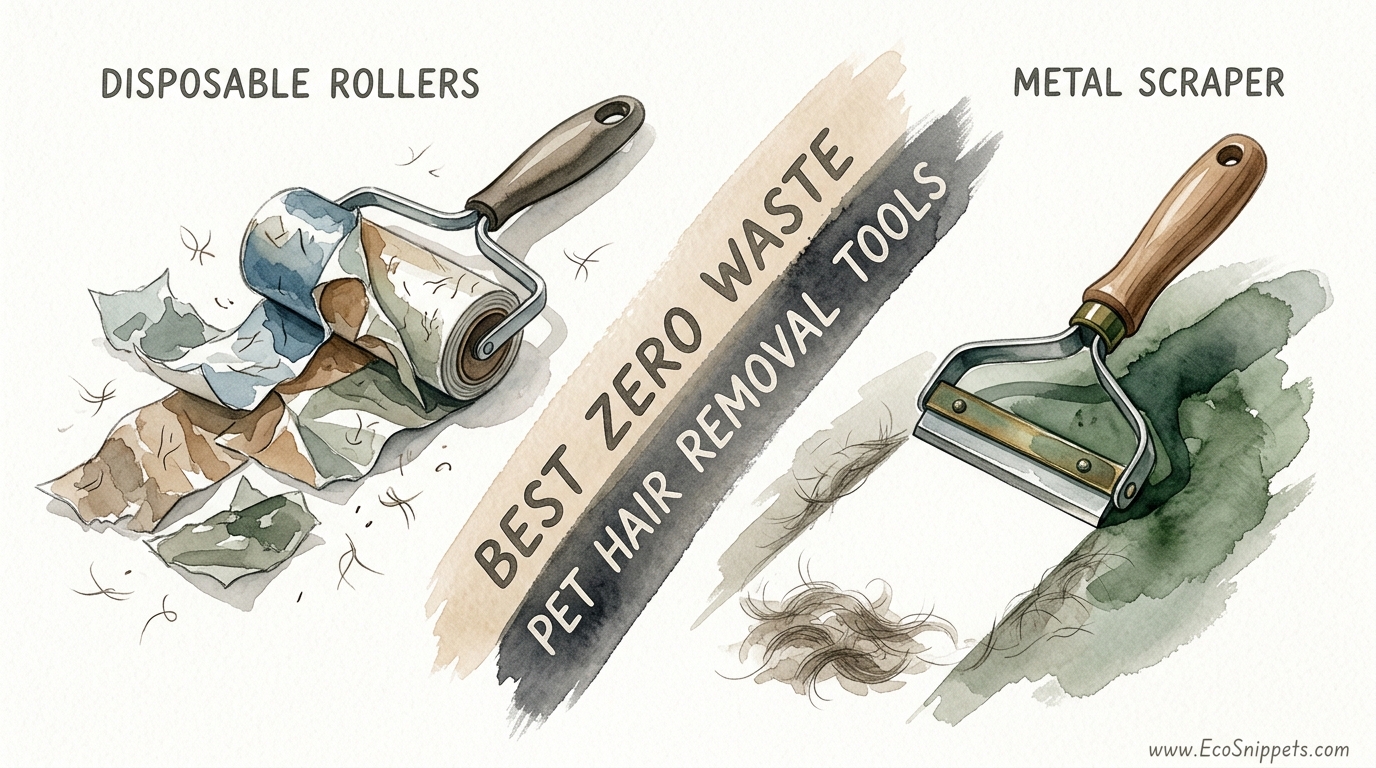
Comparison: Disposable Rollers vs. Metal Scrapers
| Feature | Disposable Roller | Metal Scraper |
|---|---|---|
| Upfront Cost | $5 – $10 | $10 – $20 |
| Long-term Cost | High (ongoing refills) | Zero |
| Waste Produced | 15+ rolls per year | None |
| Cleaning Depth | Surface only | Deep-seated fibers |
| Best For | Delicate clothing | Carpets & Upholstery |
Practical Tips for a Hair-Free Home
Efficiency is the name of the game when you are managing a shedding pet. You can make the manual scraping process much easier by preparing the surface beforehand. A light sprinkle of baking soda over your carpets not only deodorizes them but also helps neutralize the static charge that keeps hair “clinging” to the fibers. Let it sit for ten minutes, then start your scraping.
Humidity plays a massive role in hair removal. In the dry winter months, static electricity makes pet hair stick like glue. Running a humidifier can actually make it easier to lift hair from your furniture. Alternatively, lightly misting a rug with water (just a very fine dew) can help the scraper grip the fur clumps more effectively.
Layering your defenses is another ancestral secret. Instead of trying to clean the sofa every day, use a washable “furniture throw” made of a material like heavy canvas or denim. These fabrics are much easier to scrape and can be tossed in the washing machine once a week. It protects the delicate upholstery underneath while providing a sacrificial surface for the hair to accumulate on.
Advanced Techniques for Restoration
For those who have inherited a rug or purchased a second-hand piece of furniture that is heavily infested with pet hair, a standard scraping may not be enough. You might need to employ a “cross-hatch” scraping technique. Scrape the entire surface vertically, then go back and scrape it horizontally. This attacks the hair from two different angles and ensures that even the most stubborn fibers are dislodged.
Static control is another advanced consideration. If you find that hair is flying around as you scrape, you can rub a dryer sheet (if you use them) or a damp cloth along the scraper blade. This helps ground the charge and keeps the hair in a manageable clump. For the truly dedicated, a “carpet rake” with a telescoping handle allows you to apply consistent pressure across large rooms, which is essential for maintaining the uniform look of the carpet pile.
If you are dealing with delicate fabrics that cannot handle a metal scraper, look into a pumice stone. While traditionally used for feet, a dry pumice stone can be gently “petted” across car upholstery or headliners to gather hair. The porous surface of the stone acts as a series of tiny hooks that grab the hair without the aggressive edge of a metal tool.
Real-World Scenario: The Mudroom Rug
Imagine a high-traffic mudroom rug in a house with a Golden Retriever. The rug is a low-pile nylon weave, currently grey but originally navy blue. A vacuum cleaner passes over the top, making a satisfying noise, but the blue color never returns. This is because the hair has been felted into the rug fibers by the weight of boots and paws.
The owner takes a metal scraper and starts in the far corner. Using the 45-degree angle, they pull the tool toward themselves. On the very first swipe, a thick, matted rope of blonde fur appears. It is shocking how much was hidden beneath the surface. Within ten minutes, the owner has collected a pile of hair the size of a small bird. The rug is blue again.
This isn’t magic; it is simply the application of the right tool for the job. The vacuum couldn’t provide the shear force necessary to break the bond between the pet hair and the nylon. The scraper did. By repeating this process once a week, the owner extends the life of the rug and keeps the mudroom from becoming a source of dander for the rest of the house.
Final Thoughts
Embracing zero-waste pet hair removal is a step toward a more intentional and self-reliant lifestyle. It is a refusal to accept that our homes must be filled with disposable plastic and paper just because we share them with animals. By choosing a tool that lasts a lifetime, you are making a quiet statement against the throwaway culture of the modern age.
The financial savings of $60 or more per year are significant, but the real value is in the results. A house that has been properly “raked” feels different. It feels deeper-cleaned, the air feels lighter, and your furniture regains its original texture. You will find that you spend less time cleaning in the long run because you are removing the hair at the source rather than just managing the surface.
Start small. Buy one metal scraper for your sturdiest rug. Once you see the mountain of hair it pulls up, you will never want to go back to a sticky roller again. Experiment with different angles, try the rubber glove trick on your sofa, and find the rhythm that works for your home. Your pets aren’t going to stop shedding, but you can stop paying a fortune to throw paper in the trash.
