How To Become More Self-Sufficient Without Starting a Full-Blown Farm…
Want to start preserving your harvest, making your own soap, or building a backyard root cellar — but not sure where to begin? “Homesteading Advice” gives you instant lifetime access to 35+ practical homesteading books on food preservation, veggie gardening, DIY natural cleaning products (save over $250 per year with this skill alone), brewing, off-grid energy, and a whole lot more…
Click Here To Check It Out Now!
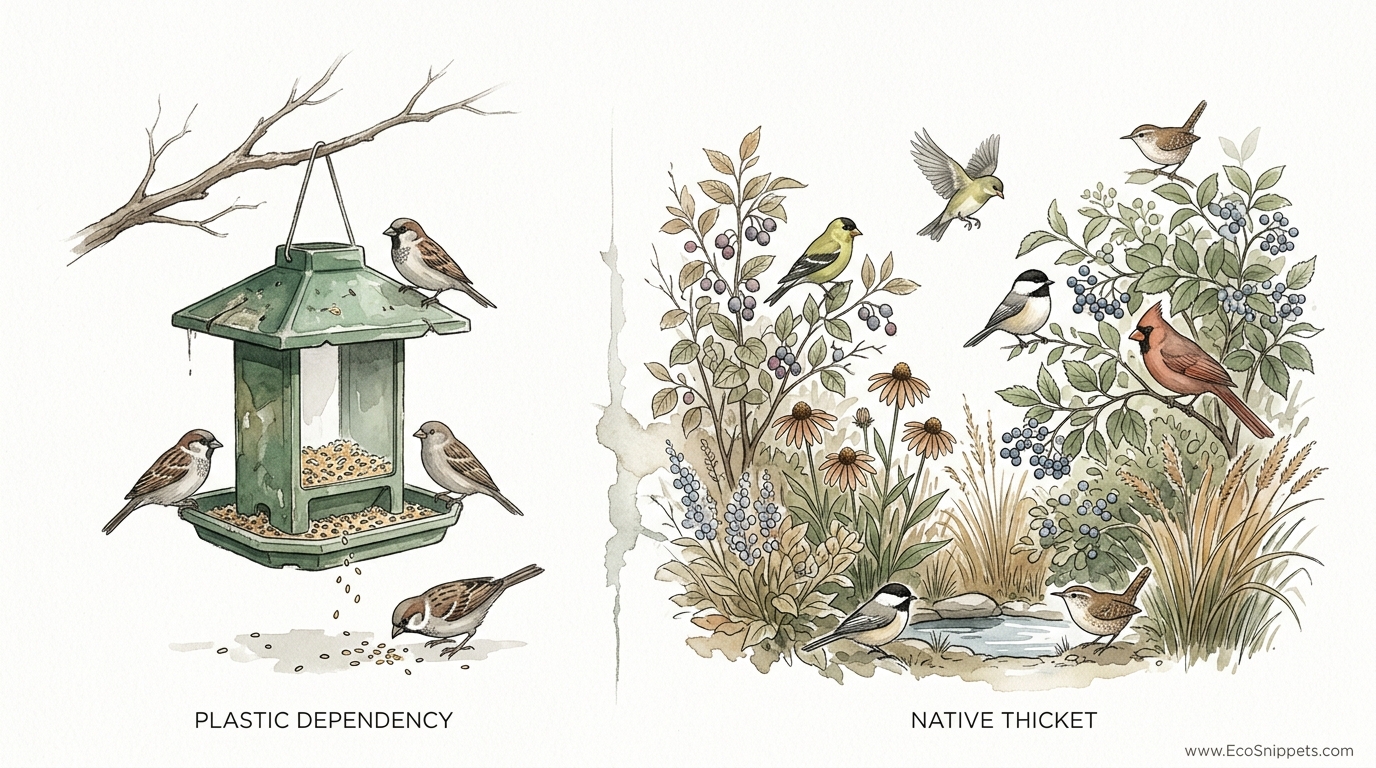
Stop buying birdseed and start growing a living grocery store in your backyard. Plastic feeders create dependency and spread disease. Planting native berry-producing shrubs creates a self-sustaining ecosystem that provides food, shelter, and nesting sites. It’s more beautiful, requires less maintenance, and supports 10x more biodiversity than a plastic tube.
Ancestral wisdom dictates that a healthy landscape should provide for all its inhabitants without constant human intervention. Modern bird feeding has become a multi-billion dollar industry that often does more harm than good by concentrating wild populations into small, unsanitary spaces. Transitioning to a native thicket restores the natural rhythm of the land and ensures your feathered neighbors have access to high-fat, high-protein fuel they actually need to survive the winter and migrate thousands of miles.
This approach moves away from the “hobbyist” mindset and toward the role of a land steward. You are not just looking at birds; you are cultivating the very foundation of their existence. True self-reliance means your backyard continues to thrive even if you never buy another bag of sunflower seeds again.
How To Attract Birds Without Birdseed
Attracting birds without seed involves replacing artificial handouts with a “living grocery store.” This concept refers to a landscape designed with layers of native plants that provide a continuous supply of food in the form of berries, nectar, seeds, and—most importantly—insects. Most terrestrial bird species, including those that visit feeders, rely on caterpillars and other protein-rich bugs to feed their young. A plastic feeder provides none of this vital nutrition.
A living grocery store mimics the natural structure of a forest edge or a wild thicket. It exists as a complex web where plants and animals have evolved together over millennia. In this system, the plants provide the fuel, and the birds provide services like pest control and seed dispersal. This is a far more robust arrangement than a plastic tube hanging from a pole, which can easily be knocked down by a storm or emptied by a clever raccoon.
Visualizing this shift requires looking past the individual bird and seeing the entire habitat. Instead of a single point of contact (the feeder), the entire yard becomes a foraging ground. Birds spend their days flitting between branches, gleaning insects from leaves, and harvesting berries that ripen at different times of the year. This natural behavior keeps them active, healthy, and less vulnerable to the predators that often stake out traditional feeding stations.
How the Living Grocery Store Works
The foundation of a seed-free bird habitat is vertical layering and plant diversity. Nature rarely grows in a single flat plane. A successful thicket incorporates a canopy of tall trees, an understory of smaller trees and large shrubs, and a ground layer of perennials and leaf litter. Each of these layers serves a specific purpose in the avian life cycle.
Native shrubs like Serviceberry (Amelanchier) and Elderberry (Sambucus) act as the primary engines of this system. These plants produce flowers that attract pollinators in the spring, followed by nutrient-dense fruit in the summer and fall. Unlike the “junk food” berries of invasive species like Japanese Barberry, native fruits are packed with the fats and lipids birds require for high-energy activities like migration. Some native berries, such as Northern Bayberry, contain nearly 50% fat by weight, providing a massive caloric boost during cold snaps.
Actionable steps to build your thicket include:
- Identify your ecoregion: Research which plants are truly native to your specific area. A plant native to your state might not be native to your specific soil type or climate zone.
- Plant in clumps: Birds feel safer in dense cover. Instead of spacing shrubs evenly, plant them in groups of three or five to create a “thick” zone where they can hide from hawks.
- Select for succession: Choose species that fruit at different times. Serviceberries provide early summer food, while Winterberry hollies hold their fruit until the dead of winter.
- Manage the “floor”: Leave the leaves. Many birds, like Fox Sparrows and Towhees, forage for insects in the leaf litter. Raking it away removes a primary food source.
Common pitfalls usually involve the “lawn mentality.” Manicured grass is an ecological desert. Shrinking the lawn and expanding the thicket is the most effective way to increase bird populations. Avoid the temptation to “clean up” dead flower stalks in the fall. These stalks often contain hibernating insects and seeds that birds will rely on when the ground is covered in snow.
Benefits of a Native Thicket Over Plastic Feeders
The practical benefits of a living grocery store extend far beyond aesthetics. The most immediate advantage is the reduction in disease transmission. Traditional bird feeders are notorious for spreading pathogens like Salmonella, Trichomoniasis, and Avian Pox. These diseases flourish when many birds of different species crowd together and defecate where they eat. A thicket spreads the birds out across the landscape, mimicking their natural foraging patterns and drastically lowering the risk of a mass die-off.
Measurable nutritional differences also favor the native approach. Research shows that native berries are significantly more nutritious than invasive alternatives or cheap seed mixes. High-fat content in native fruits allows birds to build the necessary fat reserves to survive freezing nights. Furthermore, native plants host the specific caterpillars that 96% of songbirds need to raise their chicks. A yard full of native oaks and cherries is a “caterpillar factory” that ensures the next generation of birds survives the nest.
Maintenance costs drop significantly over time. Once established, native shrubs require very little water and no fertilizer. You stop spending money on heavy bags of seed and the chemicals needed to clean plastic feeders. The landscape becomes self-sustaining, regenerating itself through natural seed dispersal and seasonal cycles. You trade the “chore” of filling feeders for the “joy” of observing a thriving, complex ecosystem.
Challenges and Common Mistakes
One frequent error is the inclusion of “near-native” or invasive species that look similar to beneficial plants but lack nutritional value. For instance, the invasive White Mulberry is often confused with the native Red Mulberry. While birds will eat the White Mulberry fruit, it is essentially “fast food” with lower nutritional density. These invasive plants can quickly take over a yard, outcompeting the high-value natives you actually want.
Patience is the primary challenge for the modern gardener. A plastic feeder provides instant gratification; the birds arrive within hours. A native thicket takes two to three years to reach a size where it provides significant food and shelter. Many people give up during this “settling in” period. Understanding the “Leap, Creep, Sleep” rule of perennial growth—where plants spend the first year establishing roots before they explode in size—is essential for staying the course.
Neglecting the water source is another common mistake. Birds need water for both drinking and bathing, especially in winter when natural sources might be frozen. A heated birdbath or a simple shallow basin with a “bubbler” to keep the water moving is a necessary companion to your thicket. Keeping this water clean is just as important as keeping a feeder clean, though the risks are slightly lower in a moving-water system.
Limitations and Realistic Expectations
Environmental constraints can dictate the success of a seed-free approach. If you live in a highly urbanized area with no surrounding green space, your “living grocery store” might act as an isolated island. While you will still attract birds, you might not see the massive diversity found in more connected landscapes. In these cases, your yard serves as a vital “rest stop” rather than a full-time residence.
Small yards also face spatial boundaries. You cannot plant a massive oak tree in a ten-foot-wide patio. However, you can still utilize vertical space with native vines like Virginia Creeper or Trumpet Honeysuckle. These provide nectar and berries without taking up a large footprint. Scaling your expectations to the size of your land prevents frustration and ensures you choose the right plants for the space available.
Time to maturity is a trade-off. If your goal is to help birds *today*, you might need to use a transition period where you keep one clean feeder while your shrubs grow. Just ensure that the feeder is cleaned weekly with a 10% bleach solution to prevent the very diseases the thicket is designed to avoid.
Comparison: Native Thicket vs. Plastic Dependency
| Factor | Native Thicket (The Living Grocery Store) | Plastic Dependency (Traditional Feeders) |
|---|---|---|
| Initial Cost | Moderate (Buying saplings/seeds) | Low (Buying the plastic tube) |
| Long-term Cost | Near Zero | High (Constant seed purchases) |
| Maintenance | Seasonal pruning/mulching | Daily filling/Weekly sanitizing |
| Disease Risk | Very Low (Natural dispersal) | Very High (Crowding/Contamination) |
| Biodiversity | Supports insects, birds, and soil | Supports only seed-eating birds |
| Resilience | Self-sustaining and drought-tolerant | Dependent on human intervention |
Practical Tips for Success
Choosing the right species is the most important decision you will make. Focus on “keystone” plants—species that support an outsized number of insects and birds. Native Oaks (Quercus) and Cherries (Prunus) are the gold standard for supporting caterpillar populations. For berries, nothing beats the Serviceberry (Amelanchier) for summer food and the Arrowwood Viburnum for high-fat fall fuel.
Techniques for planting include:
- Sheet Mulching: Instead of digging up grass, lay down cardboard and cover it with mulch. This kills the grass and builds soil health for your new shrubs without disturbing the existing soil microbes.
- Vertical Layering: Plant a tall tree (Oak), a medium shrub (Spicebush), and a groundcover (Wild Strawberry) in the same area. This creates three distinct feeding zones in the footprint of one.
- Sanitation: Even without a feeder, keep your birdbath scrubbed. Use a stiff brush and water to remove algae and droppings every few days.
- Avoid “Nativars”: Stick to the straight species of native plants. Many cultivated “nativars” are bred for showy flowers but produce less nectar or lower-quality fruit than the wild versions.
Optimization involves observing the birds. If you notice they aren’t using a certain area, it might be too open. Adding a simple brush pile made of fallen branches can provide the temporary cover they need to feel safe enough to visit the rest of your thicket.
Advanced Considerations for the Serious Practitioner
Serious land stewards look at phenology—the timing of biological events. The goal is to have “bloom and fruit overlap.” You want your spicebush to flower just as the first migrants return, providing them with immediate nectar. You want your dogwood berries to be at peak ripeness just as the fall migration begins. Mapping out the fruiting schedule of your yard ensures there are no “hunger gaps” throughout the year.
Soil health is another advanced metric. Native plants have evolved in specific soil types. Using a soil test to determine pH and drainage can help you select the exact species of Willow or Pine that will thrive. Healthy plants produce more nutrient-dense fruit. Instead of using chemical fertilizers, allow the natural leaf litter to decompose and return nutrients to the earth. This supports the fungal networks (mycorrhizae) that help your thicket resist drought and disease.
Succession planning involves thinking about the yard twenty years from now. As smaller shrubs grow and begin to shade out the ground, you may need to introduce shade-tolerant groundcovers. This dynamic management keeps the ecosystem healthy and prevents any single species from becoming a monoculture. A diverse thicket is a resilient thicket.
Scenario: The Quarter-Acre Transformation
Consider a standard suburban quarter-acre lot dominated by turfgrass. The homeowner decides to stop buying seed and starts planting. In the first year, they remove a 20×20 foot section of grass in the back corner. They plant one Downy Serviceberry tree, three Arrowwood Viburnums, and a handful of Purple Coneflowers.
By the second year, the Serviceberry provides its first small crop of berries in June. Cedar Waxwings, which rarely visit feeders, appear for the feast. The Viburnums have grown into a dense hedge, and the homeowner notices Catbirds nesting deep within the branches. Because the grass has been replaced with mulch and leaf litter, the ground is soft, allowing Robins to easily pull up worms and insects.
By year five, the thicket is a self-sustaining powerhouse. The homeowner no longer buys birdseed, saving approximately $300 a year. The yard is filled with song from dawn until dusk. During a particularly harsh winter, while neighbors struggle to keep their feeders filled and clean, the birds in this yard are busy harvesting the fat-rich berries of the Winterberry shrubs that were planted in year three. The ecosystem is working exactly as nature intended.
Final Thoughts
Building a living grocery store is an act of defiance against the convenience of plastic-bound dependency. It requires shifting your perspective from a consumer of nature to a participant in it. Replacing the feeder with a thicket does more than just feed birds; it heals the land, supports the insect populations that underpin our entire food system, and creates a legacy of beauty that grows stronger with every passing season.
Start small if you must, but start now. Plant one native shrub this weekend and leave the leaves where they fall. Observe the changes in your yard as the birds begin to forage naturally. You will soon find that the satisfaction of seeing a chickadee glean a caterpillar from a leaf you provided is far greater than the sight of ten birds fighting over a pile of store-bought seed.
Experiment with different species and watch how the wildlife responds. Nature is resilient and eager to return if given the proper foundation. Your backyard can be the starting point for a wider recovery of biodiversity, one native thicket at a time. Embrace the grit of stewardship and enjoy the wild, self-sustaining sanctuary you have created.
