How To Become More Self-Sufficient Without Starting a Full-Blown Farm…
Want to start preserving your harvest, making your own soap, or building a backyard root cellar — but not sure where to begin? “Homesteading Advice” gives you instant lifetime access to 35+ practical homesteading books on food preservation, veggie gardening, DIY natural cleaning products (save over $250 per year with this skill alone), brewing, off-grid energy, and a whole lot more…
Click Here To Check It Out Now!
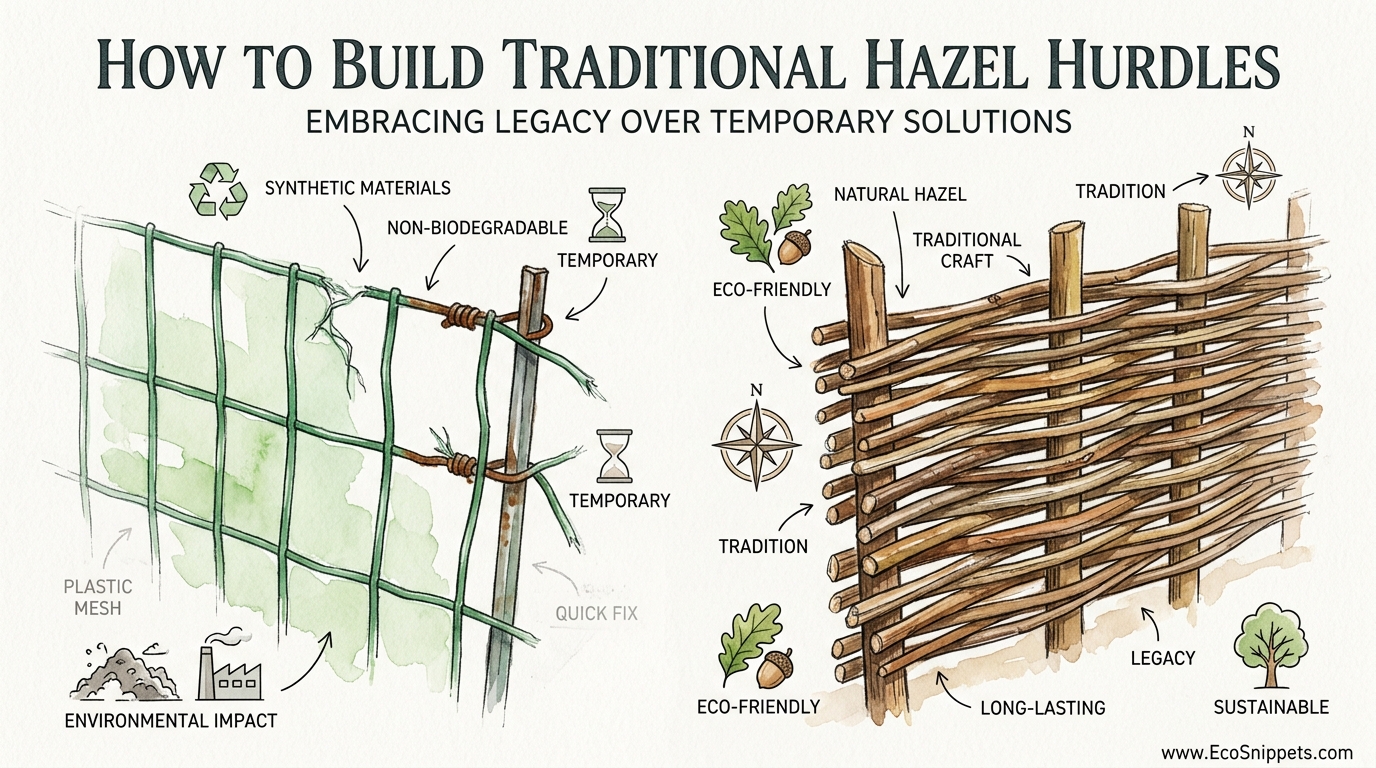
Why settle for a plastic border that shreds into your soil when you can build a legacy that feeds it? Every piece of plastic you put in your garden is a future microplastic problem. Woven hazel hurdles have been used for a millennia because they work, they’re beautiful, and they feed the soil when they’re finally done. It’s time to stop buying trash and start weaving a legacy.
Building a traditional hazel hurdle is more than just a weekend DIY project. It is a handshake with the past. Our ancestors didn’t have access to hardware stores or chemical-treated lumber. They had the woods, a sharp blade, and the wisdom to work with the grain of the land.
When you weave a hurdle, you are participating in a system of woodland management that has kept forests healthy for thousands of years. You are using materials that grew from the sun and rain, and which will eventually return to the earth without leaving a trace of poison behind. This guide will show you how to master the art of the hurdle, from the first cut to the final twist.
How To Build Traditional Hazel Hurdles
A hazel hurdle is a handwoven fence panel made from “rods” of coppiced hazel. These panels were historically portable, used by shepherds to create temporary sheep pens during lambing season. Because they are woven, they are incredibly strong yet flexible enough to withstand the most brutal winds.
The beauty of the hurdle lies in its engineering. There are no nails, screws, or glues holding it together. The tension of the weave and the friction of the wood do all the work. It is a self-supporting structure that breathes with the landscape.
In a modern garden, these hurdles serve as windbreaks, privacy screens, or elegant boundaries for vegetable patches. They offer a texture and warmth that no factory-made fence can replicate. Most importantly, they are a product of coppicing—a sustainable harvesting method where trees are cut back to the ground to encourage a flush of straight, vigorous new growth.
Understanding the Materials
You cannot build a good hurdle with dead, brittle wood. You need green, flexible hazel harvested during the dormant season, typically between October and March. This is when the sap is down, and the wood is at its most pliable.
Hazel is the gold standard for this craft because its fibers are straight and remarkably resilient. While willow can be used for smaller, decorative wattles, hazel provides the “heft” and longevity required for a serious garden boundary. A well-made hazel hurdle can last up to a decade or more if it is kept off the damp ground.
The Tools of the Trade
Traditional woodcraft requires a specific set of tools, most of which have remained unchanged for centuries. These are not power tools; they are extensions of your hands that require a sharp edge and a bit of “pioneer grit” to master.
The Billhook
The billhook is the primary tool of the hurdle maker. It has a curved blade that is perfect for clean, upward cuts when harvesting and trimming side-twigs from hazel rods. Its weight also makes it ideal for cleaving wood.
The Shave Horse and Drawknife
A shave horse is a foot-operated vice that allows you to sit while you work. You use your feet to clamp a piece of wood in place, leaving both hands free to use a drawknife. This setup is essential for “shaving” the uprights or cleaning up the ends of your weave.
The Froe and Maul
To split thicker hazel rods into “clefts,” you use a froe. This is an L-shaped tool that you tap into the end of a log with a wooden maul. Once the blade is in, you use the handle as a lever to pry the wood apart along its natural grain.
The Foundation: Creating the Mold
Before you start weaving, you need a way to hold your uprights in place. This is done using a “former” or a “mold.” Historically, this was simply a heavy log with holes drilled into it, but a modern version can be made from a thick timber beam or even by driving temporary stakes into the ground.
Setting the Zales
The vertical uprights of a hurdle are called “zales” or “sails.” For a standard six-foot hurdle, you typically use nine zales. The end zales should be the thickest, usually around one to two inches in diameter, as they take the most tension from the weave.
The internal zales can be slightly thinner. Space them evenly across your mold, ensuring they are seated firmly so they don’t wander as you begin to weave. If your zales are too loose, the tension of the horizontal rods will pull them out of alignment, resulting in a wonky, unstable panel.
Step-by-Step Weaving Technique
Weaving a hurdle is a rhythmic process. It starts at the bottom and builds upward, layer by layer.
The Bottom Weave (Wattle)
Start with your thinnest, most flexible rods. These are called “weavers” or “ethers.” Insert the butt end of a rod behind the first zale and weave it in and out of the subsequent uprights.
Use two rods at once in a “pairing” weave for the first few rows. This creates a solid foundation that locks the zales in place. Push the weave down firmly after every row. A loose weave is a weak weave; you want the wood to be packed tight.
Clefting the Rods
As you move up the hurdle, you will want to use thicker rods for strength. However, thick, round rods are difficult to bend around the end zales. To solve this, traditional makers “cleft” or split the hazel in half.
Use your billhook to start a split at the butt end of a rod. Once the split is started, you can often pull the two halves apart by hand, or use the blade to guide the split down the center. Cleft hazel is much more flexible than round wood and lays flatter, creating a tighter, more attractive finish.
The Hurdle Maker’s Twist
The most difficult part of the process is the turn at each end. When a rod reaches the last zale, you cannot simply bend it; it will likely snap. Instead, you must use a “twist and turn” technique.
You grip the rod and twist it 180 degrees as you wrap it around the zale. This twisting action separates the fibers of the wood, making it behave like a rope rather than a stick. This is the hallmark of a master craftsman. If you can master the twist, your hurdle will be incredibly strong.
Benefits of Traditional Hazel Hurdles
Choosing a handwoven hazel hurdle over a standard store-bought fence offers several practical and environmental advantages. These benefits go beyond simple aesthetics.
- Wind Resistance: Unlike solid panels that act like sails in a storm, the woven structure of a hurdle allows wind to filter through. This reduces the pressure on the posts and makes the hurdle much less likely to blow over.
- Biodiversity Support: Coppiced hazel is a renewable resource. By using it, you support the management of local woodlands, which creates habitats for birds, insects, and rare wildflowers like primroses and bluebells.
- Soil Health: When a hazel hurdle eventually reaches the end of its life, it doesn’t leave behind chemicals or plastics. It can be chipped for mulch or left to rot down, returning nutrients to the soil.
- Aesthetic Authenticity: No two hurdles are exactly alike. They provide a rustic, timeless look that settles into a garden immediately, unlike the harsh look of new, pressure-treated lumber.
Challenges and Common Mistakes
Working with natural materials is not always predictable. Beginners often face a few common hurdles—pun intended—when starting out.
Using Dry Wood
The biggest mistake is trying to weave with wood that has already dried out. Once hazel loses its internal moisture, the fibers become brittle. If you can’t weave your rods immediately after harvesting, store them in a cool, damp place or soak them in water for a few days to restore their flexibility.
Ignoring the Grain
Wood has a memory and a direction. If you try to force a rod against its natural curve, it will fight you every step of the way. Learn to look at the rod before you weave it. If it has a slight bend, use that bend to your advantage when wrapping it around a zale.
Inconsistent Tension
If you don’t pull your weavers tight enough at the ends, the hurdle will become “baggy” in the middle. Conversely, if you pull too hard on one side, you will pull the zales out of vertical alignment. Constantly check the level and the plumb of your zales as you work.
Limitations: When This May Not Be Ideal
While hazel hurdles are magnificent, they are not a “set it and forget it” solution for every situation. There are trade-offs to consider.
One major limitation is longevity in high-moisture environments. If you live in an area with constant rain and heavy, waterlogged soil, the bottom of the hurdle will rot within a few years if it is in direct contact with the ground. In these cases, you might need to mount them on a gravel board or a stone base.
Furthermore, building a hurdle takes time and physical effort. If you need 500 feet of fencing by tomorrow, hand-weaving isn’t the answer. This is a slow craft for those who value the process as much as the result.
Comparison: Legacy Hazel vs. Temporary Plastic
When deciding on a garden boundary, it is helpful to look at how traditional materials stack up against modern alternatives.
| Feature | Legacy Hazel Hurdles | Temporary Plastic Fencing |
|---|---|---|
| Material Source | Sustainable local coppice | Petroleum-based chemicals |
| Lifespan | 8–12 years | 5–20 years (degrades via UV) |
| End of Life | Composts into soil | Breaks into microplastics |
| Maintenance | Annual oiling (optional) | None, but unrepairable |
| Cost | High (labor) or Low (DIY) | Moderate |
While plastic may seem easier in the short term, the long-term cost to the environment and the soul of the garden is much higher. The “legacy” of a hazel hurdle is the health of the ground it eventually feeds.
Practical Tips and Best Practices
If you want your hurdles to stand the test of time, follow these field-tested tips from experienced woodworkers.
- Treat with Linseed Oil: While hazel doesn’t strictly need treatment, a mixture of linseed oil and turpentine applied every year can significantly extend its life by repelling moisture.
- Elevate the Base: Never let the bottom row of your weave sit in the dirt. Leave a two-inch gap at the bottom or place the hurdle on a bed of free-draining gravel to prevent rot.
- Use Proper Posts: Use sweet chestnut or oak posts to support your panels. These woods are naturally rot-resistant and will outlast the hazel, allowing you to simply swap in new panels when the old ones finally tire out.
- Alternate the Butts: When weaving, alternate which end of the rod (the thick butt or the thin tip) starts at which zale. This keeps the height of the hurdle even. If you start all the butts on the same side, your fence will quickly become lopsided.
Advanced Considerations: The Dorset Pattern
For those who have mastered the basic weave, there are regional variations that offer even more strength. The “Dorset Hurdle” is famous for its intricate top braid, often called “ethering.”
This involves taking three or four long, thin rods and braiding them across the very top of the zales. This braid acts like a “capstone” on a wall, locking everything below it into a single, rigid unit. It is also an opportunity to use different woods, like dogwood or willow, to add a splash of color to the top of your work.
Scenario: The Living Compost Bin
One of the best ways to practice your hurdling skills is by building a compost bin. Instead of a flat panel, you weave a continuous circle around four or five zales driven directly into the ground.
This creates a “living” structure that allows air to circulate through the compost, speeding up the decomposition process. As the bin eventually begins to rot itself, you simply weave a new layer of hazel around the outside of it. The old bin becomes part of the compost, and the cycle continues. This is the ultimate expression of the “pioneer-grit” philosophy: nothing is wasted, and everything has a purpose.
Final Thoughts
Building a traditional hazel hurdle is an act of defiance against the “throwaway” culture of the modern world. It requires you to slow down, sharpen your tools, and listen to what the wood is telling you. It is a skill that rewards patience and honors the land.
When you stand back and look at a finished hurdle, you aren’t just looking at a fence. You are looking at a year of growth from a forest, a few hours of your own honest labor, and a structure that will eventually feed the very flowers it protects.
Start small, perhaps with a low border for a herb garden. Once you master the “twist and turn,” you will find yourself looking at every stand of hazel in the woods with new eyes. You won’t just see a tree; you will see the potential for a legacy. Explore the art of coppicing and internalize the rhythm of the seasons—your garden, and the earth beneath it, will thank you.
