How To Become More Self-Sufficient Without Starting a Full-Blown Farm…
Want to start preserving your harvest, making your own soap, or building a backyard root cellar — but not sure where to begin? “Homesteading Advice” gives you instant lifetime access to 35+ practical homesteading books on food preservation, veggie gardening, DIY natural cleaning products (save over $250 per year with this skill alone), brewing, off-grid energy, and a whole lot more…
Click Here To Check It Out Now!
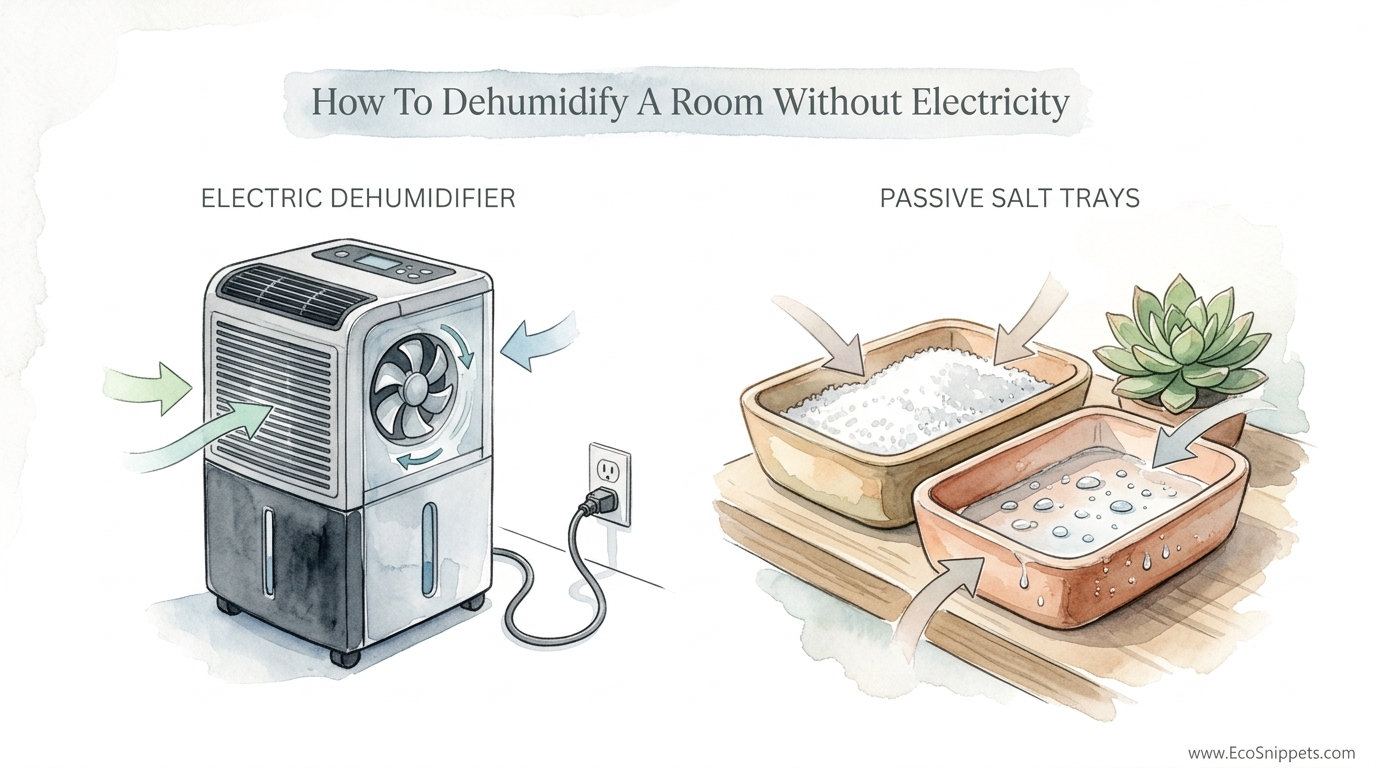
One drains your battery bank and makes noise; the other uses the power of chemistry to dry your air for free. Stop paying a monthly utility bill to fight the dampness in your home. While electric dehumidifiers are loud, bulky, and expensive to run, passive salt trays use simple hygroscopic principles to pull moisture from the air 24/7. No plugs, no noise, and zero carbon footprint.
You might be wondering how a simple tray of minerals can compete with a high-tech machine. The answer lies in the same wisdom our ancestors used to preserve meat and keep root cellars dry for generations. Humidity isn’t just a comfort issue; it is a slow-moving threat to your home’s structure, your health, and your food stores.
Modern living has made us dependent on the grid for even the simplest tasks. When the power goes out, or when you are trying to live a more self-reliant lifestyle, those heavy plastic machines become nothing more than expensive paperweights. Learning to harness the natural thirst of salt gives you a tool that works as long as the laws of physics exist.
How To Dehumidify A Room Without Electricity
Passive dehumidification is the process of using hygroscopic materials to attract and hold water molecules from the surrounding environment. Unlike an electric unit that uses a compressor and cooling coils to force condensation, salt-based systems rely on the natural affinity certain minerals have for water. This is a “passive” system because it requires no external energy source once it is set up.
In the real world, this method is a lifesaver for off-grid cabins, seasonal RV storage, and traditional root cellars. It exists because moisture is an opportunistic traveler; it creeps into every corner of a home, feeding mold spores and rotting timber. Salt trays act as a magnet, drawing that moisture into a concentrated area where it can be managed.
Think of a salt tray like a dry sponge that never needs to be squeezed by hand. Instead of mechanical parts, it uses chemical potential. When the air is thick with water vapor, the salt crystals essentially “pull” the vapor out of the gas phase and turn it into a liquid brine. It is a slow, steady, and relentless process that guards your space without a single moving part.
The Mechanics of Hygroscopy: Why Salt Breathes
Salt is more than just a seasoning; it is a chemical powerhouse. Most salts are hygroscopic, meaning they can attract and hold water molecules through either absorption or adsorption. When you see your salt shaker clumping on a humid day, you are witnessing this principle in action. The salt is literally pulling the humidity out of the kitchen air.
Some salts, like calcium chloride, are “deliquescent.” This means they are so hungry for water that they will eventually absorb enough moisture to dissolve completely and turn into a liquid solution. This is the gold standard for passive dehumidification. Sodium chloride, or common rock salt, is also effective but has a lower capacity for moisture before it reaches equilibrium.
Molecularly, the surface of a salt crystal is highly attractive to the polar nature of water molecules. As air circulates over the tray, the water vapor sticks to the salt. Over time, the salt crystals bond with the water, creating a brine. In a well-designed system, this brine drips into a reservoir, leaving the remaining dry salt on top to continue the work.
Step-by-Step: The “Pioneer Bucket” Dehumidifier
Building a high-capacity moisture trap is a straightforward task that requires only a few basic supplies. You will need two five-gallon buckets, a drill, and a bag of calcium chloride or rock salt. This “double-bucket” system is the most efficient way to manage larger rooms or basements.
First, take the top bucket and drill approximately 20 to 30 small holes in the bottom. These holes should be large enough for liquid to pass through but small enough that your salt crystals don’t fall out. A 1/8-inch drill bit is usually perfect for this task.
Next, place the bucket with holes inside the solid bucket. There should be a few inches of space at the bottom of the solid bucket to collect the liquid. If the buckets nest too tightly, you can place a brick or a small block of wood in the bottom bucket to keep the top one elevated.
Fill the top bucket with your chosen salt. As the salt pulls moisture from the air, the resulting liquid brine will filter through the holes and collect in the bottom bucket. You simply need to check the reservoir every few weeks and empty the liquid, while occasionally topping off the salt in the upper bucket.
The Hanging Sock Method for Small Spaces
For closets, pantries, or gun safes, a five-gallon bucket is often too cumbersome. The hanging sock method is a traditional alternative that uses vertical space. All you need is an old tube sock, some string, and a plastic container to catch the drips.
Fill the sock with calcium chloride pellets and tie a knot at the top. Suspend the sock over the plastic container using the string. This method allows air to circulate around the entire surface of the salt-filled sock, maximizing the “pull” of the mineral.
Gravity does the work here. As the salt becomes saturated, the brine will seep through the fabric and drip into the container below. This is an excellent way to keep your winter clothes from smelling musty or to prevent rust on tools in a small cabinet.
Benefits of Passive Moisture Control
Choosing passive salt trays over electric units offers several distinct advantages that appeal to the frugal and the self-reliant. The most immediate benefit is the cost. Once you have the buckets or trays, your only recurring expense is the salt, which can often be bought in bulk for a fraction of the cost of a monthly utility bill.
Silence is another major factor. Electric dehumidifiers hum and vibrate, which can be disruptive in a quiet home or sleeping area. Salt trays work in absolute silence, making them ideal for bedrooms or libraries. They are also incredibly durable; there are no motors to burn out, no filters to clog, and no electronics to fail during a power surge.
From an environmental standpoint, this method is nearly invisible. It uses no electricity and can be managed using recycled containers. For those living off-grid on solar or wind power, every watt saved is a watt that can be used for essential tools or lighting. Salt trays allow you to maintain a healthy environment without taxing your battery bank.
Common Pitfalls: The Corrosive Nature of Brine
The most significant mistake people make when using salt trays is underestimating the corrosive power of the collected liquid. The brine that collects in your reservoir is not just “salty water”—it is a concentrated chemical solution that can eat through metal and damage wood surfaces if spilled.
Never place a salt tray directly on a finished wood floor or near metal objects without a secondary containment tray. If the reservoir overflows or a pet knocks it over, the cleanup is difficult and the damage can be permanent. Always use sturdy, tip-proof containers and place them in areas where they won’t be disturbed.
Another common error is using the wrong type of salt. While table salt will work in a pinch, it is far less efficient than rock salt or calcium chloride. If you use a salt with a low hygroscopic rating, you might find that the air remains damp despite your efforts. Ensure you are using high-purity minerals intended for moisture removal or ice melting.
Limitations: When the Salt Reaches Its Limit
Passive dehumidification is a “slow and steady” approach. It is not designed to dry out a basement that has just been flooded or a bathroom with a steaming shower running 24/7. In those high-moisture scenarios, the rate of evaporation will likely exceed the rate of salt absorption.
Salt trays are maintenance-level tools. They are best used to keep a dry space dry, or to manage moderate humidity in enclosed areas. If your relative humidity is consistently above 70%, you may need several large bucket systems or a combination of improved ventilation and passive traps to see a significant difference.
Temperature also plays a role. In very cold environments, the chemical reaction slows down. While salt will still pull moisture in a cold cellar, it will do so much more slowly than in a warm, humid attic. Understanding these boundaries helps you set realistic expectations for your moisture control strategy.
Electric Dehumidifier vs Passive Salt Trays
| Feature | Electric Dehumidifier | Passive Salt Trays |
|---|---|---|
| Operating Cost | High (Monthly electricity) | Low (Occasional salt refill) |
| Noise Level | Loud (45-60 dB) | Silent (0 dB) |
| Speed of Extraction | Fast (Pints per day) | Slow (Constant drip) |
| Complexity | High (Mechanical parts) | Zero (Simple chemistry) |
| Off-Grid Ready | No (Requires power) | Yes (Works 24/7) |
Optimization: Placement and Airflow Dynamics
To get the most out of your salt trays, you must think about where the moisture lives. Humidity tends to settle in stagnant corners and low-lying areas. Placing your salt trap in the center of a room or near a source of air movement will significantly increase its effectiveness.
If you have a small battery-operated fan, you can place it near the salt tray to create a “forced-air” desiccant system. Moving air across the surface of the salt ensures that fresh, moist air is constantly being presented to the crystals. This can double or triple the extraction rate compared to a tray sitting in a dead corner.
Surface area is your best friend. A tall, narrow container of salt has very little surface area exposed to the air. A wide, shallow tray allows more salt crystals to come into contact with the atmosphere. If you are using the bucket method, stirring the salt once a week can help prevent “crusting” and keep the surface active.
The Self-Reliant Loop: Regenerating Your Salt
One of the most advanced techniques for the dedicated homesteader is the regeneration of salt. While calcium chloride eventually turns into a liquid brine, that brine is still valuable. You can technically drive the water back out of the solution to reclaim the salt crystals.
Spread the brine thinly in a large, black metal tray and place it in the direct sun. This solar evaporation process removes the water and leaves behind the solid minerals. Once the salt is dry and crusty, you can break it up with a hammer and reuse it in your moisture traps.
Keep in mind that this requires a significant amount of heat. In the summer months, this is a “free” way to recycle your materials. During the winter, you might find it more efficient to simply use fresh salt, but having the knowledge to reclaim your desiccant is a core skill for long-term survival and self-sufficiency.
Historical Context: How Our Ancestors Fought the Damp
Long before we had the luxury of pressing a button to change our climate, our ancestors understood the danger of dampness. In pioneer times, a wet root cellar meant rotted potatoes and a starving family by spring. They didn’t have plastic buckets, but they had salt.
Large blocks of rock salt were often placed in the corners of storage rooms to act as natural dehumidifiers. They also used charcoal and wood ash, which have similar (though less powerful) hygroscopic properties. Salt was so valuable—often referred to as “white gold”—that using it for moisture control was a sign of a well-managed and wealthy homestead.
During the Civil War, salt became a strategic resource not just for food, but for maintaining dry conditions for gunpowder and leather goods. The transition from these ancient, reliable methods to our modern, fragile electrical systems happened quickly, and many of these simple skills were nearly lost. Reclaiming them today is an act of resilience.
Practical Application: The Winter Cabin Scenario
Imagine you have a small cabin in the woods that stays closed up for most of the winter. Without any climate control, the interior air becomes stagnant and moist, leading to that classic “old cabin” smell—which is actually the scent of mold and mildew eating the curtains and wood.
By placing four five-gallon salt traps in the corners of the main room before you leave, you create a 24-hour defense system. As the temperature drops and moisture tries to condense on the walls, the salt pulls it in instead. When you return in the spring, the air is crisp and the fabrics are dry.
This scenario demonstrates the true power of passive systems. They don’t need a caretaker, they don’t risk an electrical fire, and they don’t care if the snow has knocked out the power lines. They simply do the job they were designed to do, one molecule at a time.
Final Thoughts
The transition away from energy-intensive machines and back toward simple, effective chemistry is more than just a way to save money. It is a shift in mindset that prioritizes reliability over convenience. By using salt trays to dehumidify your home, you are taking a small but significant step toward a more grounded and independent way of living.
These systems provide a silent, steady service that protects your property and your health. Whether you choose the bucket method for a basement or a simple tray for a pantry, the results speak for themselves. You will find that the air feels lighter, the musty odors vanish, and your reliance on the grid diminishes.
Experiment with different salts and placements in your own home. Observe how much liquid collects during different seasons and learn the rhythm of your environment. Once you master the power of chemistry to dry your air, you will never look at a noisy, power-hungry dehumidifier the same way again.
