How To Become More Self-Sufficient Without Starting a Full-Blown Farm…
Want to start preserving your harvest, making your own soap, or building a backyard root cellar — but not sure where to begin? “Homesteading Advice” gives you instant lifetime access to 35+ practical homesteading books on food preservation, veggie gardening, DIY natural cleaning products (save over $250 per year with this skill alone), brewing, off-grid energy, and a whole lot more…
Click Here To Check It Out Now!
You don’t need a hundred acres to grow a forest – you just need the right density. The Miyawaki method turns traditional forestry on its head. Planting native species ultra-densely triggers a competitive growth spurt that creates a mature ecosystem in record time. It’s the ultimate environmental hack for urban homesteaders who want maximum carbon sequestration and bird habitat in a tiny space.
Ancestral wisdom often hides in plain sight, and for Japanese botanist Dr. Akira Miyawaki, it was tucked away in the ancient “Chinju-no-mori” or sacred shrine groves. These tiny pockets of primary forest survived for centuries while the surrounding landscape was cleared for timber and rice. These groves held the genetic blueprints of what the land actually wanted to grow. Modern landscaping often forces a sterile, high-maintenance order onto the earth. A Miyawaki forest does the opposite. It invites the wild back in, but it does so with a calculated intensity that compresses forty years of natural succession into three.
Taking on a project like this requires more than just a green thumb; it requires the grit of a pioneer and the patience of a steward. You are not just planting trees. You are building a self-regulating machine of wood, leaf, and fungi that will eventually look after itself.
How To Plant A Miyawaki Forest In Your Backyard
A Miyawaki forest is a dense, multi-layered planting of native species designed to mimic a primary, old-growth forest. Traditional forestry usually spaces trees several meters apart to prevent competition. The Miyawaki method thrives on competition. Planting three to five saplings per square meter forces every plant to race toward the light. This vertical pressure results in growth rates up to ten times faster than conventional methods.
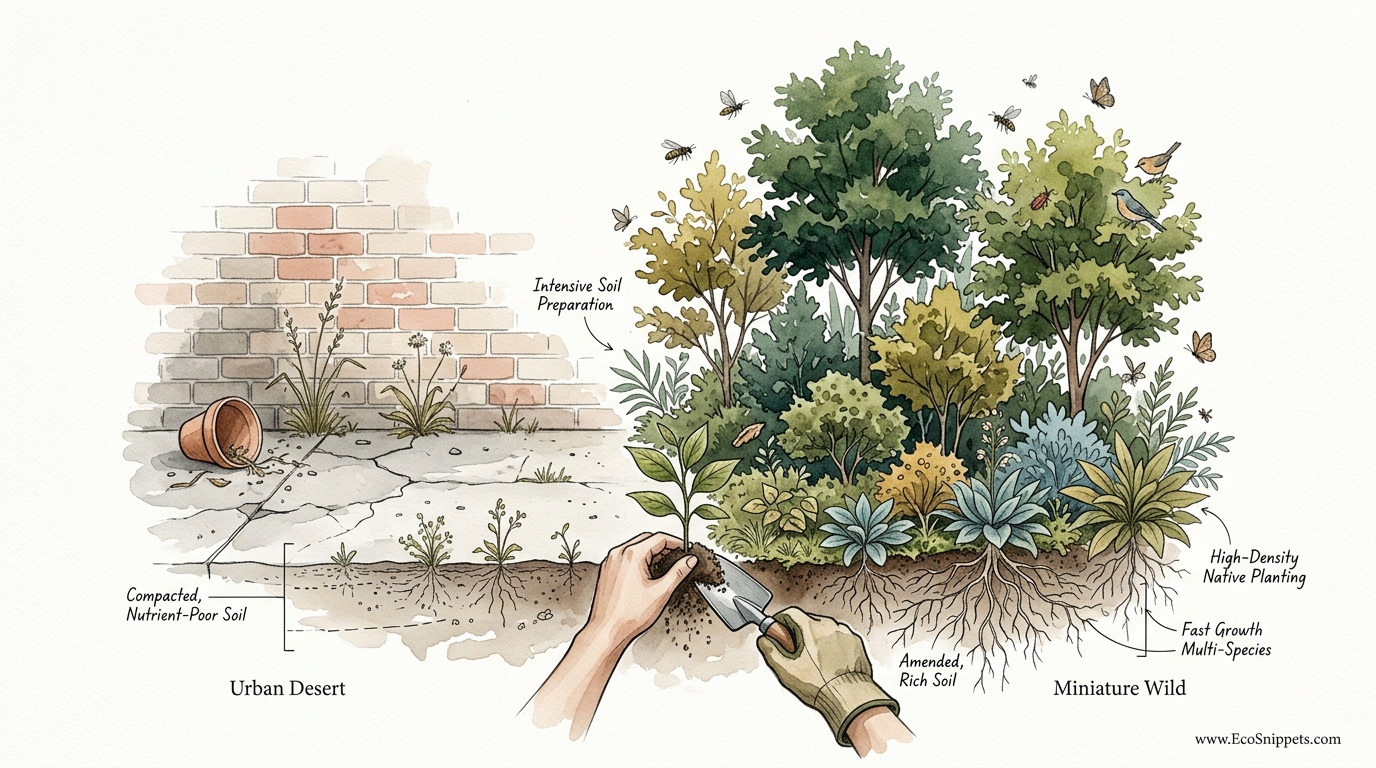
This system exists because our urban environments have become biological deserts. Modern backyards are frequently dominated by a single species of non-native grass and perhaps one or two ornamental trees that provide zero forage for local wildlife. A Miyawaki forest, or “pocket forest,” can be established on a patch of land as small as three square meters. It serves as a biological “miniature wild” that restores soil health, cools the local microclimate, and creates a refuge for pollinators and birds.
Imagine a crowd of people standing in a small room. If everyone stands far apart, they remain isolated individuals. If they stand shoulder-to-shoulder, they form a single, cohesive unit. This is the principle of the pocket forest. The root systems interlock, creating a shared fungal network that distributes nutrients and water. The dense canopy creates a “forest floor” climate that stays moist and cool, even in the heat of summer.
The Four-Layer Architecture of a Resilient Forest
A true forest is never a flat line of uniform height. It is a complex skyscraper of vegetation. Dr. Miyawaki identified four distinct layers that must be present for a pocket forest to function as a mature ecosystem. Neglecting even one of these layers reduces the forest’s ability to shade out weeds and sequester carbon.
The Canopy Layer
Canopy trees are the giants. These species would naturally dominate the landscape if left alone for five hundred years. They provide the primary structure and the highest level of carbon storage. In a backyard setting, you select native climax species that have deep roots and wide crowns. These trees eventually form the “roof” of your ecosystem.
The Tree Layer
Tree-level species sit just below the canopy. They are slightly shorter but equally vital. They fill the mid-level vertical space and provide the bulk of the nesting sites for larger birds. These trees are often the most prolific seed producers in the forest, ensuring the long-term survival of the grove.
The Sub-Tree Layer
Sub-trees are the specialists of the shade. They thrive in the dappled light filtered down from above. This layer adds incredible density to the forest, acting as a windbreak and a sound barrier. Many sub-tree species produce fruit or berries that sustain local wildlife throughout the winter months.
The Shrub Layer
Shrubs form the dense “walls” of the forest. They are the first line of defense against invasive weeds and human-caused disturbances. These plants stay low to the ground and fill every remaining gap. A thick shrub layer ensures that the sun never hits the soil directly, keeping the rhizosphere protected and moist.
Preparing the Ground: Soil Surgery for Tiny Woodlands
Urban soil is rarely ready for a forest. Most residential plots consist of “urban fill”—compacted clay, rocks, and debris left over from construction. Forest trees require “crumbly” soil that is rich in organic matter and dominated by fungi rather than bacteria. Preparing the site is the most labor-intensive part of the process, but it determines the success of the next thirty years.
Decompaction is the first priority. You must loosen the soil to a depth of at least 30 centimeters, though one meter is the gold standard for rapid growth. Use a pickaxe or a broadfork to break up the hardpan. Roots cannot penetrate “concrete” soil; they need air pockets to breathe and expand.
Adding biomass is the next step. A mixture of water-retaining materials, organic fertilizers, and aeration agents must be incorporated into the loosened earth. Common amendments include coir pith or peat moss for moisture, composted cow or goat manure for nutrients, and rice hulls or wood shavings for aeration. A standard ratio is 1:1:1:1 for soil, moisture retainer, fertilizer, and aerator. This mixture mimics the rich, spongy floor of an ancient woodland.
Microbial life is the secret engine of the forest. Mixing in a small amount of “duff” or leaf litter from a nearby healthy, native forest can inoculate your soil with the local mycorrhizal fungi. These fungi form symbiotic relationships with the tree roots, essentially extending the root system by hundreds of feet.
Selecting Your Native Crew: The PNV Approach
Success in the Miyawaki method depends on a concept called Potential Natural Vegetation (PNV). This refers to the species that would naturally occur in your specific location if human interference ceased. Choosing “native” plants is not enough; you must choose the climax species specific to your exact soil type and elevation.
Researching your PNV often involves looking at local botanical records or visiting nearby nature preserves that haven’t been disturbed. You should aim for a diversity of 30 to 50 different species. This diversity ensures that if one species falls victim to a specific pest or disease, the rest of the forest remains standing.
A typical species mix should be 70% to 80% canopy and sub-canopy trees. The remaining 20% to 30% consists of shrubs and herbaceous plants. This ratio creates the vertical pressure needed for rapid growth while ensuring the ground stays protected. Avoid ornamental cultivars or “improved” varieties; wild-type native plants have the genetic “grit” required to survive the intense competition of a pocket forest.
The Planting Ritual: Density and Randomness
Planting a Miyawaki forest is a community event. Because the density is so high, it is much easier to have multiple people placing saplings simultaneously. The goal is to plant three to five saplings per square meter. This translates to a spacing of about 60 centimeters between each plant.
Randomness is essential. Natural forests do not grow in rows. When you plant, ensure that no two plants of the same species are placed next to each other. You also want to stagger the layers so that a canopy tree is surrounded by a shrub, a sub-tree, and another tree-layer species. This “jigsaw” arrangement ensures that every vertical niche is filled from day one.
Saplings should be young—usually between 60 to 80 centimeters tall. Younger plants are more adaptable and can establish their root systems faster than older, pot-bound trees. Dig a small hole, place the sapling, and firm the soil around it. Ensure the root flare is at the soil surface, not buried too deep.
Mulching: The Protective Blanket
Mulching is the final, non-negotiable step of the planting process. In a natural forest, the “O-Horizon” or leaf litter layer protects the soil from erosion and temperature swings. Since your new forest hasn’t had time to drop its own leaves, you must provide a synthetic version.
Apply a thick layer of straw, hay, or wood chips. This mulch should be at least 15 centimeters deep. It serves three critical functions: it suppresses weed seeds that would compete with your saplings, it retains moisture so you don’t have to water as often, and it slowly breaks down into plant-available nutrients.
Securing the mulch is often necessary in windy areas. Use a network of biodegradable string or Coir netting to keep the straw from blowing away. Within a year, the plants will be tall enough to act as their own windbreak, and the mulch will have begun its transformation into rich humus.
Benefits of a Pocket Forest
The advantages of a Miyawaki forest extend far beyond aesthetics. These tiny woodlands are high-performance environmental tools.
| Feature | Miyawaki Forest | Standard Lawn/Garden |
|---|---|---|
| Growth Speed | 10x Faster | Slow / Stagnant | Biodiversity | 100x More Species | Minimal (Monoculture) | Carbon Capture | 30x-40x Higher | Negligible | Maintenance | None after 3 years | Weekly (Mowing/Trimming) | Water Usage | Low (Self-Sustaining) | High (Lawn Irrigation) |
Carbon sequestration is one of the most measurable benefits. Because the biomass is so dense both above and below ground, these forests act as massive sponges for atmospheric CO2. For the urban homesteader, this is a tangible way to offset a household’s carbon footprint in a space the size of a driveway.
Urban cooling is another immediate effect. On a hot summer day, the temperature inside a mature Miyawaki forest can be 5 to 10 degrees Celsius cooler than the surrounding pavement. This “air conditioning” effect is caused by the shade of the dense canopy and the moisture released through transpiration.
Biodiversity surges almost immediately. Within the first year, you will likely see a significant increase in local pollinators, predatory insects like dragonflies, and migratory birds. These forests provide the “stop-over” habitats that are missing in our fragmented urban landscapes.
Common Pitfalls and Why They Happen
The most common mistake is choosing the wrong species. Using “native” plants that are not part of the local climax community often leads to a forest that stalls after two years. Pioneer species like Birch or Willow may grow fast initially, but they lack the long-term resilience of Oaks, Maples, or Beech trees. Researching the specific PNV for your soil type is the only way to avoid this.
Soil compaction is another silent killer. If you only dig a hole for each tree rather than decompacting the entire plot, the roots will eventually hit the “wall” of hard earth and circle back on themselves. This creates a “potted plant” effect where the trees never become truly stable or self-sufficient.
Neglecting the first three years of maintenance is a recipe for failure. While the forest is designed to be self-sufficient, it cannot fight off invasive vines or survive a record-breaking drought in its infancy. Think of these first three years as the “nursery” phase where you are the guardian of the ecosystem.
Limitations: Where the Method Hits a Wall
The Miyawaki method is powerful, but it is not a universal solution for every landscape. It was designed for regions where the natural climax vegetation is a forest. If you live in a prairie, a wetland, or a desert, forcing a dense forest onto the land can be ecologically damaging. It consumes more water than the local ecosystem can naturally provide and may displace native species that rely on open, sunny habitats.
Space constraints also matter. While you can plant a forest in 3 square meters, you must consider the “edge effect.” Tiny plots lose moisture faster and are more susceptible to wind damage than larger plots. A plot that is long and thin will never develop the resilient “interior” climate of a square or circular plot.
Financial cost is a realistic boundary. Buying 300 saplings and several cubic yards of soil amendments requires a larger upfront investment than a traditional garden. For those on a tight budget, propagating your own saplings from local seeds is a way to reduce costs, but it adds two years to your timeline.
Urban Desert vs. Miniature Wild: A Tale of Two Backyards
The contrast between an “Urban Desert” and a “Miniature Wild” is stark. An Urban Desert is the typical modern yard: a manicured lawn, a few non-native shrubs, and a single shade tree. This landscape requires constant inputs—gasoline for the mower, synthetic fertilizers, and thousands of gallons of water. In return, it provides almost nothing to the local food web.
The Miniature Wild, or Miyawaki forest, is a complex, chaotic, and vibrant system. It requires no chemicals and very little water once established. Instead of a flat green carpet, you have a 15-foot-tall wall of green that changes with the seasons. The forest builds its own soil and manages its own pests. It is a transition from being a “consumer” of the landscape to a “producer” of ecosystem services.
The difference in skill level is also notable. Maintaining a lawn requires the ability to follow a schedule. Creating a forest requires the ability to observe and understand ecological relationships. It is a more demanding path, but it offers the reward of true self-reliance and ancestral connection to the land.
Maintenance: The Three-Year Hand-Holding Phase
The beauty of the Miyawaki method is that after three years, you are strictly forbidden from interfering. No pruning, no fertilizing, and no watering. However, getting to that point requires a disciplined approach to early care.
Watering is critical during the first two summers. The soil should be kept moist but not waterlogged. Because the plants are so dense, they will compete for every drop. A drip irrigation system is the most efficient way to manage this, as it delivers water directly to the roots and minimizes evaporation.
Weeding is the other primary task. Invasive weeds are the only things that can out-compete a native sapling in the early stages. Use the “chop and drop” method: pull the weed or cut it at the base and leave it on the ground to rot. This keeps the biomass on the site and adds to the mulch layer. Never use herbicides, as they will damage the delicate fungal networks you are trying to build.
Monitoring for “failed” saplings is part of the process. In a high-density planting, a 10% mortality rate is normal and even expected. If a tree dies, leave it in place. It will become a “nurse log” for the surrounding plants. If a large gap opens up, you may choose to replant, but usually, the neighboring trees will simply expand to fill the space.
Advanced Considerations: Mycorrhizae and Microclimates
For the serious practitioner, the forest is more than just trees; it is a chemical and biological conversation. Inoculating the site with specific strains of arbuscular mycorrhizal fungi (AMF) can significantly boost growth. These fungi act as the “internet” of the forest, allowing trees to trade phosphorus for carbon and even send chemical warning signals about pest attacks.
Managing the microclimate involves understanding wind and sun patterns. Planting a “fringe” of shorter, wind-resistant species on the windward side of your forest can protect the more sensitive interior trees. This fringe acts like a skin, keeping the humid forest air trapped inside the grove.
Scaling a Miyawaki forest requires a shift in thinking. If you are planting a larger area, you should create multiple “islands” of dense forest rather than one massive block. These islands can then expand and eventually merge, mimicking the way a natural forest recolonizes a meadow.
Example Scenario: The 100-Square-Foot Suburban Grove
Let’s look at a practical application for a typical suburban backyard. You have a 10×10 foot patch of lawn that you want to convert.
Following the Miyawaki ratio, you will need approximately 30 to 40 saplings. You select a mix of 10 different species. Your canopy trees include two White Oaks and a Sugar Maple. Your tree layer consists of several Black Cherries and Serviceberries. For the sub-tree layer, you choose Eastern Redbuds and Dogwoods. The shrub layer is filled in with Arrowwood Viburnum and Spicebush.
You spend a weekend excavating the soil to a depth of two feet, mixing in four bags of compost and a bale of peat moss. You plant the saplings in a random pattern, ensuring no two Oaks are neighbors. You finish by spreading six inches of wheat straw over the entire area.
In the first year, the trees grow about 18 inches. In the second year, the canopy begins to close, and the weeds stop appearing. By the third year, the Oaks are eight feet tall, and the forest is teeming with life. You pull up your irrigation lines and walk away. Your backyard is no longer a yard; it is a self-sustaining wilderness.
Final Thoughts
Building a Miyawaki forest is a profound act of rebellion against the sterile norms of modern landscaping. It is a way to reclaim a small piece of the earth and return it to its natural state, but at a pace that matches the urgency of our current environmental challenges. This method proves that we do not need vast tracts of land to make a meaningful impact; we only need the density and the determination to get started.
The grit required to prepare the soil and the patience to steward the saplings through their first three years will be rewarded with a legacy that lasts for centuries. These pocket forests become more than just a collection of trees; they become living classrooms and quiet sanctuaries. They remind us that nature is not something that exists “out there” in a distant national park, but something we can cultivate right outside our back doors.
If you have a small patch of dirt and the will to work, start looking for your native species today. The best time to plant a forest was twenty years ago, but the second best time is this coming spring. Apply these principles, trust the competition of the plants, and watch as your backyard transforms into a miniature wild.
