How To Become More Self-Sufficient Without Starting a Full-Blown Farm…
Want to start preserving your harvest, making your own soap, or building a backyard root cellar — but not sure where to begin? “Homesteading Advice” gives you instant lifetime access to 35+ practical homesteading books on food preservation, veggie gardening, DIY natural cleaning products (save over $250 per year with this skill alone), brewing, off-grid energy, and a whole lot more…
Click Here To Check It Out Now!
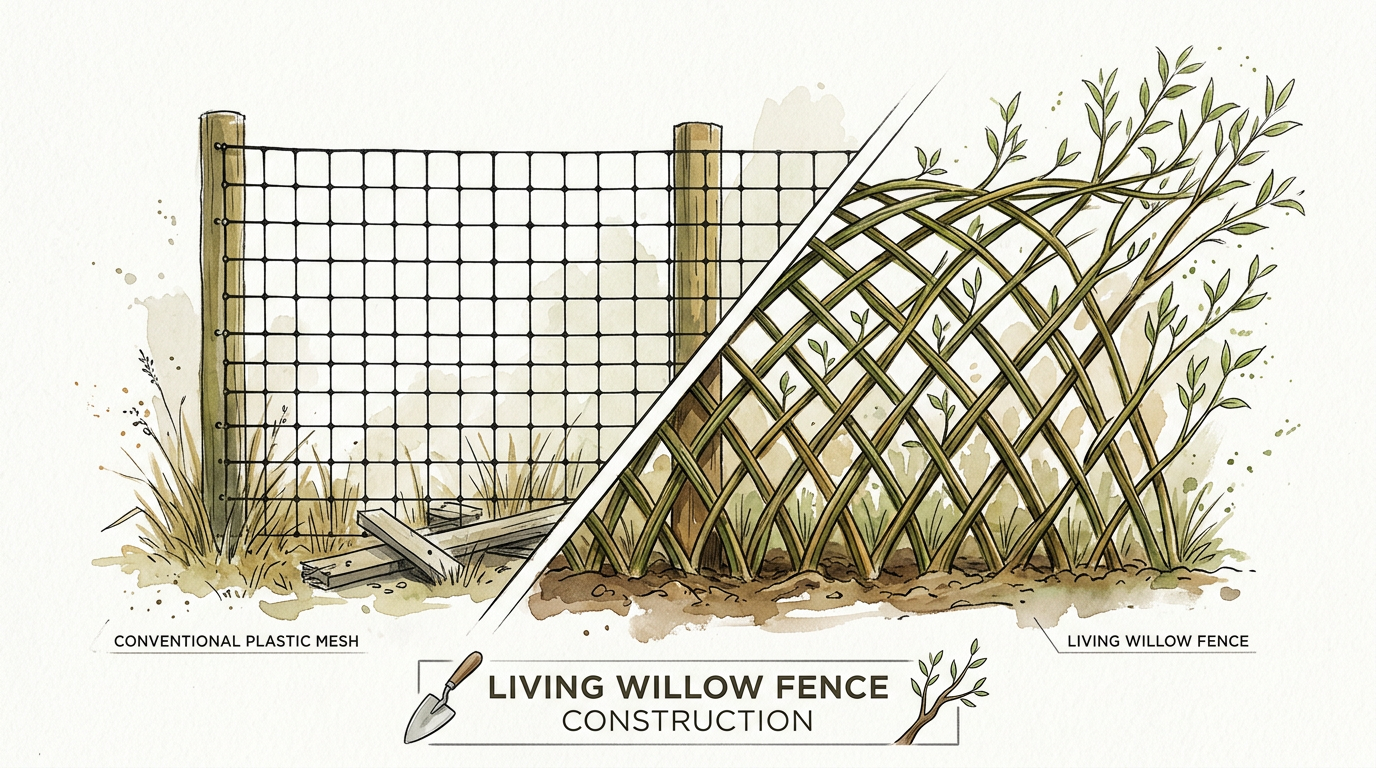
Why buy a fence that rots when you can plant one that grows? Stop buying disposable plastic supports every season. Living willow structures are carbon-negative, self-repairing, and become more beautiful every year they grow. This ancient craft, once the backbone of rural homesteads, offers a modern solution for anyone seeking a boundary that lives and breathes alongside the land.
Living willow construction taps into the ancestral wisdom of the “osier holt,” a traditional plot where willow was grown and harvested for everything from baskets to livestock fodder. Unlike a static wooden wall, a living fence—often called a “fedge”—is a dynamic ecosystem. It provides privacy, acts as a permeable windbreak, and offers a sanctuary for birds and pollinators, all while sequestering carbon in its roots and stems.
Living Willow Fence Construction
Living willow fence construction is the process of planting dormant willow rods directly into the soil and weaving them into a structural pattern. While a standard fence begins to decay the moment it is installed, a willow fedge gains strength as its stems thicken and graft together. This is not merely a barrier; it is a functional piece of land art that serves as a cross between a hedge and a fence.
In real-world situations, these structures serve as garden dividers, privacy screens, and security boundaries. They are particularly effective in damp or heavy soils where other hedging plants might struggle with “wet feet.” Historically, pioneers and farmers used these techniques to create livestock pens and windbreaks using nothing more than the natural resilience of the *Salix* genus. Today, these structures appear in permaculture designs, school sensory gardens, and sustainable homesteads as a low-cost, high-impact alternative to industrial materials.
Visualization of a living willow fence starts with the “diamond lattice” or harlequin pattern. Imagine a row of vertical wands crossing each other at 45-degree angles, creating a series of open diamonds. Over time, the points where these rods touch will often undergo “pressure grafting,” a process where the bark grows together and the two plants become one. This biological fusion creates a structural integrity that no hammer and nail can replicate.
How It Works: Building Your Living Fence
Building a living fence requires patience and a basic understanding of plant biology. The process begins during the dormant season, typically between late November and early March, when the willow is “sleeping” and its energy is stored in the stems.
Site Preparation and Sourcing
Choosing the right site is the first hurdle. Willow thrives in full sun and moist soil, though it is remarkably adaptable to various ground types, including heavy clay. Clearing a strip of ground at least 30 centimeters wide is essential. Removing all grass and perennial weeds ensures the young willow doesn’t have to compete for nutrients in its first critical year.
Sourcing “green” or fresh-cut willow rods is mandatory. Dried basketry willow will not grow. Look for rods that are one to two years old. One-year rods, known as “whips,” are highly flexible and ideal for weaving, while two-year rods provide the structural “staves” or uprights needed for taller fences.
The Planting Process
Planting depth determines the long-term survival of the fence. A common rule is to push the rods at least 25 to 30 centimeters into the ground. In drier soils, planting even deeper—up to 40 centimeters—protects the base from dehydration. Using a dibber or a simple metal rod to create a pilot hole prevents the delicate bark from peeling off as the willow is inserted.
Weaving the Harlequin Pattern
Creating the classic diamond weave involves planting rods in pairs. Space these pairs about 15 to 25 centimeters apart along the fence line. Angle one rod of each pair to the left at 45 degrees and the other to the right. As you move down the line, these angled rods will intersect with their neighbors.
Weave the rods in a “front-to-back” alternating pattern, similar to a basic basketry weave. This friction holds the structure together before you even apply ties. At the points of intersection, use biodegradable jute twine or flexible rubber ties to secure the rods. Avoid wire or thin plastic ties, as these can cut into the bark as the stems expand.
Practical Advantages of Growing Your Boundary
Choosing a living willow fence over a traditional timber or plastic alternative provides measurable benefits for the steward and the environment.
Carbon Sequestration and Environmental Impact
Living willow is a powerhouse of carbon storage. Research indicates that fast-growing willow can sequester between 3.5 and 4 metric tonnes of carbon per hectare annually in its above-ground biomass alone. The extensive root systems store even more carbon deep in the soil. Unlike treated lumber, which often contains copper, chromium, or arsenic, a living fence introduces zero toxins into the garden.
Resilience and Wind Protection
Static fences act like sails in a storm, often snapping at the post or blowing over entirely. A living willow fedge is a permeable barrier. It allows approximately 30% to 50% of the wind to pass through, which breaks the force of the gust without creating the turbulent “eddy” effect found behind solid walls. This makes it an ideal windbreak for protecting delicate vegetable patches or young orchards.
Biodiversity and Habitat
Willow is one of the earliest plants to produce catkins in the spring, providing a vital nectar source for bees emerging from hibernation. The dense, woven structure of a mature fedge offers nesting sites for small birds and a corridor for beneficial insects. In a landscape often fragmented by plastic mesh and concrete, a living fence acts as a vital bridge for local wildlife.
Challenges and Common Pitfalls to Avoid
Mistakes in living willow construction usually stem from a lack of respect for the plant’s biological needs. Success depends on timing and aftercare.
The Danger of Late Planting
Planting after the buds have begun to “break” or show green leaves is a frequent error. Once the willow leaves its dormant state, it diverts energy away from root development and toward foliage. If you plant too late in the spring, the rods will likely leaf out and then wither within weeks because the root system cannot support the water demand of the leaves.
Dehydration and “Root Rock”
Willow rods are living cuttings. If the soil is allowed to dry out during the first summer, the fence will fail. A deep mulch of wood chips, straw, or a dedicated weed mat is necessary to retain moisture. Furthermore, if the rods are not firmed into the soil properly, “root rock” can occur. Wind can wiggle the rods, preventing the fine, new hair-roots from establishing a grip on the soil.
Neglecting the Top Growth
A living fence is a tree that thinks it is a boundary. If left unmanaged, the top of the fence will send up vigorous vertical shoots that can reach two meters in a single season. This weight can cause the structure to sag or lose its geometric pattern. Regular maintenance is required to keep the “fence” from turning back into a “forest.”
Limitations: When a Living Fence Isn’t the Right Choice
While living willow is versatile, it is not a universal solution for every landscape. Recognizing its constraints is part of responsible land management.
* Proximity to Structures: Willow roots are notoriously “thirsty.” They will seek out water with aggressive efficiency. Planting a willow fedge within 10 meters of a house foundation, septic tank, or drainage pipe is a risk. The roots can infiltrate small cracks in pipes and eventually cause blockages or structural damage.
* Deep Shade: Willow is a sun-loving genus. Planting a structure under the heavy canopy of mature oaks or in the permanent shadow of a tall building will result in “leggy” growth and eventual die-back. A minimum of half-day full sun is required for the plant to remain vigorous.
* Arid Climates: In regions with prolonged droughts and no access to irrigation, willow is a poor choice. While established willow is resilient, it cannot survive in bone-dry dirt without significant intervention.
Comparing Living Willow to Traditional Alternatives
Evaluating your fencing options requires looking at the long-term cost and maintenance cycle. Traditional materials often have lower upfront labor but higher long-term financial and environmental costs.
| Feature | Living Willow Fedge | Treated Wood Fence | Plastic/Composite Mesh |
|---|---|---|---|
| Initial Cost | Low (Free if sourced) | Moderate to High | Moderate |
| Lifespan | 30–50+ Years | 10–15 Years | 5–10 Years |
| Maintenance | Pruning/Weaving (Annual) | Staining/Repair | Replacement only |
| Carbon Footprint | Negative (Stores Carbon) | Positive (Manufacturing) | High (Petrochemicals) |
| Self-Repairing | Yes | No | No |
Best Practices for a Long-Lasting Structure
Applying a few professional techniques during the installation phase can significantly increase the success rate of your living structure.
* The 24-Hour Soak: Submerging the “butt” ends (the thick bottom part) of your willow rods in 10 centimeters of water for 24 to 48 hours before planting triggers the hormones responsible for root growth. This gives the rods a “head start” once they hit the soil.
* Trimming the Base: Just before planting, snip off the bottom centimeter of the rod with a clean, sharp cut. This removes any dried-out tissue and ensures the plant can immediately begin absorbing water from the earth.
* Weed Suppression: Use a heavy-duty, biodegradable mulch mat. Planting through a slit in a mat prevents grass from strangling the young willow. Grass is a fierce competitor for surface moisture, and even a small amount of turf can stunt a new fedge.
* Regular Watering: During the first growing season, a living fence needs a thorough drenching once a week if there is no rain. Once the root system is established (usually by year two), the fence becomes much more self-sufficient.
Advanced Shaping and Design Considerations
For those looking to move beyond the basic boundary, willow offers endless possibilities for creative shaping.
Selecting Specific Cultivars
The *Salix* genus includes hundreds of species with varying colors and growth habits. *Salix viminalis* (Common Osier) is the workhorse of the living willow world, known for its long, straight, and incredibly vigorous growth. If you desire color, consider *Salix alba ‘Britzensis’* for fiery orange winter stems, or *Salix purpurea* for slender, elegant rods with a purple hue. Mixing these varieties in a single weave can create a stunning multi-colored tapestry in the winter months.
Living Furniture and Domes
The same principles used for fences can be applied to “living architecture.” By planting rods in a circle and tying them together at the top, you can create a living dome or “wigwam” that provides a shaded play area for children. Experienced practitioners even graft willow into living chairs and benches. These advanced projects require consistent “weaving back in” of new growth to thicken the “seat” and “back” of the furniture.
Grafting Techniques
Pressure grafting is the secret to the strongest willow structures. To encourage this, you can lightly “nick” the bark where two rods cross and tie them tightly together. This intentional wounding allows the cambium layers to touch and fuse. Within two growing seasons, the intersection will be a solid wooden knot, effectively turning the entire fence into a single, interconnected organism.
Scenarios: Living Willow in Action
Visualizing how a living fence fits into different environments helps in planning the right scale for your project.
The Urban Privacy Screen
In a small city garden, a six-foot living willow fedge can be planted in a narrow strip of soil along a property line. Because it can be kept very thin through pruning, it doesn’t “eat” into the garden space the way a traditional hedge like laurel or privet might. In the summer, the dense foliage blocks the view of neighbors, while the winter weave maintains a sculptural boundary.
The Rural Windbreak and Fodder Bank
On a larger homestead, a double-row willow fedge provides a massive windbreak for a vegetable garden. In this scenario, the owner might use the “Fedor” technique, which involves planting a dense hedge of willow and pollarding it at a set height. The trimmings from this maintenance aren’t waste; they can be used to weave baskets, or fed to goats and sheep as a high-protein supplement that also acts as a natural dewormer due to the presence of salicylic acid.
Final Thoughts
Planting a living willow fence is an act of stewardship that bridges the gap between the past and the future. It requires a shift in mindset—moving away from the “buy and install” culture of disposable plastic and toward the “plant and nurture” philosophy of the pioneer. These structures demand your attention, especially in the early years, but the reward is a boundary that grows stronger as it ages.
The practical value of a living fence extends far beyond its physical presence. It cleans the air, builds the soil, and provides a home for the wild things that make a garden truly healthy. Whether you are building a small screen for a patio or a massive windbreak for a farm, the willow is a resilient and forgiving partner in your journey toward self-reliance.
Experimenting with this ancient craft allows you to create a legacy that is literally rooted in the earth. As the seasons pass, your fence will transition from a collection of sticks to a lush, green wall, and eventually to a thick, grafted masterpiece. Start small, water well, and watch as your boundary becomes one of the most vibrant parts of your landscape.
