How To Become More Self-Sufficient Without Starting a Full-Blown Farm…
Want to start preserving your harvest, making your own soap, or building a backyard root cellar — but not sure where to begin? “Homesteading Advice” gives you instant lifetime access to 35+ practical homesteading books on food preservation, veggie gardening, DIY natural cleaning products (save over $250 per year with this skill alone), brewing, off-grid energy, and a whole lot more…
Click Here To Check It Out Now!
Concrete fails because it fights the water; a living shoreline succeeds because it becomes part of the flow. Every year, landowners spend thousands on concrete walls only to watch the water find a way underneath them. Nature has a better way. By using ‘living’ infrastructure, you can turn a crumbling bank into a self-repairing ecosystem that actually gets stronger the more it rains. Here is the secret to biological bank stabilization.
Water is a patient sculptor. It does not try to break through a wall in a single day; it simply waits for the first hairline crack. Once a concrete or steel bulkhead is installed, the clock starts ticking toward its eventual failure. These rigid structures reflect wave energy, scouring the riverbed at the base of the wall and accelerating erosion on your neighbor’s property. This process, often called “coastal squeeze,” eventually undermines the very foundation meant to protect the land.
Biological bank stabilization, or soil bioengineering, offers a different path. It is a method rooted in ancestral wisdom and modern ecology, where live plants are used as structural components. Instead of fighting the river’s energy, these systems absorb and dissipate it. As the roots grow deeper, they weave through the soil like a subterranean fabric, creating a reinforced matrix that no man-made material can truly replicate.
The beauty of this approach lies in its resilience. A concrete wall is strongest the day it is finished and weaker every day thereafter. A living shoreline is at its most vulnerable during the first season of growth, but it gains strength and mass with every passing year. For those who value self-reliance and the enduring strength of the natural world, this is the only logical way to hold the line against a rising tide.
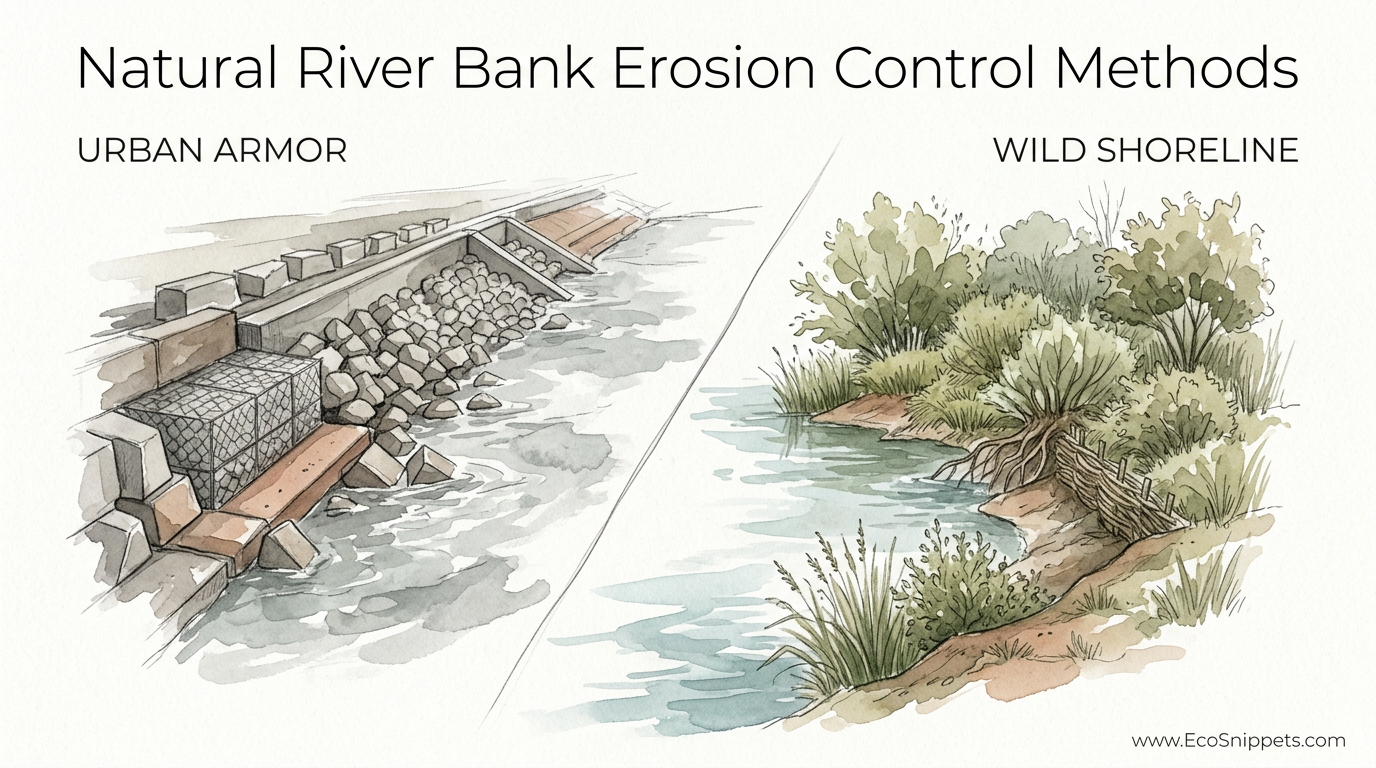
Natural River Bank Erosion Control Methods
Natural river bank erosion control methods represent a shift from “hard armoring” to “soft armoring.” This discipline, known as soil bioengineering, treats living plants as active engineering materials. These methods are designed to stabilize slopes and shorelines by utilizing the mechanical and hydrological benefits of vegetation. Unlike a static wall, these biological systems are dynamic, capable of repairing themselves after a storm and adapting to changing water levels.
In the real world, you see these methods applied along meandering creeks, large river systems, and even coastal estuaries. These techniques are particularly effective in riparian zones—the critical interface between land and water. These areas are prone to two main types of failure: surface erosion caused by rain or overland flow, and mass wasting, where entire chunks of the bank slump into the water due to saturated soil and a lack of root structure.
Biological stabilization uses a variety of “tools” from nature’s shed. Live staking involves driving dormant woody cuttings into the bank to sprout roots. Fascines are long bundles of branches buried in shallow trenches to break up the slope and trap sediment. Brush mattresses provide an immediate “skin” of protection for the soil surface. Each method is chosen based on the specific energy of the water and the steepness of the bank.
Consider the analogy of a woven basket versus a ceramic pot. A ceramic pot is rigid; if it drops or the ground shifts, it shatters. A woven basket is flexible; it can bend, stretch, and distribute stress throughout its fibers. Biological bank stabilization creates a “woven” landscape that moves with the earth rather than resisting it until it breaks.
The Mechanics of Biological Stabilization
The true strength of a living shoreline is hidden beneath the surface. To understand how these systems work, we must look at the physics of the root-soil matrix. Roots act as biological rebar. When soil is permeated by a dense network of roots, its shear strength increases significantly. This is measured by the tensile strength of the roots themselves—the force required to pull them apart.
Studies show that riparian vegetation can increase the tensile strength of the soil by as much as 245 kPa, depending on the depth and species. This reinforcement is most effective in the first 40 to 100 centimeters of soil, where root density is highest. These roots transform the soil from a collection of loose particles into a reinforced composite material.
Live Staking
Live staking is the simplest and most cost-effective method of bioengineering. It involves taking dormant cuttings from species like willows or dogwoods and driving them directly into the soil. Once the growing season begins, these stakes sprout roots that anchor the soil and foliage that slows down water flow.
Proper installation requires a “pioneer-grit” approach. Stakes should be between two and three feet long and roughly one-half to one-and-a-half inches in diameter. The bottom end is cut at a 45-degree angle to make it easier to drive into the ground and to help you identify which end goes down. At least two-thirds of the stake must be buried to ensure it reaches the permanent water table and remains stable.
Live Fascines
Fascines, also known as wattles, are long bundles of dormant branches tied together with twine. These bundles are placed in shallow trenches along the contour of the bank. They act as “mini-dams,” slowing down runoff and trapping sediment that would otherwise wash away.
This technique is excellent for slopes where you need to break up the flow of water. The bundles are secured with dead stout stakes (non-living lumber) and often reinforced with live stakes. Over time, the fascines take root and form a series of living benches or terraces along the bank.
Brush Mattresses
For banks facing higher water velocities, a brush mattress provides an immediate protective armor. This involves laying a thick layer of dormant branches over the entire bank surface. These branches are then secured with a grid of stakes and wire or biodegradable twine.
The mattress protects the soil from the physical impact of waves and flowing water while the plants are still dormant. As the branches root into the bank, they create a dense, interlocking “forest” that is incredibly difficult for the water to dislodge.
The Benefits of Living Shorelines
Choosing a biological approach over concrete or steel offers measurable advantages that extend far beyond aesthetics. The most immediate benefit is cost. While a concrete seawall can cost between $200 and $800 per linear foot, a living shoreline typically ranges from $50 to $350 per foot. When you factor in the long-term maintenance, the savings become even more dramatic.
Self-Repairing Infrastructure
Hard structures degrade. Sun, salt, ice, and constant wave action cause concrete to crack and steel to rust. Repairing these structures often requires heavy machinery and expensive materials. A living shoreline, however, is a biological entity. If a storm washes away part of the bank, the remaining plants can often grow back and re-colonize the area. The system is designed to heal itself.
Ecological Restoration
Concrete walls create a “dead zone” at the water’s edge. They provide no habitat and can even block the movement of small animals between the water and the land. In contrast, biological stabilization restores the ecosystem. The overhanging branches provide shade that cools the water for fish. The dense vegetation offers nesting sites for birds and habitat for insects, which in turn feed the local wildlife.
Pollution Filtration
Plants are nature’s kidneys. The vegetation in a living shoreline acts as a filter for upland runoff. It traps sediment and absorbs excess nutrients like nitrogen and phosphorus before they can reach the river or stream. This improves local water quality and helps prevent harmful algal blooms downstream.
Challenges and Common Mistakes
The transition from theory to practice is where most mistakes happen. The most frequent error is ignoring the timing of the project. Bioengineering relies on the biological potential of dormant cuttings. If you harvest and plant your stakes during the heat of summer, they will almost certainly die. The “pioneer rule” is to work with the seasons, planting in late fall or early spring when the plants are dormant but the ground is not frozen.
Another common pitfall is poor soil-to-stem contact. For a stake or fascine to grow, the cambium layer (the living tissue just under the bark) must be in direct contact with moist soil. If there are air pockets around the buried portion of the plant, the roots will dry out and fail to develop. Tamping the soil firmly around each planting is a non-negotiable step.
Herbivory is a challenge that often catches landowners off guard. Beavers, deer, and muskrats see your new stabilization project as a five-star buffet. Without protection, a single beaver can undo weeks of work in one night. Using temporary fencing or biodegradable tree guards during the first two growing seasons is often necessary to ensure the plants reach maturity.
Limitations and Realistic Constraints
While biological stabilization is powerful, it is not a universal solution. There are environmental conditions where nature needs a helping hand or where hard armoring is the only viable option. Understanding these boundaries is essential for a successful project.
* High-Velocity Flow: If the river flow exceeds six feet per second consistently, soft bioengineering may be scoured away before it can take root. In these cases, a “hybrid” approach using a rock toe (riprap at the base) with vegetation above it is often required.
* Steepness of Slope: Most bioengineering techniques work best on slopes of 2:1 or flatter. If your bank is a vertical cliff, you cannot simply plant stakes into the side and expect them to hold. The bank must often be regraded to a stable angle before the biological work begins.
* Shade Tolerance: Most of the fast-growing “workhorse” species like willows require full sun. If your bank is in deep, permanent shade under a heavy forest canopy, your options for live-staking are much more limited.
* Chemical Contamination: In some urban environments, the soil may be so contaminated that plants cannot survive. In these rare cases, the land must be remediated before a living shoreline can be established.
Comparing Urban Armor vs. Wild Shoreline
To see the value of these systems, it helps to compare the two dominant philosophies of bank protection. “Urban Armor” refers to traditional hardened structures, while “Wild Shorelines” utilize nature-based solutions.
| Feature | Urban Armor (Concrete/Steel) | Wild Shoreline (Bioengineering) |
|---|---|---|
| Initial Cost | High ($200 – $800/ft) | Low to Moderate ($50 – $350/ft) |
| Maintenance | Expensive repairs every 15-20 years | Minimal once established |
| Lifespan | 30 – 50 years (declining) | Indefinite (growing stronger) |
| Environmental Impact | Habitat loss, wave reflection | Habitat creation, water filtration |
| Permitting | Often difficult and restrictive | Generally favored by regulators |
| Resilience | Can fail catastrophically | Flexible and self-repairing |
Practical Tips for Success
If you are ready to apply these principles to your own land, follow these best practices derived from decades of field experience. Think like a pioneer: observe the land, use local materials, and don’t try to outsmart the water.
* Harvest Locally: The best plants for your project are likely growing within a few miles of your site. Native willows and dogwoods that are already thriving in your local climate are pre-adapted to your soil and water conditions.
* Keep Cuttings Moist: From the moment you cut a branch until it is driven into the ground, it must stay cool and wet. If the cuttings dry out for even a few hours, the survival rate drops significantly. Many practitioners soak their stakes in water for 5-7 days before planting to “pre-hydrate” the tissue.
* Use the Right Tools: A heavy-duty rubber mallet or a specialized “dead blow” hammer is best for driving stakes. If the ground is hard, use a rebar pilot hole to prevent the stake from splitting.
* Work from the Bottom Up: Always start your stabilization at the “toe” or base of the bank. If the bottom of the bank is not secure, everything above it will eventually slide into the water. Protect the toe with rock or coir logs first.
Advanced Considerations for Serious Practitioners
For those who want to take their stabilization to the next level, consider the concept of successional planting. While willows and dogwoods are excellent for initial stabilization because they root quickly, they are often relatively short-lived species. A truly resilient shoreline should include “climax” species like oaks, maples, or sycamores planted slightly further back on the bank.
Serious practitioners also pay close attention to the Root-Area-Ratio (RAR). This is a measure of the cross-sectional area of roots per unit area of soil. By selecting a mix of species with different root architectures—some with deep taproots and others with wide-spreading fibrous roots—you can create a multi-layered defense system that protects against various types of soil failure.
Hydraulic analysis is another advanced step. Calculating the shear stress exerted by the water during a 10-year or 50-year flood event allows you to select the appropriate bioengineering technique. For example, a brush mattress can withstand much higher shear forces than simple live staking.
Example Scenario: Reclaiming a 100-Foot Bank
Imagine a landowner named Silas who has a 100-foot stretch of creek bank that slumps into the water every spring. A contractor quotes him $30,000 for a riprap wall. Instead, Silas decides to use biological stabilization.
Silas spends a weekend in late February harvesting 300 willow cuttings from a nearby thicket. He spends $1,500 on coir logs (coconut fiber) for the toe of the bank and another $200 on biodegradable twine and dead stout stakes. Over two weekends, Silas and a few friends install the coir logs at the water’s edge and drive the willow stakes in a grid pattern across the eroding face.
Total cost: $1,700 and some hard work. By the end of the first summer, the willows are three feet tall. During a heavy spring rain the following year, the roots hold the soil firm. The creek still rises, but instead of taking the bank with it, the water filtered through the new growth, leaving behind a thin layer of nutrient-rich sediment. Silas didn’t just save $28,000; he built a legacy that will outlast any pile of rocks.
Final Thoughts
Biological bank stabilization is more than just a technique for erosion control; it is a philosophy of land stewardship. It requires us to move away from the “Urban Armor” mindset that seeks to dominate the landscape with concrete and steel. Instead, it invites us to look at how nature has solved the problem of moving water over millions of years.
By using living materials, you are not just building a barrier; you are planting a future. You are creating a system that breathes, grows, and gives back to the environment. While the initial establishment requires care and patience, the reward is a shoreline that is resilient, beautiful, and fundamentally at peace with the water.
Take the first step by observing your own bank. Look at the plants that are already holding firm. Study the flow of the water during the next big rain. When you are ready, work with the seasons to tuck those first few stakes into the mud. You will find that when you stop fighting the river and start working with it, the land finally starts to stay where it belongs.
