How To Become More Self-Sufficient Without Starting a Full-Blown Farm…
Want to start preserving your harvest, making your own soap, or building a backyard root cellar — but not sure where to begin? “Homesteading Advice” gives you instant lifetime access to 35+ practical homesteading books on food preservation, veggie gardening, DIY natural cleaning products (save over $250 per year with this skill alone), brewing, off-grid energy, and a whole lot more…
Click Here To Check It Out Now!
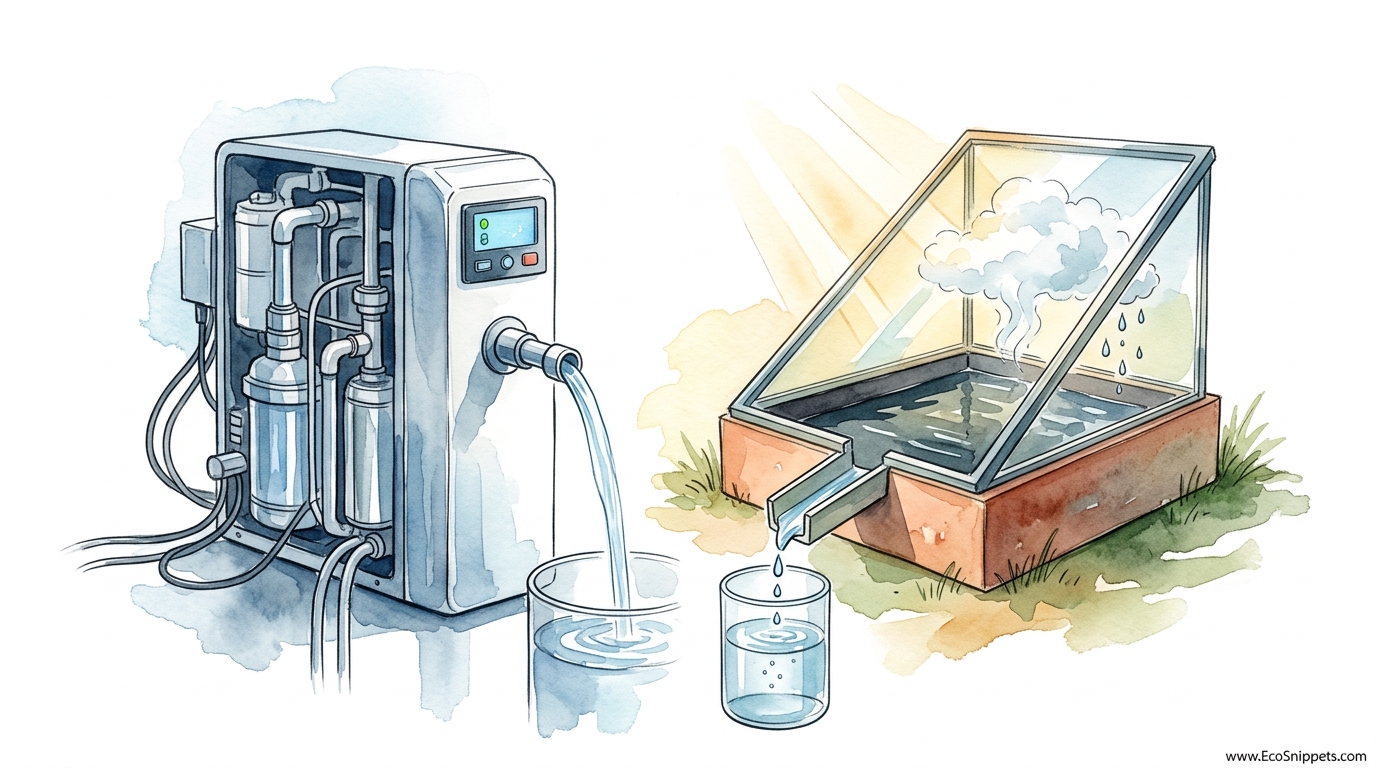
One system stops working the second the grid goes down, while the other purifies your water using nothing but the power of the sun. Why are we tethered to electric filters and proprietary cartridges? While the high-tech systems hum and drain your wallet, the simple solar still works in total silence, turning any water source into pure hydration for zero cost. It is time to let the sun do the heavy lifting.
Modern survival often leans too heavily on things that plug into a wall. If the electrons stop flowing, those high-dollar reverse osmosis machines become expensive paperweights. True self-reliance means looking back at the methods that sustained our ancestors and the pioneers who crossed the most arid stretches of this continent. They knew that the sun was not just a source of heat, but a powerful engine for purification.
The passive solar water distiller is the ultimate manifestation of this grit. It is a device that mimics the earth’s natural hydrologic cycle—evaporation, condensation, and precipitation—within a controlled environment. It is rugged, reliable, and requires no moving parts to break. Whether you are homesteading on a remote plot or preparing for a long-term emergency, mastering the art of solar distillation is a foundational skill for any serious practitioner.
Passive Solar Water Distillation Guide
Passive solar water distillation is the process of using solar energy to evaporate impure water and then condensing that vapor into a purified liquid state. At its core, it is a method of separating pure H2O from virtually any contaminant that does not evaporate at the same temperature as water. This includes heavy metals, salts, bacteria, viruses, and even certain chemical pollutants like nitrates and arsenic.
In the real world, this technology has been used for centuries, particularly in maritime and desert environments where freshwater is a luxury. The basic design involves an enclosed basin with a transparent cover. The sun’s rays pass through the cover and strike a dark surface at the bottom of the basin, which absorbs the heat and transfers it to the untreated water. As the water warms, it turns into vapor, leaving behind the heavy “junk” in the basin.
This vapor then rises and comes into contact with the cooler underside of the transparent cover. Because the cover is exposed to the outside air, it remains at a lower temperature than the saturated air inside the still. This temperature differential causes the vapor to condense back into liquid droplets. Gravity then pulls these droplets down the slope of the cover into a collection trough, delivering crystal-clear, distilled water to a storage container.
The beauty of the passive solar still lies in its independence. It does not require a pump, a heater, or a chemical additive. It simply asks for a patch of sunlight and a steady supply of untreated water. While electric distillers are faster, they are energy-intensive and prone to mechanical failure. A well-built solar still, on the other hand, can last for decades with minimal maintenance, providing a permanent solution to water insecurity.
The Mechanics of Distillation: How to Do It
Building a high-performance solar still requires an understanding of thermodynamics rather than complex engineering. The goal is to maximize the heat within the basin while ensuring the condensing surface remains as cool as possible. Follow these steps to construct a standard single-basin solar still that can provide for a family’s daily needs.
First, construct a sturdy, insulated box. The basin is the heart of the system. You can use wood, metal, or even heavy-duty plastic, but the interior must be well-insulated to prevent heat loss through the bottom and sides. High-density rigid foam insulation is an excellent choice for lining the box. This ensures that the solar energy is focused entirely on heating the water rather than the ground or the air surrounding the unit.
Second, line the basin with a black, non-toxic material. The color black has a high absorptivity, meaning it will soak up the majority of the solar radiation that hits it. Some people use EPDM pond liners or specialized black silicone coatings. If you are in a pinch, charcoal or even a layer of black cotton cloth at the bottom of the water tray can serve as a makeshift heat absorber. This material must be food-safe and able to withstand high temperatures without off-gassing.
Third, install a slanted transparent cover. Glass is the superior choice for a permanent still. It has excellent light transmissivity and is naturally “wettable,” meaning water droplets will form a thin film and slide down easily rather than sticking and falling back into the dirty water. A slope of about 10 to 15 degrees is usually sufficient to guide the water toward the collection point. If you use plastic sheeting, ensure it is UV-resistant, though be aware that many plastics can impart a chemical taste to the water over time.
Fourth, set up the collection trough and outlet. At the lowest point of the glass slope, install a small gutter or trough made of stainless steel or food-grade plastic. This trough must be angled slightly so that the water flows out through a tube into a clean jug located outside the still. Precision is key here; if the seal between the glass and the trough is not airtight, you will lose precious water vapor to the atmosphere.
Finally, fill the basin with untreated water and seal the unit. The depth of the water is a critical factor in efficiency. A shallow layer of water (about 1 to 2 inches) will heat up much faster than a deep pool, leading to higher yields. Once the lid is on, the “greenhouse effect” takes over, and the distillation process begins.
The Indisputable Benefits of the Solar Still
Why choose a passive solar still when there are so many high-tech filters on the market? The answer lies in the total cost of ownership and the reliability of the system.
Most filtration systems are designed to remove specific particles based on size or charge. A solar still, however, works by removing the water from the contaminants rather than trying to trap the contaminants in a membrane. This means that a solar still can handle water that would instantly clog an expensive ceramic filter, such as high-salinity seawater or water thick with silt and mud.
The long-term financial advantages are also significant. An electric distiller consumes roughly 3 kilowatt-hours of electricity per gallon of water produced. At current utility rates, that adds up quickly. A solar still has a higher upfront cost if you use premium materials like tempered glass and stainless steel, but after the first year of operation, the water is essentially free. There are no proprietary cartridges to buy and no dependency on a supply chain that could disappear tomorrow.
Reliability is perhaps the greatest benefit for the self-reliant individual. A solar still has no moving parts. There are no pumps to burn out, no O-rings to perish in the heat, and no electronics to fry during a power surge. It is a set-it-and-forget-it system that works as long as the sun rises. This level of simplicity is what makes it a cornerstone of ancestral wisdom and modern prepping alike.
Challenges and Common Pitfalls to Avoid
While the principle of solar distillation is simple, the execution requires attention to detail. Many beginners fail because they overlook the nuances of the environment or the materials they use.
One of the most common mistakes is a lack of airtightness. If the still is not perfectly sealed, the heated, moisture-rich air will escape before it has a chance to condense. This “vapor leak” can reduce your yield to almost nothing. Use high-temperature silicone caulk to seal every joint, especially where the glass meets the frame and where the collection tube exits the box.
Surface tension is another hurdle. If the glass is not clean or if the angle is too shallow, water droplets will “bead up” and fall back into the basin rather than sliding into the trough. This is particularly common with new glass that still has an oily film from the factory. A thorough cleaning with a mixture of vinegar and water can help prime the surface for better flow.
Thermal inertia can also work against you. If you fill the basin with six inches of water, the sun will spend the entire day trying to heat that mass, and you might only get a few drops of output. Maintaining a shallow water level is essential. Some practitioners use a “wick-type” still, where the water is absorbed into a black cloth, exposing a massive surface area to the sun and allowing for almost instantaneous evaporation.
Limitations: When This May Not Be Ideal
It is important to be realistic about what a solar still can and cannot do. This is not a high-volume solution for large-scale agriculture or a five-person household with high water demands.
The primary limitation is the yield per square foot. On a clear, sunny day, a well-designed single-basin still will produce roughly 0.06 to 0.1 gallons of water per square foot of basin area. To provide enough drinking and cooking water for a single person (about one gallon per day), you would need a still with at least 10 to 15 square feet of surface area. This requires a significant amount of space and materials.
Weather dependence is the other obvious constraint. On cloudy days or during the short days of winter, production will drop significantly. If you live in a region with persistent cloud cover or heavy shade, a solar still cannot be your only source of water. It must be part of a broader strategy that includes rainwater harvesting and other filtration methods.
Finally, while distillation removes salts and biological threats, it can struggle with Volatile Organic Compounds (VOCs). Some chemicals have a boiling point lower than water and will evaporate and condense right along with the H2O. If your water source is contaminated with industrial runoff or pesticides, it is wise to run the distilled output through a small activated carbon filter as a final “polishing” step to ensure absolute purity.
Comparing the Old Ways and the New
To understand the value of the solar still, it helps to see how it stacks up against modern alternatives. The following comparison highlights the trade-offs between a passive solar distiller and a standard countertop electric distiller.
| Feature | Passive Solar Distiller | Electric Countertop Distiller |
|---|---|---|
| Energy Source | Free Sunlight | Grid Electricity (approx. 3kWh/gal) |
| Speed | Slow (Gallon per Day) | Fast (Gallon in 4-6 Hours) |
| Maintenance | Low (Occasional Cleaning) | Moderate (Descaling, Filter Changes) |
| Grid Independence | 100% Independent | Dependent on Power Grid |
| Portability | Low (Bulky Units) | High (Compact Units) |
As the table shows, the choice comes down to your priorities. If you value speed and have plenty of electricity, the electric model is convenient. However, if you are building for a future where resources are scarce and self-sufficiency is the goal, the solar still is the clear winner. It trades time for independence, a trade that the wise practitioner is always willing to make.
Practical Tips for Peak Performance
If you want to squeeze every possible drop out of your still, you need to optimize the system. These adjustments can increase your daily yield by 20% or more.
* Use External Reflectors: Placing a mirror or a sheet of polished aluminum behind the still can bounce additional sunlight into the basin. This increases the total energy input without increasing the size of the unit.
* Insulate the Trough: While you want the basin to be hot, you want the collection trough to stay relatively cool. If the trough gets too hot, the water you have already collected might re-evaporate before it can exit the still.
* Paint the Exterior White: While the interior must be black to absorb heat, painting the exterior of the box white can help reflect ambient heat, keeping the structural components from warping and ensuring that the internal temperature gradient remains focused on the water surface.
* Optimize the Glass Thickness: Thin glass (around 1/8 inch) allows more light to pass through than thick glass. However, it is more fragile. Tempered glass is the best middle ground, offering safety and durability without sacrificing too much transmissivity.
* Flush the Basin Daily: As water evaporates, the concentration of salts and minerals in the remaining “brine” increases. If this brine becomes too thick, it will form a crust that reflects sunlight and reduces efficiency. Draining a portion of the old water and adding fresh source water every evening keeps the system running smoothly.
Advanced Considerations: Scaling and Multi-Basins
For those who have mastered the basic basin still and need more volume, the next step is the multi-basin or multi-effect still. These designs are significantly more efficient because they recycle the latent heat of condensation.
In a standard still, the heat released when vapor turns back into liquid is lost to the environment through the glass cover. In a multi-basin design, a second tray of water is placed directly above the condensing surface of the first tray. The heat released by the condensing vapor from the bottom tray is used to pre-heat the water in the top tray. This “double-dipping” of energy can nearly double the efficiency of the unit for the same footprint.
Another advanced technique is the use of a solar tracking system. By using a simple clockwork or electronic tracker to keep the still tilted toward the sun throughout the day, you can maximize the “insolation”—the amount of solar radiation hitting the surface. While this adds complexity and a potential point of failure, it is a viable option for those living in high-latitude areas where the sun is lower on the horizon.
Serious practitioners might also explore the use of phase-change materials (PCMs) in the basin. These materials, like certain waxes or salts, absorb a massive amount of heat during the day and release it slowly throughout the night. This allows the still to continue producing water long after the sun has gone down, utilizing the residual heat to keep the evaporation process moving in the cool night air.
Scenario: A Day in the Life of a Solar Still
Imagine a homestead in a high-desert environment. The owner has built a 4-foot by 8-foot solar still (32 square feet of basin area) using a reclaimed sliding glass door for the cover. The basin is lined with a black EPDM liner and insulated with two inches of rigid foam.
In the early morning, the owner adds 5 gallons of brackish well water to the basin, ensuring a depth of roughly one inch. By noon, the internal temperature of the still has reached 150 degrees Fahrenheit. Large droplets are visible on the underside of the glass, constantly streaming into the stainless steel trough.
By sunset, the still has produced approximately 2.5 gallons of pure water. The owner drains the remaining two gallons of concentrated brine (which is now too salty to drink but could be used for other chores) and prepares the unit for the next day. Over the course of a year, this single unit provides nearly 900 gallons of water—more than enough for a couple’s drinking and cooking needs—all for the cost of the initial materials.
Final Thoughts
The passive solar water distiller is more than just a piece of equipment; it is a declaration of independence. It represents a refusal to be reliant on fragile systems and a commitment to understanding the fundamental laws of nature. By harnessing the same processes that keep the planet hydrated, you ensure that your family will never be at the mercy of a dry tap or a failed grid.
This technology is a bridge between the grit of the pioneer past and the necessity of a self-reliant future. It requires patience, observation, and a willingness to work with the rhythms of the sun. But the reward is a source of life that is as certain as the sunrise itself.
Begin with a small experimental model to learn the nuances of your local climate. Once you see the first drop of pure water fall from the glass, you will understand the power of this system. From there, scale up, optimize, and share the knowledge. In a world that is increasingly complex, the most effective solutions are often the simplest ones. Experiment with different materials, watch how the shadows fall across your yard, and let the sun do the heavy lifting.
