How To Become More Self-Sufficient Without Starting a Full-Blown Farm…
Want to start preserving your harvest, making your own soap, or building a backyard root cellar — but not sure where to begin? “Homesteading Advice” gives you instant lifetime access to 35+ practical homesteading books on food preservation, veggie gardening, DIY natural cleaning products (save over $250 per year with this skill alone), brewing, off-grid energy, and a whole lot more…
Click Here To Check It Out Now!
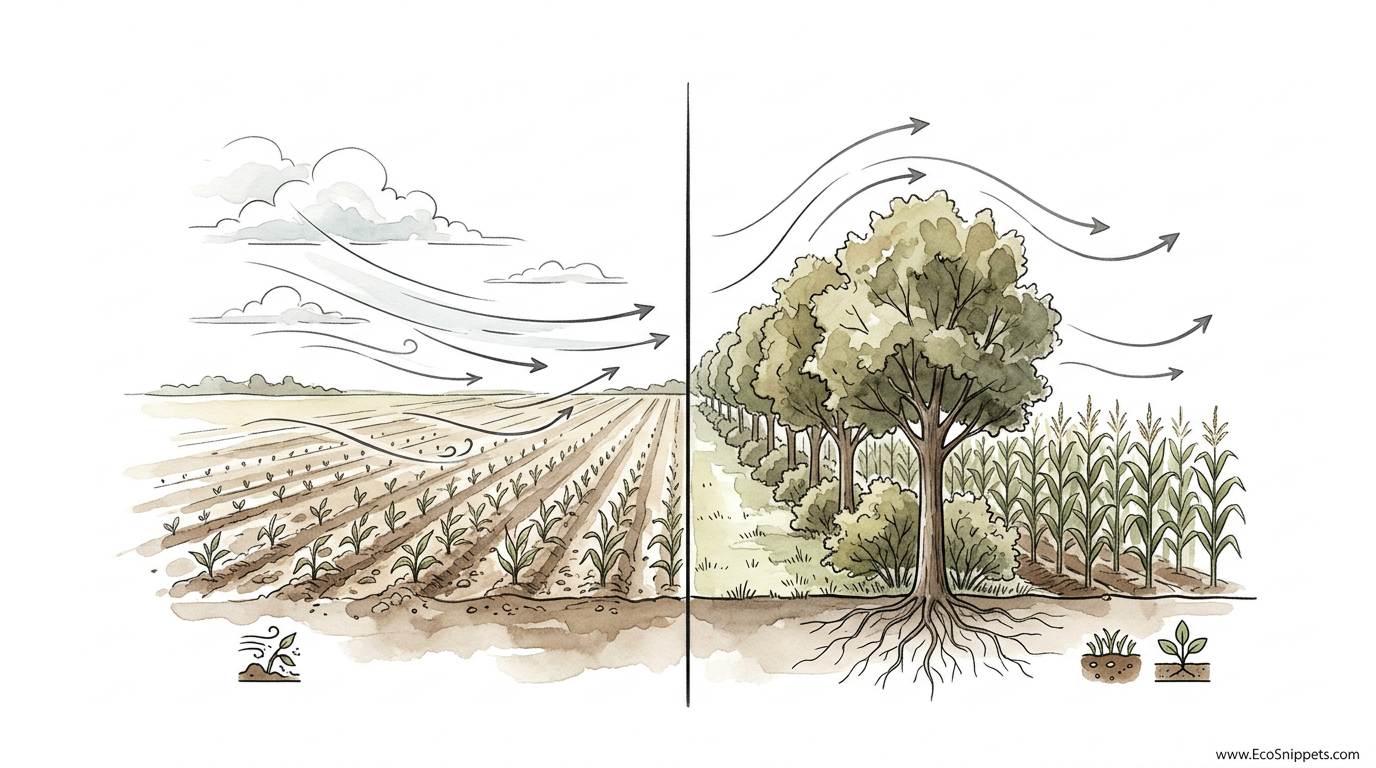
A 20mph breeze can strip 30% of your soil’s moisture in a single afternoon unless you have this ‘living wall’ in place. Most preppers focus on fences to keep people out, but they forget the silent thief that steals their harvest every day: the wind. See how a strategic shelterbelt transforms a parched, stressed field into a thriving, self-watering microclimate.
Wind is a relentless force of nature that does more than just blow hats off. On an open homestead, it acts like a giant hair dryer, pulling precious water from your plants and topsoil through a process called evapotranspiration. This constant stress stunts growth, batters delicate seedlings, and carries away the very nutrients you worked so hard to build.
Modern agriculture often treats land as a flat, empty canvas, but our ancestors knew better. They planted “living walls”—dense, multi-layered barriers of trees and shrubs—to break the wind’s power. These shelterbelts are not just for aesthetics; they are functional infrastructure that pays dividends in soil health and crop resilience.
Shelterbelt Planting For Crop Protection
A shelterbelt, often called a windbreak, is a linear planting of trees and shrubs designed to reduce wind speed and create a protected microclimate on its leeward side. This practice is a cornerstone of agroforestry, serving as a biological shield for crops, livestock, and farmsteads. While they were famously championed during the Dust Bowl era to prevent total soil collapse, their value in a modern self-reliant system is more relevant than ever.
These living barriers work by creating friction. As wind hits the wall of vegetation, some of it is forced upward over the canopy, while a portion filters through the branches. This filtering effect is crucial because a completely solid wall would create a vacuum and heavy turbulence on the other side. Instead, a well-designed shelterbelt slows the air down, creating a calm zone that can extend for a distance up to 20 times the height of the tallest trees.
In real-world application, shelterbelts are used to protect sensitive crops like berries and vegetables from mechanical damage. They also serve as “snow fences” in northern climates, catching drifting snow and depositing it across the field to melt slowly into the soil, providing a free “deep watering” for the coming spring.
How It Works: The Physics of the Windbreak
Understanding the mechanics of air movement is the first step to a successful design. You aren’t just planting a row of trees; you are engineering a fluid dynamics solution using biology.
The Rule of Height (H)
The area of protection is directly proportional to the height of your trees, commonly referred to as the “H” factor. A shelterbelt that stands 30 feet tall (H) will provide significant wind reduction for a distance of 10H (300 feet) and measurable protection out to 20H (600 feet). For maximum benefit, most agricultural crops should be situated within the 2H to 10H zone, where wind speeds can be reduced by 50% to 70%.
The Porosity Principle
One of the most common mistakes is trying to build a “solid” wall. A barrier that is 100% dense, like a stone wall or a very thick cedar hedge, forces air to tumble over the top like water over a dam. This creates a high-pressure zone and destructive turbulence immediately on the other side.
An ideal shelterbelt has a porosity of roughly 40% to 60%. This allows some air to pass through the branches, which acts as a “buffer” and keeps the airflow smooth. This permeability ensures the protected zone is longer and the air remains stable.
Step-By-Step Design for Your Land
- Map the Prevailing Winds: Identify which direction the most damaging winds come from. In the American Midwest, this is often the northwest in winter and the south in summer.
- Orientation: Place your shelterbelt perpendicular to the prevailing wind. If the wind comes from the North, your tree rows should run East-West.
- Row Count: A single row of trees is better than nothing, but a three-to-five-row system is the gold standard. This allows you to mix species and heights for a layered effect.
- Spacing: Space your rows 10 to 15 feet apart to allow for maintenance equipment. Within the rows, space deciduous trees 10 to 12 feet apart and evergreens 15 to 20 feet apart to account for their mature spread.
The Benefits of a Strategic Buffer
The most immediate benefit is the preservation of soil moisture. By slowing the wind, you drastically reduce the rate at which water evaporates from the soil surface. This means you can water less frequently and your crops are less likely to wilt during a mid-summer heatwave.
Yield Increases
Research from the USDA and various agricultural universities has shown that sheltered crops consistently outperform those in open fields. Yield increases are not just marginal; they are substantial:
- Winter Wheat: Up to 23% increase in yield.
- Corn: Roughly a 12% boost.
- Soybeans: Approximately 13% improvement.
- Small Fruits (Berries): Can see increases of 40% to 50% due to better pollination and less physical damage.
Microclimate Moderation
Shelterbelts act as a thermal blanket. During the day, the air in the sheltered zone stays slightly warmer because it isn’t being stripped away by the wind. At night, the trees help trap some ground heat. This can extend your growing season by several days or even weeks on both ends, allowing for earlier planting and later harvesting.
Challenges and Common Mistakes
The biggest pitfall in shelterbelt planting is the “Wind Tunnel Effect.” This happens when there is a gap in the row—perhaps a dead tree or a driveway that wasn’t properly angled. Wind will funnel through these openings at a higher velocity than the original wind speed, potentially causing more damage than if no trees were there at all. If you must have a gate or road through your belt, design it at an angle or use a “staggered” planting to block the direct line of sight.
Root Competition
Trees need water and nutrients just as much as your crops do. In the first few years, the root systems of your shelterbelt will compete with the nearest row of crops. This is known as the “sapping” effect. Professional growers often use a root pruner—a deep-cutting blade—to sever the lateral roots of the shelterbelt trees every few years, keeping them from encroaching into the production field.
Species Mismatch
Planting the wrong tree for your soil type is a recipe for failure. A tree that thrives in the swampy soils of the Southeast will struggle and likely die in the alkaline, dry soils of the high plains. Always match your species to your specific USDA Hardiness Zone and soil pH.
Limitations: When This May Not Be Ideal
A shelterbelt is a long-term investment. If you are on a short-term lease or planning to sell your land in two years, the time and cost of establishment may not be worth it. It takes 5 to 10 years for a windbreak to become truly effective.
Environmental constraints also play a role. In extremely arid regions, the water required to establish the trees might exceed the water saved by the windbreak. Furthermore, on very small urban lots, a large shelterbelt might cast too much shade, effectively trading your “wind problem” for a “light problem.” In these cases, a shorter, more managed “hedge” might be a better alternative to a full-scale shelterbelt.
Regional Species Guide: Selecting Your “Living Wall”
Choosing the right “soldiers” for your wall is the most critical decision in the process. You want a mix of fast-growing “nurses” and long-lived “anchors.”
| Region | Evergreen (Year-Round Cover) | Deciduous (Fast Growth) | Shrubs (Low-Level Protection) |
|---|---|---|---|
| Northern / Prairies | Norway Spruce, Colorado Blue Spruce | Hybrid Poplar, Bur Oak | Caragana (Peashrub), Lilac |
| Midwest / Plains | Eastern Red Cedar, Austrian Pine | Hackberry, Green Ash | American Hazelnut, Chokecherry |
| Southeast / Humid | Loblolly Pine, Southern Red Cedar | Tulip Poplar, Willow Oak | Wax Myrtle, Elderberry |
| West / Arid | Rocky Mountain Juniper, Ponderosa Pine | Honey Locust, Siberian Elm | Skunkbush Sumac, Nanking Cherry |
Practical Tips and Best Practices
If you want your shelterbelt to survive the critical first three years, you must treat it with the same care as your garden.
- Site Preparation: Clear all weeds in a 4-foot wide strip for each row. Use a heavy mulch of wood chips to keep the soil cool and suppress competition.
- Drip Irrigation: Even “drought-tolerant” trees need consistent water to get their roots established. A simple drip line run down the row can increase survival rates from 50% to 95%.
- Wildlife Protection: Deer and rabbits love the tender bark of young saplings. Use tree tubes or wire cages until the trees are tall enough to withstand browsing.
- Staggered Planting: Do not plant trees directly across from each other in adjacent rows. Stagger them in a “zigzag” pattern to ensure that as they grow, they close the gaps more effectively.
Advanced Considerations: The Edible Windbreak
Serious homesteaders don’t just want protection; they want production. You can design an “edible shelterbelt” by incorporating fruit and nut-bearing species. This turns a purely functional barrier into a multi-functional harvest zone.
Think about using Elderberries or Hazelnuts in the shrub layer. For the mid-story, consider hardy fruit trees like Mulberries or Crabapples. In the tall canopy, Black Walnut or Chestnut trees can provide a massive calorie crop. Just be aware that these species may require more maintenance (pruning and pest management) than a standard “wild” windbreak.
Example Scenario: Protecting a 1-Acre Market Garden
Imagine a market garden located on an open, windy flat in Zone 5. The prevailing wind comes from the Northwest. The grower plants a three-row shelterbelt on the North and West boundaries.
Row 1 (Outer/Windward) is a dense row of Lilacs and Caragana. These shrubs grow quickly and provide low-level protection to stop the wind from “scooting” under the taller trees. Row 2 (Middle) consists of Hybrid Poplars, which grow 5 feet per year, providing a fast “wind lift” within just a few seasons. Row 3 (Inner/Leeward) is Norway Spruce, providing thick, year-round evergreen protection that will last for a century.
Within five years, the wind speed in the garden has dropped by 60%. The grower notices that their tomatoes no longer suffer from “wind burn” on the leaves, and the soil stays damp for two days longer after a rain compared to the neighbors’ open fields.
Final Thoughts
The investment in a shelterbelt is an act of “ancestral grit.” It is a commitment to the long-term health of the land that moves beyond the immediate “this season” mindset. By planting these living walls, you are not just protecting a crop; you are building a resilient ecosystem that captures water, builds soil, and provides a haven for beneficial insects and wildlife.
Start small if you must, but start soon. The best time to plant a shelterbelt was twenty years ago; the second best time is today. As these trees grow, they will become a silent partner in your success, standing guard against the wind and ensuring that your hard work isn’t carried away by a 20mph breeze.
