How To Become More Self-Sufficient Without Starting a Full-Blown Farm…
Want to start preserving your harvest, making your own soap, or building a backyard root cellar — but not sure where to begin? “Homesteading Advice” gives you instant lifetime access to 35+ practical homesteading books on food preservation, veggie gardening, DIY natural cleaning products (save over $250 per year with this skill alone), brewing, off-grid energy, and a whole lot more…
Click Here To Check It Out Now!
One will be in a landfill before your kids grow up; the other will be their most prized inheritance. We have been sold the lie that ‘fast furniture’ is a bargain. But when you factor in the toxic glues, the 5-year lifespan, and the environmental cost of the landfill, it is the most expensive thing you will ever buy. Reclaim the legacy of solid hardwood and buy something that truly lasts forever.
You might be standing in a showroom right now, or perhaps you are scrolling through a digital catalog, trying to decide if that sleek, modern table is worth the price tag. It looks good on the surface, but the weight feels wrong and the edges look a little too perfect, almost like they were printed. This is the crossroads where most modern homeowners find themselves, caught between the convenience of flat-pack boxes and the enduring strength of real timber.
Choosing furniture today is about more than just aesthetics; it is a vote for the kind of home you want to live in and the legacy you want to leave behind. Practicality often points toward the cheapest option, but real-world experience tells us that those cheap options rarely survive a single move. Understanding the materials under the veneer is the first step toward building a home that stands the test of time.
This guide will walk you through the gritty details of furniture construction, from the chemical binders in engineered boards to the seasonal movement of solid oak. You will learn how to spot quality, how to maintain your investment, and why the “expensive” choice is often the most frugal one you can make. Let’s look past the marketing fluff and get into the grain of what makes a piece of furniture truly sustainable.
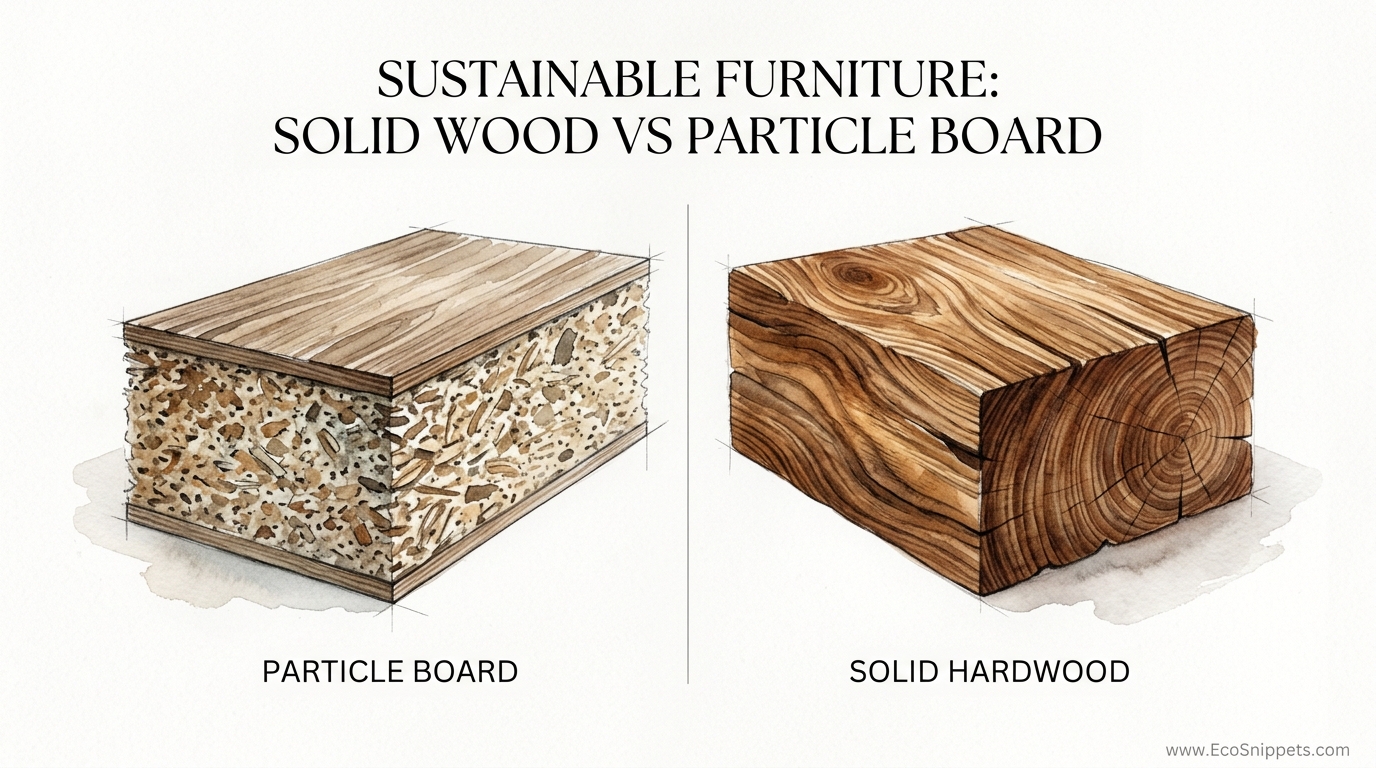
Sustainable Furniture: Solid Wood Vs Particle Board
Sustainable furniture is defined by its ability to serve its purpose for decades while maintaining a minimal impact on the Earth. At its core, the debate between solid wood and particle board is a battle between biological longevity and industrial efficiency. Solid wood comes directly from the trunk of a tree, keeping the natural cell structure intact and storing carbon for as long as the piece exists.
Particle board, also known as chipboard or low-density fiberboard, is an engineered product made by compressing wood chips, sawmill shavings, and sawdust together with synthetic resins. It exists because it is incredibly cheap to produce and makes use of every scrap of the tree, which sounds sustainable on paper. However, because it lacks the structural integrity of natural grain, it often ends up in a dumpster within a few years of purchase.
In real-world situations, you see particle board used in everything from budget-friendly kitchen cabinets to the flat-pack dressers found in college dorms. It is a material designed for “right now,” prioritizing low shipping costs and high-volume sales over durability. Solid wood, conversely, is the material of the workshop and the artisan, used for pieces intended to be used daily and eventually handed down.
Visualizing the difference is easy when you think of a stack of paper versus a thick book. A single sheet of paper is flimsy, but when you glue thousands of tiny scraps together into a board, you get something that looks solid but can easily be torn or water-damaged. A piece of solid wood is more like a stone; it is consistent all the way through, and its strength is baked into its very fibers.
The Mechanics of Construction: How Real Furniture Works
Understanding how furniture is built requires looking at the joints, as the point of connection is where most pieces fail. In solid wood construction, craftsmen use traditional joinery like mortise-and-tenon or dovetails to lock pieces of wood together. These joints rely on the physical interlocking of the wood fibers, often reinforced with simple wood glue that becomes stronger than the wood itself.
Engineered boards like particle board cannot support these kinds of joints because the material is too brittle and crumbly. Instead, “fast furniture” relies on “knock-down” hardware—cam locks, plastic dowels, and coarse-thread screws that bite into the compressed dust. Because the material has no natural grain to hold these fasteners, the holes often strip out if the piece is moved or put under too much stress.
Moisture is another area where the mechanics of these materials differ wildly. Solid wood is a “living” material that breathes, expanding and contracting slightly with the humidity of your home. Master woodworkers account for this by using “floating” panels or specialized fasteners that allow the wood to move without cracking. If you ignore this movement, the wood will eventually split, but if you respect it, the piece remains stable for a century.
Particle board reacts to moisture with structural failure rather than movement. When water hits an unfinished edge of a chipboard panel, the internal glues begin to fail and the compressed fibers swell up like a sponge. Once this swelling occurs, it is permanent; the board loses its flat profile and its ability to hold screws, effectively ending the life of the furniture piece.
The Role of Veneers and Laminates
Veneers are thin slices of real wood glued onto a core material, and they are often used to give particle board the appearance of solid hardwood. While high-end veneers on stable cores like plywood can be excellent, most mass-market furniture uses paper-thin veneers or even plastic “photographic” laminates. These surfaces are impossible to repair; if you scratch through the thin layer, you reveal the ugly, grey-brown particles underneath.
Solid wood furniture does not need a mask. The surface you touch is the same material that goes all the way through to the center of the board. This allows for a lifetime of refinishing, as you can sand away a decade’s worth of scratches and dings to reveal a fresh, beautiful surface. You are not just buying a look; you are buying a renewable resource that stays beautiful through multiple cycles of use.
The True Advantages of Heirloom Quality
Durability is the most obvious benefit of choosing solid hardwood, but it is not the only one. A piece of furniture that lasts 50 to 100 years has a dramatically lower “annualized” environmental cost than five cheap pieces that each last a decade. You are essentially halting the cycle of consumption and waste by making a single, high-quality purchase that serves your family for a lifetime.
Health is another critical advantage that is often overlooked in the showroom. Many particle boards and MDF panels use urea-formaldehyde resins as a binder, which can off-gas volatile organic compounds (VOCs) into your home for years. Choosing solid wood with natural oil or wax finishes ensures that the air in your bedroom or nursery stays clean and free from industrial chemicals.
Resale value provides a financial cushion that fast furniture can never offer. If you try to sell a used particle board dresser, you will likely get pennies on the dollar, assuming it survives the trip to the buyer’s house. Solid wood furniture, especially pieces made from desirable species like Walnut, White Oak, or Cherry, often maintains or even increases in value as it becomes an “antique.”
Repairability is perhaps the ultimate advantage of solid timber. Life happens—water rings from a forgotten glass, scratches from a move, or a dent from a dropped heavy object. With solid wood, these are just “character” marks that can be sanded out or steamed back to life. You have the power to maintain your furniture yourself, which is the ultimate form of self-reliance and sustainability.
Challenges and Common Pitfalls to Avoid
Cost is the primary hurdle for most people when considering solid wood furniture. The initial investment can be three to five times higher than a similar-looking piece made of particle board. It is easy to feel “sticker shock,” but you must remember that you are paying for the years of growth the tree required and the skilled labor needed to handle the material.
Weight is another practical challenge, as real hardwood is significantly heavier than engineered alternatives. Moving a solid oak dining table requires at least two strong people and a bit of grit, whereas a hollow-core or particle board table might be lifted by one person. This weight is a sign of density and strength, but it does mean you need to plan your living space with more permanence in mind.
Identifying “fakes” is a common pitfall in the modern market, where marketing terms are designed to confuse the buyer. Phrases like “wood solids” or “all-natural materials” are often used to describe furniture that is still primarily made of engineered boards with only the legs or trim being solid wood. You must look at the undersides and inside the drawer boxes to see the true heart of the piece.
Maintenance is a responsibility that some owners find daunting. Solid wood needs to be kept away from direct heat sources like radiators and shouldn’t sit in the path of harsh, direct sunlight all day. You also need to apply a fresh coat of wax or oil every few years to keep the wood from drying out. If you treat your furniture like a disposable appliance, solid wood might not be the right choice for you.
Real-World Limitations and Trade-offs
Solid wood is not a perfect material for every single application. In environments with extreme, rapid fluctuations in humidity—such as a non-climate-controlled cabin or a very damp basement—solid wood can warp or crack more severely than high-quality plywood or even some engineered boards. The very “life” that makes wood beautiful also makes it reactive to its environment.
Large, flat surfaces like the back of a massive wardrobe or the bottom of a long drawer are often better suited for high-quality plywood or stable MDF. Even the best craftsmen will sometimes use a “hybrid” approach, using solid wood for the frame and structure while using a stable, veneered panel for large areas that don’t need to support structural loads. This is not “cheating”; it is smart engineering that prevents the piece from tearing itself apart during the change of seasons.
Environmental trade-offs also exist within the world of solid wood. If you buy furniture made from “illegal” or endangered tropical hardwoods, you are contributing to deforestation and habitat loss. Sustainability requires looking for certifications like the FSC (Forest Stewardship Council) to ensure the timber was harvested in a way that allows the forest to regenerate.
Complex designs with ultra-thin profiles or sharp, modernist angles can sometimes be harder to achieve in solid wood. Because wood has a grain direction, it is strong in one way and weak in another. Engineered materials are “isotropic,” meaning they have the same strength in every direction, which allows for some gravity-defying designs that would be impossible with traditional timber without it snapping.
Side-by-Side: The Long-Term Comparison
The following table illustrates why the higher upfront cost of solid wood often results in a lower total cost of ownership over a 50-year period. These numbers are based on typical market averages for a standard dining table.
| Feature | Particle Board (Fast Furniture) | Solid Hardwood (Heirloom) |
|---|---|---|
| Expected Lifespan | 3 to 7 Years | 50 to 100+ Years |
| Initial Cost | $200 – $400 | $1,200 – $3,000 |
| 50-Year Cost | $2,000+ (7+ replacements) | $1,200 – $3,000 (0 replacements) |
| Repairability | Non-existent | Infinite (Sand/Refinish) |
| Health Impact | High VOC/Formaldehyde potential | Low to Zero VOC |
| Resale Value | Near zero | 50% – 110% of original cost |
Practical Tips for the Discerning Buyer
Learning to identify quality is a skill that will serve you for a lifetime. When you are inspecting a piece of furniture, the first thing you should do is pull out a drawer and look at the corner. If you see interlocking “teeth” (dovetails), you are looking at a piece that was built with care. If the drawer is just held together with staples or a single glob of glue, it is a sign of mass-production corners being cut.
Testing the “feel” of the surface is another way to spot fake wood. Real wood has a slight temperature variation and a subtle texture that follows the grain. Laminate and heavy plastic finishes often feel “room temperature” and have a repetitive texture that looks the same across the entire piece. Real wood grain never repeats; every inch of the board should be unique.
Checking the weight and the “thump” of the piece is a classic old-world test. Knock on the side of a cabinet or the top of a table. A hollow, “plasticky” sound indicates a thin veneer over a low-density core. A solid, deep “thud” tells you that there is significant mass and density behind that surface, indicating real timber.
Buying second-hand is the ultimate “hack” for getting solid wood furniture on a particle board budget. Scour estate sales, thrift stores, and online marketplaces for older pieces that look a bit tired. Because they are solid wood, you can take them home, spend a weekend sanding and re-oiling them, and end up with a high-end piece of furniture for a fraction of the showroom price.
Advanced Considerations for the Serious Collector
Understanding wood species is the next level of furniture expertise. Not all solid woods are created equal. Hardwoods like Oak, Maple, and Walnut are prized for their density and resistance to dents. Softwoods like Pine or Cedar are easier to work with and cheaper, but they will show “battle scars” from daily use much faster. Your choice should depend on how much “character” you are willing to tolerate over time.
Grain orientation is a technical detail that separates master-level furniture from the basic stuff. “Quarter-sawn” wood is cut in a way that makes the grain run vertically through the board, making it incredibly stable and less prone to warping. It is more expensive because it creates more waste at the sawmill, but for a tabletop that needs to stay perfectly flat for a century, it is the gold standard.
Finish types also matter more than you might think. A heavy “polyurethane” finish provides a thick plastic shield over the wood, which is great for water resistance but makes the piece feel less like real wood. “Oil and wax” finishes penetrate the fibers, allowing you to feel the texture of the grain. While oil finishes require a bit more maintenance, they are much easier to “spot-repair” without having to strip the whole piece.
The provenance of the wood is the final advanced consideration. Knowing where your wood came from—perhaps a local woodlot or a specific region known for its forestry practices—adds a layer of story to your home. It connects your furniture to a specific place and a specific set of hands, which is the heart of ancestral wisdom and self-reliance.
The Dining Table Scenario: A Case Study
Consider a young couple buying their first dining table. They have $400 in their budget and are looking at a modern, stylish table made of MDF with a walnut-patterned laminate. It fits the budget, looks great in the photos, and arrives in two days. However, after two years, the heat from a pizza box has bubbled the laminate, and a spilled glass of water has caused the corner to swell and crumble.
Now consider that same couple finding a solid oak table at an estate sale for $300, even though it has some old scratches and a faded finish. They spend another $50 on sandpaper and a tin of high-quality hard-wax oil. After a few hours of work, they have a table that is structurally perfect and visually stunning. This table doesn’t care about pizza boxes or water spills; if it gets a mark, they just wipe it down or do a five-minute touch-up.
In five years, the MDF table will be in a landfill, and the couple will be spending another $400 on a replacement. The oak table will still be in their dining room, looking better than the day they bought it. By the time their children are grown, that oak table will have hosted thousands of meals and will be ready to move into the next generation’s home. The “cheaper” table ended up costing them more money and more waste.
Final Thoughts
Sustainable furniture is not a trend; it is a return to a way of living that values quality over quantity. Choosing solid wood is a quiet act of rebellion against a “throwaway” culture that wants you to buy the same thing every five years. It requires a bit more research and a larger upfront investment, but the rewards are measured in decades of service and a healthier home environment.
Start your journey by looking closely at the pieces you already own. Identify which ones are built to last and which ones are already showing the tell-tale signs of industrial fatigue. When it comes time to add to your home, look for the grain, feel the weight, and ask about the joinery. You are not just buying a place to sit or a surface to eat on; you are building the foundation of your family’s history.
Remember that the most sustainable item is the one you never have to replace. By choosing the grit of solid hardwood over the convenience of particle board, you are reclaiming a piece of ancestral wisdom that says things should be built right the first time. Take pride in your choices, maintain your investments, and enjoy the peace of mind that comes from owning something that truly lasts forever.
