How To Become More Self-Sufficient Without Starting a Full-Blown Farm…
Want to start preserving your harvest, making your own soap, or building a backyard root cellar — but not sure where to begin? “Homesteading Advice” gives you instant lifetime access to 35+ practical homesteading books on food preservation, veggie gardening, DIY natural cleaning products (save over $250 per year with this skill alone), brewing, off-grid energy, and a whole lot more…
Click Here To Check It Out Now!
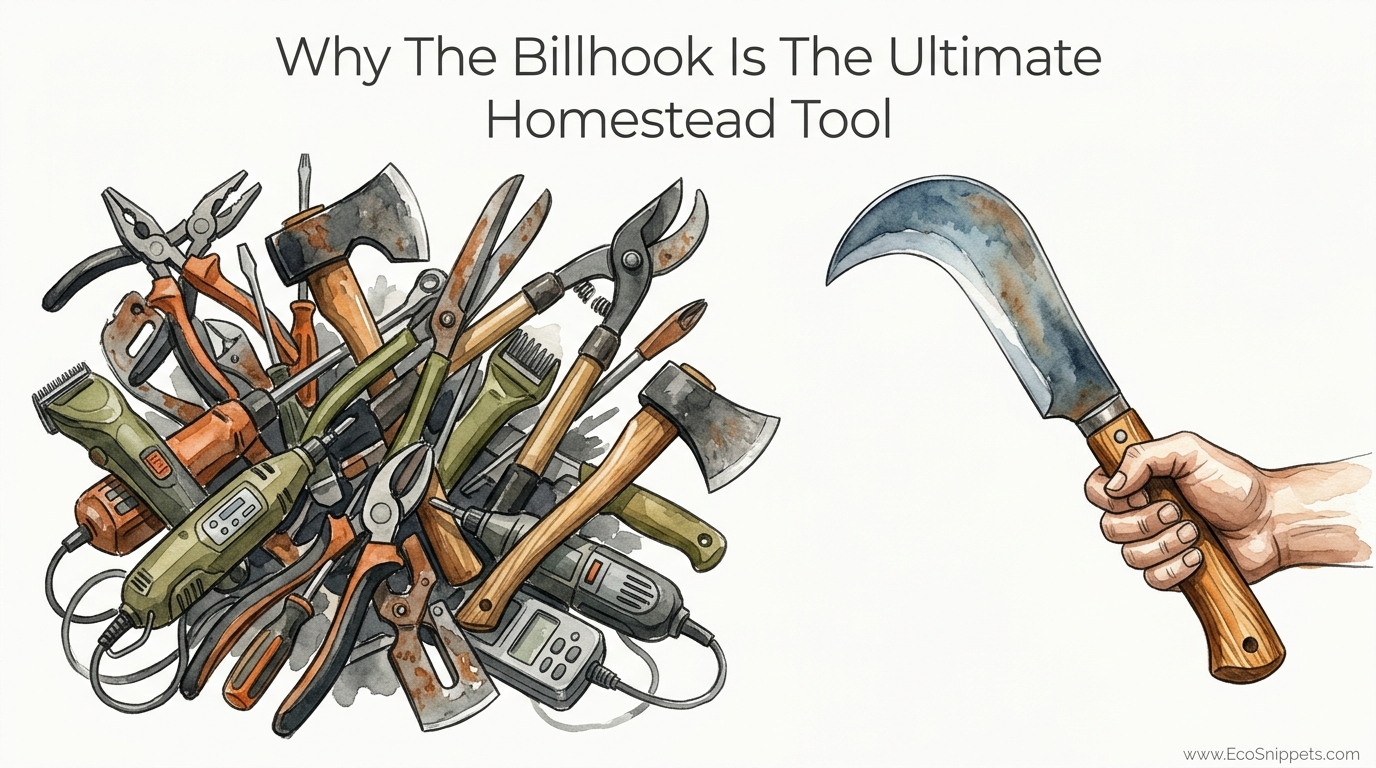
One tool to cleave, prune, split, and hedge – why are you carrying a toolbox into the woods? For centuries, the billhook was the heartbeat of the homestead. Its unique hooked tip protects the blade when cutting near the ground, while its weighted belly delivers more power than a machete. From hedge-laying to kindling prep, this single piece of forged steel replaces four modern gadgets and will outlive them all.
Stepping onto a modern homestead often feels like entering a showroom for specialized equipment. There is a specific saw for the orchard, a hatchet for the woodpile, and a thin-bladed machete for the brush. Yet, if you look back at the historical record, you find a different story. The old-timers carried one tool that did it all. This tool, the billhook, is a masterclass in ergonomic efficiency and rugged versatility.
Understanding the billhook means understanding the landscape. It was born from the necessity of managing woodlots and hedgerows before the age of fossil fuels. It is a tool designed for the hand, not for a shelf. In this guide, we will explore why this ancient implement is making a massive comeback among self-reliant practitioners and how you can master its use on your own land.
Why The Billhook Is The Ultimate Homestead Tool
The billhook is a traditional cutting tool used primarily for managing woody vegetation. It is defined by its thick, heavy blade and a characteristic “beak” or hook at the end of the cutting edge. Unlike a knife, which relies on a thin edge and slicing motion, the billhook uses mass and momentum to shear through green wood, saplings, and thick vines.
In the real world, the billhook exists to bridge the gap between a hatchet and a knife. It is the European equivalent of the machete but built for the dense, hardwood environments of the temperate north. Where a machete might bounce off a thick oak sapling or vibrate uncomfortably in the hand, the billhook’s weighted belly bites deep. The hooked tip serves a dual purpose: it allows you to pull material toward you for a precision cut, and it prevents the sharpened edge from hitting rocks or soil when you are clearing brush at ground level.
Modern homesteaders often find themselves overwhelmed by cluttered gadgets. You might have a pair of loppers that jam on thick branches and a pruning saw that takes forever on thin ones. The billhook handles both. It excels in “coppicing,” a traditional forest management technique where trees are cut at the base to encourage rapid regrowth. This makes it the premier tool for anyone looking to produce their own sustainable firewood, fencing materials, or garden stakes.
How the Billhook Works: Anatomy and Technique
To use a billhook effectively, you must understand the physics behind its design. The blade is typically forged from high-carbon steel, providing a balance of toughness and edge retention. The weight is concentrated toward the front third of the blade, which creates a “sweet spot” for chopping. This forward-leaning balance allows the tool to do the heavy lifting, requiring less effort from your arm and shoulder.
Technique is everything when swinging a billhook. Unlike a hammer or a hatchet, you do not need to white-knuckle the handle. A relaxed grip allows the tool to pivot slightly in the hand, absorbing the shock of the impact. Professionals often describe the motion as being similar to a golf swing or a controlled sword stroke. You should aim to cut through the wood, not just to it. This means your target isn’t the surface of the branch, but a point several inches beyond it.
Safety is paramount when working with a single-handed swinging tool. Always maintain a clear “blood circle” around you—an arms-length radius plus the length of the tool where no other person or pet should stand. When clearing brush, keep your non-cutting hand behind your back or firmly tucked into your belt. A common injury occurs when a worker tries to hold a branch while swinging toward it; if the blade deflects or shears through faster than expected, the free hand is in the line of fire.
The Diversity of Regional Patterns
One of the most fascinating aspects of the billhook is the sheer variety of its shapes. Historically, every county in the United Kingdom and every region in France or Italy had its own specific pattern. These were not just stylistic choices; they were functional adaptations to local geology and vegetation.
The Yorkshire pattern is perhaps the most famous. It features a long, straight back-edge often used for splitting kindling and a double-edged blade. This allows the user to switch between a heavy chop and a finer shearing cut without changing tools. In contrast, the Devon pattern is typically single-edged with a more pronounced hook, designed for the specific types of thorn and hazel found in southwestern hedgerows.
Other variations include the “Spar Hook,” a smaller, lighter version used for making the wooden pins (spars) used in thatched roofs. There is also the “Slasher,” which is essentially a billhook blade mounted on a long, five-foot handle. This allows for clearing high branches or deep bramble patches from a safe distance. Choosing the right pattern depends on your specific land; if you are clearing briars, a hooked tip is essential. If you are prepping firewood, a heavier, straighter belly is your best friend.
Benefits of Using a Billhook
Choosing a billhook over a suite of modern power tools or specialized hand tools offers several measurable advantages. The most immediate is efficiency. In the time it takes to prime a chainsaw or untangle a pair of loppers, a skilled billhook user can have a sapling felled and stripped of its side-branches (a process known as “snedding”).
Durability is another hallmark of the billhook. Most modern gardening tools are built with thin stamped steel and plastic handles designed for a short lifecycle. A forged billhook, especially one with a through-tang or a socket-set handle made of ash or hickory, is a multi-generational tool. If the handle breaks, a new one can be carved from a sturdy branch right in the woods. The thick steel can withstand decades of sharpening without losing its structural integrity.
The billhook also offers superior protection for the user and the tool. Because the hook extends past the cutting edge, it acts as a bumper. If you are cutting a root or a stem at the base of a wall, the hook hits the stone first, sparing the sharp edge from dulling. This allows you to work faster and in more challenging environments than you could with a standard knife or axe.
Common Mistakes and How to Avoid Them
Beginners often treat the billhook like a heavy kitchen knife, using only their wrist to power the cut. This leads to rapid fatigue and poor accuracy. To avoid this, use your entire body. The power should come from the legs and the rotation of the torso, with the arm acting as a guide. If you find yourself “hacking” at a branch with twenty small strikes, your tool is either too light or your swing is too tentative.
Another frequent error is poor sharpening. Because of the curved “beak,” a standard flat whetstone can be difficult to use. Many people end up rounding off the hook or leaving the most important part of the blade—the inside curve—completely dull. Use a “cigar stone” or a small, rounded diamond file to follow the contour of the hook. A sharp billhook should be able to shave hair; a dull one is a dangerous tool that is more likely to bounce and cause injury.
Ignoring handle maintenance is a mistake that can lead to blisters or even tool failure. Wood handles should be treated with raw linseed oil to keep them from becoming brittle. If you buy a modern billhook that comes with a thick coat of varnish, sand it off immediately. Varnish becomes slippery when wet with sweat or rain, making the tool much harder to control. A natural, oiled finish provides a superior grip and ages beautifully with use.
Limitations of the Billhook
While the billhook is incredibly versatile, it is not a magic wand. It has realistic constraints that every practitioner must respect. For one, it is not a felling axe. Attempting to cut down a tree thicker than four or five inches with a billhook is an exercise in frustration and wasted energy. The blade geometry is optimized for “green” (living) wood; it can struggle with very dry, seasoned hardwoods which are better handled by a saw or a splitting maul.
Environmental limitations also play a role. The billhook is a “contact” tool. If you are working in an area with extremely high, dense canopy where you cannot swing your arm freely, a folding saw might be more practical. Additionally, because the billhook is a swinging tool, it requires a certain amount of physical strength and coordination. For those with limited mobility or joint issues, a high-quality ratcheting lopper might be a safer alternative for heavy pruning tasks.
Billhook vs. Machete vs. Hatchet
Understanding where the billhook fits in the tool hierarchy helps in choosing the right equipment for a day’s work. While they may seem similar, their performance varies significantly based on the task.
| Feature | Billhook | Machete | Hatchet |
|---|---|---|---|
| Primary Target | Woody brush, saplings, vines | Leafy vegetation, soft grass | Small logs, splitting firewood |
| Weight Distribution | Forward-heavy belly | Evenly balanced, thin | Extreme head-weight |
| Precision | High (using the hook) | Medium | Low (chopping only) |
| Safety | Hook protects edge from ground | Open edge is vulnerable | Prone to glancing off round wood |
The machete is a “velocity” tool; it relies on speed to cut through soft, non-woody plants. The hatchet is a “force” tool; it relies on weight to split fibers apart. The billhook is a “shear” tool; it uses a combination of mass and a curved geometry to slice through the tough, stringy fibers of green wood. If you are clearing a path through a jungle of ferns, take the machete. If you are managing a temperate woodland, the billhook is the superior choice.
Practical Tips and Best Practices
Immediate application is the best way to learn. When you first get your billhook, spend time “feeling” the balance. Practice on small, thumb-thick branches first. One of the best techniques to master is the “pull-cut.” By placing the hook over a small vine and pulling sharply toward your body (ensuring your legs are well out of the way), you can clear messy growth with incredible precision.
For kindling preparation, the billhook is unmatched. You can use it as a “froe” by placing the blade on top of a small log and tapping the back of the blade with a wooden mallet (a “baton”). This is safer and more accurate than swinging an axe at small pieces of wood. The wide blade acts as a wedge, popping the grain apart with very little effort.
Storage is also part of best practice. High-carbon steel will rust if left in a damp shed. After every use, wipe the blade clean of sap and moisture. Apply a very thin coat of camellia oil or even a bit of beeswax to the steel. Store the tool in a leather or heavy canvas sheath. Never store a billhook “naked” on a concrete floor, as the moisture from the stone will pit the steel and ruin the edge.
Advanced Considerations: Hedge Laying and Coppicing
For the serious practitioner, the billhook is the gateway to advanced land management skills like hedge laying. This is the ancient art of creating a “living fence.” By using a billhook to partially cut through the base of a sapling (a process called “pleaching”) and laying it over at an angle, you can create a thick, stock-proof barrier that continues to grow. This requires a level of control over the blade that only comes with practice—you must cut far enough to bend the wood but leave enough of the “cambium layer” intact so the tree survives.
Coppicing is another advanced strategy where the billhook shines. In a managed hazel or willow plat, you harvest the straight poles every seven to ten years. A billhook allows you to make clean, slanted cuts at the base of the “stool.” These slanted cuts ensure that rainwater runs off the stump, preventing rot and encouraging the tree to send up a new crop of straight, vigorous shoots.
Those looking to maximize efficiency might also look into the “double-handed” billhooks found in parts of Europe. These allow for much more powerful swings and are used for heavy-duty clearing of invasive species like gorse or heavy bramble. Understanding these advanced techniques turns a simple tool into a sophisticated system for land stewardship.
A Scenario in the Field: The Morning Clean-Up
Imagine a crisp autumn morning on the homestead. A storm the night before has brought down several large oak limbs, and a thicket of wild blackberry is encroaching on the garden path. Instead of fetching a chainsaw, a pair of shears, and a rake, you grab your Yorkshire billhook.
First, you move to the fallen oak limbs. Using the heavy belly of the hook, you quickly “sned” the side branches, turning the messy limb into a clean pole in minutes. Then, you flip the tool over and use the straight back-edge to split the thicker branches into perfectly sized kindling for the evening fire.
Moving to the garden path, you use the hook to reach into the base of the thorny blackberry vines. You don’t have to bend over; the length of the tool and the hook allows you to pull the vines out and slice them at the root. Within thirty minutes, the path is clear, the wood is prepped, and you haven’t used a single drop of gasoline or struggled with a single jammed mechanism. This is the practical reality of a well-used billhook.
Final Thoughts
The billhook is more than just a piece of historical trivia; it is a functional masterpiece that solves the problem of modern tool clutter. It rewards the user who values skill over gadgetry and durability over convenience. By consolidating the functions of a knife, axe, and saw into one forged blade, it simplifies the work of land management and connects the homesteader to a lineage of self-reliance that stretches back to the Bronze Age.
Embracing this tool requires a shift in mindset. It asks you to learn a rhythm, to maintain an edge, and to understand the specific needs of your landscape. Whether you are clearing a small suburban lot or managing a multi-acre woodlot, the billhook offers a level of intimacy with the land that power tools simply cannot provide.
Experiment with different patterns and find the one that feels like an extension of your own arm. Start with simple tasks, respect the edge, and soon you will find yourself leaving the heavy toolbox behind. The heartbeat of the homestead is still found in the simple, elegant utility of forged steel.
