How To Become More Self-Sufficient Without Starting a Full-Blown Farm…
Want to start preserving your harvest, making your own soap, or building a backyard root cellar — but not sure where to begin? “Homesteading Advice” gives you instant lifetime access to 35+ practical homesteading books on food preservation, veggie gardening, DIY natural cleaning products (save over $250 per year with this skill alone), brewing, off-grid energy, and a whole lot more…
Click Here To Check It Out Now!
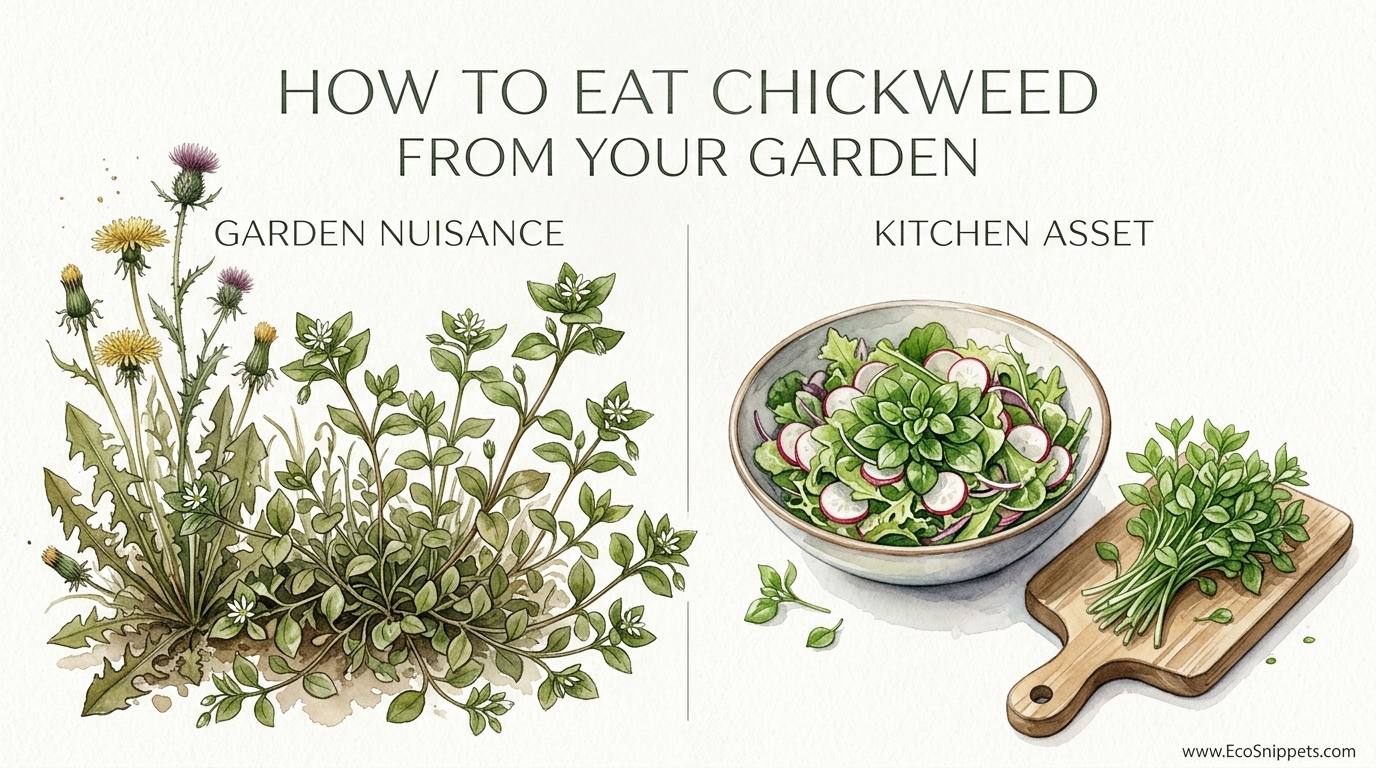
You are spending hours killing the most nutrient-dense green on your property – here is why you should be harvesting it instead. Chickweed is the ‘nuisance’ that smothers your spring garden. But while you’re fighting it, you’re missing out on a plant that has more Vitamin C than oranges and more iron than spinach. Stop the war and start the feast.
Modern landscaping has taught us to fear anything that grows without a permission slip from a seed packet. We spend billions every year on chemical sprays and plastic weed-mats to suppress “invaders” that our ancestors would have guarded like gold. Chickweed, or Stellaria media, is the ultimate example of this forgotten heritage. It is a persistent, sprawling green that thrives when the rest of your garden is still shivering in the frost.
Understanding this plant means reclaiming a piece of self-reliance that was lost somewhere between the pioneer trail and the suburban grocery store. This isn’t just about saving a few dollars on salad; it is about recognizing that nature provides its most potent nutrition exactly when our bodies need it most. After a long winter of heavy foods and stored grains, this cooling, mineral-rich “weed” arrives to wake up the system.
How To Eat Chickweed From Your Garden
Chickweed is a succulent, low-growing annual that belongs to the carnation family. It thrives in moist, nitrogen-rich soil and often forms dense, lush mats that can blanket a garden bed in a matter of weeks. While most gardeners see a tangled mess, a trained eye sees a “living mulch” that is entirely edible from the tiny white flowers down to the tender stems.
The flavor of chickweed is remarkably mild, often described as a cross between corn silk, young peas, and premium baby spinach. Unlike dandelion greens, which can be aggressively bitter, or mustard greens, which carry a spicy bite, chickweed is sweet and refreshing. This makes it an ideal “gateway” wild edible for those who are skeptical of foraging. It doesn’t need to be buried in dressing or boiled for hours to be palatable.
In real-world terms, you can use chickweed anywhere you would use sprouts, microgreens, or lettuce. It is a “cut-and-come-again” crop. If you use a pair of scissors to snip the top 5 to 8 centimeters (2 to 3 inches) of growth, the plant will push out new tender shoots within days. This makes a single patch a reliable source of fresh greens for the entire duration of the cool season.
Because of its high water content, chickweed is best eaten fresh. It provides a juicy crunch that is hard to find in cultivated greens. Whether you are piling it onto a sourdough sandwich or tossing it into a morning smoothie, it brings a brightness to the plate that feels like the very essence of spring.
How to Identify and Harvest Chickweed Correctly
Identifying chickweed is a masterclass in paying attention to detail. While the plant may look like a generic green sprawl at first glance, nature has left a very specific “fingerprint” on Stellaria media that makes it easy to distinguish from toxic lookalikes once you know where to look.
The most famous identifier is the “mohawk” of hair. If you look closely at a chickweed stem, you will see a single, fine line of white hairs running down one side. At every node—where the leaves join the stem—the line of hair shifts, rotating to a different side of the stem. This is a unique trait; most hairy plants are covered in fuzz all the way around. If the stem is smooth or hairy in a circle, you aren’t looking at common chickweed.
The flowers are another giveaway. They are tiny, white, and star-shaped. While they appear to have ten petals, they actually have only five. Each petal is deeply cleft, or split nearly to the base, creating a beautiful “double” look. This is why the Latin name is Stellaria, which translates to “little star.” The leaves are oval-shaped with pointed tips and grow in opposite pairs along the stem.
When you are ready to harvest, avoid pulling the plant up by the roots. Ripping it out brings dirt into your kitchen and kills your future harvests. Instead, take a sharp pair of scissors and give the patch a “haircut,” removing the top third of the plant. This keeps the greens clean and encourages the plant to branch out and become even more dense. Focus on the young, light-green tips. As the plant ages and the weather warms, the lower stems can become stringy and tough, losing that signature succulent crunch.
Benefits of Harvesting This Garden Asset
The nutritional profile of chickweed is nothing short of extraordinary. While a head of iceberg lettuce is mostly water and fiber, chickweed is a dense concentration of vitamins and minerals that puts most supermarket produce to shame.
Testing has shown that fresh chickweed can contain significantly more Vitamin C than an equivalent weight of oranges. This was a well-known fact to 19th-century sailors and pioneers who used chickweed-infused vinegar to prevent scurvy during long winters or sea voyages. Additionally, its iron content is substantially higher than that of spinach, making it a powerful ally for those struggling with fatigue or anemia.
Beyond vitamins, chickweed is rich in saponins. These are natural compounds that help the body absorb nutrients more effectively by increasing the permeability of cell membranes. In traditional herbalism, chickweed is considered a “lymphatic tonic.” It helps move congestion through the body, supporting the kidneys and liver in their natural detoxification processes. This is why it has been a staple of “spring cleanses” for centuries.
Topically, chickweed is a superstar for skin health. It is remarkably cooling and soothing. If you have ever suffered from an itchy rash, a minor burn, or a stubborn insect bite, a crushed-leaf poultice of chickweed can provide nearly instant relief. Its anti-inflammatory properties help draw out heat and reduce swelling, making it a favorite ingredient for modern natural salves and ointments.
Challenges and Common Mistakes
The biggest challenge with chickweed is also its greatest strength: it loves to grow in the same places humans love to live. This means it often pops up in lawns, flower beds, and along the edges of driveways. The mistake many foragers make is harvesting from areas that have been treated with herbicides, pesticides, or fertilizers. Chickweed is a bio-accumulator, meaning it can pull chemicals and heavy metals from the soil and concentrate them in its leaves.
Another common pitfall is misidentification with the “Scarlet Pimpernel” (Anagallis arvensis). Before it blooms, this toxic lookalike can appear very similar to chickweed. However, it lacks the single line of hair on the stem and has square stems rather than round ones. Once it blooms, the difference is obvious: Scarlet Pimpernel has salmon-colored or red-orange flowers, while chickweed’s are always white.
Beginners often wait too long to harvest. Once the weather stays consistently above 21°C (70°F), chickweed begins to “bolt” or go to seed. The stems become wiry and the leaves turn a yellowish-green. At this stage, the plant is still edible, but the texture is unpleasant. To get the best out of your patch, you must be proactive during the cool, damp weeks of early spring or late autumn.
Limitations: When This Plant Is Not Ideal
While chickweed is a powerhouse of health, it is not a “magic pill” for everyone. Because it contains saponins, consuming it in massive, industrial quantities can lead to digestive upset or diarrhea in sensitive individuals. Think of it as a potent supplement provided by nature; it is best enjoyed as part of a varied diet rather than as your only source of calories.
Environmental limitations also play a role. Chickweed is a “winter annual” in many climates. It hates extreme heat and will vanish as soon as the summer sun bakes the soil. If you live in an arid region with little shade, your chickweed season might be only a few weeks long. Conversely, in very wet, stagnant areas, the dense mats of chickweed can harbor slugs or mold. Always inspect your harvest carefully and wash it thoroughly to remove any hidden garden guests.
Those with a history of kidney stones should also exercise moderate caution. Like many leafy greens, including spinach and chard, chickweed contains some oxalates. While the levels are generally lower than those in cultivated greens, it is worth noting for anyone on a strictly low-oxalate diet.
Comparing the Assets: Chickweed vs. Spinach
To understand the value of what is currently growing in your garden for free, it helps to look at a direct comparison with the most popular cultivated green: spinach.
| Feature | Garden Chickweed | Cultivated Spinach |
|---|---|---|
| Nutrient Density | Higher Vitamin C and Iron levels. | Solid, but lower mineral concentration. |
| Cost to Grow | Free; volunteers in most soils. | Requires seeds, prep, and water. |
| Pest Resistance | Extremely hardy; few natural enemies. | Prone to aphids, leaf miners, and wilting. |
| Seasonality | Thrives in cold (down to -5°C / 23°F). | Best in mild temps; sensitive to frost. |
| Shelf Life | Wilts quickly once picked. | Higher commercial shelf life. |
The efficiency of chickweed is clear. It requires zero maintenance, zero financial investment, and provides a superior nutritional profile. The trade-off is the time required for identification and the fact that it doesn’t store as well as the thick-leaved varieties found in stores.
Practical Tips for the Home Forager
Successful foraging is about more than just finding the plant; it is about knowing how to integrate it into your daily life without it feeling like a chore.
One of the best practices is to keep a pair of “garden scissors” near your back door. When you are heading in to make lunch, take thirty seconds to snip a handful of chickweed. Freshness is everything with this plant. If you pick it and leave it on the counter for an hour, it will look like a sad, limp pile of thread. If you must store it, wrap it in a damp paper towel and place it in a sealed container in the refrigerator for no more than 24 hours.
If your chickweed has wilted slightly after harvest, you can “revive” it. Submerge the greens in a bowl of ice-cold water for five minutes. The stems will pull in the moisture, and the leaves will “crisp” back up. This is a trick used by professional chefs to ensure their wild garnishes look vibrant on the plate.
When cleaning your harvest, a salad spinner is your best friend. Because chickweed grows low to the ground and in dense mats, it can trap a surprising amount of grit and dirt. Multiple rinses in a large bowl of water—allowing the dirt to settle at the bottom—is more effective than rinsing under a running tap. Spin it dry immediately to prevent the leaves from becoming soggy.
Advanced Considerations: Preservation and Long-Term Use
For the serious practitioner who wants to extend the benefits of chickweed beyond the short growing season, preservation is the next step. While chickweed does not dry well for tea—it loses much of its medicinal “spark” and flavor—it excels in other forms of preservation.
Chickweed pesto is perhaps the most popular way to store the harvest. By blending the fresh greens with olive oil, garlic, nuts, and a hard cheese, you create a concentrated paste that freezes beautifully. Spoon the pesto into ice cube trays and freeze them. Once solid, transfer the cubes to a freezer bag. You can drop a cube of “spring garden” into a hot bowl of pasta or a winter soup six months later.
Infused vinegars are another ancestral method. Pack a clean glass jar with fresh chickweed and cover it with apple cider vinegar. Let it sit in a cool, dark place for two to four weeks, then strain. The vinegar will pull out the minerals, particularly the calcium and potassium. Use this as a base for salad dressings or take a tablespoon in water as a digestive tonic.
If you are interested in topical applications, “succus” is a traditional preparation. This is essentially the expressed juice of the plant. You can blend fresh chickweed with a tiny bit of water, strain out the pulp, and freeze the juice in small portions. This frozen juice can be rubbed directly onto a sunburn or itchy skin for an immediate cooling effect that is far superior to store-bought aloe vera.
Examples of Chickweed in the Kitchen
To see how this works in practice, let’s look at two simple ways to use a morning harvest.
Scenario A: The “Field Salad”
Imagine a crisp March morning. You’ve just harvested two large handfuls of chickweed tips. You toss them into a bowl with some sliced radishes, a few hard-boiled eggs from your chickens, and some toasted sunflower seeds. You don’t need a heavy dressing—just a squeeze of lemon and a drizzle of olive oil. The chickweed provides a succulent, “juicy” base that acts more like a vegetable than a leaf. It is a meal that costs pennies but contains more bioavailable minerals than a $15 restaurant salad.
Scenario B: The Recovery Smoothie
After a heavy workout or a long day of yard work, your body needs electrolytes and anti-inflammatories. Instead of a processed sports drink, you blend a cup of fresh chickweed with a green apple, a piece of ginger, and some coconut water. The saponins in the chickweed help your body process the nutrients quickly, while the high potassium and magnesium content helps prevent muscle cramps. It is a functional food at its most basic and effective level.
Final Thoughts
Learning to harvest chickweed is a radical act of rebellion against a food system that prioritizes shelf-life over nutrient density. It is an acknowledgment that the “nuisances” in our garden are often the very assets we need to thrive. By shifting our perspective from “war” to “harvest,” we reduce our reliance on industrial agriculture and reconnect with the seasonal rhythms of the land.
This plant has been a companion to humanity for thousands of years. It followed our ancestors across continents, thriving in the disturbed soil around their homes and providing a safety net against famine and disease. When you choose to eat chickweed, you are participating in a tradition of self-reliance that spans generations. It is a simple, humble way to bring ancestral wisdom into the modern kitchen.
Start small. Find a patch in your garden that hasn’t been sprayed, identify the line of hairs on the stem, and take a taste. You might find that the “weed” you’ve been trying to kill for years is actually the best thing growing on your property. Once you experience the vibrant energy of fresh chickweed, you’ll never look at your garden the same way again.
