How To Become More Self-Sufficient Without Starting a Full-Blown Farm…
Want to start preserving your harvest, making your own soap, or building a backyard root cellar — but not sure where to begin? “Homesteading Advice” gives you instant lifetime access to 35+ practical homesteading books on food preservation, veggie gardening, DIY natural cleaning products (save over $250 per year with this skill alone), brewing, off-grid energy, and a whole lot more…
Click Here To Check It Out Now!
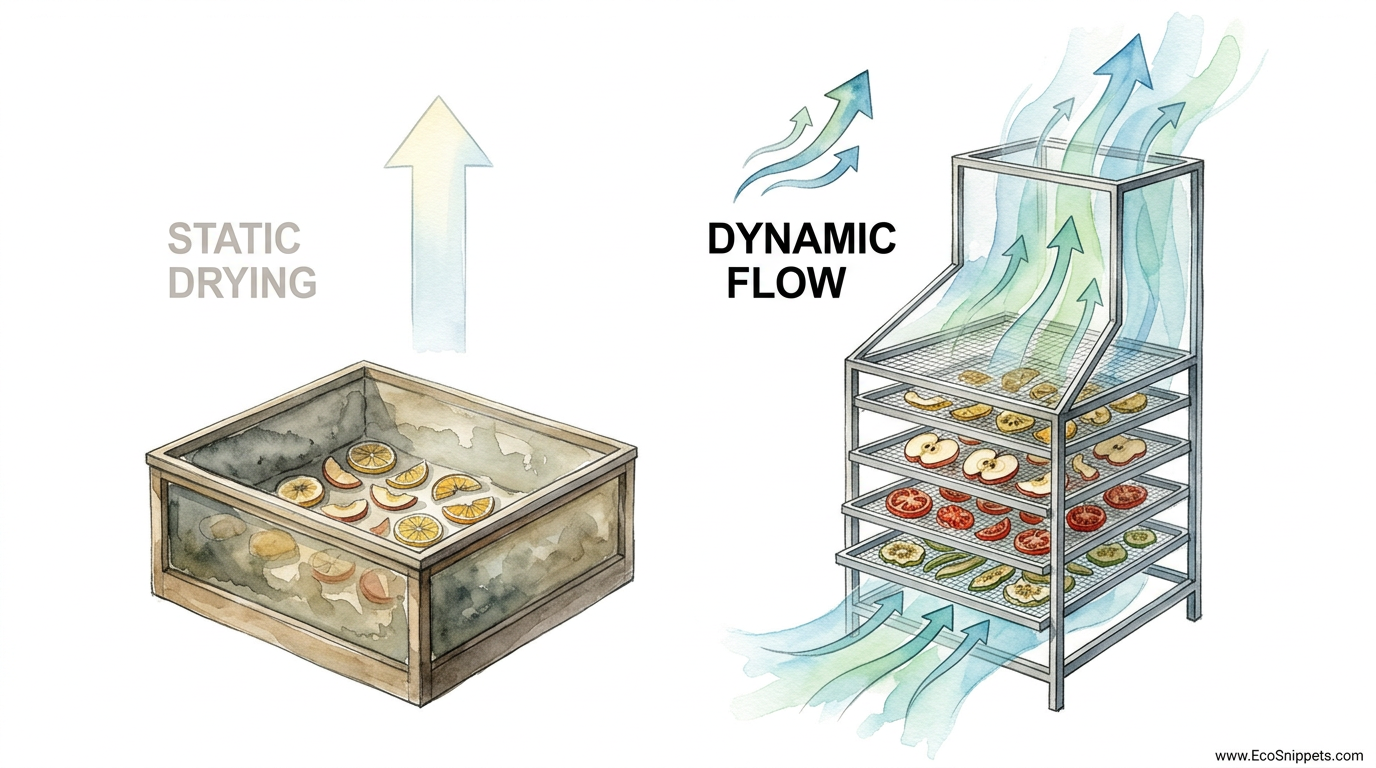
If the air isn’t moving, your food is just rotting in the sun; here is how to use physics to create a high-speed drying tunnel. Laying food out on a tray in the sun is the oldest trick in the book, but it’s also the slowest. Stagnant air invites mold, dust, and pests. By building a dynamic solar chimney, you harness the ‘stack effect’—using the sun’s energy to create a constant, high-speed wind that strips moisture away in hours. Don’t just dry your food; move it.
Harvesting the bounty of a garden is only half the battle for a self-reliant household. Keeping that harvest through the winter requires a firm grasp on the laws of nature. Traditional sun drying often leaves the gardener at the mercy of the wind and the flies. A solar chimney dehydrator changes the game entirely, turning passive sunlight into a mechanical force that pulls moisture out of every slice of apple or strip of venison with relentless efficiency.
This system is a testament to the wisdom of working with the environment rather than against it. It requires no fuel, no electricity, and very little maintenance once the structure is upright. If you are tired of watching your hard-earned crops soften and spoil because of a humid afternoon, this build is your path to food security.
Diy Solar Chimney Food Dehydrator Benefits
A DIY solar chimney food dehydrator is a structure designed to capture solar radiation and convert it into a powerful, upward-moving current of warm air. Unlike a standard cabinet dryer that might just sit and bake, the chimney model uses a vertical shaft to create a pressure differential. This physical phenomenon, known as the stack effect, ensures that air is constantly being drawn over the food and exhausted out the top.
In real-world applications, this technology has been pioneered by researchers at institutions like UC Davis to help farmers in developing regions save their crops without expensive machinery. It essentially acts as a solar-powered engine where the fuel is light and the exhaust is water vapor. You can think of it as a wind tunnel where the wind is generated by heat rather than a fan blade.
This setup is particularly useful for those living off-grid or anyone looking to reduce their reliance on the local power company. It allows for the preservation of massive quantities of food—often hundreds of pounds in a single season—using nothing but the grit of your own hands and the energy of the sun. It bridges the gap between ancient open-air drying and modern industrial dehydration.
The Physics of the Stack Effect and Thermal Buoyancy
Understanding the science behind the chimney is vital for any serious practitioner. Warm air is less dense than cold air, which causes it to rise. In a closed collector at the base of your dehydrator, the sun beats down on a black surface, heating the air trapped inside to temperatures significantly higher than the ambient surroundings. This hot air wants to escape upward immediately.
The addition of a tall chimney provides a dedicated path for this air to travel. As the hot air rises through the chimney, it creates a low-pressure zone at the bottom of the drying chamber. Fresh, cooler air is sucked in through the intake to fill the void, creating a continuous loop of movement. This isn’t a gentle drift; in a well-constructed chimney, the air velocity can be surprisingly high.
Removing moisture from food is not just about heat. Air movement is actually the more important factor in most climates. Moving air carries away the “boundary layer” of moisture that sits on the surface of the food. If that moisture stays put, the drying process stalls, and bacteria begin to colonize the sugars. The solar chimney ensures that the boundary layer is constantly stripped away and replaced with dry, thirsty air.
Building the High-Speed Drying Tunnel
Constructing this beast requires a bit of carpentry and a solid understanding of the four main components. You will need a solar collector, a drying table or chamber, a chimney, and a covering that ties it all together. A common and highly effective design involves a horizontal table roughly four meters long connected to a vertical chimney that stands at least two meters high.
Start with the table. Build a sturdy frame using rot-resistant wood like cedar or pressure-treated lumber. The surface of this table should be covered in a dark, heat-absorbent material. Black plastic or heavy black landscape fabric works well here. This surface is the engine of your dehydrator, as it absorbs the sun’s rays and transfers that energy into the air directly above it.
Next, construct the chimney. It must be at least as wide as the drying table to prevent a bottleneck in the airflow. Frame it out and cover the interior with a reflective material or leave it as a dark shaft. The chimney needs to be tall enough to create a significant draft; two meters above the level of the drying table is generally considered the minimum for high performance. Seal the chimney with clear polyethylene plastic on the sides to keep the heat trapped inside as the air moves upward.
The drying trays are where your harvest will rest. Use food-grade mesh or stainless steel screening stretched over wooden frames. These trays should be elevated slightly off the black collector surface using small wooden cleats. This allows the air to flow both under and over the food, maximizing the surface area exposed to the breeze. Finally, drape a clear, UV-resistant plastic sheet over the entire table, sealing it tightly to the base of the chimney. This creates the tunnel where the magic happens.
Advantages of Dynamic Solar Dehydration
Speed is the most obvious advantage of this system. Experiments have shown that a chimney-style solar dryer can process food twice as fast as traditional cabinet dryers. When you are dealing with a massive harvest of tomatoes or berries that are all ripening at the same time, every hour saved is an hour closer to a shelf-stable product.
Hygiene is another massive win for the solar chimney. Because the system is entirely enclosed by plastic or glass, your food is protected from the elements. Flies, wasps, and birds cannot reach the produce. Dust and debris blown by the wind are kept at bay. You are essentially creating a clean-room environment in the middle of your backyard, ensuring that the final product is as safe as it is delicious.
Nutrient retention is significantly higher in these units than in open sun drying. Direct UV light can degrade vitamins, especially Vitamin C and Vitamin A. Since the solar chimney uses indirect heat—the air is heated in the collector and then passed over the food—the produce is often shielded from direct sunlight. This results in brighter colors and a much higher concentration of the healthy compounds you grew the food for in the first place.
Challenges and Common Pitfalls
Poor sealing is the most frequent cause of failure in a DIY solar chimney. If air can leak out of the sides of the drying tunnel before it reaches the chimney, the pressure differential drops. This kills the velocity of the air movement. You must ensure that the clear plastic cover is tucked tightly and weighted down or stapled securely to the frame. Think of it like a leak in a vacuum hose; even a small hole can ruin the suction.
Chimney height is another area where builders often cut corners. A short chimney simply doesn’t provide enough “pull” to overcome the resistance of the food trays. If you have ten trays of sliced peaches, that’s a lot of surface area for the air to drag against. A taller chimney creates a stronger vacuum effect at the base, ensuring that the air keeps moving even when the dehydrator is fully loaded to capacity.
Using the wrong materials for the drying racks can lead to heartbreak. Never use galvanized hardware cloth or common window screening that contains lead or other toxins. The heat and acidity of the drying food can cause chemicals to leach into your harvest. Always source food-grade nylon mesh or high-quality stainless steel. It is a one-time investment that ensures your food remains a source of health rather than a source of contamination.
Limitations of the Solar Chimney Method
Climate is the ultimate arbiter of solar drying success. If you live in a region with high humidity and frequent overcast skies, a purely passive solar chimney may struggle to get the job done. While the system can still move air on a cloudy day, the lack of intense heat means the air won’t be “thirsty” enough to pull moisture out of dense foods like meat or thick-cut vegetables. In these areas, the chimney serves better as a pre-dryer or requires a backup heat source.
Space is a practical constraint that cannot be ignored. A high-performance solar chimney dehydrator is not a small appliance. It is a significant piece of infrastructure that requires a large, flat, south-facing area (in the northern hemisphere) that remains unshaded throughout the day. If you have a small suburban lot with many trees, finding a spot for a four-meter-long drying table can be a logistical challenge.
Nighttime drying is a limitation of all solar-based systems. Once the sun goes down, the engine stops. In very humid environments, food that isn’t fully dry can actually reabsorb moisture from the cool night air. Practitioners often have to bring trays inside overnight or use thermal mass to keep the air moving after dark. This adds a layer of management that some might find tedious compared to an electric unit you can simply plug in and forget.
Static Drying vs. Dynamic Flow Comparison
| Feature | Static Sun Drying (Open Trays) | Solar Chimney (Dynamic Flow) |
|---|---|---|
| Drying Speed | Slow (3-5 days) | Fast (1-2 days) |
| Protection from Pests | None (Requires netting) | Excellent (Fully enclosed) |
| Airflow Mechanism | Natural breeze only | Thermal stack effect |
| Nutrient Retention | Lower (UV exposure) | Higher (Indirect heat) |
| Cost to Build | Minimal | Moderate ($100 – $300) |
Practical Tips and Best Practices
Orientation is the most critical factor for daily operation. You want the long collector table to be angled toward the sun to maximize heat absorption. In the northern hemisphere, this means the table should face south. If possible, build the unit with an adjustable incline so you can tilt it more steeply in the autumn when the sun is lower in the sky. This ensures that the black surface is always getting the most direct hit of radiation possible.
Uniformity in food preparation will save you countless headaches. Slice your produce to a consistent thickness—usually around one-quarter of an inch. If some pieces are thick and others are paper-thin, you will spend your whole day picking through the trays to remove the finished bits while the rest continues to dry. A simple mandoline slicer is a worthwhile investment for anyone serious about high-volume dehydration.
Airflow management within the chamber can be fine-tuned by how you load the trays. Don’t let the pieces of food overlap or touch. Every slice needs its own little island of space so the air can wrap around it. If you crowd the trays, you create “dead zones” where the air becomes stagnant and the food begins to rot. It is better to run two batches with proper spacing than one batch that is crammed together and destined for the compost pile.
Advanced Considerations for the Serious Practitioner
Thermal mass can be used to solve the problem of nighttime cooling. Some advanced builders line the bottom of the collector with heavy bricks or dark stones. These materials soak up heat all day long and release it slowly throughout the night. This keeps the air inside the chamber slightly warmer than the outside air, preventing moisture from condensing on your food and keeping a gentle draft moving through the chimney even after the sun has set.
Hybridization is another path for those who want the best of both worlds. A tiny solar-powered computer fan can be mounted at the base of the chimney. On days when the sun is weak or the air is exceptionally still, the fan provides the extra kick needed to maintain airflow. Since these fans require very little power, a small dedicated solar panel is often enough to keep them spinning from dawn to dusk.
Scaling up for community use is entirely possible with this design. If you have a neighborhood orchard or a large farm, you can build multiple collector tables that all feed into a single, massive central chimney. This increases the total volume of air being moved and allows for the processing of hundreds of pounds of food at once. Just remember that as you increase the table surface, the chimney must grow taller and wider to handle the increased load of moist air.
Scenario: Drying a Harvest of Roma Tomatoes
Imagine it is late August and your Roma tomato plants are practically sagging under the weight of five hundred ripe fruits. In a traditional setting, you might be looking at hours of canning or a house filled with the hum of multiple electric dehydrators. With a solar chimney, you can process this entire harvest in a couple of days with zero impact on your electric bill.
First, wash and halve the tomatoes, scooping out the seeds if you want a faster drying time. Lay them cut-side up on the mesh trays. Because the solar chimney moves so much air, you don’t need to worry about the tomatoes “dripping” and causing mold; the moving air will skin them over quickly. Load the trays into the drying tunnel and seal the plastic cover.
Within four hours, you will notice the clear plastic of the chimney beginning to fog slightly as it carries the moisture away. By sunset on the first day, the tomatoes will be significantly shrunken and leathery. If the weather holds, by the afternoon of the second day, they will be perfectly dry—intense, sweet, and ready for long-term storage in glass jars. You have successfully preserved a massive harvest using nothing but the physics of the atmosphere.
Final Thoughts
Building a DIY solar chimney food dehydrator is more than just a weekend project; it is a commitment to a lifestyle of self-reliance. It forces you to look at the sun and the wind not as obstacles to be avoided, but as tools to be harnessed. The stack effect is a powerful ally for anyone who values the security of a full pantry and the satisfaction of traditional craftsmanship.
This system respects the ancestral wisdom of sun drying while upgrading it with the precision of modern physics. It removes the variables of pests and stagnant air, replacing them with a reliable, high-speed drying environment that costs nothing to operate. Whether you are drying herbs for medicine, fruit for snacks, or meat for the winter, the solar chimney ensures your work is not in vain.
Take the time to build it sturdy and seal it tight. Experiment with different foods and observe how the air moves through the shaft. As you watch the moisture escape the top of your chimney, you will feel a deep sense of connection to the rhythms of the earth. You aren’t just preserving food; you are mastering the elements to provide for your family, one dry slice at a time.
