How To Become More Self-Sufficient Without Starting a Full-Blown Farm…
Want to start preserving your harvest, making your own soap, or building a backyard root cellar — but not sure where to begin? “Homesteading Advice” gives you instant lifetime access to 35+ practical homesteading books on food preservation, veggie gardening, DIY natural cleaning products (save over $250 per year with this skill alone), brewing, off-grid energy, and a whole lot more…
Click Here To Check It Out Now!
One tastes like a wet sponge, the other tastes like it was picked five minutes ago—even after twenty-five years in storage. Most preppers think a pressure canner is the ultimate gold standard for the larder. But high heat can destroy up to 50% of the vital nutrients your family will need most during a crisis. If you want food that actually fuels your body and retains its original texture for decades, you need to see the ‘pro’ difference between high-heat canning and sub-zero freeze drying.
Survival is not just about having calories on the shelf. It is about having the strength to rebuild when the world goes quiet. Our ancestors relied on salt, smoke, and root cellars to see them through the winter. Today, we have tools they could only dream of, but we often trade nutritional density for the comfort of a sealed jar.
Modern food preservation has split into two camps. On one side, you have the reliable, steam-driven tradition of the pressure canner. On the other, the high-tech, cold-vacuum marvel of the home freeze dryer. Understanding which one earns a spot in your basement is the difference between surviving and thriving.
Freeze Drying Vs Pressure Canning For Survival
Pressure canning is the process of using high-pressure steam to reach temperatures above 240°F. This heat is necessary to kill off the spores of *Clostridium botulinum*, the bacteria responsible for botulism, which can thrive in low-acid environments like meat and vegetables. It has been a staple of the American homestead for over a century, providing a way to keep summer harvests edible through the frost.
Freeze drying, or lyophilization, works on an entirely different principle. Instead of using heat to sterilize, it uses extreme cold and a vacuum to remove moisture. This method was perfected during World War II to preserve blood serum and penicillin without the need for refrigeration. Eventually, it moved into the food industry, allowing astronauts and hikers to carry lightweight, nutritionally intact meals into the unknown.
In a survival context, these methods serve different roles. Canning is your frontline defense for high-volume, relatively short-term storage. Freeze drying is your long-range “insurance policy,” capable of keeping food fresh for a quarter of a century. While canning transforms the texture of food—think soft carrots or mushy green beans—freeze drying puts the food into a state of suspended animation.
How the Mechanics Define the Result
Pressure canning relies on thermal processing. You pack food into glass jars, submerge them in a few inches of water inside a heavy pot, and lock the lid. As the water boils, pressure builds, and the temperature rises far beyond the standard boiling point. This heat penetrates the food, killing microorganisms and creating a vacuum seal as the jars cool.
Freeze drying uses the magic of sublimation. The machine first freezes your food to a staggering -40°F or lower. Once the food is a solid block of ice, a powerful vacuum pump removes the air from the chamber. A small amount of heat is then applied to the trays, causing the ice crystals to turn directly into water vapor without ever melting back into a liquid.
This “missing” liquid phase is the secret to quality. When water melts in a traditional freezer or during canning, it collapses the cellular structure of the food, leading to that “wet sponge” texture. Sublimation leaves the cellular “scaffolding” intact. When you finally add water back to a freeze-dried strawberry, the moisture fills the original cellular gaps, returning it to a state nearly indistinguishable from fresh fruit.
The Nutritional Integrity of Your Larder
Thermal processing is the enemy of many essential vitamins. Studies show that pressure canning can cause a loss of 40% to 60% of heat-sensitive nutrients, specifically Vitamin C, Vitamin A, and many B-complex vitamins. The high heat literally breaks the chemical bonds of these nutrients, leaving you with a jar of calories that lacks the micronutrient punch your body requires during high-stress situations.
Freeze drying is much gentler on the biology of your food. Because the temperatures never reach a point where nutrients degrade, freeze-dried food typically retains 90% to 97% of its original nutritional value. In a long-term grid-down scenario, this could be the difference between maintaining your immune system or falling victim to preventable deficiencies.
Consider the role of enzymes. These biological catalysts are essential for digestion and metabolic function. Heat-based canning destroys enzymes completely. Freeze drying preserves many of them, allowing the food to provide more than just energy—it provides the building blocks for health.
The Hidden Costs of Self-Reliance
Standard canning is highly accessible because the entry price is low. You can purchase a high-quality aluminum pressure canner for under $200. Jars and lids are relatively inexpensive, and you can even find them at yard sales or thrift stores. The operational cost is mostly the fuel for your stove, whether that is electricity, propane, or even a wood fire in an emergency.
Freeze drying is a significant financial commitment. A home unit will set you back anywhere from $2,500 to $5,000 depending on the size and features. You also have the ongoing cost of electricity, as a single batch can take 24 to 48 hours of continuous operation. Maintenance is another factor; traditional pumps require frequent oil changes, although newer oil-free models are becoming more common.
While the upfront cost is higher, the long-term value of freeze drying starts to shine when you look at food waste. You can freeze dry almost anything: leftovers from dinner, excess milk that is about to expire, or even eggs from your backyard chickens. Canning is much more restrictive, requiring specific acidities and recipes to remain safe.
Challenges and Common Pitfalls
Pressure canning is a skill that demands precision. Failing to reach the correct pressure or processing for the wrong amount of time can lead to spoilage or, worse, botulism. You must also deal with the risk of seal failure over time. If a lid loses its vacuum in the pantry, that entire jar is a total loss.
Freeze drying has its own set of hurdles. The most common mistake is not removing enough moisture. If even 2% of the water remains in the food, it will eventually spoil inside the Mylar bag. You must also become an expert in “packaging for the long haul.” This involves using high-quality oxygen absorbers and sealing bags properly to prevent air from creeping back in over the decades.
Mechanical failure is another risk for the freeze dryer owner. These machines are complex, involving sensors, vacuum pumps, and refrigeration compressors. If a seal on the door leaks or the pump loses its vacuum, your expensive batch of food could be ruined. Keeping spare parts and knowing how to troubleshoot your machine is a necessity for the serious practitioner.
Limitations of Both Methods
Pressure canning is not ideal for high-fat foods. Fats and oils can interfere with the sealing process and may go rancid even inside a sealed jar. You cannot safely can dairy, thick purees like pumpkin, or many types of noodles and grains. This limits your “meals-in-a-jar” to specific stews, meats, and vegetables.
Freeze drying also has boundaries. Foods with extremely high fat content, like peanut butter or fatty bacon, do not freeze dry well because the fat does not contain water that can be sublimated. High-sugar foods can also be tricky; they often stay “tacky” and never fully dry out. Additionally, freeze-dried food is fragile. If you don’t pack it correctly, your beautiful slices of peaches will turn into peach dust during transport.
Storage space is a trade-off. Canned jars are heavy and take up a lot of room. They are also prone to breaking during an earthquake or move. Freeze-dried food is feather-light and can be stored in boxes or buckets, but it requires protection from light and heat just like any other storage.
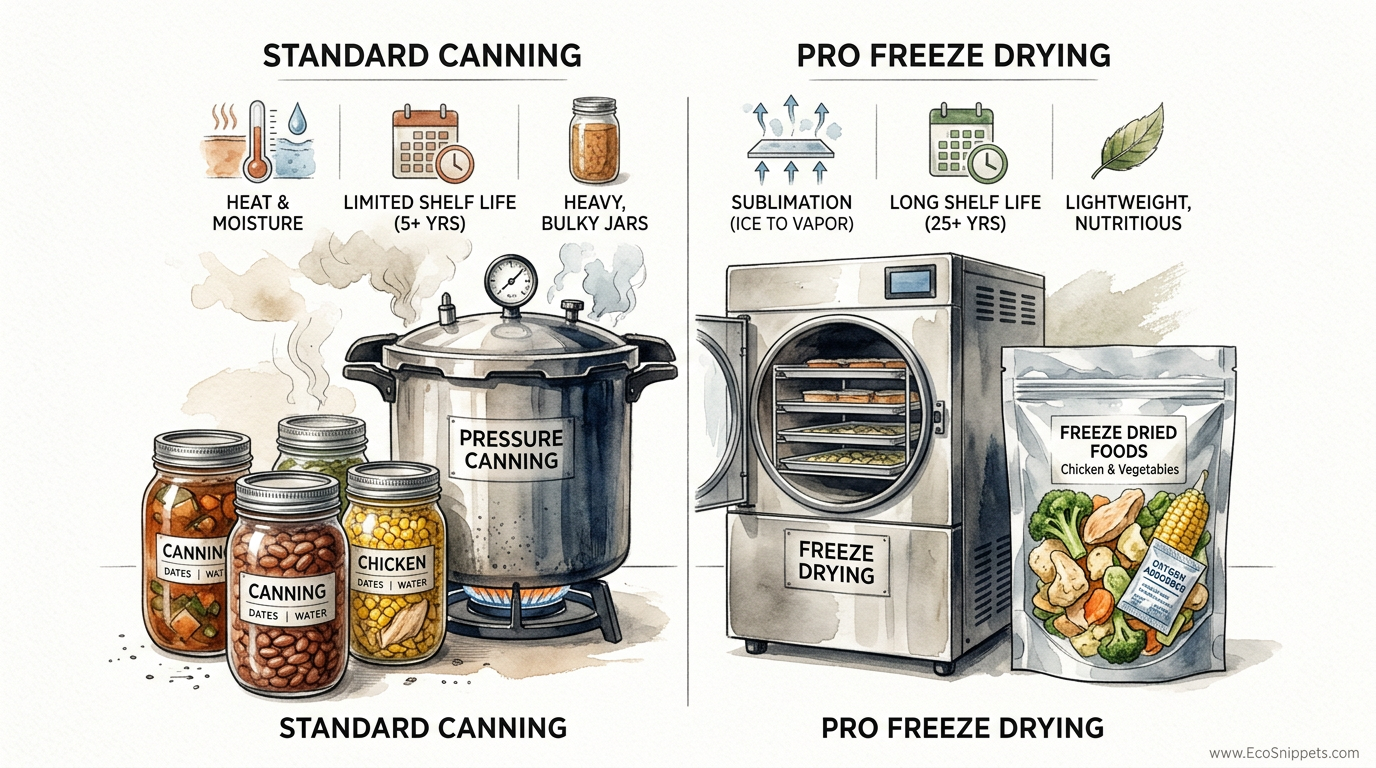
Side-by-Side: STANDARD CANNING vs PRO FREEZE DRYING
| Feature | Pressure Canning | Pro Freeze Drying |
|---|---|---|
| Shelf Life | 1–5 years (Quality degrades) | 25+ years |
| Nutrient Retention | ~40–60% | ~90–97% |
| Upfront Cost | $150 – $500 | $2,500 – $5,000 |
| Portability | Heavy, bulky, fragile | Ultra-light, compact |
| Food Variety | Limited (No dairy/high fat) | Almost anything (Dairy, meals) |
| Texture | Softer, cooked | Original texture (after rehydration) |
Practical Tips for the Survivalist
Establishing a routine is the best way to build a robust food supply. If you are using a freeze dryer, pre-freeze your food in a standard freezer first. This reduces the workload on your machine and can shave hours off the cycle time. It also allows you to “stage” loads so the freeze dryer is never sitting empty.
Organization is your best friend when it comes to long-term storage. Label every bag and jar with the contents and the date it was processed. For freeze-dried goods, include a “rehydration guide” on the label—how much water is needed to bring that specific meal back to life. In a high-stress emergency, you don’t want to be guessing at measurements.
Rotation remains a core principle of the pioneer-grit lifestyle. Even though freeze-dried food lasts 25 years, you should still incorporate it into your regular diet. This ensures your body is accustomed to the food and allows you to test your rehydration skills. Eat what you store, and store what you eat.
Advanced Considerations for Deep Stockpiling
Scaling your operations requires a look at energy independence. If you plan to rely on a freeze dryer, consider your off-grid power capabilities. These machines pull a significant amount of current, especially when the compressor and vacuum pump are both running. A robust solar array with a large battery bank is almost a requirement if you intend to keep processing food during a long-term power outage.
Canning, by contrast, is much easier to scale in a low-tech environment. You can run multiple canners on a single large propane burner or a specialized outdoor stove. This allows you to process a massive harvest in a few days without worrying about your electric bill. The wise prepper uses the freeze dryer for high-value items like meats and dairy, while using the canner for bulk vegetables and fruits.
Think about the “water budget” of your food storage. Freeze-dried food requires clean water to rehydrate. If your water supply is limited, canned goods have a distinct advantage: they come with their own liquid. You can drink the juice from canned pears or use the broth from canned beef to cook other grains. Balancing these two methods ensures you aren’t completely dependent on a single resource like water or electricity.
From Garden to Long-Term Storage: A Real-World Example
Imagine you have just harvested fifty pounds of fresh summer corn. If you choose to pressure can that corn, you will spend an afternoon shucking, blanching, and processing jars. By dinner time, you have two dozen jars of sweet corn that will stay delicious for the next two to three years. The texture will be soft, perfect for corn chowder or a side dish.
If you take that same fifty pounds of corn and put it in the freeze dryer, the process is different. You spread the kernels on trays and let the machine run for twenty-four hours. When it is finished, you have a few pounds of lightweight corn that tastes like a “corn chip” in its dry state. You seal it in Mylar bags with oxygen absorbers.
Fast forward ten years. A particularly harsh winter has cut off supply lines. You pull a bag of that corn from your pantry. You add a cup of warm water, and within ten minutes, the corn is plump, crisp, and tastes exactly like it was picked that morning a decade ago. Your family gets the full dose of vitamins that would have long since vanished from a canned jar.
Final Thoughts
Building a larder is an act of defiance against an uncertain future. It is a way of saying that no matter what happens, your family will not go hungry. Both pressure canning and freeze drying are valuable tools in the pioneer’s kit, but they serve different masters. Canning provides the bulk and the immediate readiness, while freeze drying provides the longevity and the nutritional density.
Serious practitioners do not choose one over the other; they use both to create a layered defense. They use the canner for the everyday staples and the freeze dryer for the long-term essentials and the “luxury” items that keep morale high. Whether you are sealing a jar of stew or vacuum-packing a tray of eggs, you are participating in a tradition of self-reliance that stretches back to the first settlers.
Take the time to learn the nuances of each method. Start small with a canner if the budget is tight, but keep the freeze dryer as the ultimate goal for your homestead. The investment in your food security is the most important one you will ever make. Following these principles will ensure that twenty-five years from now, your food will still be as life-giving as the day you put it away.
