How To Become More Self-Sufficient Without Starting a Full-Blown Farm…
Want to start preserving your harvest, making your own soap, or building a backyard root cellar — but not sure where to begin? “Homesteading Advice” gives you instant lifetime access to 35+ practical homesteading books on food preservation, veggie gardening, DIY natural cleaning products (save over $250 per year with this skill alone), brewing, off-grid energy, and a whole lot more…
Click Here To Check It Out Now!
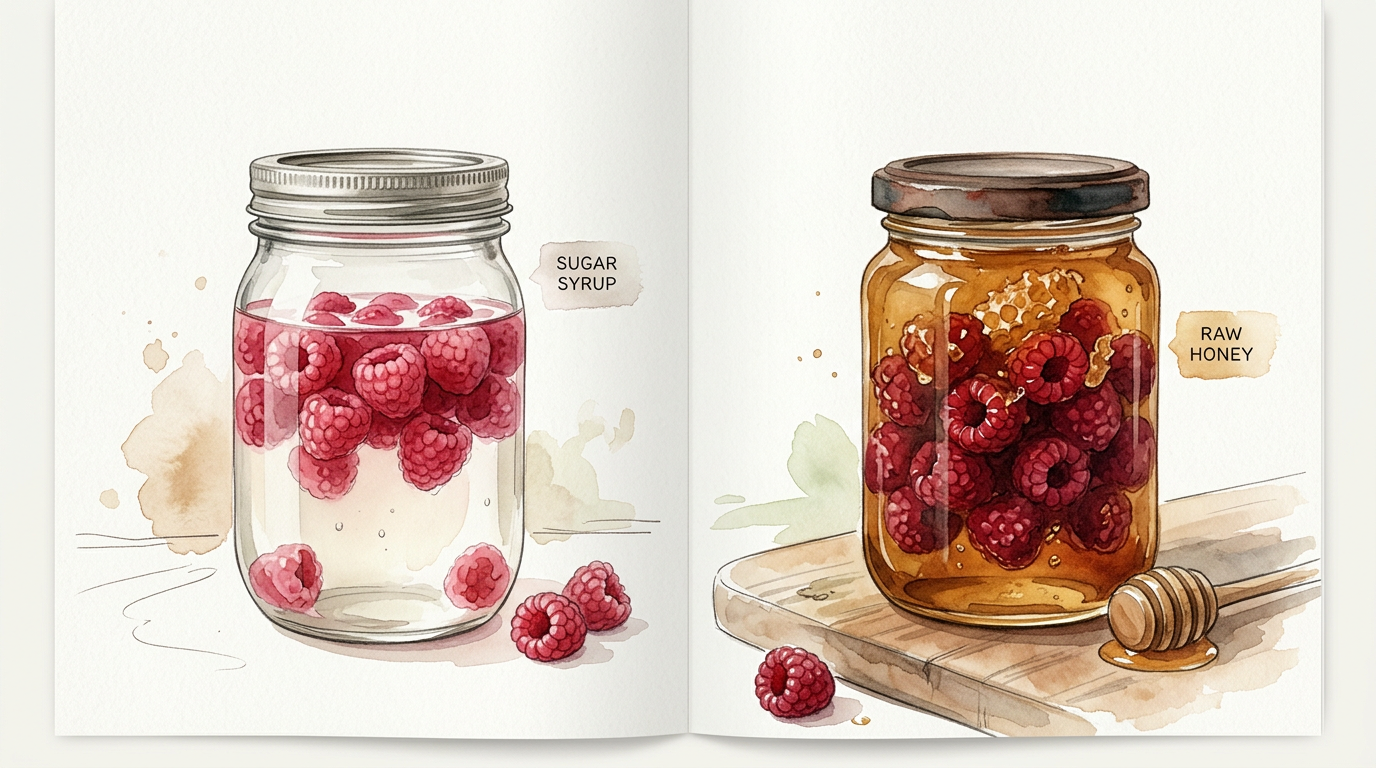
White sugar only preserves; raw honey preserves, heals, and creates a secondary tonic in the process. Standard canning relies on dead white sugar. By submerging your summer berries in raw honey, you keep the enzymes alive. The fruit stays fresh, and the honey transforms into a delicious, fruit-infused medicinal syrup for winter coughs.
This ancient method feels more like kitchen alchemy than a chores list. You are not just filling a larder; you are building a biological defense system. Raw honey acts as a high-density barrier that locks out spoilage while drawing out the essence of the fruit. This process results in two distinct treasures: a plump, honey-soaked berry and a powerful, enzyme-rich syrup.
Modern food preservation often kills the very nutrients we seek to save. High heat and refined sugars strip away the life force of your harvest. Choosing raw honey returns you to a tradition that prioritizes vitality over convenience. It is a slow, quiet transformation that works with nature rather than trying to overpower it.
How To Preserve Berries In Raw Honey
Preserving berries in raw honey is the practice of using honey’s natural chemical properties to keep fresh fruit edible without the use of high-heat canning or synthetic preservatives. This technique relies on the unique composition of raw honey—specifically its low water activity, high sugar concentration, and natural acidity. These factors create a hypertonic environment where most bacteria and molds cannot survive.
Honey serves as a biological “shield” in this context. It has been used for millennia, with historical records showing honey-preserved fruits in ancient Egyptian tombs still identifiable after thousands of years. In a practical, modern homestead, this method is used to keep seasonal gluts of blueberries, raspberries, or elderberries fresh for months while simultaneously creating a medicinal syrup.
The process is remarkably simple compared to pressure canning or water bath methods. You do not need expensive equipment or a boiling stove. Instead, you need high-quality raw honey and a basic understanding of how moisture moves between substances. When you drop a fresh berry into honey, a process called osmosis begins. The honey draws moisture out of the fruit, and the fruit’s juices slowly thin the honey, creating a shelf-stable infusion.
How the Process Works: A Step-by-Step Guide
Understanding the mechanics of honey preservation ensures your success. The secret lies in the balance between the moisture of the berry and the density of the honey. Follow these steps to transform your summer harvest into a winter tonic.
Step 1: Selecting Your Ingredients
Always use raw, unpasteurized honey. Processed honey has been heated to high temperatures, which kills the glucose oxidase enzyme responsible for producing hydrogen peroxide—a key antimicrobial agent. Your berries should be ripe but firm. Overripe or bruised berries release too much moisture too quickly, which can lead to spoilage or unintended fermentation.
Step 2: Cleaning and Drying
Wash your berries gently to remove dirt and insects. Drying is the most critical part of this step. Any external water left on the fruit will dilute the honey’s protective barrier. Spread the berries on a clean towel and let them air dry until no trace of surface moisture remains. Professional practitioners often wait several hours or even use a very low-temperature dehydrator for 20 minutes to ensure the skins are completely dry.
Step 3: Submerging the Fruit
Fill a sterilized glass jar about half-way with berries. Pour raw honey over the fruit until it is completely covered. Use a clean wooden spoon or a chopstick to stir the mixture, releasing any air bubbles trapped between the berries. Oxygen is the enemy of preservation, so those bubbles must be removed. Leave at least an inch of headspace at the top of the jar, as the fruit will expand slightly and release juices.
Step 4: The Waiting Period
Store the jar in a cool, dark place. For the first week, flip the jar upside down every day (ensure the lid is tight). This ensures the fruit remains coated in honey and doesn’t sit on the surface where it might attract mold. You will notice the honey becoming thinner and more liquid over time. This is normal. The process usually takes 2 to 4 weeks to reach full flavor and stability.
The Biological Benefits of Honey Preservation
Choosing raw honey over sugar syrup offers physiological advantages that go far beyond taste. You are effectively creating a living food that supports the human microbiome.
Enzymatic Activity
Raw honey contains active enzymes like diastase and glucose oxidase. These help break down the sugars in the fruit, making them easier for your body to process. Standard canning destroys these enzymes, but honey preservation keeps them intact.
Probiotic Growth
As the honey draws moisture from the fruit, the water activity increases just enough to activate wild yeasts and beneficial bacteria naturally present in the raw honey. This leads to a mild fermentation. These probiotics support gut health and can strengthen the immune system against seasonal pathogens.
Bioavailability of Antioxidants
Recent studies suggest that fermentation and honey infusion can increase the bioavailability of the anthocyanins and polyphenols found in berries. Your body can absorb these antioxidants more efficiently from honey-soaked berries than from fruit that has been boiled in a jam.
The Secondary Tonic
The resulting syrup is not just a sweetener. It is a concentrated medicine. An elderberry-infused honey, for instance, provides a potent dose of Vitamin C and antiviral compounds that are perfect for soothing a winter sore throat.
Challenges and Common Mistakes
Even a simple process has its pitfalls. Most failures in honey preservation stem from moisture management.
The “Water Trap”
The most frequent error is introducing outside water. If you do not dry your berries perfectly after washing, that extra water can raise the water activity of the mixture above the safe threshold of 0.6. This allows mold to take hold on the surface. If you see fuzzy growth or smell something “off” (like gym socks or rotten eggs), the batch must be discarded.
Ignoring the Daily Flip
Fruit tends to float. If the top layer of berries stays exposed to the air inside the jar for too long, they can develop mold. Flipping the jar daily during the first week is non-negotiable. This keeps every berry coated in the protective antimicrobial film of the honey.
Using Low-Quality Honey
Supermarket honey is often “stretched” with corn syrup or is so heavily filtered that it contains no pollen or enzymes. This honey lacks the chemical “teeth” needed to preserve fruit. Always source raw honey from a local beekeeper or a trusted organic supplier.
Limitations and When to Choose Other Methods
Honey preservation is powerful, but it is not a universal solution for every food storage need. You must understand its boundaries to keep your family safe.
Temperature Sensitivity
Honey-preserved berries are semi-shelf-stable. They thrive in a cool pantry, but they will not last for years in a hot garage. If your kitchen stays above 75 degrees Fahrenheit, the fermentation process may accelerate into “boozy” territory. For long-term storage in warm climates, refrigeration is necessary after the initial two-week infusion period.
Not for Low-Acid Foods
This method is ideal for high-acid fruits like berries. Do not attempt to preserve low-acid vegetables like green beans or carrots in pure honey without adding an acidifier like vinegar. Low-acid environments are the playground of botulism spores, which honey cannot always suppress on its own if the moisture content is too high.
Volume Constraints
Preserving 50 pounds of berries in honey is expensive. Raw honey costs significantly more than white sugar. For massive harvests meant to last multiple years, traditional water-bath canning or freezing is often more practical. Honey preservation is best reserved for smaller, high-value medicinal batches.
Raw Honey vs. Sugar Syrup Comparison
| Feature | Raw Honey Preservation | Sugar Syrup (Canning) |
|---|---|---|
| Nutrient Retention | Very High (No Heat) | Low (Heat-Sensitive) |
| Living Enzymes | Active and Present | Destroyed |
| Flavor Profile | Complex, Floral, Tangy | Uniformly Sweet |
| Skill Level | Beginner Friendly | Moderate (Equipment Needed) |
| Cost | Higher (Per Quart) | Lower (Per Quart) |
Practical Tips for Best Results
Apply these small adjustments to elevate your preservation game and ensure your winter larder is both safe and delicious.
- Use Darker Honeys: Varieties like Buckwheat or Wildflower honey often contain higher concentrations of antioxidants and minerals. These darker honeys provide a more robust flavor that stands up well to the tartness of berries.
- Prick Thick-Skinned Berries: Blueberries have a waxy, tough skin. Gently pricking each berry with a sterilized needle allows the honey to penetrate the fruit faster and prevents the berries from shriveling too much.
- Add Supporting Herbs: Dropping a sprig of fresh thyme or a slice of ginger into the jar can enhance the medicinal properties. Thyme-infused blueberry honey is an exceptional remedy for respiratory congestion.
- Monitor the “Burp”: If your mixture is fermenting actively, carbon dioxide will build up. Open the lid once every two days to release the pressure. This prevents the “sticky explosion” that can occur with tight-fitting lids.
Advanced Considerations for Serious Practitioners
For those who want to take their preservation to a professional level, focus on the science of water activity and pH levels. Serious practitioners often use a refractometer to measure the moisture content of their honey. Keeping the total moisture level below 19% ensures that the honey remains stable and does not turn into mead (honey wine).
If you are preserving high-moisture fruits like raspberries, you may need to “pre-dry” the fruit. Lightly dehydrating the berries until they are slightly wrinkled but still pliable removes enough internal water to make the honey preservation virtually foolproof. This technique allows you to use a higher fruit-to-honey ratio without risking spoilage.
Another advanced technique involves pH testing. Most berries are naturally acidic (pH 3.0 to 4.0), which adds a layer of safety. If you are concerned about botulism, using a simple pH strip to ensure the mixture remains below 4.6 provides absolute peace of mind. Botulism spores cannot germinate in an environment with a pH below this threshold.
Examples and Scenarios
Let’s look at how this works in a real-world kitchen. Imagine you have just harvested two pints of wild blackberries. They are juicy, tart, and full of Vitamin K.
Instead of turning them into a jam that requires 4 cups of sugar, you take a clean quart jar. You fill it with the blackberries, leaving 2 inches of space. You pour in local raw clover honey, watching it slowly seep through the cracks. You stir it once, seal it, and place it on a shelf.
Ten days later, the honey has turned a deep, royal purple. The blackberries have shrunk slightly, but they are still whole. You take a spoonful of the purple syrup and stir it into your morning tea. Not only does it taste like a summer field, but it also delivers a concentrated dose of immune-supporting compounds. By the time winter flu season arrives, you have a medicinal powerhouse sitting on your counter, ready to soothe throats and fight inflammation.
Final Thoughts
Preserving berries in raw honey is a return to a more intuitive way of eating. It acknowledges that nature has already provided the preservatives we need—enzymes, acidity, and osmotic pressure. You do not need a factory to keep your food safe; you only need the patient work of the bees and a little bit of grit in the kitchen.
This method rewards the patient homesteader with a product that is both food and medicine. It bridges the gap between the abundance of summer and the scarcity of winter. Experiment with different berry combinations and honey varietals to find the flavor profile that suits your family best.
Ultimately, this practice is about self-reliance. It is about knowing exactly what is in your jar and why it is there. Whether you are soothing a child’s cough or simply enjoying the taste of a sun-ripened raspberry in January, you are participating in a tradition that has sustained humanity for ages. Start small, stay observant, and let the honey do the work.
