How To Become More Self-Sufficient Without Starting a Full-Blown Farm…
Want to start preserving your harvest, making your own soap, or building a backyard root cellar — but not sure where to begin? “Homesteading Advice” gives you instant lifetime access to 35+ practical homesteading books on food preservation, veggie gardening, DIY natural cleaning products (save over $250 per year with this skill alone), brewing, off-grid energy, and a whole lot more…
Click Here To Check It Out Now!
The Ultimate Guide to Off-Grid Food Security
One power outage stands between your family and a winter of hunger. Most people think a big freezer is the ultimate food security. But when the lights go out, the clock starts ticking. True resilience isn’t found in an appliance; it’s built into the earth itself. Learn how to use geothermal cooling to keep your harvest fresh for months without a single watt of power.
Stepping away from the hum of the modern refrigerator feels like a leap backward to some, but it is actually a leap toward true independence. Our ancestors didn’t worry about grid failure because their “refrigerator” was the very ground they walked on. They understood that the earth provides a constant, stabilizing temperature that preserves life long after the summer sun has faded.
This guide will walk you through the mechanics of preserving your hard-earned harvest using the ancient wisdom of the earth. We are going to look at how you can transform a patch of dirt into a high-performance storage facility. It is time to stop renting your food security from the electric company and start owning it yourself.
Long Term Vegetable Storage Without Electricity
Long term vegetable storage without electricity is the practice of utilizing the earth’s natural thermal mass to maintain a cool, humid environment. This method, often referred to as root cellaring or earth-sheltered storage, relies on the fact that once you go a few feet below the frost line, the ground stays a consistent temperature year-round. While the surface might be freezing in January or scorching in July, the deep earth remains steady, usually between 45 and 55 degrees Fahrenheit.
This isn’t just a “backup plan” for when the power goes out; it is a superior way to store certain types of produce. Modern refrigerators are designed to be dry, which actually causes many root vegetables to shrivel and lose their nutritional value. An earth cellar provides the high humidity that living vegetables need to stay dormant but alive. When you store a carrot in the ground, you aren’t just keeping it cold; you are keeping it in an environment that mimics its natural habitat.
In the real world, this looks like a subterranean room, a buried barrel, or even a simple trench filled with straw. It is used by homesteaders, off-grid enthusiasts, and anyone who wants to reduce their carbon footprint while increasing their self-reliance. It is the ultimate insurance policy against rising energy costs and supply chain disruptions.
How Geothermal Cooling Works
Understanding the science of the earth is the first step to mastering food storage. The earth acts as a massive thermal battery. It absorbs heat from the sun slowly and releases it even slower. This creates a “thermal lag,” meaning the temperature underground doesn’t fluctuate with the daily weather patterns.
When you dig into the earth, you are tapping into this stability. At a depth of about ten feet, the temperature remains almost constant regardless of the season. For most temperate climates, this “sweet spot” is right around 52 degrees Fahrenheit. This is the perfect temperature for slowing down the respiration of vegetables without freezing them.
Vegetables are living organisms. Even after they are pulled from the soil, they continue to breathe and consume their own internal energy. Lowering the temperature slows this “breathing” process down to a crawl. High humidity prevents the water inside the vegetable from evaporating into the air. By controlling these two factors—temperature and humidity—you can keep a potato firm and nutritious for eight months or more.
The Role of Air Circulation
While the earth provides the cooling, you must provide the ventilation. Vegetables release ethylene gas as they age, which can cause other produce to sprout or rot prematurely. A well-designed storage space uses passive convection to move air. Cold air is heavier than warm air, so you place your intake pipe low to the ground and your exhaust pipe high on the ceiling. This creates a natural “chimney effect” that refreshes the air without needing a fan.
Building Your Earth Cellar: Step-by-Step
Building a storage space doesn’t require a degree in engineering, but it does require attention to detail. You can start small with a “Garbage Can Cellar” or go big with a full walk-in concrete bunker. The principles remain the same regardless of the scale.
First, choose a location with excellent drainage. You want humidity, but you do not want standing water. If your cellar sits in a puddle, your harvest will turn to mush within weeks. Ideally, build into a north-facing slope to keep the entrance away from the direct heat of the sun.
Second, excavate the site. For a full-sized cellar, you need to get deep enough so that the ceiling has at least two to three feet of earth over it. This earth “cap” is what provides the insulation. If you are using a buried barrel, make sure the top of the barrel is below the frost line for your specific region.
Third, install your ventilation. Use four-inch PVC or metal piping. The intake pipe should travel from the outside, down through the earth (which pre-cools the air), and open near the floor of the cellar. The exhaust pipe should start at the highest point of the ceiling and exit straight up through the roof. Cover the exterior ends with fine mesh to keep out rodents and insects.
Finally, fit the interior with rot-resistant wooden shelves. Cedar or white oak are excellent choices. Avoid using treated lumber, as the chemicals can off-gas into your food. Space the slats on your shelves to allow air to circulate around every single vegetable. Crowding is the enemy of longevity.
Benefits of Geothermal Food Storage
The primary advantage of earth-based storage is its total independence. When the grid fails, your food remains safe. You don’t need solar panels, batteries, or a backup generator to keep your family fed. This peace of mind is invaluable in an uncertain world.
Beyond security, there is the factor of quality. Root vegetables stored in a humid cellar often taste better and retain more vitamins than those kept in a dry refrigerator. The texture remains crisp because the cellular structure of the vegetable isn’t being dehydrated by a frost-free cooling cycle.
Cost is another significant factor. Once the initial labor of digging and building is done, the operating cost of an earth cellar is exactly zero. There are no monthly utility bills and no mechanical parts to break down or replace. It is a one-time investment that pays dividends for decades. In many cases, an earth cellar can pay for itself in just a few years through energy savings and reduced food waste.
Common Mistakes and Pitfalls
The most common mistake beginners make is failing to “cure” their vegetables before storage. Onions, potatoes, and squash need a period of drying in a warm, airy place to toughen their skins. If you put a “green” potato directly into a damp cellar, it will rot. Curing creates a protective barrier that seals in moisture and keeps out pathogens.
Another frequent error is improper sorting. You must be ruthless. One bruised apple or one nicked potato can produce enough ethylene gas and mold spores to ruin an entire bin. Check your stores weekly. The old saying “one bad apple spoils the bunch” is a literal scientific fact in the world of root cellaring.
Ventilation management is often overlooked. New users often close the vents when it gets cold outside, fearing the cellar will freeze. However, cutting off the air allows humidity to spike to 100%, causing condensation to drip from the ceiling. This standing water on the produce is a death sentence. You must learn to “tune” your vents based on the outside temperature.
Limitations of Earth-Based Storage
Geothermal cooling is not a magic bullet for every type of food. It is specifically designed for dormant root crops and certain hardy fruits. You cannot store leaf lettuce, berries, or fresh meat in an earth cellar for long periods. These items require much lower temperatures (closer to 33-35°F) than a standard cellar can usually provide in the warmer months.
Environmental factors can also limit your success. If you live in an area with a very high water table, digging a hole might result in a well rather than a cellar. In these cases, you may need to build an “above-ground” cellar by mounding earth over a structure, which requires significantly more space and soil movement.
Climate plays a role as well. In very southern latitudes where the ground temperature never drops below 60 degrees, a traditional root cellar won’t be cold enough to keep temperate crops dormant. In these regions, you might need to look into deeper “well-hole” storage or use the cellar only for short-term preservation and fermentation crocks.
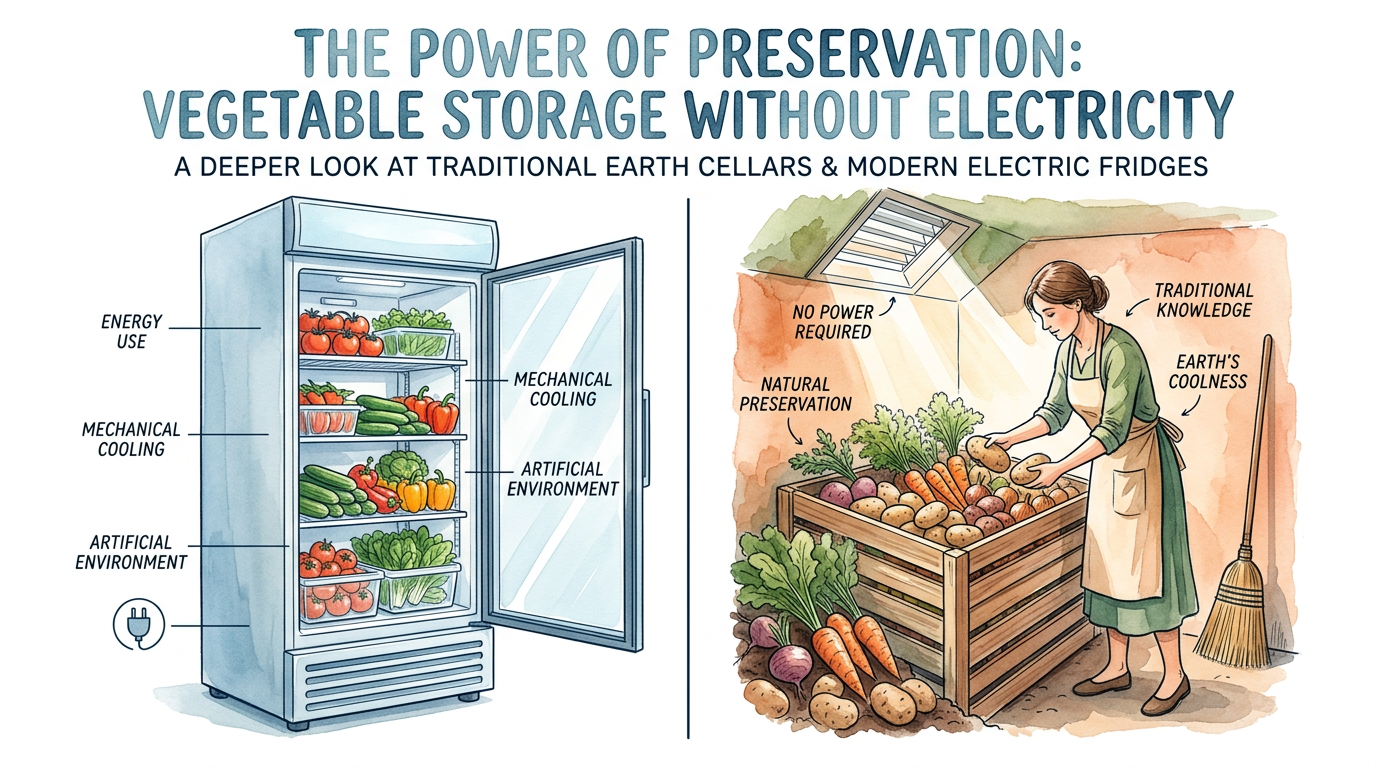
Electric Fridge vs Earth Cellar
Comparing these two methods helps highlight where each shines. While the electric fridge offers convenience and precision, the earth cellar offers volume and resilience.
| Feature | Electric Refrigerator | Earth Cellar |
|---|---|---|
| Power Source | Grid Electricity/Solar | None (Passive Geothermal) |
| Maintenance | Occasional repairs/cleaning | Periodic cleaning/vent tuning |
| Humidity | Very Low (Dry) | High (80% – 95%) |
| Capacity | Limited (Cubic Feet) | Large (Square Footage) |
| Longevity | 10-15 Years | Indefinite (Generational) |
| Initial Cost | $500 – $2,000 | $100 – $5,000 (Scale dependent) |
In a balanced homestead, both have a place. The fridge is for your daily milk, eggs, and leftovers. The earth cellar is your “savings account,” holding hundreds of pounds of produce that will see you through the lean months of spring.
Practical Tips for Success
Keep a thermometer and a hygrometer in your cellar. You cannot manage what you do not measure. Check these instruments daily during the first season to understand how your cellar responds to outside weather changes. Aim for 32-40°F for most roots, with humidity between 85% and 95%.
Use sand or sawdust to pack carrots and beets. These vegetables have thin skins and lose moisture quickly. Burying them in a box of damp sand helps maintain their turgidity and prevents them from getting rubbery. It also acts as an extra layer of insulation against temperature swings.
Store apples away from potatoes. This is a classic rule of thumb. Apples release a high amount of ethylene gas, which will cause your potatoes to sprout much faster than they should. If you must store them in the same room, put the apples near the exhaust vent and the potatoes near the intake vent so the gas is pulled away immediately.
Don’t wash your vegetables before storing them. The light coating of soil actually helps preserve them. Washing can bruise the skin and introduce excess moisture that encourages mold. Simply brush off the heavy clumps of dirt and let them be.
Advanced Considerations
For those looking to optimize their system, consider the “Earth-Tube” heat exchanger. Instead of a simple intake pipe, run 50 to 100 feet of pipe four feet underground before it enters the cellar. This uses the earth’s temperature to cool the incoming summer air or warm the incoming winter air even more effectively, creating a very stable microclimate.
Scaling up your storage can also involve integrating “active” passive systems. For example, using a heavy, insulated door with a thermal break prevents the entrance from being the weak point in your insulation. Some practitioners also use “ice-house” techniques, where they harvest ice from a pond in winter and store it in a corner of the cellar to extend the cooling deep into the summer months.
Think about the “living” aspect of your cellar. A well-built cellar can also serve as a place for fermenting crocks. The stable temperatures are perfect for the slow fermentation of sauerkraut, pickles, and kimchi. This adds another layer to your food security, as fermented foods provide probiotics that are essential for health when fresh greens are scarce.
Real-World Example: The 500-Pound Harvest
Imagine a family that grows 500 pounds of potatoes and 200 pounds of carrots in their backyard garden. Storing this in an electric refrigerator is impossible for most households. Without a cellar, they would be forced to can or dehydrate the entire harvest, which requires massive amounts of time, jars, and energy.
With a simple 8×8 earth cellar, this family can move their harvest directly from the field (after curing) into the ground. They spend one Saturday afternoon organizing bins. Throughout the winter, they simply walk down the stairs and grab a basket of fresh, crisp produce. Even if a blizzard knocks out the power for two weeks, their food supply remains unaffected. They are eating “fresh” food in March that was harvested in October, all thanks to the soil beneath their feet.
Calculations show that the energy saved by not running a chest freezer for these vegetables can amount to over $150 a year. Over twenty years, that’s $3,000 in savings, not including the cost of the produce itself. The math of self-reliance always adds up in favor of the earth.
Final Thoughts
Building a geothermal storage system is more than just a construction project; it is an act of defiance against a fragile modern system. It is a commitment to the idea that we can provide for ourselves using the tools the earth has already given us. Whether you start with a barrel in the backyard or a stone cellar under your porch, you are taking a vital step toward true independence.
True food security isn’t about having the newest gadgets. It is about understanding the relationship between the harvest, the temperature, and the soil. When you master these elements, you no longer fear the winter or the occasional power outage. You become a participant in a tradition that has kept humanity fed for millennia.
Take the time to observe your land. Look for the shadows, the slopes, and the drainage patterns. Your future “earth fridge” is already there, waiting to be uncovered. Start digging, and build the resilience your family deserves.
