How To Become More Self-Sufficient Without Starting a Full-Blown Farm…
Want to start preserving your harvest, making your own soap, or building a backyard root cellar — but not sure where to begin? “Homesteading Advice” gives you instant lifetime access to 35+ practical homesteading books on food preservation, veggie gardening, DIY natural cleaning products (save over $250 per year with this skill alone), brewing, off-grid energy, and a whole lot more…
Click Here To Check It Out Now!
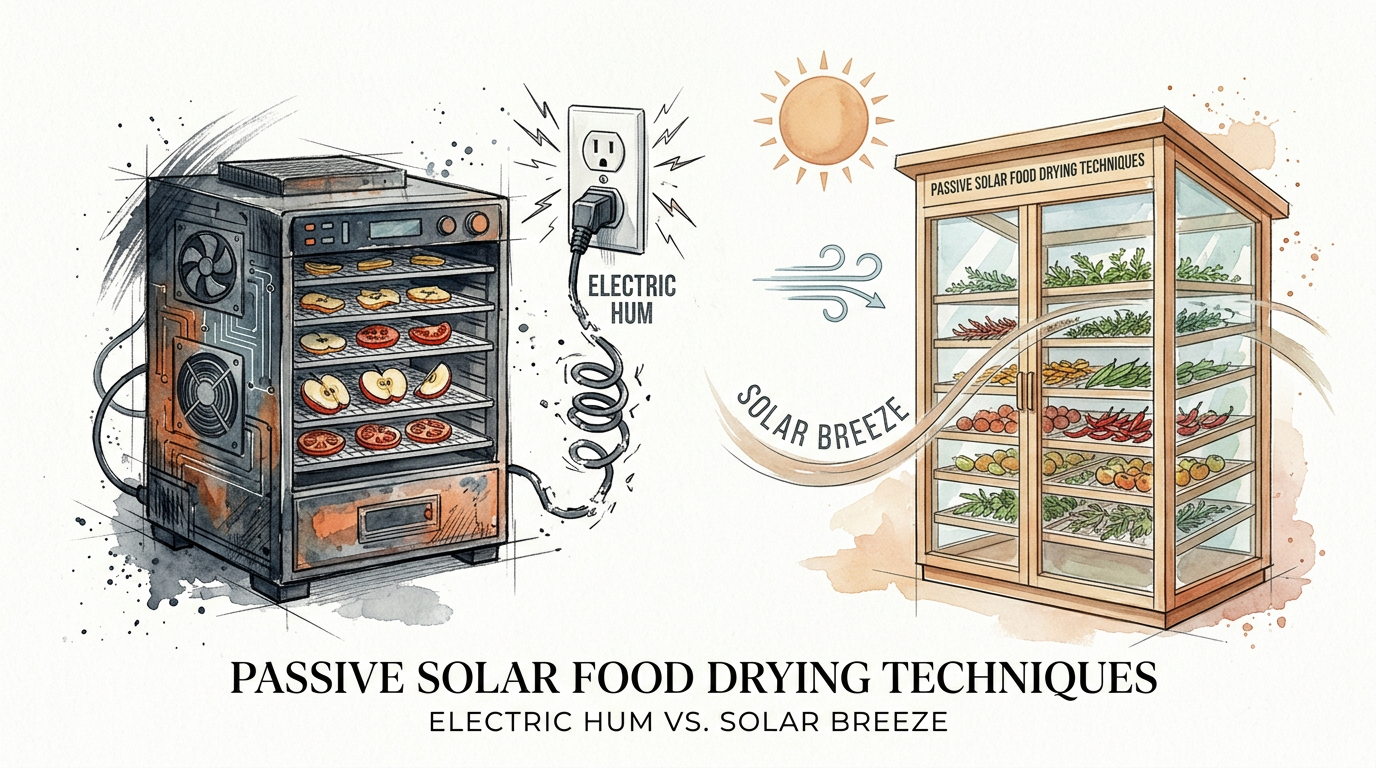
One costs $0.15 per hour to run; the other is powered by the sky for free. Why plug in a machine to do what the sun and wind do for free? Passive solar drying uses natural airflow to gently remove moisture, preserving more enzymes and vitamins than high-heat electric units. It’s the ultimate silent partner for the off-grid kitchen.
Mastering the art of the solar breeze requires a shift in mindset. You are no longer tethered to a thermostat and a wall outlet. Instead, you are partnering with the rhythms of the day and the physics of the atmosphere. This transition from active consumption to passive harvesting is the hallmark of a resilient homestead.
Traditional electric dehydrators often rely on brute force. They use high-wattage heating elements and noisy fans to blast moisture out of food, often cooking the edges before the center is dry. Passive solar drying takes a more sophisticated approach. It uses the greenhouse effect to create a steady, gentle rise in temperature and the chimney effect to pull fresh air across your harvest.
Practical self-reliance is built on systems that work when the power goes out. Learning to dry food with the sun is not just a way to save a few pennies on the electric bill. It is a way to reclaim an ancestral skill that ensures your pantry remains full regardless of the grid’s stability.
Passive Solar Food Drying Techniques
Passive solar food drying is the process of using solar radiation and natural convection to reduce the water content of food to a level that prevents spoilage. It is a technique as old as civilization itself, used by our ancestors to preserve everything from grapes in the Mediterranean to bison meat on the American plains. Unlike simple “sun drying,” where food is laid out on a sheet in the open air, passive solar drying uses an enclosed structure to manage the environment.
This method exists to provide a controlled space that protects food from pests, dust, and sudden rain while maximizing the efficiency of the sun’s energy. In a well-designed system, the air inside the dryer becomes warmer and less dense than the outside air. As this warm air rises, it carries away the moisture released by the food, creating a continuous, self-regulating loop of dehydration.
Real-world applications of these techniques vary by climate. In arid regions, a simple direct-gain cabinet might suffice. In more humid environments, an indirect-gain system with a long solar collector is necessary to pre-heat the air enough to drop its relative humidity before it ever touches the food. Understanding these nuances allows a practitioner to preserve a harvest in almost any environment.
Visualizing this process is like thinking of a chimney on a wood stove. The “draft” is created by the temperature difference between the bottom of the unit and the top. The greater the temperature difference, the stronger the airflow. This airflow is your most important tool, acting as a conveyor belt that moves water molecules from your sliced apples or herbs out into the atmosphere.
How the Solar Dehydration System Works
The underlying principle of a passive solar dehydrator is the relationship between air temperature and moisture capacity. As air warms up, its ability to hold water vapor increases significantly. For every 20-degree Fahrenheit rise in temperature, the air’s capacity to hold moisture roughly doubles. This is the engine that drives the drying process.
A typical system consists of three main components: a solar collector, a drying chamber, and a ventilation system. The collector is usually a shallow box with a dark-colored absorber plate and a clear cover made of glass or polycarbonate. Sunlight passes through the glazing and hits the dark plate, turning light energy into heat. Air entering the bottom of this collector is heated as it passes over the absorber.
Once the air is heated, it enters the drying chamber where the food is arranged on mesh trays. Because the air is now warm and “thirsty,” it pulls moisture from the surface of the food. To keep the process moving, this moist air must be exhausted through vents at the top of the chamber. This creates a vacuum effect at the bottom, pulling in more fresh, dry air to continue the cycle.
Actionable success depends on managing the speed of this air. If the air moves too slowly, the temperature rises too high, and the food may case-harden or even cook. If it moves too fast, the air won’t have enough time to pick up moisture. Adjusting the intake and exhaust vents allows the user to find the “sweet spot” where the internal temperature stays between 110°F and 140°F, which is ideal for most fruits and vegetables.
The Major Benefits of Going Passive
The most immediate advantage is the total elimination of operating costs. While an electric dehydrator might seem cheap to run for a few hours, a large harvest of tomatoes or peaches can take days of continuous operation. When you scale up your preservation efforts to meet the needs of a family for an entire winter, those kilowatt-hours add up to a significant expense.
Nutritional integrity is another measurable benefit. Many electric units use high-wattage coils that create “hot spots,” potentially destroying heat-sensitive vitamins like Vitamin C and various enzymes. Passive solar units provide a more gradual, gentle heat. Because the process is driven by airflow rather than just raw temperature, the food often retains a more vibrant color and a more complex flavor profile.
Silence is a benefit that is often overlooked until you experience it. Electric dehydrators produce a constant, high-pitched hum from their fans that can be intrusive in a quiet home. A passive solar unit sits outside, doing its work in absolute silence. It respects the peace of the homestead, requiring nothing but the movement of the sun and the shifting of the wind.
Durability and simplicity are also key factors. With no moving parts, no heating elements to burn out, and no fans to seize up, a well-built solar dehydrator can last for decades. Maintenance usually involves nothing more than cleaning the trays and wiping down the glazing once a season. It is a piece of equipment designed for the long haul, much like a good cast-iron skillet or a well-forged axe.
Challenges and Common Pitfalls
Case hardening is the most frequent error encountered by beginners. This occurs when the outer layer of the food dries too quickly, forming a hard, impermeable skin that traps moisture inside. This trapped moisture eventually leads to mold during storage. Case hardening is usually the result of excessive heat and insufficient airflow, often caused by placing the dehydrator in a spot with no cross-breeze or failing to open the vents sufficiently.
Mold growth is another common challenge, particularly during periods of high humidity or overcast weather. If the air inside the chamber isn’t moving fast enough or isn’t warm enough to carry away the moisture, the humid environment becomes a breeding ground for fungi. Choosing the right days to dry is crucial. A “solar breeze” approach works best on days when the relative humidity is below 60%.
Pests and contamination can also threaten a harvest. Since solar dryers are located outdoors, they are targets for flies, wasps, and ants. Any gap in the construction or a hole in the screening can lead to infested food. It is vital to use food-grade mesh and ensure that all intake and exhaust vents are covered with a fine-gauge screen that prevents even the smallest “no-see-ums” from entering the chamber.
Inconsistent drying is a pitfall that stems from poor tray loading. Packing the trays too tightly prevents the air from circulating around the food. Each slice needs space to breathe. Think of the air as water flowing through a stream; if you choke the stream with rocks, the water stops moving. Keep your slices uniform in thickness and give them plenty of elbow room on the mesh.
Limitations of Passive Solar Systems
Climate and geography play a massive role in the effectiveness of solar drying. In regions with high ambient humidity, such as the American Southeast or tropical zones, the air is already saturated. Even when heated, it may not have enough capacity to dry food quickly enough to prevent spoilage. In these areas, passive systems must be much larger and more efficient, or they may need a small electric “booster” fan to assist the airflow.
Diurnal cycles—the natural rise and fall of the sun—create a built-in limitation. Drying stops at night. During the evening hours, the temperature drops and the humidity rises, which can lead to “re-hydration” if the food is left in the unit. Experienced practitioners often bring their trays inside at night or close the vents tightly to seal out the damp night air.
The lack of precise temperature control is a trade-off for the simplicity of the system. Unlike an electric unit where you can dial in exactly 115°F for herbs or 155°F for jerky, a solar unit fluctuates with the clouds and the angle of the sun. This requires the user to be more attentive and involved in the process, checking the unit periodically and adjusting vents or orientation to compensate for the weather.
Space requirements are also a consideration. A solar dehydrator large enough to process a significant harvest takes up a fair amount of room in the yard or on a south-facing deck. It cannot be tucked away in a kitchen corner. You must have a clear, unshaded spot that receives at least 6 to 8 hours of direct sunlight, which may be a challenge for those with heavily wooded lots or urban homesteads.
Electric Hum vs. Solar Breeze
| Feature | Electric Hum (Plug-in) | Solar Breeze (Passive) |
|---|---|---|
| Energy Cost | $0.10 – $0.20 per hour | $0.00 (Free) |
| Noise Level | Constant fan noise | Silent |
| Control | Digital/Analog Thermostat | Manual Vent Adjustment |
| Batch Size | Limited by unit size | Easily scalable to large loads |
| Weather Reliance | None (indoor use) | Highly dependent on sun/humidity |
When comparing these two methods, it becomes clear that the electric unit offers convenience and predictability, while the solar unit offers sustainability and scale. For someone living in a small apartment, the [Electric Hum] is the only logical choice. However, for the serious gardener or off-gridder, the [Solar Breeze] allows for the preservation of massive quantities of food without increasing the monthly overhead.
The skill level required for solar drying is slightly higher. You have to learn the “language” of your local climate. You become an amateur meteorologist, watching the barometer and the cloud formations. This engagement with the environment is exactly what many modern homesteaders are seeking—a deeper connection to the natural cycles that sustain us.
Efficiency in a solar unit is measured by how well it converts sunlight into airflow. In an electric unit, efficiency is measured by the insulation of the box and the wattage of the fan. While the electric unit is faster in humid conditions, the solar unit wins on total lifecycle cost and environmental impact every time.
Practical Tips and Best Practices
Orientation is the first step toward a successful dry. In the northern hemisphere, your solar collector must face true south. Do not rely on a magnetic compass alone without adjusting for declination; you want the most direct “solar noon” sun hitting your collector plate. If your unit is portable, rotating it a few degrees every couple of hours can significantly increase the total heat gain for the day.
Preparation of the food is just as important as the design of the dryer. Slicing everything to a uniform thickness—usually about 1/4 inch—ensures that the entire tray finishes at the same time. For light-colored fruits like apples or pears, a quick dip in a solution of lemon juice and water prevents oxidation and keeps the fruit looking appetizing.
Blanching vegetables before drying can improve both color and texture. Briefly steaming or dipping vegetables like broccoli, carrots, or green beans in boiling water stops the enzymatic action that leads to flavor loss during storage. This “sets” the nutrients and softens the cellular structure, often allowing the food to dry more quickly and rehydrate more effectively later on.
Monitoring the internal temperature is vital. Place a simple compost thermometer or a remote digital probe inside the drying chamber. If the temperature climbs above 150°F, open the vents or shade a portion of the collector. If it stays below 100°F on a sunny day, you may need to reduce the airflow by partially closing the exhaust vent to allow heat to build up.
Advanced Considerations for Serious Practitioners
For those looking to push the limits of passive design, thermal mass can be integrated into the dehydrator. By placing dark-colored stones or water-filled jugs inside the bottom of the drying chamber, you can store heat during the day. This stored energy is slowly released as the sun goes down, extending the drying time into the evening and preventing the food from absorbing moisture from the cooling air.
The use of selective surfaces on the absorber plate can also increase efficiency. Special “solar black” paints are designed to maximize absorption in the visible spectrum while minimizing re-radiation in the infrared spectrum. This ensures that more of the heat captured by the collector stays inside the system rather than leaking back out through the glazing.
Glazing materials matter more than most realize. While glass is traditional and durable, multi-wall polycarbonate panels provide much better insulation. These panels have “channels” of air trapped between layers, which act as a thermal break. This allows the collector to stay hot even when a cool wind is blowing across the surface, making the unit much more effective in the shoulder seasons of spring and fall.
Automated venting is an advanced modification for the tech-savvy homesteader. Using a simple wax-pellet actuator—the same kind used in greenhouse windows—you can create a system where the vents open and close automatically based on the temperature. This reduces the need for constant monitoring and protects the food from overheating if you are away from the homestead during the heat of the day.
Real-World Example: The Apple Harvest
Consider a homestead with three mature apple trees. In a “mast year,” these trees can produce several hundred pounds of fruit in a three-week window. Processing this amount of food in a standard 9-tray electric dehydrator would take weeks of continuous operation, costing upwards of $50 in electricity and creating a constant background noise in the kitchen.
Instead, the homesteader uses a large, indirect-gain solar dehydrator with 20 square feet of tray space. On a clear Saturday morning, the family slices 40 pounds of apples. They load the trays by 9:00 AM. The sun hits the collector, and by 11:00 AM, the internal temperature has stabilized at 125°F with a brisk upward draft.
By Sunday afternoon, the apples are leathery and “snappy,” with no remaining pockets of moisture. The total cost of this preservation was $0.00. The enzymes remained intact because the temperature never spiked, and the apples retained their natural sweetness. The fruit is packed into half-gallon jars, conditioned for a few days, and then moved to the cool, dark pantry for winter snacking.
This scenario demonstrates the power of scale. Solar drying allows you to “work with the glut.” When nature provides an abundance all at once, the sun provides the energy required to save it all at once. It is a harmonious system where the source of the growth (the sun) is also the source of the preservation.
Final Thoughts
Passive solar food drying is more than just a technique; it is a philosophy of cooperation with the natural world. By understanding the simple physics of air, heat, and moisture, you can create a food preservation system that is both economically free and ecologically sound. It bridges the gap between the wisdom of the past and the needs of a self-reliant future.
Success in this endeavor comes through observation and adjustment. Each dehydrator has its own personality, influenced by its construction and its environment. As you spend time working with your unit, you will develop an intuition for the “solar breeze,” knowing exactly when to open the vents or when to bring the trays inside. This mastery is the true reward of the off-grid kitchen.
Whether you are drying medicinal herbs, seasonal fruits, or garden vegetables, the sun remains your most reliable ally. It is a silent, powerful partner that asks for nothing and provides everything. Embrace the gentle pace of solar dehydration and enjoy the peace of mind that comes from a pantry filled by the sky.
