How To Become More Self-Sufficient Without Starting a Full-Blown Farm…
Want to start preserving your harvest, making your own soap, or building a backyard root cellar — but not sure where to begin? “Homesteading Advice” gives you instant lifetime access to 35+ practical homesteading books on food preservation, veggie gardening, DIY natural cleaning products (save over $250 per year with this skill alone), brewing, off-grid energy, and a whole lot more…
Click Here To Check It Out Now!
Stop buying poison to do a job that your poultry would love to do for free. Chemical sprays are a never-ending subscription to a toxic shed. Integrating ‘clean-up’ animals creates a biological loop that deletes pests before they even hatch. This is the way of the old-timers, a system where every beak has a purpose and every scratching claw is a tool for farm hygiene. When we lean into the natural instincts of our birds, we stop fighting nature and start partnering with it.
Modern agriculture has spent decades trying to sterilize the barnyard. We’ve been told that a clean farm is a chemical-smelling farm. Yet, the flies always return, often stronger and more resistant than before. The truth is that nature never leaves a vacuum. If you remove a pest with a spray, you’ve left an empty niche that another pest will quickly fill. A biological approach doesn’t just kill a fly; it occupies the space with life that works in your favor.
Stepping back into ancestral wisdom means looking at your flock as more than just egg or meat producers. They are the frontline soldiers in a war against filth and disease. They are your sanitation department, your mobile fertilizer units, and your pest control squad all rolled into one feathered package. This guide will walk you through the grit and grace of building a fly-free homestead using the very animals you already care for.
Biological Fly Control With Poultry
Biological fly control is the practice of using living organisms—specifically poultry—to interrupt the life cycle of pest flies before they become a nuisance or a health hazard. This isn’t just about a chicken occasionally snapping a fly out of the air. It is a systematic approach where birds are managed to target the fly at its most vulnerable stages: the egg, the larva (maggot), and the pupa [1.1, 1.12].
In a natural ecosystem, flies serve a purpose as decomposers, but in the concentrated environment of a farm or backyard coop, they quickly become vectors for pathogens. Flies are known carriers of Salmonella, E. coli, and Campylobacter, which can affect both your birds and your family [1.3, 1.8]. Biological control turns the barnyard into a gauntlet that these pests cannot easily run. Instead of allowing manure to sit and breed thousands of maggots, you introduce “clean-up” animals that see those maggots as high-protein treats.
This method is used everywhere from small urban backyards to massive pastured poultry operations. The core concept remains the same: use the bird’s natural desire to scratch and peck to keep the ground clean. When birds forage through manure or compost, they expose fly larvae to the sun, which dehydrates them, and to their own hungry beaks, which deletes them entirely. It is a loop of nutrient recycling where “waste” is turned into “protein” [1.21, 1.25].
How It Works: Interrupting the Cycle
To master this system, you must understand the enemy. A house fly doesn’t just appear; it follows a predictable four-stage path: egg, larva, pupa, and adult. The entire process can take as little as 7 to 10 days in the heat of summer [1.6, 1.11]. If you wait until you see adult flies buzzing around, you have already lost the first three rounds of the fight.
The Larval Buffet
Female flies lay hundreds of eggs in moist organic matter, usually fresh manure or spilled, wet feed. Within 12 to 24 hours, these eggs hatch into creamy white larvae, better known as maggots [1.6]. This is the “golden hour” for poultry. Chickens, ducks, and guineas have an uncanny ability to spot movement in the soil or manure. As they scratch through the top layers of bedding or cow patties, they find these nutrient-dense maggots and consume them by the hundreds.
Mechanical Disturbance
Scratching does more than just feed the birds. Fly larvae require a specific moisture level (usually between 50% and 85%) to survive [1.7, 1.20]. When a hen scratches through a pile of manure, she breaks up the clumps and aerates the material. This speeds up the drying process. Once the moisture content of manure drops below 30%, it becomes a desert for flies. They can no longer breed there [1.1, 1.6]. Your birds are essentially “tilling” the fly habitat into oblivion.
The Pupal Interruption
If a maggot survives the larvae stage, it crawls to a drier area to form a hard, reddish-brown shell called a puparium [1.11]. While adult flies are fast and hard to catch, the pupa is a sitting duck. Birds that are allowed to forage in the “perimeters”—the edges of the coop, the dry corners of the barn, or the areas under the feeders—will find these pupae and eat them before they can emerge as winged adults.
Benefits of the Biological Loop
The advantages of using poultry for fly control extend far beyond a less annoying afternoon on the porch. This is a holistic improvement to the health of your entire property.
Higher Protein, Lower Feed Costs
Fly larvae are a superfood for poultry. Black Soldier Fly larvae, for example, are packed with essential amino acids, fats, and calcium [1.25]. When your birds spend their day hunting pests, they are supplementing their diet with high-quality, free-range protein. Many homesteaders find that their supplemental feed requirements drop during the height of the “bug season” because the birds are so successful at harvesting their own meals [1.13].
Reduced Disease Transmission
Flies are mechanical vectors for disease. They land on filth and then land on your birds’ waterers, your eggs, or even your kitchen table. By reducing the fly population at the source, you are effectively practicing biosecurity [1.4, 1.18]. You are lowering the risk of Salmonella and other pathogens spreading through your flock or to your family.
Improved Soil and Sanitation
As birds hunt for flies, they distribute their own manure and the manure of other livestock more evenly across the pasture. This prevents “hot spots” of parasites and nitrogen burn while encouraging faster decomposition of organic matter. The result is a more fertile, aerobic soil environment that smells better and grows better forage.
Challenges and Common Mistakes
Even the best biological system can fail if it isn’t managed with a bit of grit and observation. One of the most common errors is over-relying on the birds without managing the environment.
The “Too Much Manure” Problem
If you have two chickens and ten cows, the chickens will be overwhelmed. Flies breed at an exponential rate. One female fly can lay up to 900 eggs in her short life [1.11]. If the volume of manure is too high for the birds to scratch through effectively, the flies will win. You must balance your “clean-up crew” size to the waste output of your farm.
Ignoring “Fly Traps” in the Infrastructure
Flies love moisture. Leaky waterers, clogged gutters, or low spots in the yard that hold puddles will create fly breeding grounds that birds might not be able to reach, especially if the ground becomes a muddy slurry. Sanitation and water management must go hand-in-hand with poultry integration [1.14, 1.18].
Predator Pressure
Sending your birds out to hunt flies in the tall grass or distant pastures puts them at risk from hawks, foxes, and neighborhood dogs. Many people fail at biological control because they lose their “workers” to predators. Secure fencing, livestock guardian dogs, or mobile “chicken tractors” are necessary to keep your fly-control units safe while they work.
Limitations: When Poultry Might Not Be Enough
While poultry are incredible, they are not a silver bullet for every situation. Environmental constraints can sometimes limit their effectiveness.
Climate and Seasonality
In extremely wet, tropical climates, manure stays wet regardless of how much a chicken scratches. In these environments, the fly life cycle can move faster than the birds can keep up with. Conversely, in the dead of winter, both the flies and the birds’ foraging activity slow down. Biological control is a seasonal strategy that peaks in spring and summer.
Specific Fly Species
Poultry are excellent at controlling House Flies and Stable Flies, which breed in manure. However, they are less effective against “filth flies” that might be breeding in high, unreachable areas or “deer flies” and “horse flies” that develop in swampy, aquatic environments away from the barnyard. You must identify which flies are your primary problem to see if poultry are the right solution.
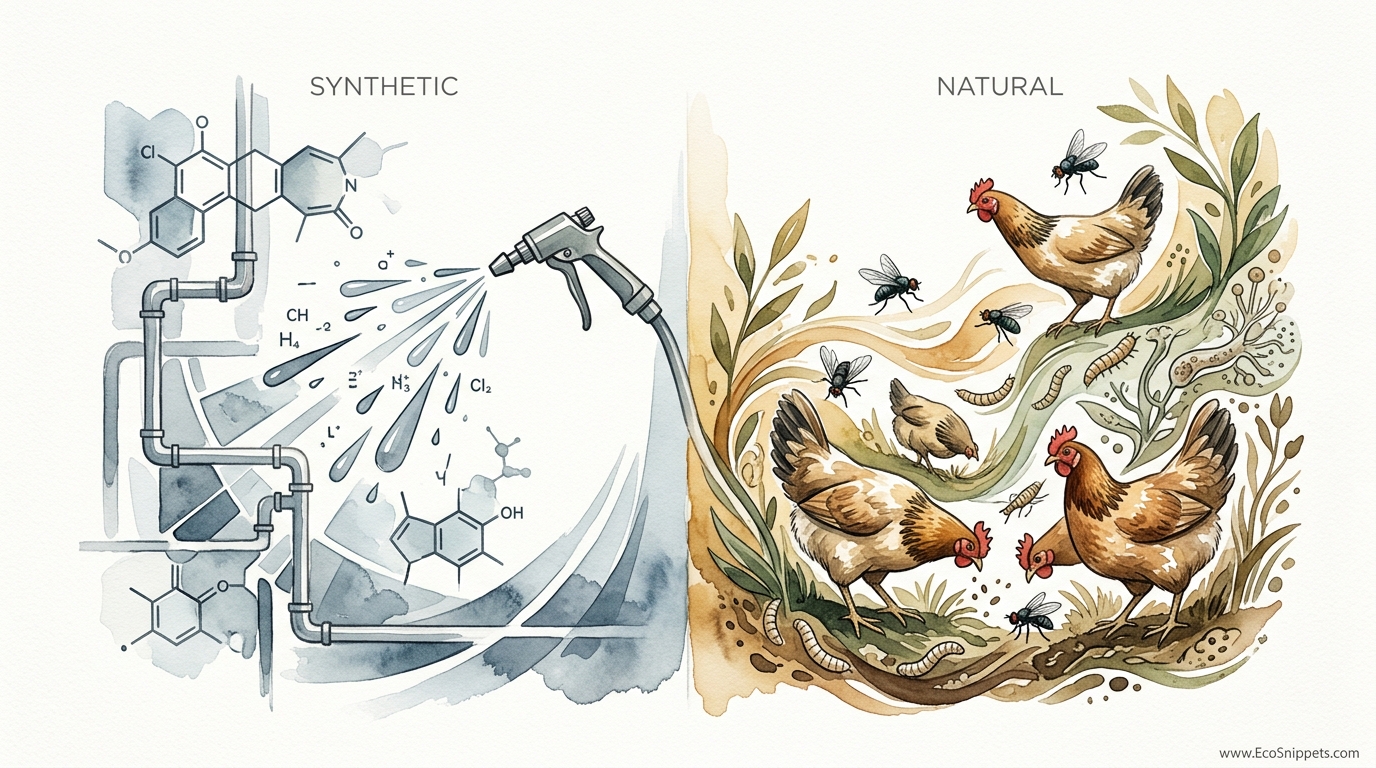
Synthetic vs. Natural Fly Control
Choosing between chemical intervention and biological loops is a choice between a short-term fix and a long-term system.
| Factor | Synthetic Sprays/Baits | Poultry/Biological Control |
|---|---|---|
| Initial Cost | Low (per bottle) | Medium (bird purchase/housing) |
| Long-term Cost | High (repeated purchases) | Low (birds produce eggs/meat) |
| Labor | Periodic spraying | Daily animal care |
| Environmental Impact | Can kill beneficial insects | Improves soil health |
| Resistance | Flies develop resistance quickly | Flies cannot resist being eaten |
| Safety | Toxic residues possible | Natural and non-toxic |
Chemical sprays are often “broad-spectrum,” meaning they kill the bad bugs but also the good ones—like the predatory mites and wasps that naturally eat flies [1.20]. This creates a “rebound effect” where the fly population explodes after the spray wears off because their natural enemies have been wiped out. Poultry, on the other hand, are selective and integrated.
Practical Tips for Implementation
If you are ready to put your birds to work, follow these best practices to ensure they are as efficient as possible.
Choose the Right Breeds
- Muscovy Ducks: Often called “the fly vacuums,” these ducks are famous for their ability to snatch adult flies right out of the air and hunt larvae with precision.
- Guinea Fowl: These are the ultimate foragers. They are relentless hunters of ticks, beetles, and fly larvae, and they are less destructive to gardens than chickens [1.2].
- Heritage Chickens: Breeds like Rhode Island Reds, Plymouth Rocks, or Icelandic chickens are active foragers that will spend the entire day scratching [1.13, 1.15].
Use Rotational Grazing
Move your poultry to where the manure is. If you have cattle or horses, follow them with a “chicken tractor” or mobile coop 3 to 4 days after the larger animals have moved. This timing is critical; it’s when the fly larvae are at their peak size but haven’t yet turned into adult flies [1.6].
Manage the “Hot Spots”
Flies congregate around feeders and waterers. Keep these areas as dry as possible. Consider placing hardware cloth or slats over “wet zones” so that birds can still reach the area but aren’t constantly standing in mud.
Advanced Considerations: The Black Soldier Fly Loop
For the serious practitioner, the ultimate fly control system involves Black Soldier Fly Larvae (BSFL). Unlike house flies, adult Black Soldier Flies do not have mouthparts—they don’t bite, they don’t eat your food, and they don’t carry diseases [1.21]. Most importantly, their larvae secrete a pheromone that actually discourages house flies from laying eggs in the same area.
You can set up a “BSFL Bin” or “biopod” near your coop. You feed your kitchen scraps and even some manure into the bin. The BSFL will consume the waste at an incredible speed, outcompeting the pest flies [1.19, 1.21]. When the larvae are ready to pupate, they naturally climb out of the bin and can be directed to “self-harvest” into a container that your chickens can access. It is a perfect, closed-loop protein factory that actively repels the pests you hate.
Example Scenario: The Follow-Behind System
Imagine a small homestead with two dairy goats and a flock of twelve chickens. The goats are kept in a fenced paddock. Every morning, the goats produce fresh manure. Left alone, these piles would become nurseries for thousands of flies.
Instead, the homesteader opens the chicken coop shortly after the goats have moved to their daytime pasture. The chickens immediately head for the goat berries. They spend the first two hours of the day scratching every pile flat, hunting for the maggots that hatched from the previous day’s eggs.
By the time the sun is high, the manure is spread thin, drying out in the ultraviolet light, which kills any remaining eggs [1.6]. The chickens have full bellies of high-protein insects, and the fly population is kept so low that the homesteader doesn’t need a single sticky trap in the milk stand. This is bio-integration in its simplest, most effective form.
Final Thoughts
Relying on poultry for fly control is an act of restoration. It restores the bird to its role as a productive member of the farm ecosystem and restores the land to a state of biological balance. When you stop reach for a can of spray and start reaching for a bag of scratch to guide your birds to the trouble spots, you are making a choice for health and self-reliance.
Every homestead is different, and your “loop” may look different than your neighbor’s. Experiment with different breeds, watch how your birds interact with the “fly zones,” and adjust your management to suit the rhythm of your seasons. The goal isn’t just a farm with fewer flies—it’s a farm with more life.
As you move forward, remember that the best tools on your farm have feathers, not triggers. Treat your clean-up crew well, keep them safe from predators, and they will reward you with a pest-free environment and the highest quality eggs you’ve ever tasted. This is the grit of the pioneer spirit, working hand-in-wing with nature.
