How To Become More Self-Sufficient Without Starting a Full-Blown Farm…
Want to start preserving your harvest, making your own soap, or building a backyard root cellar — but not sure where to begin? “Homesteading Advice” gives you instant lifetime access to 35+ practical homesteading books on food preservation, veggie gardening, DIY natural cleaning products (save over $250 per year with this skill alone), brewing, off-grid energy, and a whole lot more…
Click Here To Check It Out Now!
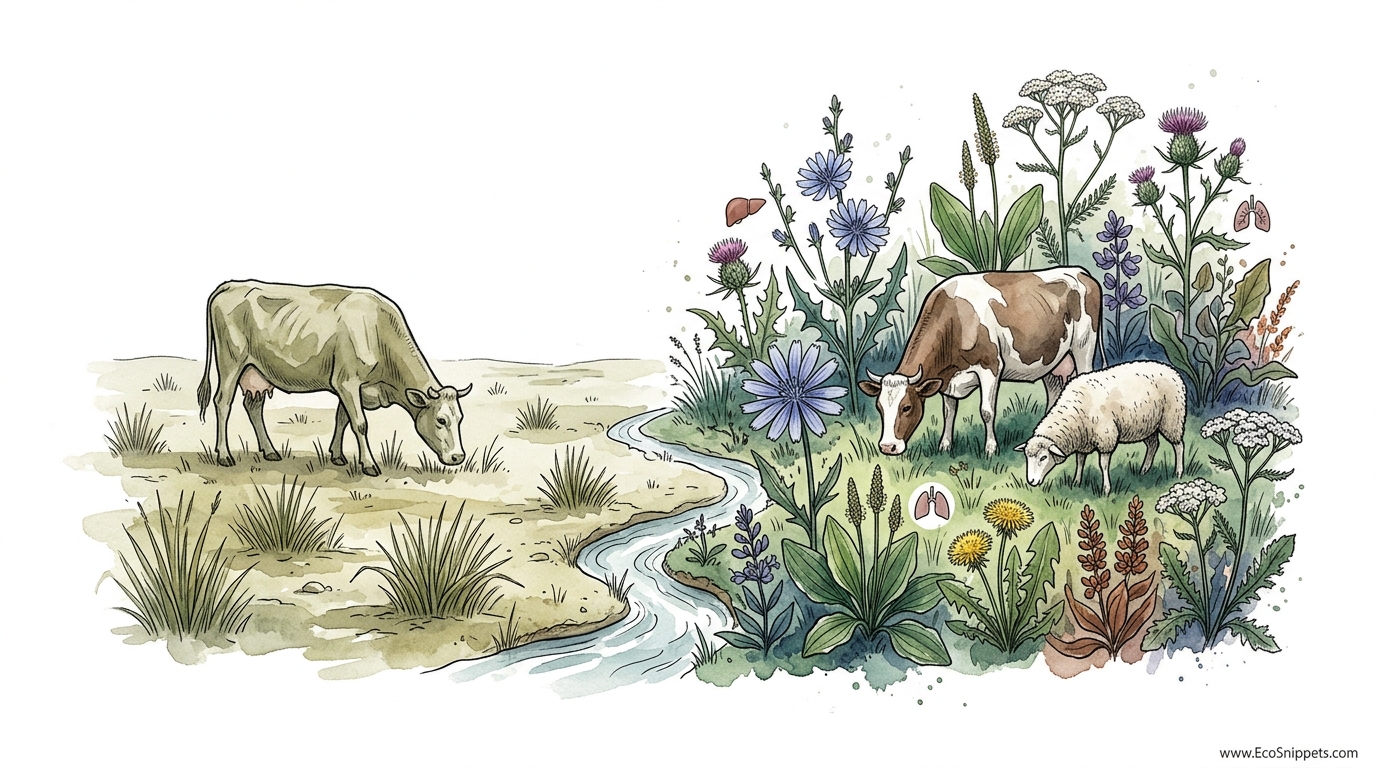
Your livestock are craving the very ‘weeds’ you’ve been trying to spray out of your pasture. We were taught that a clean, grass-only field was the gold standard. But our sheep were always needing minerals. When we let the ‘wild’ back in—the chicory, the dandelions, the ‘weeds’—our vet bills plummeted. Nature doesn’t grow in monocultures, and your animals shouldn’t eat them.
Modern agriculture spent decades chasing the “Green Desert.” This is a field that looks lush and uniform from a distance but offers a hollow diet. High-input perennial ryegrass and white clover mixes provide energy and protein, but they often lack the complex chemical compounds found in the forgotten corners of old-world meadows. Animals are intuitive foragers. When given the choice, they will often bypass a clump of tender grass to nibble on a bitter leaf of yarrow or a prickly thistle head.
This behavior is not random. It is self-medication. Ancestral wisdom tells us that a diverse pasture is a living pharmacy. By bringing back medicinal pasture plants, we are not just feeding our livestock; we are empowering them to manage their own health. This shift in management requires unlearning much of what we were told about “clean” farming and embracing the messy, productive complexity of a medicinal wild sward.
Medicinal Pasture Plants For Livestock
Medicinal pasture plants for livestock, often referred to in modern terms as “herbal leys” or “multi-species swards,” are diverse mixtures of grasses, legumes, and forage herbs. Unlike a standard two-species mix, these swards can contain 15 to 30 different species. Each plant serves a specific purpose, whether it is accumulating minerals from the subsoil, fixing nitrogen, or providing secondary metabolites that fight internal parasites.
The concept of the medicinal pasture is rooted in the understanding that plants produce more than just calories. They produce secondary metabolites—compounds like tannins, saponins, alkaloids, and terpenes. In a monoculture “Green Desert,” these compounds are almost entirely absent. In a “Medicinal Wild” pasture, they are the backbone of the herd’s immune system. These plants thrive in varied environments, from the high-rainfall regions of the United Kingdom to the arid plains of the United States and Australia.
Real-world application of these pastures has shown remarkable results in sheep, cattle, and goats. These plants work by mining the soil. While shallow-rooted grasses only access the top 10 to 15 centimeters (4 to 6 inches) of soil, medicinal herbs like chicory and plantain send taproots down over 1 meter (3 feet) into the earth. This allows them to pull up trace elements like cobalt, selenium, and copper, which are often locked away from conventional forage.
Think of it as the difference between a person living on white bread versus a person eating a varied diet of whole grains, vegetables, and medicinal herbs. The caloric count might be similar, but the long-term health outcomes are vastly different. Livestock on medicinal pastures often show better coats, stronger hooves, and a higher resilience to environmental stress.
How Secondary Metabolites Work in the Rumen
The secret to why these “weeds” work lies in their chemistry. Secondary metabolites are the plant’s defense mechanisms, and when ingested by livestock in the right quantities, they provide pharmacological benefits. One of the most studied groups of these compounds is condensed tannins. These are found in plants like sainfoin, birdsfoot trefoil, and chicory.
Condensed tannins perform a unique service in the rumen. They bind to proteins, preventing them from being broken down too quickly by rumen bacteria. This “bypass protein” then moves into the small intestine where the animal can absorb it more efficiently. This process does more than just improve growth; it prevents the formation of foam, which is the primary cause of pasture bloat. Tannins are essentially a natural anti-bloating agent.
Another critical function of these compounds is their anthelmintic effect. Internal parasites, particularly gastrointestinal nematodes, are a constant threat to small ruminants. Compounds like sesquiterpene lactones found in chicory have been shown to directly interfere with the life cycle of these worms. Research from New Zealand and Wales has demonstrated that lambs grazing on chicory-rich pastures have significantly lower fecal egg counts (FEC) compared to those on traditional ryegrass and clover.
Beyond tannins, plants like plantain contain aucubin and catalpol. These are iridoid glycosides known for their antimicrobial and anti-inflammatory properties. When an animal is feeling the early stages of a respiratory infection or a digestive upset, they will seek out these specific plants. This is not a theory; it is a documented behavior known as zoopharmacognosy—the process by which animals self-medicate by selecting and ingesting certain plants.
Profiles of Essential Medicinal Pasture Plants
Building a medicinal pasture requires a deep understanding of the individual players. You aren’t just tossing seeds into the wind; you are curating a community of healers. Here are the heavy hitters that every self-reliant producer should consider for their sward.
Chicory (Cichorium intybus)
Chicory is perhaps the king of the medicinal sward. It is a perennial herb with a deep, persistent taproot. Its leaves are highly palatable and high in protein, often exceeding 20% crude protein in its vegetative stage. More importantly, it is a mineral powerhouse. It contains significantly higher levels of zinc, potassium, and magnesium than standard pasture grasses.
The real value of chicory is its ability to suppress internal parasites. Because of its upright growth habit and the secondary compounds in its leaves, it creates a sward environment that is less conducive to larval migration. Lambs finished on chicory often reach target weights weeks earlier than their counterparts on grass.
Narrow-Leaved Plantain (Plantago lanceolata)
Often called ribwort plantain, this plant is frequently sprayed out as a weed. However, it is one of the most resilient and nutrient-dense plants you can have. Plantain is particularly high in calcium, sodium, and cobalt. It remains productive even in dry conditions where grasses go dormant.
Plantain is known for its “cooling” properties in traditional herbalism. For livestock, this translates to improved digestive health and reduced inflammation. It is also an excellent soil conditioner, as its fibrous roots help to break up compaction in the upper soil layers.
Sainfoin (Onobrychis viciifolia)
Sainfoin is a legume that was once widely grown before the advent of cheap synthetic fertilizers. It is often called “holy hay” because of its incredible healing properties. Unlike alfalfa or clover, sainfoin is completely non-bloating due to its high tannin content. It is also highly palatable; the name itself comes from the French “sain foin,” meaning “healthy hay.”
Dandelion (Taraxacum officinale)
Do not be fooled by the yellow flowers in your yard. Dandelions are a vital part of a medicinal ley. They are exceptionally high in vitamins A and C, and their roots act as a liver tonic for grazing animals. Dandelions are one of the first plants to emerge in the spring, providing early-season minerals when the soil is still too cold for other plants to thrive.
Yarrow (Achillea millefolium)
Yarrow is a deep-rooted perennial that is often described as a “general practitioner” for the pasture. It contains over 20 different active ingredients, including anti-inflammatory and antiseptic compounds. It is known to stimulate the appetite and aid in the digestion of tougher fibrous forages. Yarrow is also extremely drought-tolerant, making it a reliable “insurance policy” for dry summers.
Stinging Nettle (Urtica dioica)
While livestock rarely eat fresh nettles due to the sting, they will devour them once they are wilted or dried into hay. Nettles are an iron mine. They also provide high levels of nitrogen and protein. Many old-timers would mow patches of nettles and leave them in the field to wilt, knowing the cattle would rush to eat the “iron-rich” greens the next day.
Benefits of the Medicinal Wild Approach
The transition from a monoculture to a medicinal sward offers measurable advantages that affect the bottom line and the health of the land. The primary benefit is reduced dependency on external inputs. When plants fix their own nitrogen and livestock manage their own mineral needs, the need for synthetic fertilizers and expensive mineral tubs begins to fade.
Drought resilience is another significant factor. During a dry summer, a “Green Desert” of ryegrass will turn brown and dormant within weeks. In contrast, the deep taproots of chicory, lucerne (alfalfa), and plantain can reach deep water reserves. This ensures that your animals have a consistent source of high-quality green forage even when the rest of the county is feeding expensive hay.
Animal performance often improves in terms of daily liveweight gain. Studies have shown that lambs grazing herbal leys can gain between 150 grams and 250 grams (0.33 lbs to 0.55 lbs) per day. This is due to the higher nutrient density and the reduced “parasitic drag” on their systems. A healthier animal spends less energy fighting off worms and more energy putting on muscle and fat.
Soil health is the foundation of this system. Diverse root architectures create a more robust soil structure. Deep roots punch through plow pans and bring minerals to the surface. When these plants die and decompose, they leave behind channels that improve water infiltration. This prevents runoff and erosion, keeping your topsoil where it belongs.
How to Establish a Medicinal Herbal Ley
Establishing these pastures requires more patience than a standard grass reseed. Most medicinal herbs have small seeds and require shallow planting. If you bury them too deep, they will fail to germinate. The goal is to create good seed-to-soil contact without overworking the ground.
The best time to sow is when the soil temperature is between 7°C and 10°C (45°F to 50°F) and there is consistent moisture. This usually occurs in late spring or early autumn. Avoid the heat of mid-summer, as the small seedlings can easily desiccate before their taproots find deep water.
- Site Preparation: Graze the existing pasture very short or mow it to the ground. If you are over-sowing into an existing sward, you need to create at least 50% to 70% bare ground. Use a harrow to scratch the surface and remove thatch.
- Sowing Depth: These seeds are tiny. Do not sow deeper than 1 centimeter (about 0.4 inches). If you can see some seed on the surface after sowing, you have probably done it correctly.
- Seeding Method: Broadcasting followed by a heavy roller is often more successful than drilling. The roller ensures the seed is pressed firmly into the soil, which is critical for moisture uptake.
- Stocking Management: After sowing, you can use livestock to “tread in” the seed for a few days, but remove them as soon as the first green shoots appear. Do not graze the new ley until the plants have at least six leaves and the roots are firmly anchored.
It is important to note that nitrogen fertilizer is the enemy of a diverse ley. If you apply high levels of synthetic nitrogen, the grasses will outgrow and smother the herbs and legumes. The “Medicinal Wild” approach relies on the legumes to provide the nitrogen naturally. Trust the system to balance itself.
Challenges and Common Mistakes
The biggest hurdle for most producers is the change in visual aesthetics. A medicinal pasture looks “weedy” and untidy. If you are used to a manicured lawn-like field, the sight of tall chicory stems and flowering yarrow can be jarring. You must realize that “untidy” often means “productive.”
Selective grazing is a major challenge. Livestock are like children at a buffet; they will eat the “candy” (chicory and clover) first and leave the “broccoli” (mature grasses). If you leave animals in one paddock for too long, they will overgraze the medicinal herbs until the plants die out, leaving you with only the less palatable grasses. This is why rotational grazing is non-negotiable.
Persistence is another issue. Chicory and plantain are often described as “short-term perennials.” In a heavily grazed system, they may only last three to five years. You should plan to over-sow these species every few years to maintain the medicinal density of the sward. This is a small price to pay for the health benefits they provide.
Establishment failure often happens because of “capping.” If you roll the soil too hard on a heavy clay field and then experience heavy rain followed by sun, a hard crust can form. The delicate seedlings of herbs like yarrow or sheep’s parsley cannot punch through this crust. Always monitor your soil type and weather forecast before committing your seed to the ground.
Limitations and When This May Not Work
Medicinal pastures are not a “set it and forget it” solution. They require a higher level of management skill than a simple grass field. If you do not have the infrastructure for rotational grazing—fencing and water—you will likely lose the diversity of your ley within the first two seasons.
Environmental constraints also play a role. Some medicinal plants, like sainfoin, require free-draining soils with a pH above 6.0. If your land is a waterlogged peat bog or highly acidic, many of these plants will struggle to survive. In such cases, you must select species that are adapted to your specific site, such as birdsfoot trefoil for wetter ground.
There is also the risk of toxic “mimic” plants. While we want to encourage diversity, we must be able to distinguish between medicinal wild and dangerous intruders. Plants like hemlock, ragwort, or certain nightshades can easily infiltrate a diverse sward. A producer must be diligent in identifying and occasionally spot-removing truly harmful species.
Finally, these pastures may not be ideal for every stage of production. For example, some herbs can occasionally taint the flavor of milk if fed in very high quantities immediately before milking. While this is rarely an issue in a balanced sward, it is something for dairy producers to keep in mind when managing their grazing rotations.
Comparing the Systems
To understand the value of this approach, we must look at the measurable differences between the old way and the ancestral way. The table below compares the two systems across key performance indicators.
| Feature | Green Desert (Monoculture) | Medicinal Wild (Herbal Ley) |
|---|---|---|
| Root Depth | Shallow (10-15 cm / 4-6 in) | Deep (1 m+ / 3 ft+) |
| Mineral Profile | Limited; requires supplementation | Rich; bio-mined from subsoil |
| Parasite Management | Relies on chemical drenches | Natural suppression via metabolites |
| Drought Tolerance | Low; goes dormant quickly | High; stays green longer |
| Nitrogen Source | Synthetic fertilizer (High cost) | Natural fixation (Zero cost) |
| Management Level | Low to Moderate | High (Rotational grazing required) |
Practical Tips for the Self-Reliant Producer
If you are ready to start, do not try to convert your entire farm at once. Start with one “sick bay” paddock. This is a field close to the barn where you can put ewes after lambing or animals that seem “off color.” Use this as your testing ground for medicinal diversity.
- The “Welly” Rule: For rotational grazing, move your livestock into the ley when the forage is about “wellie height” (around 25-30 cm or 10-12 inches). Move them out when they have eaten it down to about 7-10 cm (3-4 inches).
- Let it Flower: At least once a year, let a portion of your medicinal pasture go to flower. This allows the plants to recharge their root reserves and provides a habitat for beneficial pollinators.
- Ditch the Nitrogen: If you are worried about yield, remember that legumes like white clover, red clover, and sainfoin can fix up to 200 kg of nitrogen per hectare (180 lbs per acre). This is more than enough to power a productive sward.
- Observe Your Animals: Watch which plants your livestock go for first. If they are aggressively seeking out yarrow, they might be dealing with internal inflammation. If they are head-down in the chicory, they are likely managing a parasite load.
When mixing your own seed, aim for a ratio of roughly 50% grasses, 30% legumes, and 20% herbs. This provides a balanced “plate” that ensures the animal gets enough fiber for rumen function while still benefiting from the medicinal compounds.
Advanced Considerations for Serious Practitioners
For those looking to take this further, consider the “Bio-diversity Index” of your pasture. A truly resilient sward should have species that represent different functional groups. You want cool-season grasses for early spring, warm-season herbs for mid-summer, and deep-rooted legumes for soil fertility.
You can also tailor your leys to specific species. Goats, for example, have a much higher tolerance for tannins and actually prefer “browse”—shrubs and tall-growing herbs. If you are raising goats, your medicinal pasture should look more like a scrubland than a field. For cattle, you want a higher percentage of broad-leaved plantain and red clover to support their higher protein requirements for milk and growth.
Think about the “synergy” of compounds. Some research suggests that tannins and saponins work better when ingested together. Saponins can help to “permeabilize” the membranes of parasites, making them more susceptible to the toxic effects of tannins. By providing a diverse “wild” sward, you are allowing the animal to create its own chemical cocktails for health.
Scenario: A Sheep Farm Transition
Consider a farm in the American Midwest or the British Midlands that has struggled with drench-resistant worms in their sheep. For years, they used a standard ryegrass and white clover mix. Every summer, the lambs would scour, and the “Green Desert” would stop growing during the August dry spell.
The producer decides to frost-seed chicory and plantain into a 5-acre (2-hectare) paddock in late winter. By June, the herbs have established. They begin a “mob grazing” protocol, where the sheep are moved every 3 days and the paddock is rested for 35 days.
The results are immediate. The lambs on the herbal ley show a 40% reduction in fecal egg counts compared to the control group. Because the chicory stays green during the August heat, the lambs continue to gain 200 grams (0.44 lbs) a day, while the grass-only group stalls. By the end of the season, the producer has saved significantly on veterinary costs and has finished their lambs three weeks ahead of schedule. This is the power of the “Medicinal Wild.”
Final Thoughts
The “weeds” we have spent a lifetime fighting are often the very keys to livestock health. By moving away from the sterile “Green Desert” and embracing a more ancestral, medicinal approach to our pastures, we restore the natural balance that livestock evolved with. This isn’t just about saving money on vet bills or fertilizer; it’s about building a system that is inherently resilient.
A medicinal pasture is a living testament to self-reliance. It requires us to be observers of nature rather than just operators of machinery. When we provide our animals with the tools they need to heal themselves, we find that the land becomes more productive, the animals become more robust, and our own work becomes more aligned with the rhythms of the natural world.
Take the leap and let a little “wild” back into your fields. Start small, observe closely, and trust the wisdom that has been growing under your feet all along. Your livestock will thank you with shiny coats, clear eyes, and a vitality that a monoculture simply cannot provide.
