How To Become More Self-Sufficient Without Starting a Full-Blown Farm…
Want to start preserving your harvest, making your own soap, or building a backyard root cellar — but not sure where to begin? “Homesteading Advice” gives you instant lifetime access to 35+ practical homesteading books on food preservation, veggie gardening, DIY natural cleaning products (save over $250 per year with this skill alone), brewing, off-grid energy, and a whole lot more…
Click Here To Check It Out Now!
Your metal shelter might actually be making your livestock hotter – here is the ‘living’ AC that costs nothing to run. Most homesteaders think a roof is enough, but a metal shed in July is just a slow cooker. We swapped the tin for a ‘living barn’ of fast-growing trees, and our milk production didn’t drop a single pint during the last heatwave. Here is how to plant your own climate control.
Every seasoned farmer knows the feeling of a stagnant July afternoon when the air sits heavy and the only sound is the rhythmic, labored breathing of the herd. You might think you have done your duty by providing a three-sided metal shed, but inside those walls, the temperature often climbs higher than the open field. Metal absorbs and radiates heat back onto the animals, trapping them in a convection oven of their own making.
The solution isn’t a bigger fan or a more expensive cooling system that racks up the electric bill. Instead, we look to the ancestral wisdom of the “living barn.” By integrating specific fast-growing trees into your pasture—a practice known as silvopasture—you create a self-regulating ecosystem that breathes, cools, and even feeds your stock.
This approach isn’t just about shade; it is about biological engineering. A tree doesn’t just block the sun; it actively pulls water from the deep earth and releases it through its leaves, cooling the surrounding air through the miracle of evapotranspiration. It is a persistent, reliable, and cost-free way to ensure your farm remains a sanctuary rather than a furnace.
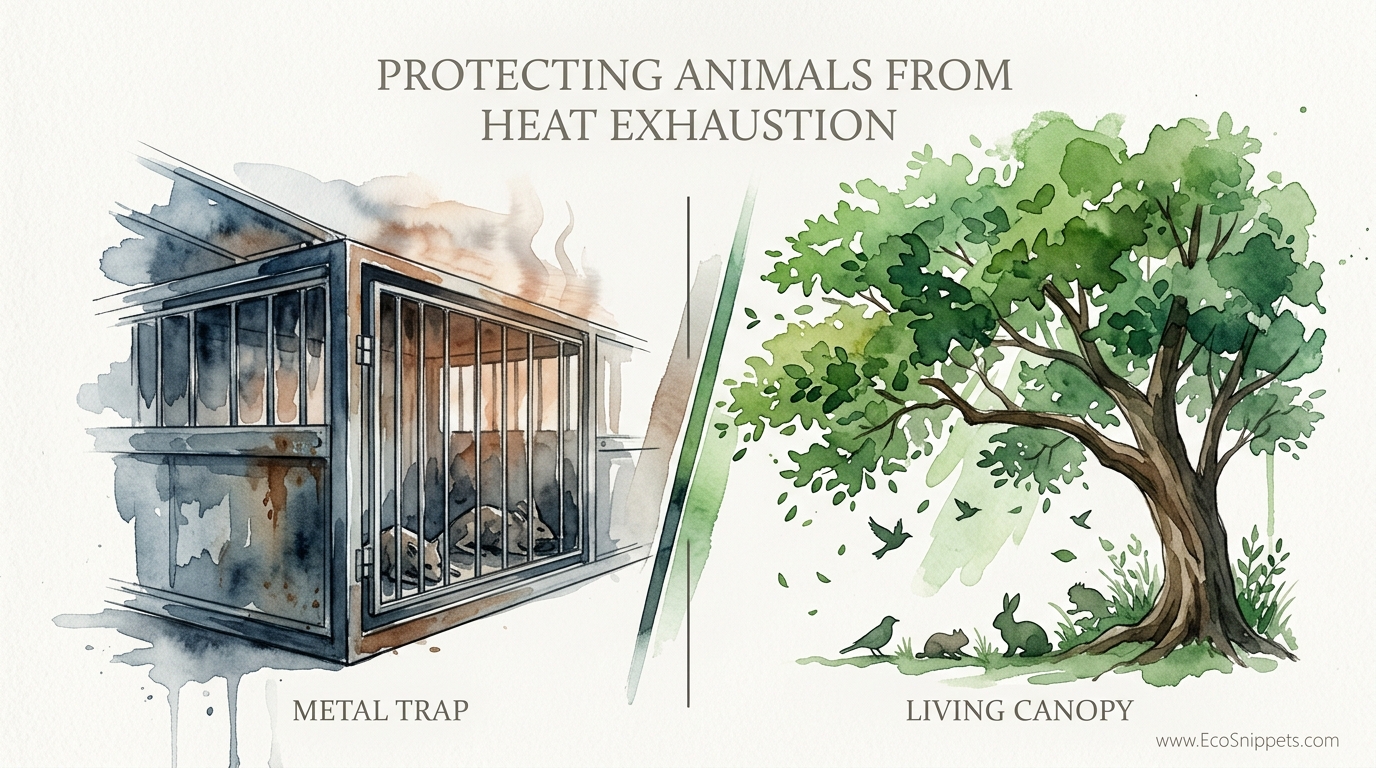
Protecting Animals From Heat Exhaustion
Heat exhaustion in livestock is a silent thief that steals weight, milk, and fertility before most owners realize there is a problem. It occurs when an animal’s core temperature rises faster than it can dissipate heat, usually due to a combination of high ambient temperature, humidity, and direct solar radiation. Unlike humans, many farm animals have limited ways to cool themselves, making environmental management a matter of life and death.
Cattle, for instance, rely heavily on panting because they cannot sweat as effectively as horses or humans. When the Temperature-Humidity Index (THI) crosses a certain threshold—often as low as 72 degrees in high humidity—their systems begin to struggle. You will see the signs: open-mouth breathing, excessive slobbering, and a refusal to move or graze. They are simply trying to survive the metabolic fire burning inside them.
This stress has a direct impact on your bottom line. Lactating dairy cows will prioritize staying alive over producing milk, leading to a sharp drop in daily yield. Beef cattle will stop eating to avoid the heat generated by rumen fermentation, resulting in stalled weight gain. By the time an animal is stumbling or trembling from heat stroke, the internal damage is often irreversible, affecting their reproductive health for months to come.
A living barn provides a multi-layered defense against this exhaustion. It creates a microclimate where the air is moving and the radiant heat from the ground is suppressed. While a metal roof provides a physical barrier to light, a canopy of leaves provides a dynamic filter that allows air to circulate while dropping the temperature by as much as 15 to 25 degrees Fahrenheit compared to the open sun.
How the Living AC Works
The effectiveness of a living barn comes down to the physics of water and light. While a static structure like a shed simply blocks light, a tree is a living pump. Through a process called transpiration, trees draw moisture from the soil and release it as vapor through the stomata in their leaves. This phase change—liquid water turning into gas—requires energy, which it pulls from the heat in the air, creating a natural refrigeration effect.
To build your own living barn, you must think in layers rather than walls. Start by identifying the prevailing winds and the path of the afternoon sun. Planting trees in “shade belts” or “alley cropping” patterns allows you to maximize the cooling footprint. For a standard homestead, a mix of fast-growing “nursery” trees and long-term “legacy” trees creates a system that starts working in as little as three years.
Implementation starts with site preparation and species selection. You aren’t just planting a forest; you are designing a pasture that supports grazing. Spacing is critical to ensure that enough light still reaches the ground to grow high-quality forage. A common layout involves rows of trees spaced 40 to 60 feet apart, allowing a tractor or mower to pass through while ensuring that the shadow of one row eventually meets the root zone of the next.
Protecting your investment is the most labor-intensive part of the process. Young saplings are a delicacy for goats, sheep, and cattle. You must use sturdy fencing, tree tubes, or “living fences” to shield the trees until they grow above the browse line. Once the leading shoot is out of reach, the trees can be integrated into the rotation, providing both shade and occasional fodder for the animals.
Benefits of a Biological Shelter
The primary advantage of a living canopy is the measurable increase in animal productivity. Research has shown that heifers provided with natural shade can gain nearly half a pound more per day than those left in the sun. For the homesteader, this means reaching slaughter weight faster or having a healthier cow for the winter season without increasing feed costs.
Milk production stability is another massive win. Because trees mitigate the extreme spikes in temperature, dairy animals maintain their appetite and metabolic balance. You won’t see the typical “summer slump” where the cream disappears and the gallon count drops. The animals spend more time ruminating and less time panting, which translates directly into the milk pail.
Beyond the animals, the soil itself reaps the rewards. The deep roots of shade trees break up compaction and pull nutrients from the subsoil, eventually dropping them as leaf litter to fertilize the grass. The shade also prevents the pasture from “burning out” in August, keeping the soil cool enough for microbes to stay active and the grass to keep growing through the dry spells.
There is also the benefit of “free” fodder. Many of the best shade trees, such as Willow and Black Locust, have leaves that are as nutrient-dense as alfalfa. During a drought, when the grass turns to tinder, you can “pollard” or prune branches to provide fresh, green feed to your stock. This dual-purpose nature makes trees a far more valuable asset than any pile of lumber and tin.
Challenges and Common Mistakes
The most frequent error homesteaders make is planting trees and walking away. Livestock are incredibly destructive to young timber. A single curious goat can strip the bark of a five-year-old tree in minutes, girdling it and killing your future shade. If you cannot commit to fencing off the trees for the first three to five seasons, your living barn will never reach maturity.
Choosing the wrong species is another pitfall. Some trees, like Black Cherry, can have wilted leaves that are toxic to cattle. Others, like certain maples, create such a dense, shallow-rooted canopy that no grass will grow beneath them, leaving you with a muddy mess instead of a shaded pasture. You must select trees that offer “dappled” shade, allowing enough sunlight to keep the forage alive while blocking the harshest UV rays.
Over-crowding is a challenge that reveals itself years later. If you plant too many trees too close together, you lose the airflow that makes the living AC work. A stagnant, shaded area can become a breeding ground for flies and parasites because the sun isn’t there to dry out the manure. Balance is the key—you want a canopy, not a dark thicket.
Maintenance is a lifelong commitment, albeit a light one. You will need to prune lower branches to keep them above the reach of the animals and ensure the wind can whistle through the “trunk zone.” This prevents the “umbrella effect” where heat gets trapped under low-hanging branches, defeating the purpose of the natural cooling system.
Limitations of the Living Barn
Time is the most obvious constraint. A metal shed can be erected in a weekend, while a tree takes years to provide significant relief. If you are in an immediate crisis with a heatwave, trees won’t save you today. This is a long-term strategy that requires the patience of a true steward of the land.
Environmental conditions also play a role. In extremely arid regions, the water required to establish shade trees might be a luxury you cannot afford. While trees eventually help retain soil moisture, they are heavy drinkers during their establishment phase. You must ensure your water source can handle the needs of both your livestock and your growing shelter belt.
Land availability can limit your design. On very small plots, a large oak or poplar might take up too much grazing space or interfere with power lines and foundations. You have to work within the boundaries of your property, sometimes opting for smaller, shrub-like trees like Mulberry or Elderberry which provide lower-profile shade but still offer cooling benefits.
Comparison: Metal Trap vs. Living Canopy
| Feature | Metal Shed/Shelter | Living Tree Canopy |
|---|---|---|
| Upfront Cost | High (Materials + Labor) | Low (Seedlings/Stakes) |
| Cooling Method | Passive Blocking | Active Evapotranspiration |
| Maintenance | Low (Rust/Repairs) | Moderate (Pruning/Protection) |
| Added Value | None | Fodder, Fuel, Soil Health |
| Lifespan | 15-30 Years | 50-200 Years |
| Airflow | Often Stagnant | Enhanced Convection |
Practical Tips for Planting Your Living Barn
If you want shade fast, look toward Hybrid Poplars and Willows. These species are the “sprint runners” of the tree world, often putting on six to eight feet of growth in a single season. Willows, in particular, can be started from “live stakes”—simply cutting a branch from a healthy tree and shoving it into moist ground in early spring. They provide quick relief while your slower, sturdier oaks and walnuts find their feet.
- Use Tree Tubes: For the first two years, 4-foot or 5-foot vented tree tubes protect against rabbits and smaller livestock while creating a greenhouse effect that accelerates vertical growth.
- Mulch Heavily: Grass is the biggest competitor for a young tree. A thick ring of wood chips or old hay keeps the roots cool and moist, mimicking the forest floor.
- Orient East-West: Planting your main shade line on an east-west axis provides the longest shadow during the heat of the afternoon (2:00 PM to 5:00 PM) when animals need it most.
- Water in Year One: Even drought-tolerant trees need a deep drink every week during their first summer. Once the root system is established, they can fend for themselves.
Consider the “Three-Row Windbreak” design. Plant a row of fast-growing Poplar on the outside, a row of Mulberry in the middle for fruit and fodder, and a row of durable Oak on the inside. This creates a tiered canopy that blocks wind in the winter and provides a massive “cooling zone” in the summer. As the Poplars reach the end of their short life, the Oaks are ready to take over for the next century.
Advanced Considerations for the Serious Practitioner
For those looking to optimize their system, focus on Nutrient Cycling. Trees like Black Locust and Alder are nitrogen-fixers. They have a symbiotic relationship with soil bacteria that pulls nitrogen from the air and deposits it into the soil. This actually improves the protein content of the grass growing nearby, meaning your “shade” is also a “fertilizer spreader.”
Dappled shade management is an art form. You want to aim for roughly 30% to 50% shade coverage across the pasture. This level of light keeps “cool-season” grasses like Orchardgrass and Fescue productive even in the heat of summer. Too much shade and the grass thins out; too little, and the soil dries out. Moving your livestock through these silvopasture “paddocks” ensures that no single area gets over-manured or over-compacted.
Genetic diversity in your planting is also vital. Do not plant a monoculture of one tree species. If a specific pest or disease hits, you could lose your entire “barn” in a single season. Mix species with different leaf shapes, root depths, and bloom times. This not only protects the herd but also provides a haven for beneficial insects and birds that keep your pasture’s fly population in check.
Example Scenario: The 5-Acre Shade Belt
Imagine a typical 5-acre rectangle of open pasture. Without trees, the wind whips across it in winter and the sun bakes it in summer. By planting a double row of trees along the southern and western edges, you create a “L-shaped” sanctuary. In year three, the Willows are 15 feet tall, offering the first real relief. The sheep huddle there at 2:00 PM, ruminating peacefully while the neighboring flock is panting at the fence line.
By year ten, the Mulberry and Black Locust have filled in. The farmer notices that even during a three-week dry spell, the grass within 40 feet of the tree line is still green, while the center of the field is brown. The milk cow, a Jersey who usually struggles in the humidity, hasn’t dropped her production. The “living barn” has become the most valuable piece of infrastructure on the farm, and it cost less than a single sheet of high-quality galvanized roofing.
In this scenario, the initial investment was roughly $200 in seedlings and some sweat equity in fencing. The return is measured in gallons of milk, pounds of beef, and the peace of mind that comes from knowing your animals are comfortable. This is the difference between fighting nature with expensive machinery and working with nature to create a resilient home.
Final Thoughts
Building a living barn is an act of faith in the future and a commitment to the welfare of your stock. It moves us away from the “tin and grease” mentality of modern farming and back toward the biological systems that sustained our ancestors. While the metal shed is a quick fix, it is often a trap; the tree is a slow solution, but it is a legacy that grows stronger every year.
The cooling power of a well-planted pasture is a tool every homesteader should master. It requires no fuel, creates no waste, and provides a multi-purpose yield that a shed could never match. Whether you are raising a single family cow or a commercial herd, the shade of a tree is the kindest gift you can give your animals during a sweltering summer.
Start small if you must—plant three trees this spring. Protect them, water them, and watch how your animals gravitate toward them. Once you see the difference in their behavior and your production, you’ll never look at a metal shed the same way again. You aren’t just planting trees; you are planting the future resilience of your farm.
