How To Become More Self-Sufficient Without Starting a Full-Blown Farm…
Want to start preserving your harvest, making your own soap, or building a backyard root cellar — but not sure where to begin? “Homesteading Advice” gives you instant lifetime access to 35+ practical homesteading books on food preservation, veggie gardening, DIY natural cleaning products (save over $250 per year with this skill alone), brewing, off-grid energy, and a whole lot more…
Click Here To Check It Out Now!
The very machine used to ‘save’ your honey might be stripping away its most powerful healing properties. Modern centrifugal extractors are fast, but the high-velocity air and friction can oxidize delicate enzymes and filter out the medicinal pollen. Our ancestors used the ‘crush and strain’ method—it’s slower, but it keeps the honey ‘living’ and full of the propolis and wax compounds that make it a true homestead superfood. Ready to slow down your harvest for better results?
Pioneer beekeeping wasn’t about the fastest turnaround or the clearest jar on a grocery store shelf. It was about the relationship between the keeper, the hive, and the medicine produced within those wax walls. Modern beekeeping often prioritizes the preservation of the comb to maximize the next honey flow, but in doing so, we might be sacrificing the very essence of what makes honey a miracle food. Taking a step back into the old ways allows us to capture the full spectrum of the hive’s offerings.
When you crush the comb by hand, you are engaging in a process as old as the hills. This method doesn’t just extract sugar; it captures the resins, the oils, and the bio-active particles that a high-speed spinner leaves behind. If you are a small-scale homesteader or a backyard keeper with only a few hives, the choice between the high-speed spin and the gentle hand crush is more than a matter of equipment. It is a choice of philosophy.
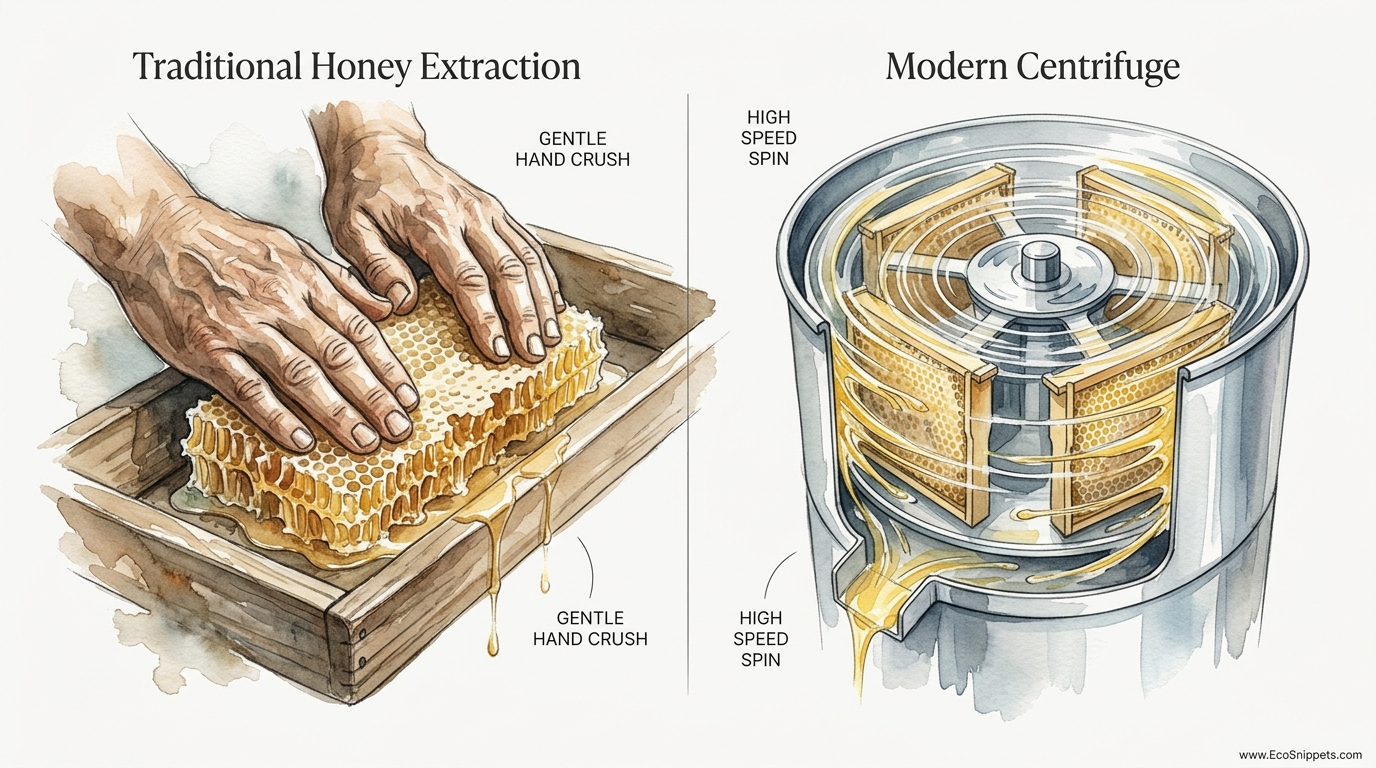
Traditional Honey Extraction Vs Modern Centrifuge
Traditional honey extraction, commonly known as the “crush and strain” method, is the foundation of ancient apiculture. Before the industrial revolution brought us the mechanical centrifuge, every drop of honey consumed by humans was extracted by breaking the comb and letting gravity do the heavy lifting. This process involves removing the entire wax structure from the hive, mashing it into a pulp, and straining the resulting mixture through a coarse mesh. It is a slow, methodical, and deeply tactile experience that connects the keeper to the bees’ labor.
Modern centrifugal extraction, by contrast, is a child of the 19th century. Invented by Franz von Hruschka in 1865, the honey extractor uses centrifugal force to sling honey out of the cells without destroying the wax comb. The frames are “uncapped” with a hot knife, placed in a spinning drum, and rotated at high speeds. The honey flies out against the walls of the drum and drains to the bottom, leaving the empty comb intact to be returned to the bees. While this is undeniably efficient for commercial production, it introduces factors—like high-velocity air and friction-induced heat—that were never part of the traditional harvest.
The core difference lies in the “living” components of the honey. Centrifugal honey is often prized for its clarity and liquid state. It looks beautiful in a glass jar. However, the crushing method creates a product that is cloudier because it is richer. It contains micro-particles of propolis (the “bee glue” used to sanitize the hive), shards of medicinal wax, and significantly higher concentrations of pollen. This “peasant-style” honey is what our ancestors recognized as medicine. It hasn’t been whipped through the air or separated from its companion compounds; it remains a holistic reflection of the hive’s environment.
How to Do a Traditional Crush and Strain Harvest
Executing a successful crush and strain harvest requires very little in the way of specialized machinery, but it demands a great deal of patience and a warm workspace. Warmth is your greatest ally here. Honey is a non-Newtonian fluid with a viscosity that changes drastically with temperature. If the room is cold, the honey will cling to the wax and refuse to flow. Aim for a workspace around 80°F to 90°F (27°C to 32°C) to ensure the honey moves freely.
Begin by gathering your tools. You will need two food-grade five-gallon buckets, a sturdy potato masher or a clean wooden timber, a long serrated knife, and a double-straining system. One bucket should have a spigot at the bottom for bottling. The other will serve as your crushing vessel. Many traditionalists also use a fine-mesh nylon bag or a stainless steel sieve to catch the larger wax fragments.
First, remove the honey frames from the hive. If you are using a Langstroth hive, you will cut the comb away from the four edges of the wooden frame. If you are using a Top Bar or Warré hive, the job is even simpler, as the comb is usually only attached to the top bar. Use your serrated knife to slice the comb into the first bucket. Do not be afraid to get messy. This is a visceral process that requires you to be hands-on with the harvest.
Once the bucket is filled with comb, use your masher to thoroughly pulverize every single wax cell. You are looking to create a uniform mash where no intact cappings remain. This physical destruction is what releases the honey from its hexagonal prisons. After the mash is consistent, pour it into your straining system over the second bucket. Gravity will now take over. It may take 12 to 24 hours for the honey to fully separate from the wax. Resist the urge to heat the mixture to speed things up, as high heat can damage the very enzymes you are trying to protect.
The Benefits of Choosing the Traditional Path
The primary benefit of the crush and strain method is the preservation of the honey’s medicinal integrity. Scientific analysis of pressed honey versus centrifuged honey often shows a higher retention of phenolic compounds and flavonoids. These are the antioxidants responsible for honey’s reputation as a healing agent. When honey is spun in a centrifuge, the surface area of the honey exposed to the air increases exponentially as it is flung through the drum. This can lead to oxidation, which slightly alters the chemical profile of the more delicate enzymes like invertase and glucose oxidase.
Beyond the chemistry, there is the matter of the “hive’s immune system.” Propolis is a resinous substance bees collect from tree buds. They use it to seal cracks and, more importantly, to line every cell in the comb with an antimicrobial layer. When you crush the comb, you are forcing these propolis fragments into the honey. You are also incorporating bee bread—fermented pollen—into the mix. This creates a nutritional profile that simply cannot be replicated by mechanical extraction. The result is a richer flavor profile with floral and earthy notes that are often lost in “clean” honey.
Self-reliance is another major advantage. A mechanical extractor is a significant investment that takes up valuable space in a homestead barn or garage. It has moving parts, bearings that can fail, and motors that require maintenance. The crush and strain method requires only basic kitchen tools and your own grit. For the person looking to decouple their life from industrial supply chains, this is the only way to harvest honey that makes sense. You aren’t beholden to a machine; you are only beholden to the season and the sun.
Challenges and Common Pitfalls to Avoid
The most immediate challenge of the traditional method is the “wax tax.” It takes a tremendous amount of energy for bees to build wax. General estimates suggest that for every pound of wax the bees produce, they must consume between 8 and 10 pounds of honey. When you crush the comb, you are taking that wax away. The bees must start from scratch to rebuild their infrastructure before they can store more honey. This can significantly reduce your total yield for the season, especially in regions with a short nectar flow.
Hygiene is another area where beginners often stumble. Because the process is so manual, the risk of contamination is higher. Every surface, tool, and even your arms must be scrubbed and sanitized. Honey is naturally antimicrobial, but introducing excess moisture (even from a damp towel) can raise the water content above 18.6%, leading to fermentation. Traditionalists must be vigilant about the “capping rule”: only harvest frames that are at least 80% capped by the bees. This ensures the honey is “cured” and has a shelf life that can last for years.
Finally, there is the “robber bee” factor. The scent of crushed comb is incredibly potent. If you attempt this process in a garage with an open door or a screened-in porch, you will quickly find yourself surrounded by every foraging bee in a three-mile radius. They can smell the exposed honey from a distance and will become aggressive in their attempts to reclaim it. Always perform your crush and strain indoors, in a bee-tight environment, and clean up every sticky drip immediately to prevent a neighborhood-wide feeding frenzy.
Limitations: When the Spinner Might Be Necessary
While the pioneer spirit favors the crush, we must be honest about its limitations. Scale is the primary hurdle. If you are managing 50 hives, the manual labor required to crush and strain every frame would be insurmountable. Centrifugal extraction was invented for a reason: it allows a single person to process hundreds of pounds of honey in a single afternoon. If your goal is commercial viability or providing honey for an entire community, the machine becomes a necessity rather than a luxury.
Environmental factors also play a role. If you live in a region with a very late, cold harvest season, gravity straining becomes almost impossible without supplemental heat. In these cases, the “high speed spin” can force thick, cold honey out of the cells in a way that gravity never could. Additionally, if your bees are struggling with a weak population or a poor forage year, the “wax tax” mentioned earlier might be too high. Forcing a struggling colony to rebuild all their wax after a harvest can sometimes lead to hive failure in the winter. In these specific scenarios, preserving the comb with an extractor is the more compassionate choice for the bees’ survival.
Comparison: Manual Crush vs. Centrifugal Spin
| Feature | Manual Crush & Strain | Centrifugal Extraction |
|---|---|---|
| Equipment Cost | Low ($20 – $50) | High ($150 – $1,500+) |
| Processing Speed | Slow (12-24 hours for straining) | Fast (Minutes per frame) |
| Nutritional Profile | Superior (High pollen/propolis) | Standard (Clearer, less particulate) |
| Comb Preservation | None (Comb is destroyed) | High (Comb is reusable) |
| Required Skill | Low/Beginner Friendly | Moderate (Machinery operation) |
Practical Tips and Best Practices
To get the best results from a traditional harvest, you must think like a scientist but act like a pioneer. Always start with clean equipment. A single drop of water left in a bucket can ruin an entire batch. Dry your buckets and mashers thoroughly in the sun or with a lint-free cloth before you begin. Even the moisture in the air can be an issue; avoid harvesting on a rainy or highly humid day if possible.
Settling is the secret to clear-ish honey without industrial filters. Once your honey has finished straining, let the bucket sit undisturbed for at least 48 hours in a warm room. Air bubbles, tiny wax particles, and bee parts will naturally float to the top. This layer, often called “honey foam,” is actually incredibly delicious and packed with pollen. You can skim this off with a spoon and keep it for yourself, leaving the clearer honey below for bottling. This “gravity filtering” is much gentler than forced filtration and keeps the honey’s structure intact.
Consider the timing of your crush. If you harvest early in the summer, the bees have more time to rebuild their wax before winter. If you wait until late autumn to do a crush and strain, you might be setting the hive up for a difficult winter. A good rule of thumb for the traditionalist is to only harvest the “surplus”—leave the bees with more than they need, especially if you are taking their wax. If you find yourself needing to harvest late, consider only taking a few frames and leaving the rest for the colony’s own stores.
Advanced Considerations: The Chemistry of the Hive
For the serious practitioner, understanding the chemistry of honey is vital. Honey contains a compound called Hydroxymethylfurfural (HMF), which is a marker for heat damage and aging. In a centrifuge, if the motor or the friction of the spin generates even minor heat, the HMF levels can begin to rise. The crush and strain method, when done at room temperature, keeps HMF levels at their absolute minimum. This ensures the longest possible shelf life and the highest enzymatic activity.
Invertase is the enzyme that bees add to nectar to break down sucrose into glucose and fructose. It is extremely sensitive to heat and physical agitation. Studies have shown that the “shear force” created in a high-speed centrifugal extractor can actually break down some of these complex protein chains. By using a slow, manual crush, you are preserving the structural integrity of these enzymes. This isn’t just theory; it’s the difference between a sweetener and a bio-active food. The honey remains “raw” in the truest sense of the word, continuing to evolve and even change flavor slightly over time as it sits in the jar.
The wax itself is a treasure that shouldn’t be overlooked. After the honey has finished dripping, you are left with a massive pile of “slumgum”—the wax and hive debris. Don’t throw this away. This wax is the purest you can get, as it hasn’t been recycled through a hive for years like commercial foundation. You can melt it down to make candles, salves, or wood polish. The value of this wax often offsets the “honey loss” caused by the bees having to rebuild it. It is a secondary crop that the modern centrifugal beekeeper often forgets to value correctly.
Scenario: The Two-Hive Harvest
Imagine you are a homesteader with two thriving hives in the backyard. It’s mid-July, the clover is in full bloom, and your supers are heavy with capped honey. You have a choice: spend $300 on a basic hand-crank extractor or spend $20 on a couple of buckets and a masher. You choose the pioneer’s path. You bring six frames into the kitchen. The air is warm, smelling of summer and wild resins.
As you slice the golden comb away from the wood, you see the different colors of the honey—some light and floral, some dark and rich. You crush them together, creating a beautiful, chaotic mash. You pour it into the strainer and go to bed. By morning, the bottom bucket is filled with three gallons of deep gold liquid. It’s thick, it’s cloudy, and when you taste it, there’s a distinct tang of propolis that makes your throat tingle. You didn’t just harvest honey; you harvested the essence of that specific summer on your specific patch of land. That’s the power of the old ways.
Final Thoughts
Modern technology has a way of making us believe that faster is always better. In the world of beekeeping, the mechanical extractor is a marvel of efficiency, but it comes at a cost that isn’t always measured in dollars. By returning to the traditional crush and strain method, you are choosing to prioritize the medicinal power of the hive. You are embracing a slower pace that respects the complexity of what the bees have created.
Traditional extraction is more than just a way to get honey out of a frame; it is an act of preservation. It preserves the enzymes, the pollen, the propolis, and the grit of the pioneer spirit. Whether you are a beginner looking to save money or an experienced keeper looking to improve the quality of your harvest, the crush and strain method offers a path toward a more authentic, self-reliant life. Slow down, get your hands sticky, and taste what true honey is supposed to be.
As you move forward, remember that beekeeping is a journey of constant learning. Experiment with different hive types, observe how your bees respond to different harvest methods, and always keep the health of the colony at the center of your work. The old ways were built on observation and respect—two tools that will never go out of style.
