How To Become More Self-Sufficient Without Starting a Full-Blown Farm…
Want to start preserving your harvest, making your own soap, or building a backyard root cellar — but not sure where to begin? “Homesteading Advice” gives you instant lifetime access to 35+ practical homesteading books on food preservation, veggie gardening, DIY natural cleaning products (save over $250 per year with this skill alone), brewing, off-grid energy, and a whole lot more…
Click Here To Check It Out Now!
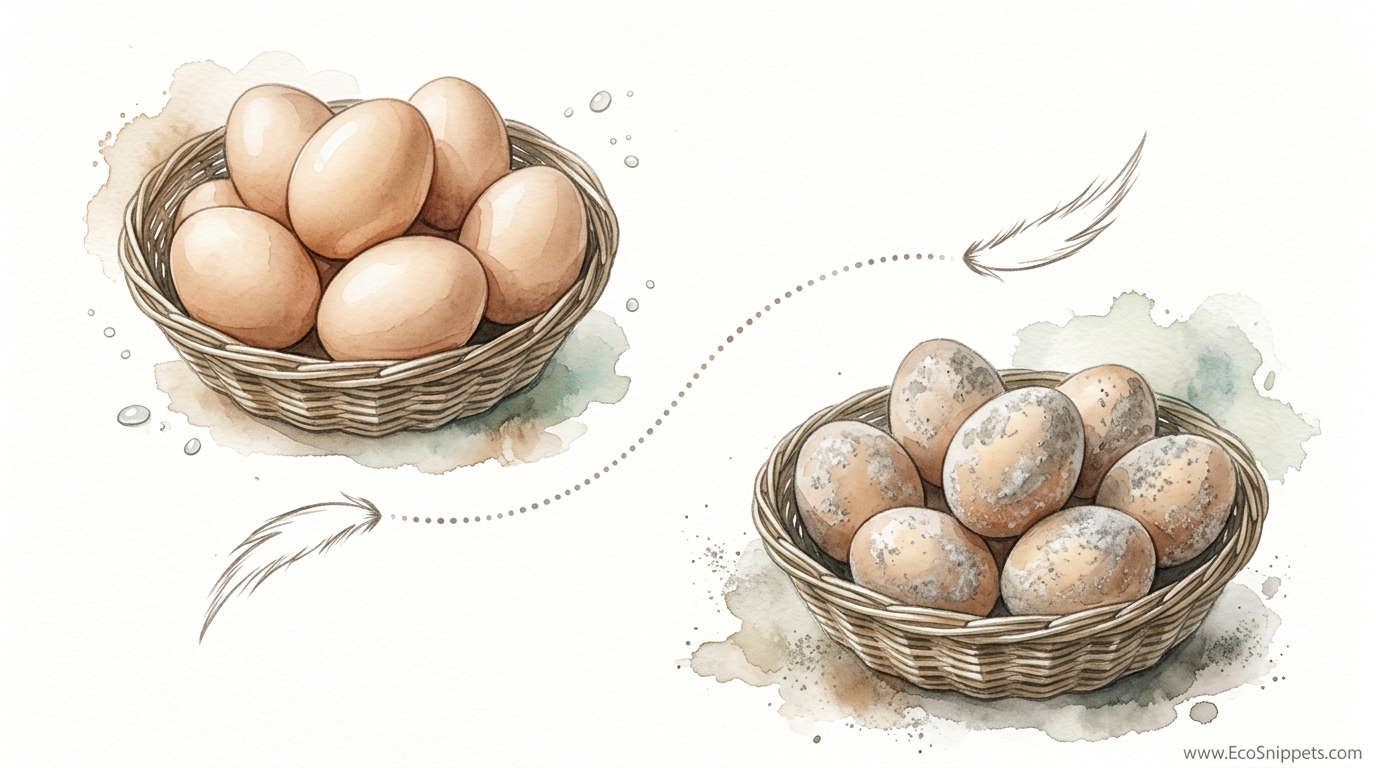
The moment you ‘clean’ an egg, you’ve actually started its countdown to rot. In most of the world, eggs sit on the counter, not in the fridge. Nature provides a ‘bloom’—a biological seal—that keeps eggs fresh for weeks. When you wash it, you’re inviting the bacteria in.
There is a deep-seated satisfaction in reaching into a nesting box and pulling out a warm, heavy egg. It is the culmination of a morning’s work for your hens and a staple of the self-reliant pantry. However, for many modern folks raised on supermarket aisles, the first instinct upon seeing a speck of dirt or a stray feather is to scrub it clean. That instinct is the enemy of preservation. To understand why we leave our eggs “dirty,” we must look back at ancestral wisdom and the brilliant design of the egg itself.
This guide will walk you through the science of the bloom, the pitfalls of the modern “washed clean” philosophy, and how you can manage your harvest like a true pioneer. We are moving beyond the sterile, fragile systems of industrial agriculture and returning to a method that respects the bird and the biology.
Why You Shouldn’t Wash Fresh Eggs
The core reason to avoid washing fresh eggs is the preservation of the **cuticle**, commonly known among homesteaders as the **bloom**. This is a nearly invisible, thin proteinaceous layer deposited on the shell in the final stages of the egg-laying process. In the natural world, this seal is the first line of defense for a developing embryo, ensuring that while the shell remains porous enough for the chick to breathe, it is sealed enough to keep out the microscopic predators that cause decay.
When an egg is laid, it exits the hen’s body through the cloaca—a shared exit for both reproductive and digestive systems. While this may sound unappealing to the uninitiated, nature has compensated for this by applying the bloom. This coating dries within seconds, creating a physical and chemical barrier that plugs the 6,000 to 10,000 microscopic pores on the surface of the shell.
In real-world terms, an unwashed egg is a sealed vessel. A washed egg, conversely, is an open door. By scrubbing away that natural seal, you expose the porous calcium carbonate shell to the environment. Any bacteria lingering on your hands, the kitchen counter, or in the wash water itself can then be drawn into the interior of the egg, where the nutrient-rich yolk acts as a perfect medium for bacterial growth.
How the Bloom Works and Why It Exists
The eggshell is not a solid wall; it is a complex, breathable membrane. If you were to look at a shell under a microscope, you would see a landscape of tiny craters. These pores allow for the exchange of oxygen and carbon dioxide, which is essential if a chick is developing inside. However, these same pores are large enough for *Salmonella*, *E. coli*, and various fungal spores to pass through.
The bloom is composed primarily of **glycoproteins, lipids, and polysaccharides**. Its function is two-fold:
- Physical Sealing: It acts as a “pore plug,” physically obstructing the entrance to the shell’s interior.
- Antimicrobial Action: The proteins within the bloom, such as lysozyme, possess natural antibacterial properties that actively kill or inhibit pathogens on contact.
In the wild, a hen may take two weeks to “clutch” a dozen eggs before she begins to sit on them for incubation. Without the bloom, those first eggs would rot in the nest long before the last one was laid. This same biological timer works in your favor in the kitchen. By leaving the bloom intact, you are allowing the egg to maintain its internal moisture and chemical balance for weeks without the need for mechanical refrigeration.
The Benefits of Keeping Your Eggs Natural
Choosing the natural bloom over the “washed clean” standard offers several measurable advantages for the serious practitioner of self-reliance.
1. Extended Shelf Life at Room Temperature
An unwashed egg with its bloom intact can sit on a cool kitchen counter for two to three weeks without any significant loss of quality. This frees up valuable refrigerator space and allows for a more traditional, “grab-as-you-cook” kitchen workflow. In many European countries, where eggs are never washed at the commercial level, refrigeration in grocery stores is practically non-existent.
2. Retention of Internal Moisture
Because the bloom seals the pores, it prevents the water inside the egg from evaporating. A washed egg begins to dry out immediately. Over time, the air cell inside the egg expands, the whites become watery, and the yolk loses its firm, domed structure. The bloom keeps the egg “meaty” and fresh for much longer.
3. Reduced Risk of “Suction” Contamination
One of the greatest dangers in egg handling is the temperature differential. If you wash a warm egg in cold water, the interior of the egg contracts, creating a vacuum that literally sucks the wash water—and any surface bacteria—through the pores and into the yolk. By not washing, you eliminate this risk entirely.
Challenges and Common Mistakes
While the “no-wash” rule is simple, there are common pitfalls that beginners often encounter. Understanding these is the difference between a healthy pantry and a case of food poisoning.
The “Slippery Slope” of Moisture
The bloom is water-soluble. Even a light misting or high humidity can start to break down the seal. A common mistake is bringing cold eggs out of a refrigerator and letting them sit in a warm room. This causes “sweating” (condensation), which dissolves the bloom and creates a highway for bacteria to enter the shell. If an egg gets wet, the countdown has started; you must wash it thoroughly and move it to the fridge immediately.
Ignoring Nest Box Hygiene
The “no-wash” philosophy is not an excuse for filth. A common error is allowing the nesting boxes to become fouled with manure or broken eggs. If an egg is heavily coated in waste, the bacteria load may be too high for the bloom to handle. The goal of the homesteader is to produce **naturally clean** eggs, which starts with fresh straw and daily collection.
Mistaking Stains for Dirt
New chicken keepers often worry about slight discolorations or “skid marks” on the shell. These are often just pigments or harmless organic matter. Scrubbing these off out of vanity is a mistake that compromises the egg’s safety.
Limitations: When You Must Wash
There are specific situations where the bloom cannot do its job, and a more aggressive cleaning approach is required. It is important to know where the boundaries of “natural preservation” lie.
- Heavily Soiled Eggs: If an egg is covered in more than a small speck of manure, the risk of cross-contamination in the kitchen is too high. These eggs should be washed and used immediately.
- Cracked Shells: If the shell is compromised even slightly, the bloom is irrelevant. Bacteria have a direct path to the interior. These should never be stored and are best fed back to the chickens or the farm dog.
- Commercial Requirements: If you are selling eggs, you must adhere to your local and state regulations. In the United States, most states require eggs for sale to be washed and sanitized. While this removes the bloom, it is a legal necessity for many small-scale producers.
Washed Clean vs. Natural Bloom: A Comparison
Understanding the trade-offs between these two methods helps you decide which is best for your specific situation.
| Feature | Washed (Industrial Standard) | Natural Bloom (Pioneer Method) |
|---|---|---|
| Storage Location | Always Refrigerated | Countertop or Cool Larder |
| Shelf Life (Room Temp) | 2–4 Hours | 2–4 Weeks |
| Shelf Life (Fridge) | 3–5 Weeks | 3+ Months |
| Contamination Risk | Lower Surface / Higher Internal | Higher Surface / Lower Internal |
| Complexity | High (Requires Heat/Sanitizer) | Low (Zero Processing) |
Practical Tips and Best Practices
To master the art of the unwashed egg, you need to adjust your daily habits and kitchen management.
The “Dry Cleaning” Technique
If an egg has a small amount of dried mud or a single speck of manure, do not reach for the faucet. Use a piece of high-grit sandpaper, a stiff-bristled brush, or a dry “scrubby” sponge to gently buff away the debris. This “dry cleaning” removes the unsightly mess without dissolving the underlying bloom.
The “Pointy End Down” Rule
Whether on the counter or in the fridge, always store eggs with the blunt end up and the pointy end down. The blunt end contains the air cell. Storing them this way keeps the air cell at the top, preventing it from rupturing or moving toward the yolk, which helps keep the egg fresh and the yolk centered.
The Float Test
If you are ever unsure of an egg’s freshness, use the float test. Place the egg in a bowl of water. A fresh egg will lay flat on the bottom. An older (but still safe) egg will stand on one end. If the egg floats to the surface, the air cell has grown too large, indicating it is likely spoiled and should be discarded. **Note:** Doing this removes the bloom, so only float eggs you intend to use immediately.
Advanced Considerations: Water Glassing
For those looking to go beyond the basics of countertop storage, the bloom is the essential ingredient for long-term preservation methods like **water glassing**. This is an old pioneer technique that allows you to store eggs for up to a year without electricity.
Water glassing involves submerging **clean, unwashed eggs** in a solution of hydrated lime (calcium hydroxide) and water. The lime reacts with the natural bloom and the calcium in the shell to create a permanent, stony seal that prevents any air or bacteria from entering. You cannot water glass a washed egg; the lack of a bloom and the open pores will allow the lime to seep into the egg, ruining it. This highlights how critical the bloom is—not just for the first few weeks, but for true long-term food security.
A Realistic Example: The Mid-Summer Harvest
Imagine it is July. Your hens are in peak production, and you are collecting a dozen eggs a day—more than your family can eat. You have two baskets on your counter.
In Basket A, you place eggs that come out of the nest perfectly clean. These stay on the counter, where you use them for daily breakfast. You know that even in the summer heat, as long as your kitchen stays below 75°F, these eggs are perfectly safe for the next 14 days.
In Basket B, you have the “problem eggs”—the ones from the hen who insisted on laying in the dirt under the coop. You wash these under warm running water (never soaking them), dry them immediately, and put them in the refrigerator. These become your “baking eggs,” used for cakes and cookies later in the week.
By using both systems, you respect the biology of the egg while maintaining a safe, efficient kitchen. You aren’t fighting nature; you are working within its parameters.
Final Thoughts
The moment you ‘clean’ an egg, you’ve actually started its countdown to rot. By trusting in the natural bloom, you are embracing a system of food preservation that has served humanity for thousands of years. It is a shift in mindset from the sterile, plastic-wrapped expectations of the modern world to a more grounded, observational approach to food.
Leaving the bloom intact isn’t about being lazy or “dirty.” It is an act of intentionality. It requires you to keep a cleaner coop, to collect eggs more frequently, and to understand the microscopic life cycles happening right on your kitchen counter. It is a return to a time when we knew our food, and we knew how to keep it.
Whether you are a seasoned homesteader or a beginner with three hens in a backyard coop, start treating that bloom as the precious resource it is. Leave the soap in the cupboard, keep the sandpaper handy, and let nature’s biological seal do the work it was designed to do. Apply these lessons, and you will find your eggs taste better, last longer, and bring you one step closer to true self-reliance.
