How To Become More Self-Sufficient Without Starting a Full-Blown Farm…
Want to start preserving your harvest, making your own soap, or building a backyard root cellar — but not sure where to begin? “Homesteading Advice” gives you instant lifetime access to 35+ practical homesteading books on food preservation, veggie gardening, DIY natural cleaning products (save over $250 per year with this skill alone), brewing, off-grid energy, and a whole lot more…
Click Here To Check It Out Now!
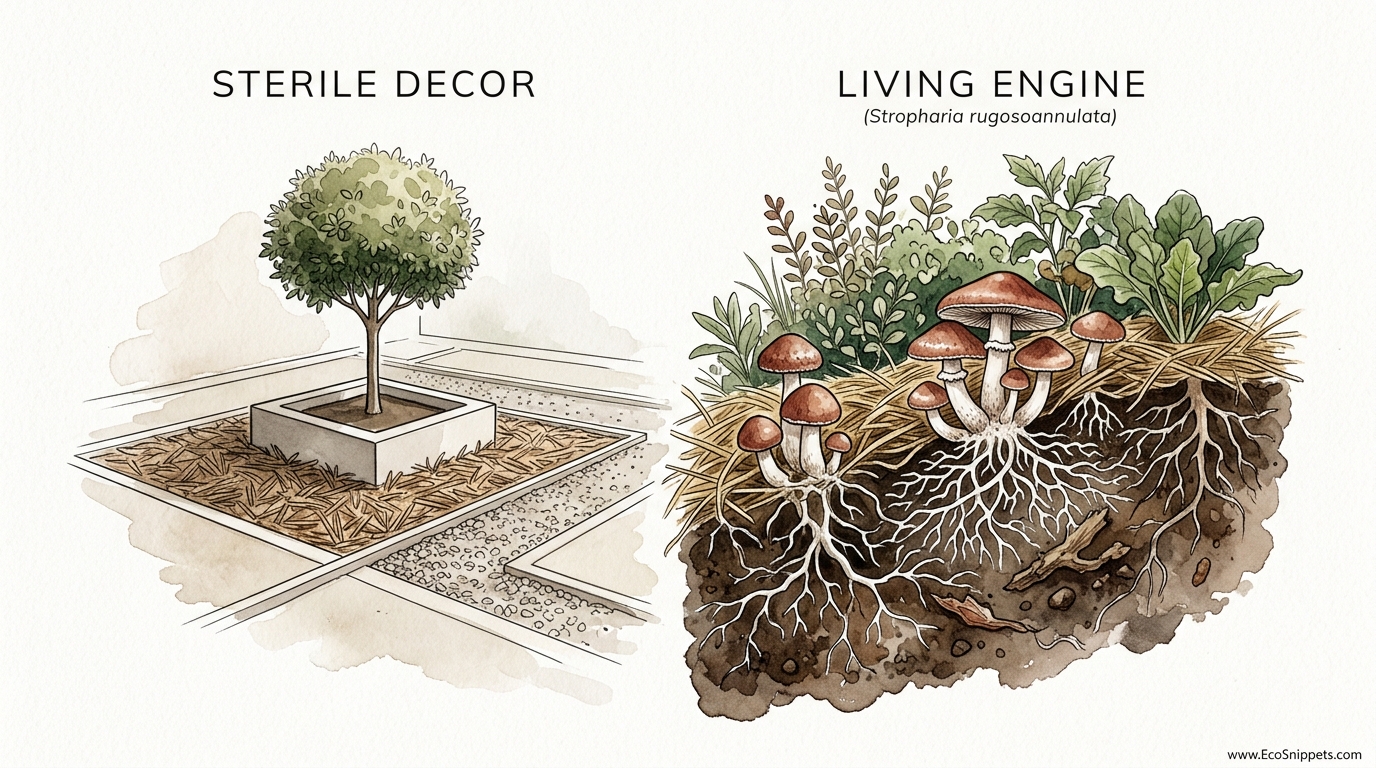
Your garden paths are either a biological dead zone or a high-speed nutrient highway—which one did you build? Most gardeners treat their paths as an afterthought, using dyed bark and plastic to ‘keep things clean.’ But in a permaculture system, every square inch must work for you. By swapping sterile mulch for fungal-inoculated woodchips, you aren’t just building a path; you’re building a massive mycelial network that transports water and nutrients directly to your plants’ roots while growing gourmet mushrooms for your dinner table.
Traditional gardening creates a divide between the “productive” bed and the “sterile” walkway. This waste of space is a relic of industrial mindset. A living path, powered by the Wine Cap mushroom (Stropharia rugosoannulata), turns that wasted square footage into a decentralized composting machine. These fungi act as the connective tissue of your garden, weaving together the disparate elements of your landscape into a single, breathing organism.
Choosing to cultivate these “Garden Giants” is a nod to ancestral wisdom. It is about working with the grain of nature rather than against it. You provide the carbon, and the fungi provide the labor. This is pioneer-grit at its finest: finding utility in the mundane and turning a simple walking surface into a source of sustenance and soil fertility.
Benefits Of Wine Cap Mushrooms In Permaculture
Wine Cap mushrooms, also known as King Stropharia or the Garden Giant, serve as the primary decomposers in a woodchip-based permaculture system. These fungi are aggressive, fast-growing, and exceptionally resilient, making them the perfect entry point for anyone looking to integrate mycology into their homestead. Unlike many delicate indoor mushroom species, Wine Caps thrive in the chaotic, non-sterile environment of an outdoor garden path.
The primary role of the Wine Cap is to facilitate the rapid breakdown of woody biomass. Hardwood chips, which might take five years to rot on their own, can be transformed into rich, black humus in as little as two seasons when inoculated with Stropharia. This process releases locked-up minerals and carbon back into the soil, making them available to the vegetables growing just inches away in your raised beds.
Beyond simple decomposition, these mushrooms are famous for their ability to transport resources. Mycelium acts as a subterranean logistics network. If one part of your path is damp and another is dry, the fungal threads can actually move moisture across the network to maintain equilibrium. This hydraulic redistribution keeps your garden more resilient during the heat of mid-summer, reducing your reliance on the garden hose.
The ecological benefits extend to pest management as well. Research shows that Wine Cap mycelium produces specialized cells called acanthocytes. These microscopic structures are jagged and can physically snag and consume root-knot nematodes. Incorporating these fungi into your paths creates a protective “moat” around your vegetable beds, naturally reducing the population of soil-borne pests that would otherwise feast on your tomato or carrot roots.
How To Build Your Mycelial Path
Creating a fungal path is a straightforward process that mimics the natural forest floor. Success depends on the quality of your materials and the timing of your installation. Early spring or late autumn are the ideal windows for “planting” your mushrooms, as the cooler temperatures and increased rainfall support the initial colonization phase.
Preparation begins with clearing the desired path area of aggressive perennial weeds. While the mycelium is strong, it cannot easily fight through a thick mat of established sod. Scalping the grass and laying down a layer of plain, non-glossy cardboard serves as a clean slate. This cardboard acts as a “starter fuel” that the Wine Caps find irresistible, allowing them to establish a foothold before moving into the tougher woodchips.
Sourcing the right substrate is the next critical step. Fresh hardwood chips from species like Oak, Maple, Beech, or Birch are the gold standard. These woods contain the complex lignins and celluloses that Stropharia evolved to digest. Avoid using 100% softwood or cedar, as the natural resins and anti-fungal properties of these trees will inhibit or kill the mushroom spawn. A small percentage of aged pine is acceptable, but the majority of your path should be deciduous hardwood.
The “lasagna method” is the most reliable way to ensure even inoculation. Spread a two-inch layer of woodchips over your cardboard base. Break up your Wine Cap sawdust spawn and sprinkle it evenly over the chips, much like seasoning a cast-iron skillet. Repeat this process with another two-inch layer of chips and more spawn until you reach a total depth of four to six inches. This thickness provides enough thermal mass to protect the mycelium from temperature swings and keeps the core of the path moist.
Watering the new path is non-negotiable. Think of the woodchips as a giant sponge that needs to be fully saturated. After the initial soaking, the path should feel like a wrung-out sponge—damp to the touch but not waterlogged. In shaded areas, you may only need to water once a week during dry spells. In full sun, a light daily misting until the mycelium “takes” is often necessary to prevent the top layer from becoming a parched desert.
Practical Advantages Of Fungal Paths
One of the most immediate advantages of a Wine Cap path is the sheer volume of food it produces. A well-established ten-foot path can yield several pounds of mushrooms in a single flush. These are not flimsy, tasteless store-bought varieties; they have a meaty texture and a nutty, potato-like flavor that stands up to grilling and heavy stews. Harvesting your dinner from the same path you walked on to pick your tomatoes is the pinnacle of permaculture efficiency.
Weed suppression is another measurable benefit. As the mycelium colonizes the woodchips, it binds them together into a dense, white mat. This physical barrier makes it difficult for wind-blown weed seeds to find the soil and germinate. Even if a weed does manage to sprout, the loose, crumbly nature of the partially decomposed chips makes it incredibly easy to pull. You are essentially replacing the chore of weeding with the “chore” of harvesting mushrooms.
Soil building happens silently beneath your feet. Over time, the bottom layer of the path turns into “spent mushroom compost.” This material is a biological powerhouse, teeming with beneficial bacteria and protozoa. Every few years, you can shovel this dark gold directly into your garden beds and top up the path with fresh woodchips. This creates a closed-loop system where your walking surfaces are the primary source of fertility for your growing areas.
The thermal regulation provided by a thick, fungal-rich mulch is superior to any synthetic ground cover. Mycelium generates a small amount of heat as it digests carbon. This subtle warmth can actually buffer the soil temperature, protecting the roots of adjacent perennial crops from late-season frosts. It is a living insulation layer that keeps the ground cool in the summer and slightly warmer in the late autumn.
Common Mistakes and Pitfalls
Impatience is the most common reason for failure in mushroom cultivation. Unlike a radish that pops up in 25 days, Wine Caps take their time. Depending on the weather and the freshness of the woodchips, you might not see a single mushroom for six to twelve months. Many beginners assume their spawn has died and stop watering, which is exactly when the mycelium is most vulnerable. Trust the process and keep the moisture consistent even if you don’t see surface growth.
Choosing the wrong wood is a frequent error. Using “free” mulch from a municipal pile can be risky if it contains a high percentage of cedar, walnut, or treated lumber. Walnut contains juglone, which can inhibit certain fungi, and treated wood contains heavy metals or chemicals that you do not want in your dinner. Always ask your arborist exactly what went into the chipper before you commit to spreading it across your land.
Harvesting too late is a culinary mistake rather than a biological one. Wine Caps can grow to the size of a dinner plate, but they are best eaten when the cap is still bell-shaped and the veil underneath is just beginning to tear. Once they fully expand and the gills turn a dark purple-black, the texture becomes soft and the flavor less refined. Check your paths daily after a heavy rain to catch the “buttons” at their peak.
Neglecting the “moisture bridge” between the path and the garden bed can limit the benefits. If the path is bone-dry while the garden is wet, the fungi will struggle to survive. Try to treat the entire area as a single ecosystem. Designing your garden so that runoff from your beds naturally drains into the woodchip paths ensures the mushrooms have the hydration they need without extra effort on your part.
Limitations And Realistic Constraints
Environmental limitations play a major role in the success of Stropharia. These fungi prefer temperate climates with reliable rainfall. If you live in a high-desert environment with 5% humidity and scorching sun, a woodchip path will require significant irrigation to stay alive. In such cases, the “cost” in water may outweigh the “benefit” in mushrooms. They are resilient, but they are not magical; they need water to function as a nutrient highway.
Heavy traffic can be a double-edged sword. While the mycelium is tough, constant compaction from heavy machinery or high-speed foot traffic can crush the delicate hyphae and prevent fruiting. A path that sees occasional walking is perfect, but a main thoroughfare used by a tractor will likely remain a biological dead zone. Reserve your mushroom inoculation for the secondary paths where the ground can remain relatively loose.
Contamination from wild fungi is a natural part of the outdoor process. You are not growing in a sterile lab. Eventually, other “LBMs” (Little Brown Mushrooms) will show up in your woodchips. This is why positive identification is mandatory. If you cannot identify the “toothed” ring on the stem and the purple-brown spore print of a Wine Cap, do not eat it. The garden is a wild place, and self-reliance requires the wisdom to know what is safe and what is not.
Substrate exhaustion is the final limitation. Wine Caps are voracious eaters. They will eventually consume all the available carbon in your path, at which point the mushrooms will stop appearing and the “living engine” will stall. To keep the system running, you must commit to an annual or biennial “feeding” of fresh woodchips. It is a long-term relationship, not a set-it-and-forget-it installation.
Comparison: Sterile Decor vs. Living Engine
| Feature | Sterile Mulch/Plastic | Living Fungal Path |
|---|---|---|
| Primary Goal | Appearance / Weed blocking | Soil building / Food production |
| Nutrient Flow | None (Barrier) | Active transport to plants |
| Maintenance | High (Plastic degrades/weeds grow) | Low (Add chips annually) |
| Yield | Zero | Gourmet mushrooms & Compost |
| Cost | High (Frequent replacement) | Low (Arborist chips are often free) |
Practical Tips For Success
Strategic placement is the key to minimizing your workload. Locate your mushroom paths in the “Zone 1” areas of your permaculture design—the places you visit every single day. This ensures you catch the mushrooms at the perfect harvest window and makes it easy to splash a bit of water on the path whenever you are tending to your vegetables. Dappled shade under a trellis or the north side of a garden bed provides the perfect microclimate.
Monitoring the health of your path is done by “peeking” under the chips. Every few weeks, gently pull back the top layer of wood. You should see white, stringy threads that look like thick cobwebs. This is the rhizomorphic mycelium. If the threads are thin and wispy, the path might be too dry. If the area smells sour or like rotten eggs, it is too wet and needs better drainage. A healthy path should smell like fresh rain and forest earth.
Integrating “companion chips” can boost the diversity of your system. While Wine Caps are the stars, adding a bit of chopped straw or even fall leaves can provide different types of carbon that the fungi enjoy. This diversity of food sources creates a more robust mycelial mat that is less likely to be wiped out by a single pest or weather event.
Harvest with a knife rather than pulling the mushroom out of the ground. Cutting the stem at the base leaves the mycelial “roots” intact and prevents you from dragging dirt into your kitchen. It also ensures that the remaining network isn’t disrupted, allowing the next flush of mushrooms to emerge quickly from the same spot.
Advanced Considerations For Serious Practitioners
Serious permaculture practitioners can use the “expansion method” to inoculate an entire property from a single bag of spawn. Once your initial path is fully white with mycelium, you can take a five-gallon bucket of those colonized chips and use them as “spawn” for a new area. This allows you to scale your fungal network across orchards, swales, and berry patches without ever buying spawn again. You are essentially creating a perennial mushroom nursery.
Mycoremediation is an advanced application for these fungi. Because Stropharia rugosoannulata is so aggressive, it has been used to filter runoff from livestock areas. Placing a Wine Cap path between a chicken coop and a waterway can help “catch” and break down harmful bacteria like E. coli before it reaches the water. The fungi act as a biological filter, cleaning the environment while they grow.
Companion planting with tall, large-leafed crops like corn or squash can create a symbiotic microclimate. The leaves of the plants provide the shade the mushrooms love, while the mushrooms provide the water and nutrients the plants need. This “vertical stacking” of functions is the hallmark of a mature permaculture system, where the soil, fungi, and plants work in a continuous, self-sustaining loop.
Experimenting with different wood types can yield interesting results. Some growers report that Stropharia grown on Alder has a sweeter flavor, while those grown on Oak produce larger, meatier caps. Keeping a garden journal of your substrates and harvest weights can help you fine-tune your “path recipe” for your specific local climate and tastes.
Example Scenario: The Urban Garden Path
Imagine a standard 40-foot urban lot. Most of the space is taken up by the house, leaving a small backyard for gardening. The owner installs three raised beds but realizes that the 3-foot gaps between the beds account for nearly 25% of their total garden area. By filling these gaps with a 6-inch layer of hardwood chips and inoculating them with Wine Cap spawn, they transform 120 square feet of “walking space” into a secondary production zone.
In the first year, they harvest 15 pounds of mushrooms—more than enough for weekly dinners throughout the spring and fall. The tomato plants bordering the paths grow visibly more robust, as the fungal network bridges the gap between the beds, allowing the roots to tap into the moisture stored in the woodchips. When a summer heatwave hits, the owner notices that the soil under the woodchips remains cool and damp, while the neighbor’s bare soil has cracked.
After two years, the bottom layer of the path has turned into two cubic yards of premium compost. The owner scoops this out, puts it onto the raised beds, and gets a free load of chips from a local tree service to reset the cycle. Total cost: the price of one bag of spawn. Total return: hundreds of dollars in gourmet food, increased vegetable yields, and a permanent increase in soil health.
Final Thoughts
Transforming your garden paths into a living mycelial network is one of the most impactful changes you can make to a permaculture system. It moves your landscape away from the brittle, high-input models of the past and toward a resilient, self-maintaining engine of growth. By choosing the “Garden Giant” as your partner, you are ensuring that every step you take in your garden is a step toward greater fertility and self-reliance.
This approach requires a shift in perspective. You must stop seeing woodchips as “decoration” and start seeing them as “fuel.” You must stop seeing fungi as “pests” and start seeing them as “livestock.” The grit required to build these systems is rewarded with a bounty that sterile gardening can never match. It is a slow, steady accumulation of biological wealth that pays dividends in both the kitchen and the soil.
Start small, focus on the moisture, and trust the ancient relationship between wood and fungi. Whether you are managing a small urban plot or a sprawling homestead, the Wine Cap mushroom is ready to go to work for you. Build your nutrient highway this season, and watch as your garden transforms from a collection of plants into a unified, thriving ecosystem.
