How To Become More Self-Sufficient Without Starting a Full-Blown Farm…
Want to start preserving your harvest, making your own soap, or building a backyard root cellar — but not sure where to begin? “Homesteading Advice” gives you instant lifetime access to 35+ practical homesteading books on food preservation, veggie gardening, DIY natural cleaning products (save over $250 per year with this skill alone), brewing, off-grid energy, and a whole lot more…
Click Here To Check It Out Now!
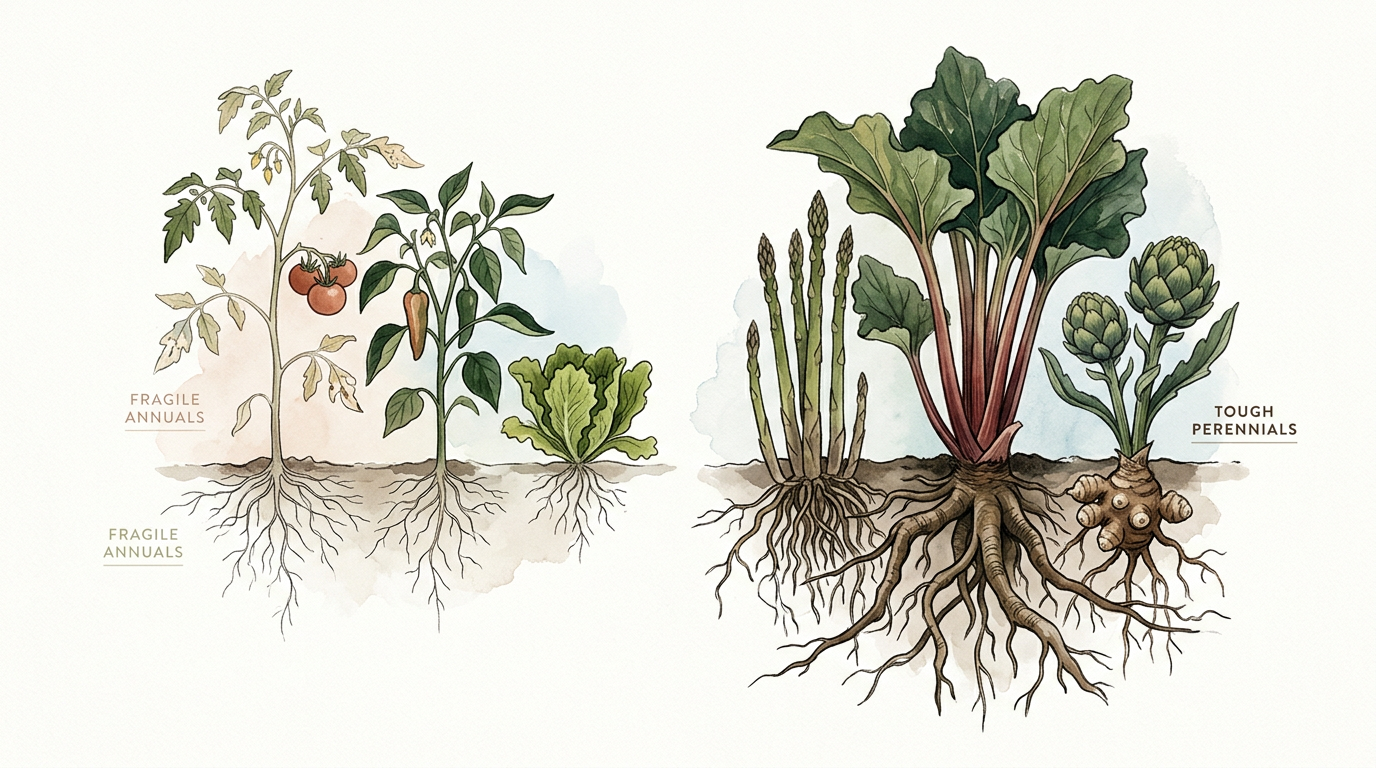
What if you could plant your dinner once and harvest it for the next twenty years? Annual vegetables are high-maintenance divas. Perennial crops like rhubarb, asparagus, and sea kale are the survivalists of the garden, returning every year stronger than before with zero replanting.
This isn’t just a lazy gardener’s dream; it is the cornerstone of a truly self-reliant homestead. When you lean on perennials, you are tapping into ancestral wisdom that prioritizes the health of the land and the longevity of the harvest over the quick, fragile wins of the annual seed packet.
Every spring, while others are struggling with finicky seed starts and tilling up their topsoil, you could be out in the garden with a basket, harvesting the first shoots of the season. These plants don’t ask for much, but they give back in spades once they are established.
Building a garden that lasts decades requires a shift in mindset. You are moving from a “one-and-done” seasonal approach to a long-term investment in your soil and your food security. Let’s walk through how to build a garden that works for you, rather than the other way around.
Best Perennial Vegetables
Perennial vegetables are the sturdy backbone of a productive landscape. Unlike annuals that die off after one season, these plants live for many years—sometimes decades—regrowing from the same root system every spring. They are the survivors of the plant world, often deeper-rooted and more resilient than their annual cousins.
These crops generally fall into three main categories: shoots and stalks, leafy greens, and hardy tubers. Because they stay in one place for a long time, they become deeply integrated into the soil biology, helping to build a stable ecosystem in your backyard.
Asparagus (Asparagus officinalis)
Asparagus is the undisputed king of the perennial bed. Once established, a well-tended asparagus patch can produce tender spears for 20 to 30 years [1.1, 1.15]. It thrives in Zones 3 through 8 and is often the first vegetable to emerge in the spring.
Pioneers prized asparagus because it provided a fresh source of nutrients after a long winter of eating stored grains and salted meats. Growing it requires patience—you typically wait two to three years before your first full harvest—but the reward is a lifetime of gourmet spears that far surpass the woody stalks found in grocery stores.
Rhubarb (Rheum rhabarbarum)
Rhubarb is a rugged, cold-hardy plant often nicknamed the “pie plant.” It is known for its tart, thick red or green stalks. While the leaves are toxic due to high oxalic acid content, the stalks are a staple for preserves and desserts [1.1, 1.10].
This plant is incredibly self-sufficient and can thrive for decades with minimal intervention. It prefers cooler climates (Zones 3-7) and actually benefits from a hard winter freeze. For the self-reliant gardener, rhubarb is a reliable source of early-season bulk and Vitamin C.
Jerusalem Artichokes / Sunchokes (Helianthus tuberosus)
Despite the name, these are actually a species of native North American sunflower. They produce knobby, potato-like tubers that have a nutty, water-chestnut-like flavor [1.24, 1.27]. Sunchokes are incredibly hardy and can grow in almost any soil, often reaching heights of 10 feet in a single season.
They are famous (or infamous) for their vigor. If you leave even a small piece of a tuber in the ground, it will grow back next year. This makes them a perfect “survival” crop, but you must choose their location carefully so they don’t take over your entire garden.
Egyptian Walking Onions (Allium × proliferum)
These are perhaps the most entertaining plants in the perennial garden. Instead of producing seeds, they grow small bulbs (topsets) at the tip of their stalks. As the stalk gets heavy, it tips over, the bulbs hit the ground, and they take root. The onion literally “walks” across your garden over the years [1.24].
Walking onions provide food at every stage: you can eat the green shoots in the spring, the small bulbs in the summer, and the underground shallot-like bulbs in the fall. They are incredibly hardy, often surviving in Zone 3 with no protection.
Sea Kale (Crambe maritima)
Sea kale is a traditional European perennial that was a favorite in Victorian gardens. It is a multi-purpose plant where the young spring shoots are eaten like asparagus, the leaves are used like kale, and the honey-scented flowers attract beneficial insects [1.1, 1.3].
It requires a bit of extra work in the early spring—gardeners often “blanch” the shoots by covering them with a pot to keep them tender and sweet—but once established, it is a beautiful and productive addition to any landscape.
How to Establish a Perennial Vegetable Garden
Success with perennials starts with the understanding that you are building a permanent home. You can’t just till the ground every spring to fix your mistakes. You have to get the foundation right from day one.
Site Selection and Planning
Choose a spot that won’t be disturbed. Since these plants will stay put for 20 years, avoid areas where you might want to build a shed, a path, or a new fence later. Most perennial vegetables prefer full sun, though some, like sorrel and wild leeks (ramps), can tolerate or even prefer partial shade [1.1, 1.10].
Consider the height and spread of the mature plants. Sunchokes can reach 10 feet tall and will shade out smaller crops if planted on the south side of the garden. Asparagus develops tall, feathery fronds after the harvest season that can reach five feet high [1.15].
Soil Preparation
Soil for perennials needs to be rich, deep, and well-drained. Because you won’t be tilling, you need to incorporate plenty of organic matter before you plant. Dig in at least 4 to 6 inches of well-rotted compost or aged manure to a depth of 12 inches [1.4, 1.9].
Check your soil pH. Most perennial vegetables thrive in a slightly acidic to neutral range of 6.5 to 6.8 [1.4, 1.18]. If your soil is too acidic, add garden lime in the fall before planting. If it is too alkaline, use elemental sulfur or acidic mulch like pine needles.
Planting and Initial Care
Most perennials are best started from “crowns,” “sets,” or “tubers” rather than seeds. This gives you a one-to-two-year head start on the establishment phase.
- Asparagus: Plant one-year-old crowns in a trench 12 inches wide and 6-8 inches deep. Spread the roots out over a small mound of soil in the bottom of the trench and cover with 2 inches of soil. Gradually fill the trench as the shoots grow [1.24].
- Rhubarb: Plant crowns with the “eyes” (growing points) just 1-2 inches below the soil surface. Space them at least 3 feet apart to allow for their massive leaf spread [1.6].
- Sunchokes: Plant tubers 3-5 inches deep and 12-18 inches apart. They are not picky about soil but appreciate a bit of loose earth to expand [1.24].
Watering is critical during the first two years. These plants are building massive root systems that will eventually make them drought-tolerant, but until those roots are deep, they need consistent moisture to survive the summer heat [1.20].
Benefits of Choosing Perennials Over Annuals
Perennial crops offer a level of stability and ecological health that annual monocultures simply cannot match. They represent a partnership with nature rather than a constant battle against it.
Soil Building and Carbon Sequestration
Traditional annual gardening involves tilling, which breaks up soil structure and kills beneficial fungi. Perennials stay in the ground, allowing a complex network of mycorrhizal fungi to thrive. These fungi help plants absorb nutrients and water more efficiently [1.2].
Deep-rooted perennials also act as “nutrient pumps,” bringing minerals from deep in the subsoil up to the surface. When their leaves drop and decompose, they create a rich, self-fertilizing layer of topsoil. This process stores carbon in the ground, helping to mitigate environmental impact while feeding your family.
Labor Efficiency and Cost Savings
The “plant once” philosophy is the ultimate time-saver. Once a perennial bed is established, your primary tasks are mulching and harvesting. You save hours every spring that would otherwise be spent on seed starting, transplanting, and heavy tilling.
From a financial perspective, perennials are an investment. While a crown of rhubarb or asparagus might cost more than a packet of seeds, that one-time purchase provides food for decades. Over 20 years, a perennial bed is significantly cheaper than buying new seeds and amendments for annual crops every season [1.7, 1.22].
Extended Harvest Seasons
Perennials are often the “first responders” of the garden. While your annual soil is still too cold and wet to work, crops like sorrel, sea kale, and asparagus are already pushing through the frost. This fills the “hunger gap”—the period in early spring when winter stores are running low and the summer garden hasn’t started yet [1.11, 1.16].
Challenges and Common Mistakes
Even the toughest perennials have their weaknesses. Success requires a different kind of vigilance than annual gardening.
The “Patience Trap”
The most common mistake beginners make is harvesting too soon. If you pick all the asparagus spears in the first or second year, the plant won’t have enough energy to build the root system it needs for the next 20 years. You must resist the temptation to harvest for at least two full seasons [1.1, 1.24].
Poor Location Planning
Because these plants are permanent, a mistake in placement can haunt you for years. Planting sunchokes in the middle of a prime garden bed often leads to a lifetime of regret as they spread aggressively. Similarly, planting rhubarb in a low spot that collects water will lead to crown rot and plant death [1.6, 1.13].
Neglecting the Weeds
Many people think “low maintenance” means “no maintenance.” In the first few years, perennials are vulnerable to being smothered by aggressive weeds. Once weeds like quackgrass or bindweed get tangled in the roots of your asparagus or rhubarb, they are nearly impossible to remove without digging up the whole plant [1.11, 1.18].
Limitations of Perennial Crops
Perennials are powerful, but they are not a magic bullet. There are realistic constraints you must consider before committing.
Climate and Hardiness Zones
A plant that is a perennial in Georgia might be an annual in Maine. For example, globe artichokes are magnificent perennials in Zone 7 and above, but in Zone 5, they will freeze and die unless you use extreme protection measures [1.1, 1.13]. Always verify the hardiness of your chosen varieties for your specific microclimate.
Invasive Potential
Some of the most productive perennials are also the most aggressive. Sunchokes and certain perennial onions can become invasive if not managed. If you have a small urban lot, you might need to grow these in large containers or dedicated “containment zones” bounded by deep edging [1.13, 1.27].
Space Requirements
Perennials generally need more elbow room than annuals. A single rhubarb plant can easily take up nine square feet. If you have limited space, you have to choose your “investments” wisely, as you won’t be able to rotate them out if you change your mind next year.
Perennial vs. Annual: A Side-by-Side Comparison
| Feature | Fragile Annuals | Tough Perennials |
|---|---|---|
| Planting Frequency | Every single season. | Once every 10–25 years. |
| Time to First Harvest | 30–90 days. | 1–3 years for full yield. |
| Maintenance Level | High (tilling, seeding, weeding). | Low (mulching, occasional division). |
| Soil Impact | Depletes nutrients if not rotated. | Builds soil structure and fertility. |
| Drought Tolerance | Low (shallow roots). | High (deep, established roots). |
| Cost Over Time | Steady yearly expense. | High upfront, nearly zero later. |
Practical Tips for a Thriving Perennial Garden
To get the most out of your plants, follow these time-tested best practices from the homesteading tradition.
- Mulch Heavily: Apply 3-4 inches of organic mulch (straw, wood chips, or leaves) every year. This mimics the forest floor, suppresses weeds, and keeps the soil moist [1.2, 1.20].
- Divide and Conquer: Every 5 to 10 years, plants like rhubarb and sorrel can become crowded. Dig them up in early spring, split the root ball with a sharp spade, and replant the pieces. This rejuvenates the parent plant and gives you free plants for a new bed [1.23].
- Don’t Harvest the Leaves: For root-focused perennials like sunchokes or horseradish, let the leaves grow all summer. The leaves are the “solar panels” that charge the roots with energy for next year’s growth.
- Manage Pests Naturally: Since perennials are in the ground year-round, they can host beneficial predatory insects. Avoid broad-spectrum pesticides that kill your “garden allies” like ladybugs and lacewings [1.5].
Advanced Considerations: Guilds and Food Forests
Serious practitioners of self-reliance don’t just plant a row of vegetables; they design a “guild.” This is a group of plants that support one another.
For example, you can create an Asparagus Guild by planting strawberries as a ground cover around the asparagus. The strawberries act as a “living mulch,” keeping the soil cool and suppressing weeds, while the tall asparagus ferns provide a bit of dappled shade in the heat of the summer [1.10].
Another advanced technique is integrating perennials into the “vertical layers” of a food forest. You might have a canopy of fruit trees, a shrub layer of blueberries, and a ground layer of perennial greens like sorrel and sea kale. This maximizes every square inch of your land and mimics a natural ecosystem where no space is wasted [1.5, 1.8, 1.21].
Example Scenario: A 10×10 Perennial Survival Plot
If you only have a small space, you can still produce a staggering amount of food. Here is a sample layout for a 100-square-foot bed:
The North Edge (Background): Plant a row of 5-6 Jerusalem Artichokes. They will act as a windbreak and a source of high-calorie tubers in the fall.
The Middle Section: Plant two rows of Asparagus (about 10-12 crowns). This will be your primary spring crop. Between the asparagus, plant a few clumps of Rhubarb at the corners where they have room to spread.
The South Edge (Foreground): Plant a border of French Sorrel and Egyptian Walking Onions. These stay relatively low and won’t shade the other plants. They provide zesty greens and onions throughout the season.
This simple layout provides four different harvest windows: spring shoots (asparagus), late spring stalks (rhubarb), summer greens and onions (sorrel/onions), and fall starches (sunchokes).
Final Thoughts
The transition to perennial gardening is more than just a change in technique; it is an act of legacy building. When you plant an asparagus bed or a rhubarb patch, you are making a promise to the future. You are saying that this piece of land is worth tending for the next twenty years, and that you value the slow, steady resilience of nature over the frantic pace of the modern world.
Annuals will always have a place for their quick variety and summer favorites like tomatoes and peppers. However, the true security of a homestead lies in the plants that don’t need your permission to return every spring. They are the quiet workers, building soil and gathering strength while the snow is still on the ground.
Start small. Plant one or two varieties this year—perhaps a few crowns of asparagus or a single rhubarb plant in a sunny corner. Watch how they grow, learn their rhythms, and before you know it, you’ll be harvesting your dinner from a garden that practically takes care of itself. Experiment with the unusual, trust in the deep roots, and enjoy the freedom of a garden that lasts a lifetime.
