How To Become More Self-Sufficient Without Starting a Full-Blown Farm…
Want to start preserving your harvest, making your own soap, or building a backyard root cellar — but not sure where to begin? “Homesteading Advice” gives you instant lifetime access to 35+ practical homesteading books on food preservation, veggie gardening, DIY natural cleaning products (save over $250 per year with this skill alone), brewing, off-grid energy, and a whole lot more…
Click Here To Check It Out Now!
Why pay for a monthly electricity bill to clean your air when nature does it for free while exhaling oxygen? Modern homes are sealed tight, trapping toxins and CO2. While an electric filter works against the room, a ‘Botanical Lung’—a high-density indoor plant system—works with the ecosystem. It passively scrubs the air, regulates humidity, and produces fresh oxygen without a single watt of power.
If you have ever felt that “stale” feeling in a modern apartment, you are experiencing the byproduct of a sealed environment. We build houses to keep the cold out, but in doing so, we trap formaldehyde from furniture, benzene from detergents, and the very CO2 we exhale. Our ancestors lived in drafty, wood-heated cabins or homes integrated with the land. They had a natural exchange of air. Today, we need to intentionally bring that life support system back inside. This guide will show you how to build a living lung for your home using natural indoor air purification plants.
Natural Indoor Air Purification Plants
Natural indoor air purification plants are living organisms that actively remove harmful chemicals and particulates from the air through biological processes. This concept, often called phytoremediation, was famously championed by NASA in the late 1980s when they searched for ways to keep space station air breathable without massive mechanical machinery.
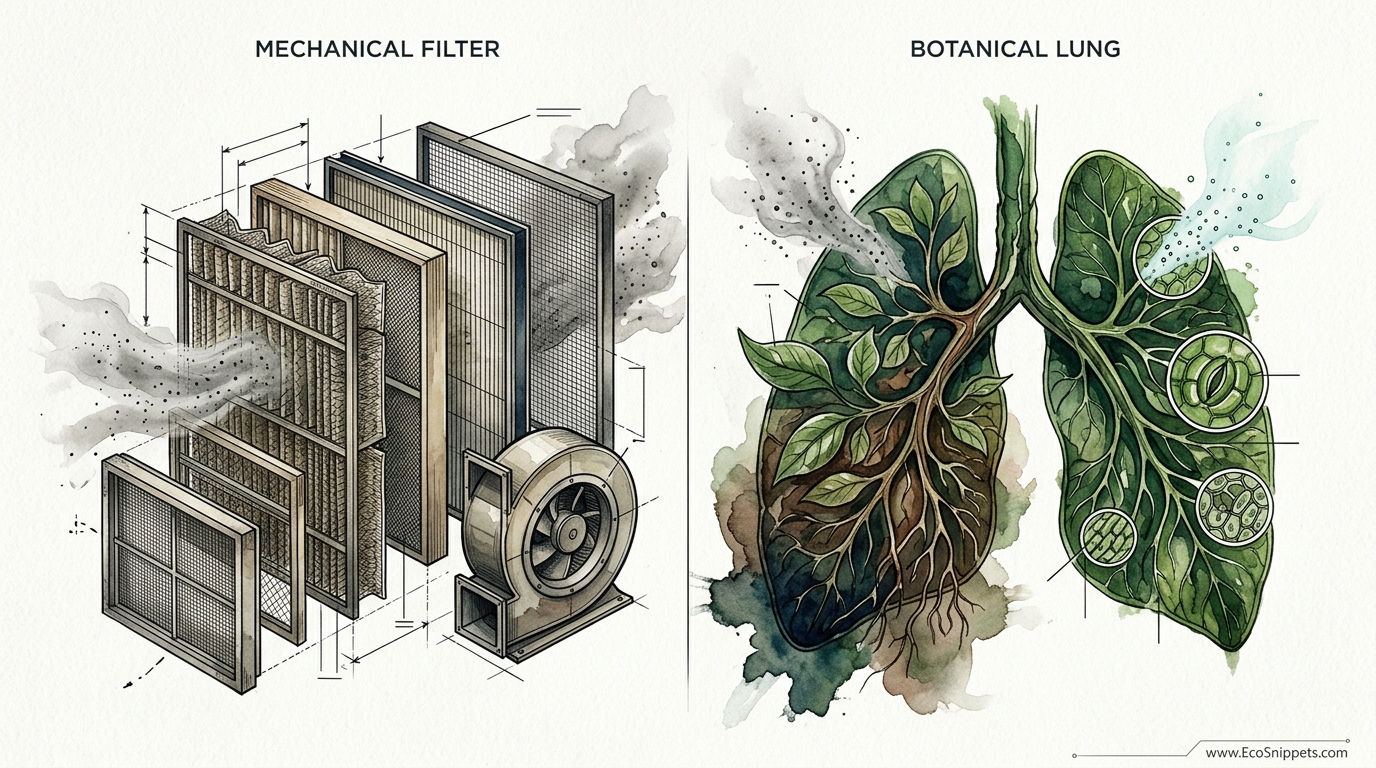
In the real world, these plants act as a 24/7 cleaning crew. They don’t just “sit there” looking green; they are machines that consume what we find toxic. Formaldehyde, a common VOC (Volatile Organic Compound) found in carpets and particleboard, is literally “eaten” by the plant and its soil. Think of a botanical lung as the ancestral counterpart to the HEPA filter. While a mechanical filter uses force to trap dust, a plant uses life to transform poison into food.
These systems are used everywhere from high-end biophilic offices to off-grid homesteads. They serve as a bridge between our modern, sterilized indoor lives and the rugged, self-sustaining outdoors. By understanding which species work best and how they interact with their environment, you can turn a decorative hobby into a functional piece of home infrastructure.
How the Botanical Lung Functions
To build an effective system, you must understand that the plant isn’t working alone. It is a partnership between the leaves, the roots, and the soil microbiome.
The Leaf Phase: Stomata and Absorption
The leaves are the first line of defense. Through tiny pores called stomata, plants “breathe” in gases. While they are looking for CO2 for photosynthesis, they also pull in VOCs like benzene and xylene. Once inside the leaf, these chemicals are broken down by enzymes or moved down to the roots. English Ivy and Peace Lilies are particularly skilled at this leaf-level scrub.
The Root Phase: Rhizosphere Magic
Surprisingly, most of the heavy lifting happens in the “rhizosphere”—the area of soil immediately surrounding the roots. Research shows that as a plant adapts to a specific toxin, the microbes in its soil begin to multiply and specialize in eating that specific chemical. This is why a botanical lung becomes more efficient over time. Unlike a mechanical filter that gets “full” and loses efficiency, a living system grows stronger the more it is exposed to its “food” (the pollutants).
The Transpiration Pull
As plants release water vapor into the air (transpiration), they create a tiny vacuum effect that pulls air down into the soil. This “pull” brings more pollutants in contact with the root-zone microbes. This is why high-transpiration plants like the Boston Fern are so valuable; they are effectively “pumping” the air through their own root system.
The Primary Players: Selecting Your Squad
Not all plants are created equal in the fight for clean air. If you want a functional botanical lung, you need a diverse team that covers different shifts and different toxins.
1. Snake Plant (Sansevieria trifasciata)
The “Pioneer” of the group. It is nearly impossible to kill and, unlike most plants, it performs Crassulacean Acid Metabolism (CAM). This means it opens its stomata and releases oxygen at night. It is the perfect “night shift” worker for bedrooms, scrubbing formaldehyde and nitrogen oxides while you sleep.
2. Spider Plant (Chlorophytum comosum)
If you have a home office with a printer or a garage with fuel smells, the Spider Plant is your specialist. It is remarkably effective at removing carbon monoxide and xylene. It also produces “pups” (offsets) rapidly, allowing you to scale your botanical lung for free.
3. Peace Lily (Spathiphyllum)
This is the “Generalist.” It removes all five of the major toxins tested by NASA (formaldehyde, benzene, trichloroethylene, xylene, and ammonia). It also acts as a natural humidity regulator. If the leaves droop, your air is likely too dry. It is a living hygrometer.
4. English Ivy (Hedera helix)
For those dealing with older homes or damp basements, English Ivy is the mold specialist. Studies have shown it can significantly reduce airborne mold spores. It is a vigorous climber, meaning it can provide a large “leaf surface area” in a small footprint if grown vertically.
Benefits of a Living Filtration System
Choosing a botanical lung over—or alongside—a mechanical filter offers benefits that a plastic box with a fan simply cannot match.
- Regulated Humidity: Plants don’t just clean the air; they humidify it. This keeps your mucous membranes moist, which is your body’s first defense against viruses and bacteria.
- Zero Noise and Power: A mechanical filter hums and draws wattage. A botanical lung is silent and runs on the stray sunlight hitting your windows.
- Mental Resilience: Living with greenery has been proven to lower cortisol levels and improve focus. Our ancestors didn’t just look at nature; they were part of it. Bringing that into the home restores a psychological balance that modern “sterile” living lacks.
- Self-Regulating: As air pollution levels rise, the microbes in the soil actually increase their metabolic rate to compensate. It is an “intelligent” system that adapts to your environment.
Challenges and Common Pitfalls
The most common mistake people make is treating a botanical lung like furniture. If the “filter” is dead, it isn’t cleaning the air.
Overwatering: This is the number one killer. Excess water suffocates the roots and encourages the “wrong” kind of microbes—the ones that cause rot instead of eating VOCs. Use the finger test: if the top inch of soil is wet, don’t water.
Dusty Leaves: If the leaves are covered in a thick layer of dust, the stomata are blocked. The plant can’t “breathe” in the pollutants. A quick wipe with a damp cloth every few weeks is the equivalent of “changing the filter” in a mechanical system.
Synthetic Fertilizers: Avoid heavy chemical fertilizers. These can “salt” the soil and kill the beneficial microbes in the rhizosphere that do the bulk of the air cleaning. Stick to organic compost or worm castings to feed the whole ecosystem, not just the plant.
Limitations of Botanical Air Purification
To maintain professional credibility, we must acknowledge the math. A single potted plant in a large, drafty room is not a filter; it’s a decoration.
In modern rooms with high air exchange rates (where the HVAC system swaps the air every hour), plants often cannot keep up with the volume. To achieve the same “clean air delivery rate” (CADR) as a high-end HEPA filter, you would need a high density of plants—roughly one large plant for every 100 square feet at a minimum.
Furthermore, plants do not “filter” large dust bunnies or pet hair as effectively as a mechanical fan. They are molecular cleaners, focusing on the invisible gases and microscopic spores. If you have heavy allergies to dander, you may still need a mechanical pre-filter to handle the “heavy lifting” of large particulates.
Mechanical Filter vs. Botanical Lung
How do these two approaches stack up in a real-world scenario?
| Factor | Mechanical Filter (HEPA) | Botanical Lung (Plants) |
|---|---|---|
| Primary Target | Dust, Dander, Pollen (Particulates) | VOCs, Chemicals, CO2 (Gases) |
| Maintenance | Monthly Filter Change / Costly | Watering / Pruning / Free |
| Energy Use | Constant Wattage / Noise | Zero (Uses Sunlight) |
| Longevity | 5–10 Years (Machine Life) | Indefinite (If Propagated) |
| Mental Impact | Industrial / Sterile | Soothing / Biophilic |
Practical Tips for Success
To maximize the efficiency of your natural indoor air purification plants, follow these “pioneer-grit” best practices:
- The “Cluster” Method: Don’t scatter plants individually. Group them together. This creates a “microclimate” with higher humidity and more concentrated microbial activity, making the air cleaning more effective.
- Airflow is Key: A plant in a stagnant corner can only clean the air immediately around it. Place your plants near natural air paths—near windows, doors, or hallways—so the “dirty” air is forced to pass by the leaves.
- Diversify the Species: Use a mix of “leafy” plants (like Pothos) for surface area and “succulent” types (like Aloe or Snake Plants) for their chemical resilience.
- Use Porous Pots: Terra cotta or unglazed ceramic pots allow some air to pass through the sides of the pot directly to the root zone, speeding up the microbial breakdown of toxins.
Advanced Considerations: The Active Biofilter
For those who want to take their botanical lung to the next level, consider “active biofiltration.” This is the process of using a small, low-wattage fan to pull air directly through the soil and root system of the plants.
Research from the John C. Stennis Space Center showed that an active biofilter can be up to 10 to 100 times more effective than a passive pot. You can build a DIY version by using a specialized planter that has a perforated bottom and a small fan in the base. By forcing air through the rhizosphere, you bypass the “speed limit” of natural transpiration and turn your plants into a high-octane air-scrubbing machine.
Example Scenario: The Toxic Home Office
Imagine a 150-square-foot home office. It has new laminate flooring (off-gassing formaldehyde), a laser printer (releasing ozone and particulates), and a human (exhaling CO2).
A “pioneer” approach to this room would involve:
1. **A large Peace Lily** in the corner to manage the humidity and general VOCs.
2. **Two Spider Plants** on top of the bookshelf or near the printer to handle the xylene and carbon monoxide.
3. **A Snake Plant** on the desk for a steady supply of oxygen and a resilient shield against the laminate fumes.
By placing these strategically, you create a living barrier that mitigates “Sick Building Syndrome” without ever needing to plug in an extra appliance.
Final Thoughts
Relying on a plastic machine for the very air we breathe is a relatively new, and somewhat fragile, human experiment. For thousands of years, we lived in a reciprocal relationship with the plant world. They take our waste (CO2 and chemicals) and turn it into the very thing we need to survive (Oxygen). Building a botanical lung is about more than just “air quality”; it is about reclaiming that ancestral connection and building a home that is a self-sustaining ecosystem.
Start small. Buy a Snake Plant or a Pothos and learn its language. Once you see the resilience of these living filters, you will find yourself adding more, room by room. You aren’t just decorating; you are installing a life-support system that will work for you as long as you give it a little water and a window to the sun.
Experiment with different groupings and watch how your indoor environment changes. You may find that you sleep deeper, focus longer, and breathe easier. In the end, nature’s technology is often far more sophisticated than anything we can build in a factory. It is time to let the plants do what they were born to do.
