How To Become More Self-Sufficient Without Starting a Full-Blown Farm…
Want to start preserving your harvest, making your own soap, or building a backyard root cellar — but not sure where to begin? “Homesteading Advice” gives you instant lifetime access to 35+ practical homesteading books on food preservation, veggie gardening, DIY natural cleaning products (save over $250 per year with this skill alone), brewing, off-grid energy, and a whole lot more…
Click Here To Check It Out Now!
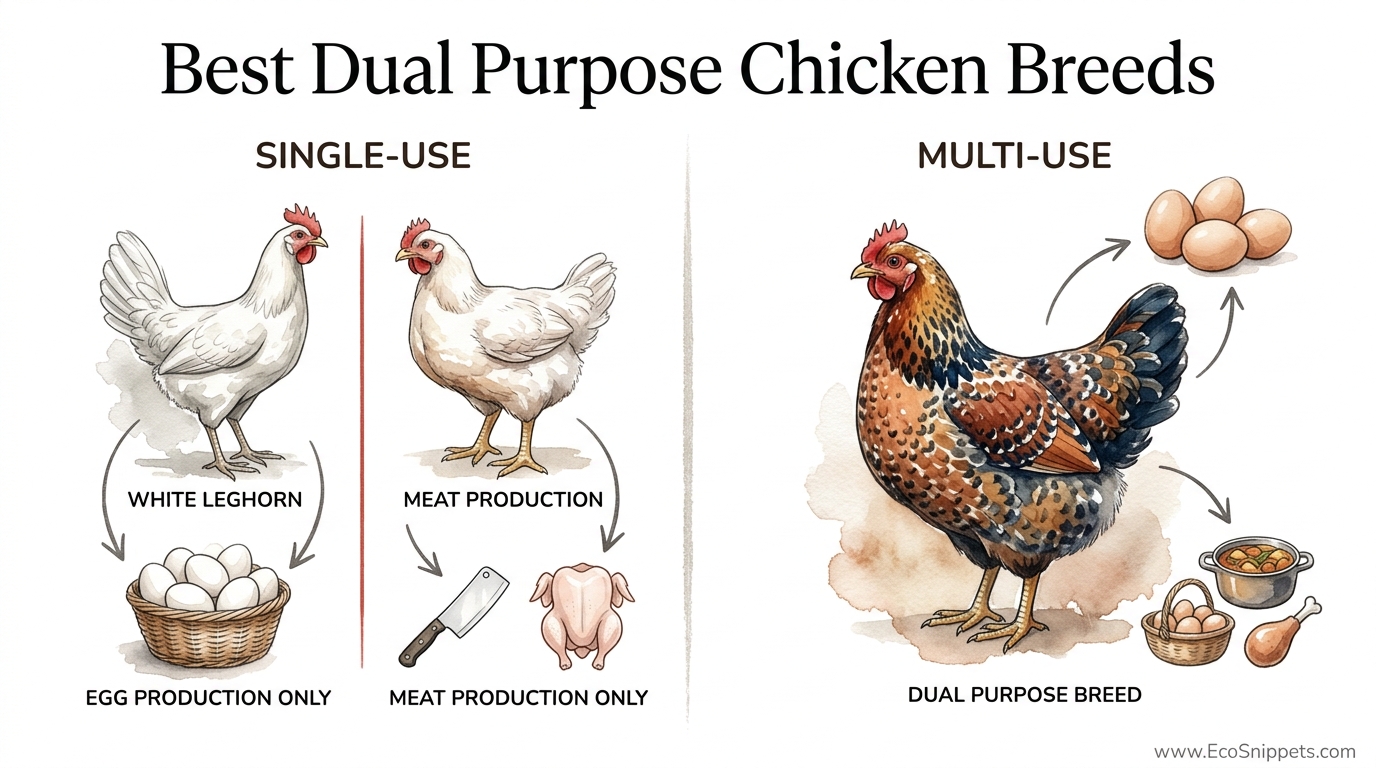
One of these birds is a seasonal expense; the other is a permanent foundation for your family’s food security. Industrial hybrids are designed for a factory, not a homestead. Heritage dual-purpose breeds give you eggs, meat, and the next generation of chicks all in one bird.
If you are looking at your coop today and seeing a collection of high-strung, single-purpose birds that require a steady supply of expensive store-bought feed just to stay alive, you aren’t building a homestead. You are managing a hobby that is entirely dependent on a fragile supply chain. Real food security starts when you stop buying replacements and start breeding resilience.
In the old days, a farmer didn’t have a “meat flock” and an “egg flock.” They had chickens. These birds were the multi-use tools of the barnyard. They were large enough to fill a roasting pan by Sunday and productive enough to keep the egg basket full through the week. Choosing the best dual-purpose chicken breeds is about more than just picking a feather color; it is about reclaiming the ancestral wisdom of a closed-loop system.
Best Dual Purpose Chicken Breeds
A dual-purpose chicken is exactly what it sounds like: a breed capable of producing both a respectable number of eggs and a significant amount of meat. Unlike the modern Cornish Cross, which is a genetic anomaly designed to grow so fast its legs often fail, or the Leghorn, which is a lean egg-machine with very little muscle, these heritage breeds offer a balanced middle ground. They exist to serve the small-scale farmer who values self-reliance over industrial efficiency.
In real-world situations, these birds are the backbone of the regenerative homestead. They are foragers by nature, hardwired to hunt for grubs, seeds, and kitchen scraps. This reduces your dependency on bagged grain. Because they are heritage breeds, they also possess the natural instincts required to survive in a pasture—predator awareness, broodiness (the desire to sit on and hatch eggs), and the grit to endure harsh winters or sweltering summers.
1. Rhode Island Red (Heritage)
The Heritage Rhode Island Red is perhaps the most famous American breed. Developed in the late 1800s, it was designed specifically for the backyard flock. These birds are legendary for their hardiness. A heritage hen can lay between 250 and 300 large brown eggs per year, even when the thermometer drops below zero. On the meat side, a mature rooster can reach 8 pounds, providing a substantial carcass with a deep, rich flavor that no grocery store bird can match.
2. Plymouth Rock (Barred Rock)
The Barred Rock is the “pioneer” bird. With its striking black-and-white striped plumage, it was once the most common chicken in America. They are exceptionally docile, making them ideal for families with children. A Plymouth Rock hen is a steady producer, giving you around 200 to 280 eggs annually. They are heavy birds, with roosters often tipping the scales at 9 pounds. Their skin is yellow, and their meat is succulent, making them a favorite for traditional roasting.
3. Black Australorp
Hailing from Australia, this breed holds world records for egg production. One hen famously laid 364 eggs in 365 days. While you shouldn’t expect that every day on the homestead, 250 to 300 eggs is common. Australorps have deep, wide bodies and a calm temperament. They are excellent foragers and handle heat better than many other heavy breeds. When it comes time to cull, a 6 to 8-pound rooster provides a very clean, high-quality carcass.
4. Buff Orpington
If temperament is your priority, the Buff Orpington is the “golden retriever” of the chicken world. These birds are massive, fluffy, and exceptionally gentle. Because of their heavy feathering, they are among the most cold-hardy breeds available. A hen will lay roughly 200 to 240 eggs a year. Their size is their greatest asset for meat, with roosters reaching up to 10 pounds. They are also prone to broodiness, which is a vital trait if you want your flock to self-replicate without an incubator.
5. Speckled Sussex
The Sussex is an ancient breed from England that was prized for its meat quality long before the industrial age. They are masterful foragers and very alert to their surroundings, which helps them survive in free-range environments. They lay about 200 to 250 light brown eggs per year. The Sussex has a wide, flat back and a deep breast, providing a “blocky” meat bird that is easy to dress out.
6. Silver Laced Wyandotte
Developed in New York, the Wyandotte was named after the indigenous people of the region. They are beautiful, but more importantly, they are functional. They possess a “rose comb,” which is low to the head and far less susceptible to frostbite than the “single comb” found on many other breeds. They are reliable winter layers, producing 200 to 260 eggs. A mature rooster weighs about 8.5 pounds, making them a solid choice for the table.
7. Delaware
The Delaware is a relatively “new” heritage breed, developed in the 1940s. It was actually the bird that the industrial complex tried to use for meat before the Cornish Cross was invented. They grow faster than most heritage breeds, reaching a respectable processing weight in about 16 to 20 weeks. They lay large, jumbo-sized brown eggs (about 200 per year) and are remarkably heat-tolerant, making them a favorite for southern homesteaders.
8. Buckeye
The Buckeye is the only American breed developed entirely by a woman, Nettie Metcalf, and it is built for the rugged Midwest. These birds are unique because they have a “pea comb” and a very thick, muscular build. They are famous for being “mousers”—they will actively hunt and eat mice in the barn. They lay about 180 to 240 eggs and provide a very dark, rich meat. They are arguably the “grittiest” bird on this list.
How It Works: Managing the Multi-Use Flock
Managing a dual-purpose flock requires a shift in perspective. You are no longer just collecting eggs; you are managing a population. This starts with the understanding that not every bird will live a long life. In a truly sustainable system, you keep the best layers for several years and harvest the excess roosters and older hens for the pot.
The cycle begins with hatching. Because heritage breeds can mate naturally, you can keep a rooster (or three) and let your broody hens do the work. Unlike an industrial hatchery that ships you 25 pullets every spring, you are “growing your own” foundation. This creates a closed loop where the only external inputs are high-quality feed and fresh water.
When the chicks hatch, they are raised together until they reach puberty (around 16-20 weeks). At this point, the young roosters (cockerels) will begin to challenge each other. This is your harvest window. While a Cornish Cross is ready in 8 weeks, a heritage bird takes 20. The wait is worth it, as the slower growth allows the meat to develop a complex flavor and firmer texture that industrial birds lack.
Benefits of Heritage Dual-Purpose Breeds
The primary benefit is true self-reliance. If the local feed store closes or a shipping delay stops the arrival of mail-order chicks, your homestead keeps running. Heritage birds are a genetic insurance policy for your family.
Another major advantage is resilience. These birds have been bred over centuries to live outdoors. They have stronger immune systems than industrial hybrids and are better at avoiding predators. A Barred Rock or a Sussex knows how to find cover when a hawk circles overhead; a Cornish Cross often doesn’t have the mobility to even try.
The nutritional profile of these birds is also superior. Because they spend their lives foraging for greens and insects, their eggs are higher in Omega-3 fatty acids and Vitamin D. The meat is leaner and contains more protein per ounce than the water-injected, mushy chicken found in plastic wrap at the grocery store.
Challenges and Common Mistakes
The most common mistake beginners make is expecting industrial speed. If you try to compare a heritage Rhode Island Red to a commercial broiler, you will be disappointed. Heritage birds grow at a natural pace. If you process them too early, you will have a tiny carcass; if you process them too late, the meat will be tough. The sweet spot is usually between 20 and 26 weeks.
Another challenge is managing the rooster-to-hen ratio. In a dual-purpose system, you will hatch roughly 50% males. You cannot keep all of them, or they will over-breed and stress your hens. You must have the “grit” to cull and process your excess roosters. If you aren’t prepared for the meat side of the dual-purpose equation, your system will eventually collapse under the weight of too many mouths to feed.
Lastly, feed management is critical. While these birds are excellent foragers, they still need high-quality protein to grow muscle and produce eggs. Many homesteaders make the mistake of feeding “scratch grain” (mostly corn) and expecting high performance. Scratch is a treat; a balanced layer or grower crumble is the foundation.
Limitations: When Dual-Purpose May Not Be Ideal
Dual-purpose breeds are not the right choice for those with extremely limited space. These birds are active and thrive when they have room to roam. If you are trying to raise chickens in a small “city coop” with no run, you might be better off with a smaller, more docile egg-specialist.
They are also not ideal for those who are strictly motivated by the lowest possible cost per pound. If you buy all your feed at the store, it is technically “cheaper” to buy a bag of frozen chicken than to raise a heritage bird for 6 months. Dual-purpose birds only become economically superior when you account for the value of high-quality, organic-standard food, the benefits of pest control in your garden, and the security of a self-replicating flock.
Finally, climate matters. While breeds like the Chantecler can handle extreme cold, they will struggle in a Texas summer. Conversely, a bird designed for the heat may stop laying the moment the first frost hits the ground. You must choose the breed that matches your specific environment.
Comparison: Single-Use vs. Multi-Use Systems
| Feature | Industrial Hybrid (Single-Use) | Heritage (Dual-Purpose) |
|---|---|---|
| Breeding | Cannot breed true; must buy new every year. | Naturally mates; self-sustaining flock. |
| Growth Rate | Fast (8 weeks to harvest). | Slow (16-24 weeks to harvest). |
| Egg Production | Extreme (300+ eggs) for 1-2 years. | Moderate (200-250 eggs) for 4-5 years. |
| Foraging Ability | Poor; relies 100% on commercial feed. | Excellent; hunts for much of its own food. |
| Flavor Profile | Bland, soft texture. | Rich, complex, firm “real chicken” taste. |
Practical Tips for Success
To make the most of your heritage birds, you must select for your goals. If you want more eggs, keep the hens that start laying earliest and lay most consistently through the winter. If you want more meat, keep the roosters that are the largest and most robust by week 16 to be your future sires.
Consider supplemental lighting in the winter if you need a year-round egg supply, but remember that heritage birds often benefit from a natural “rest” during the shortest days of the year. This rest period allows them to molt (replace their feathers) and ensures they stay productive for many years, rather than “burning out” like a production hybrid.
Always provide “grit” and oyster shells. Because these birds are heavy and produce large eggs, they have high calcium requirements. If they are foraging, they will find their own pebbles for their gizzard, but offering free-choice oyster shells ensures their eggshells stay strong and their bones remain healthy.
Advanced Considerations: Spiral Breeding
For the serious practitioner who wants to maintain a closed flock for decades without the negative effects of inbreeding, spiral breeding is the gold standard. This involves dividing your flock into three separate groups or “clans.” You then rotate your roosters in a specific pattern every season: Group A’s roosters move to Group B, Group B’s to Group C, and Group C’s to Group A.
This system maintains high genetic diversity while allowing you to keep all your own replacements. It requires careful record-keeping and separate pens during the breeding season, but it is the ultimate way to ensure that your “permanent foundation” never crumbles. It turns your chicken coop into a living genetic archive.
You should also look into the concept of terroir in chicken meat. The specific minerals in your soil and the types of plants your birds forage will change the flavor of the meat. A Buckeye raised on a woodland edge will taste different from a Delaware raised on clover pasture. This is a level of culinary depth that industrial agriculture has completely erased.
Example Scenario: The Self-Sufficient Family Flock
Imagine a family of four that wants to be entirely self-sufficient in eggs and meat. They start with a flock of 15 Black Australorp hens and 2 roosters. Throughout the year, they collect over 3,000 eggs—more than enough for daily breakfast and baking.
In the spring, they allow three of their best hens to go “broody” and hatch out 30 chicks. By late summer, they can identify the 15 young roosters. These roosters are moved to a separate pasture and “finished” on fermented grain and kitchen scraps for another 4 weeks. By autumn, the family harvests 15 roosters, providing roughly 60 to 75 pounds of high-quality meat for the freezer. They keep the best 5 young pullets to replace the older hens they cull for stewing. The cycle repeats, and they never have to buy another chick from a catalog.
Final Thoughts
Building a foundation for food security is not about finding the fastest or the cheapest solution; it is about finding the one that lasts. Heritage dual-purpose breeds are a bridge to a more resilient way of living. They require more patience and a deeper understanding of the natural cycles of life and death, but they reward the homesteader with independence.
When you choose a breed like the Rhode Island Red, the Orpington, or the Buckeye, you are participating in a tradition of stewardship that stretches back generations. These birds are not just livestock; they are partners in your survival. They turn the “seasonal expense” of industrial farming into a “permanent foundation” for your home.
Start by choosing one or two breeds that fit your climate and your family’s needs. Observe them, learn their habits, and respect their instincts. Over time, you will find that the rhythm of a dual-purpose flock is the rhythm of the homestead itself—steady, reliable, and deeply fulfilling.
