How To Become More Self-Sufficient Without Starting a Full-Blown Farm…
Want to start preserving your harvest, making your own soap, or building a backyard root cellar — but not sure where to begin? “Homesteading Advice” gives you instant lifetime access to 35+ practical homesteading books on food preservation, veggie gardening, DIY natural cleaning products (save over $250 per year with this skill alone), brewing, off-grid energy, and a whole lot more…
Click Here To Check It Out Now!
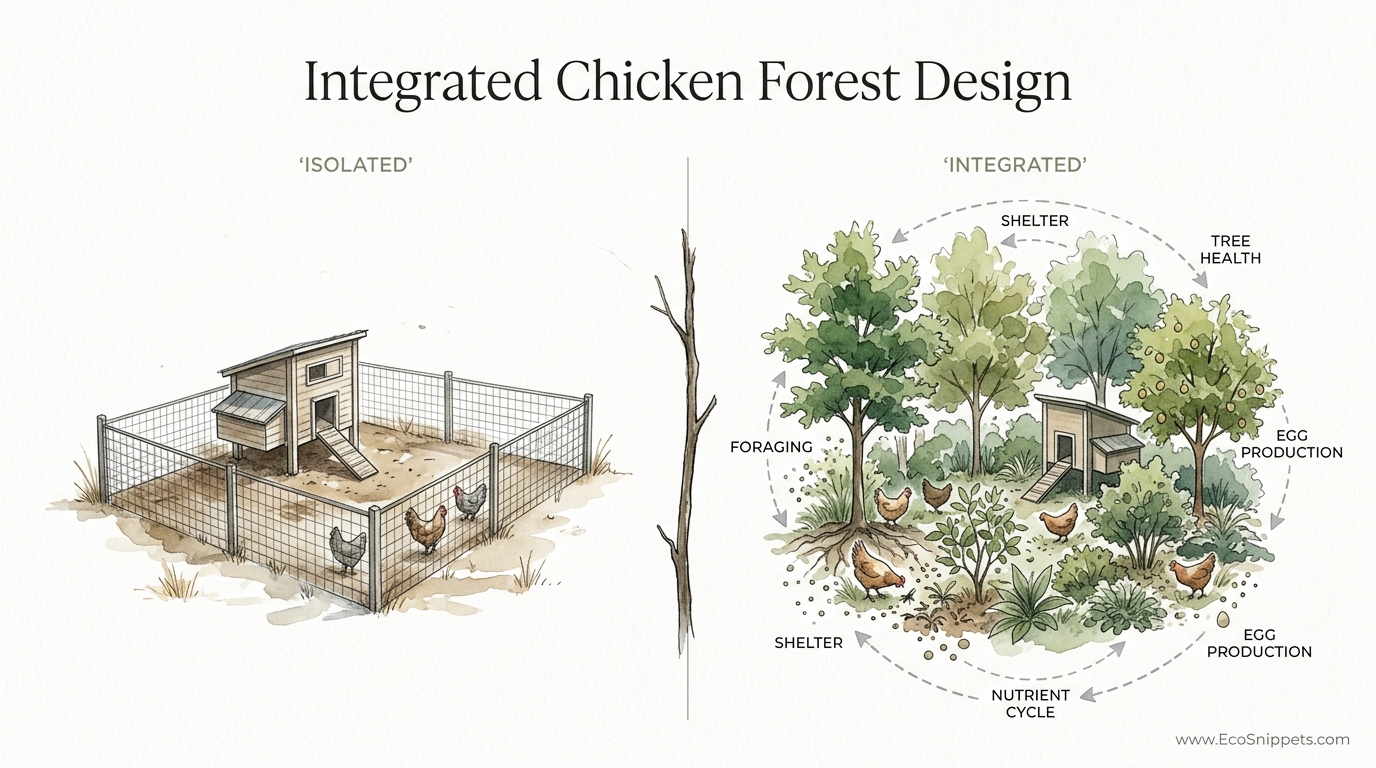
Why are you paying to feed chickens in a dirt box when your land could be a self-filling buffet? An isolated chicken run is a nutrient waste site. An integrated poultry forest is a self-fertilizing, high-protein food system. Switch from managing waste to managing an ecosystem.
The standard backyard coop is a relic of industrial thinking. We take a bird descended from the Red Junglefowl and shove it into a dry, barren square. Then we buy bags of grain and wonder why our input costs are so high. This approach ignores the ancestral wisdom of how chickens actually thrive. They are forest floor creatures, designed by nature to forage under the protection of a canopy.
When you integrate your flock into a living forest, you stop fighting nature and start partnering with it. You aren’t just raising birds anymore. You are managing a cycle of energy where every dropping becomes fertilizer and every fallen leaf becomes habitat for high-protein insects. This guide will show you how to build a system that feeds itself, heals the soil, and produces the healthiest eggs and meat you’ve ever seen.
Integrated Chicken Forest Design
Integrated chicken forest design is the practice of creating a multi-layered ecosystem where poultry and plants exist in a symbiotic relationship. Instead of a single-purpose garden or a single-purpose coop, you build a “food forest” specifically tailored to the needs of the birds. This system mimics the edge of a woodland, which is the most productive habitat on earth.
In this design, every element serves at least three functions. A mulberry tree provides shade for the birds, fruit for their diet, and falling leaves that build soil carbon. The chickens, in turn, provide pest control by eating larvae in the soil and provide nitrogen-rich manure to fuel the tree’s growth. This isn’t just a place for chickens to live; it is a biological machine designed for maximum yield with minimum external input.
Real-world applications of this concept often fall under the term silvopasture, which is the intentional integration of trees, forage, and livestock. While cattle farmers have used this for generations, applying it to poultry is the ultimate hack for the small-scale homesteader. It turns a “problem” like chicken manure into a “resource” for a high-value orchard or timber stand.
Visualizing this system is easy if you think about layers. Imagine a tall canopy of nut trees, a secondary layer of fruit trees, a shrub layer of berries and medicinal herbs, and a ground cover of nutrient-dense grasses and legumes. The chickens move through these layers, harvesting energy that would otherwise go to waste.
How to Build Your Self-Filling Buffet
Building an integrated poultry forest starts with observation. You must look at the sun patterns, the slope of your land, and the existing vegetation. The goal is to set up a system that requires more “brain-work” at the start so it requires less “back-work” later on.
First, secure your perimeter. A poultry forest is only as good as its defense. Use heavy-duty fencing that is buried at least six inches into the ground to prevent digging predators. Consider a “living fence” of thorny shrubs like hawthorn or honey locust to add an extra layer of security and forage.
Second, establish your water management. Use swales or contour trenches to catch rainwater and keep it on-site. Moisture is the lifeblood of a food forest. It ensures your plants stay productive and your soil stays soft enough for chickens to scratch for worms. Position your coop at the highest point of the system so that nutrient-laden runoff from the birds naturally flows downhill to fertilize the trees.
Third, plant in guilds. A guild is a group of plants that support each other. For example, a “chicken guild” might include a central mulberry tree (fruit/shade), surrounded by comfrey (mineral accumulator/medicinal forage), and clover (nitrogen fixer/high-protein ground cover). Plant these in clusters throughout the forest to create diverse foraging stations for your birds.
Fourth, implement a rotational system. Even a forest has its limits. If you leave chickens in one spot for too long, they will scratch the ground to bare dirt. Divide your forest into paddocks using movable electric fencing or permanent gates. This allows one area to rest and regrow while the birds “work” another section. This rest period is essential for breaking parasite cycles and ensuring your plants aren’t overgrazed.
The Seven Layers of Forage
The beauty of a forest is that it stacks production vertically. In a dirt run, you only have one layer: the ground. In a poultry forest, you have seven. Each layer provides a different type of nutrient at a different time of year.
The **Canopy Layer** consists of large trees like black walnut, oak, or chestnut. These provide high-calorie mast (nuts) in the fall and essential overhead protection from hawks. Chickens feel safer and are less stressed when they have a canopy above them.
The **Understory Layer** includes smaller trees like apples, pears, and especially mulberries. Mulberries are often called “chicken candy” because the birds will gorge themselves on the falling fruit, which reduces your need for supplemental grain during the summer months.
The **Shrub Layer** is where you plant berries like elderberry, raspberry, or Siberian pea shrub. The Siberian pea shrub is a legendary plant in poultry systems because it fixes nitrogen in the soil and produces small, high-protein seeds that chickens can harvest directly from the ground.
The **Herbaceous Layer** focuses on medicinal and nutrient-dense plants. Comfrey is a powerhouse here; its deep taproots pull minerals from the subsoil into its leaves, which the chickens eat for a nutritional boost. Include herbs like wormwood and oregano, which act as natural dewormers and antibiotics.
The **Ground Cover Layer** is the daily bread of the forest. Use a mix of white clover, alfalfa, and diverse grasses. Clover is particularly valuable because it is high in protein and attracts a wide variety of insects, another key protein source.
The **Rhizosphere (Root) Layer** involves tubers like sunchokes or sweet potatoes. While chickens might not dig deep for these, pigs could be rotated through later, or you can harvest them yourself, leaving the scraps for the birds.
The **Vertical Layer** uses fences for climbing plants like grapes or passionfruit. This turns a simple barrier into a productive forage wall.
Biological Cycles: Cultivating Insects and Microbes
The real “self-filling” part of the buffet isn’t just the plants; it’s the life that lives among them. A healthy poultry forest is an insect factory. Chickens are naturally insectivores, and their digestive systems are optimized for animal protein.
Encourage insect life by creating habitat. Leave “log stacks” or brush piles in the forest. These become breeding grounds for beetles, crickets, and woodlice. Every time a chicken flips a piece of bark, they are finding a high-protein snack that costs you nothing.
Maintain a “continuous compost” system within the forest. Instead of cleaning the coop and hauling the bedding away, dump it into the forest in specific zones. Add wood chips, straw, and kitchen scraps. This pile will quickly become a haven for worms and soldier fly larvae. The chickens will spend hours every day turning the pile for you, accelerating the composting process while feeding themselves.
Soil microbes play a silent but vital role. When chickens scratch and manure the soil, they are feeding a massive network of fungi and bacteria. These microbes break down organic matter and make nutrients available to your trees. A forest with a healthy microbial life will be more resilient to drought and pests, ensuring that the buffet never runs dry.
Benefits of the Integrated Approach
Switching to an integrated forest system offers measurable advantages that affect your bottom line and the health of your flock. The most immediate benefit is **reduced feed costs**. While it is difficult to achieve a 100% self-sustaining flock, many practitioners report reducing their grain bill by 30% to 50% once the forest is established.
The **quality of the product** is noticeably superior. Eggs from forest-raised chickens have deep orange yolks, thicker whites, and a higher concentration of Omega-3 fatty acids and vitamins. The meat is firmer and more flavorful, reflecting a diet that isn’t just corn and soy, but a complex mix of greens, fruits, and insects.
**Animal welfare** is another major win. Chickens in a forest environment exhibit their full range of natural behaviors. They are less prone to feather pecking, bullying, and stress-related illnesses. The trees provide a moderate microclimate, keeping the birds cooler in the summer and offering windbreaks in the winter.
From a **land management** perspective, the forest becomes a carbon sink. Rather than the ammonia-heavy runoff associated with dry lots, the forest absorbs nitrogen and stores carbon in the soil and the wood of the trees. You are building “natural capital” that appreciates every year as the trees grow.
Challenges and Common Mistakes
The biggest mistake beginners make is **introducing birds too early**. A flock of chickens can destroy a young sapling in an afternoon. They will scratch up the roots and peck the bark until the tree dies. You must protect your trees with wire cages or temporary fencing until they are large enough to withstand the “chicken pressure.” Usually, a tree needs 3-5 years of growth before it can be fully integrated.
Another pitfall is **improper stocking density**. Just because it’s a forest doesn’t mean it can support an infinite number of birds. If you have too many chickens in too small a space, they will outpace the forest’s ability to regenerate. You will end up with a “dirt box” with a few dying trees in it. Start with fewer birds than you think you need and observe how the land responds.
**Neglecting biosecurity** is a risk in a forest system. Because the birds are in a more “wild” environment, they may come into contact with wild birds or rodents that carry diseases like Avian Influenza. Maintaining a clean coop and monitoring the health of the flock is still necessary, even in a natural system.
Limitations: When This System May Not Work
While powerful, an integrated poultry forest isn’t a silver bullet for every situation. **Space** is the primary constraint. To truly mimic a forest ecosystem and allow for rotation, you generally need more room than a standard suburban lot provides. A quarter-acre is often the minimum to see the full benefits of plant stacking and nutrient cycling.
**Climate** also dictates what you can grow. A poultry forest in the desert will look very different from one in the Pacific Northwest. If you live in a region with extreme winters, your “buffet” will be closed for several months of the year, meaning you must still rely heavily on stored grain.
Furthermore, the **initial investment** in time and money is higher. Planting an orchard and installing professional fencing is more expensive than buying a pre-made coop and a bag of feed. You are playing a long game. If you need a “quick fix” for your feed bill, the forest system might frustrate you with its slow pace of development.
Integrated vs. Isolated: A Comparison
| Feature | Isolated (Standard Run) | Integrated (Poultry Forest) |
|---|---|---|
| Feed Dependence | 90-100% Purchased Grain | 50-70% Purchased Grain |
| Waste Management | Manual cleaning/disposal | Automated via nutrient cycling |
| Bird Health | Higher stress/boredom | Lower stress/Natural behavior |
| Land Value | Often degraded soil | Regenerative soil building |
| Maintenance | High (cleaning) | Medium (pruning/rotation) |
Practical Tips for Immediate Success
If you are ready to start, don’t try to plant the whole forest at once. Start with **Zone 1**, the area closest to the coop. Focus on getting your ground cover and a few key “fast-food” trees like mulberries established first.
Use **mulch heavily**. Wood chips are a chicken’s best friend. They suppress weeds, retain moisture for your trees, and provide a habitat for the insects your birds crave. A six-inch layer of wood chips in your “scratch zones” will keep the mud down and the protein up.
Select **hardy, foraging breeds**. Not all chickens are built for the forest. Modern industrial hybrids (like Cornish Cross) are often too lazy or physically limited to forage effectively. Look for “heritage” breeds or “landrace” birds that have retained their survival instincts. Breeds like the Delaware, Chantecler, or Icelandics are excellent choices for a forest system.
Don’t forget the **medicinal plants**. Planting a “first-aid kit” in the forest allows the birds to self-medicate. Garlic, sage, and mint can help with internal parasites and respiratory health. Watch your birds; they will often seek out exactly what their bodies need if the variety is available.
Advanced Considerations: Scaling and Optimization
For the serious practitioner, optimizing the forest means looking at **succession**. Your forest will change over 10, 20, and 50 years. Design with the “climax” forest in mind, but plant fast-growing “nanny trees” like black locust or tagasaste to provide immediate shade and nitrogen while your slow-growing oaks and walnuts take hold.
Consider **multi-species integration**. Ducks and geese can often be rotated through the same forest. Ducks are excellent for slug and snail control, while geese act as “lawnmowers” for the grassier areas. However, be mindful that different species have different impacts on the land; geese can be hard on young bark, while ducks need access to water which can create muddy spots.
**Data-driven management** can take your system to the next level. Track your feed inputs against your egg or meat yields. Observe which plants are being eaten first and which are being ignored. This feedback loop allows you to “tune” your forest over time, replacing underperforming plants with high-value ones.
If you have the space, look into **paddock shift systems**. Using a central coop with “spokes” of different forest paddocks allows for the most efficient rotation. You can time the shifts based on the life cycles of specific pests, like the plum curculio, ensuring the chickens are in the orchard exactly when the larvae are dropping to the ground.
Scenario: The Quarter-Acre “Buffer” Forest
Let’s look at a practical example. Imagine a homesteader with a quarter-acre (about 10,000 square feet) dedicated to 25 laying hens.
They begin by planting 10 mulberry trees and 5 apple trees in a grid. Between the trees, they plant “forage strips” of alfalfa and clover. Along the fence line, they plant a dense hedge of elderberries and Rugosa roses. In the center, they build a mobile “chicken tractor” coop that they move every two weeks.
In the first year, they keep the chickens in a small portable run to protect the young trees. In year three, they allow the birds limited access to the whole area. By year five, the canopy is closed. The mulberries drop fruit for eight weeks in the summer, during which the homesteader stops feeding grain entirely. The chickens are healthy, the soil is dark and rich, and the “waste” from the birds has fueled a harvest of 200 pounds of apples and 50 pounds of elderberries for the family.
This scenario isn’t a dream; it’s a calculated design. It turns a liability (feeding 25 hens) into an asset (a productive orchard and self-maintaining flock).
Final Thoughts
The integrated poultry forest is more than just a clever way to raise chickens. It is a return to a way of living that respects the cycles of the earth. It acknowledges that a chicken is not a machine to be fueled with grain, but a living creature that belongs in a complex web of life. When we provide that environment, the birds reward us with health, productivity, and a sense of harmony that no industrial system can match.
Transitioning from a dirt box to a forest buffet takes time and grit. You will plant trees that die, you will miscalculate your stocking rates, and you will spend many afternoons observing the quiet drama of the forest floor. But every tree that takes root and every orange yolk you crack into a pan is a testament to the power of integration over isolation.
Start small, observe closely, and trust the wisdom of the forest. Your land has the potential to feed your flock and your family simultaneously. All it needs is for you to stop managing waste and start managing an ecosystem. Experiment with a few guilds this season, and watch as your “dirt box” begins to transform into a thriving, self-filling buffet.
