How To Become More Self-Sufficient Without Starting a Full-Blown Farm…
Want to start preserving your harvest, making your own soap, or building a backyard root cellar — but not sure where to begin? “Homesteading Advice” gives you instant lifetime access to 35+ practical homesteading books on food preservation, veggie gardening, DIY natural cleaning products (save over $250 per year with this skill alone), brewing, off-grid energy, and a whole lot more…
Click Here To Check It Out Now!
Nature doesn’t distribute heat evenly—here is how to hijack the sun to extend your growing season by months. Most preppers focus on the seeds, but the smartest ones focus on the site. By simply changing the shape of your garden and adding thermal mass like stone or water, you can create a microclimate that stays 10 degrees warmer than the rest of your yard. No electricity, no plastic covers—just the physics of permaculture design.
The modern gardener often fights against the sky, relying on thin plastic sheets and expensive heating systems to keep a few fragile tomatoes alive through October. Our ancestors did not have that luxury. They understood that the earth itself is a massive battery, and they knew how to charge it. They observed where the snow melted first in the spring and where the frost lingered longest in the fall. This wisdom allowed them to harvest fresh greens when their neighbors were staring at frozen dirt.
Creating a microclimate is an act of defiance against your local hardiness zone. It is about identifying the “sun-traps” and “cold sinks” on your property and then bending them to your will. When you master the art of thermal mass, you are no longer at the total mercy of the weather report. You are building a sanctuary where the rules of the season are rewritten by the stones and water you place with intention.
Protecting Plants From Frost With Thermal Mass
Thermal mass is the ability of a material to absorb, store, and eventually release heat energy. In the context of a garden, it acts as a thermal flywheel, smoothing out the jagged peaks and valleys of daily temperature swings. During the day, dense objects like stone, brick, or water barrels soak up the sun’s radiant energy. As the sun sets and the air temperature plummets, these objects begin to radiate that stored heat back into the surrounding air and soil.
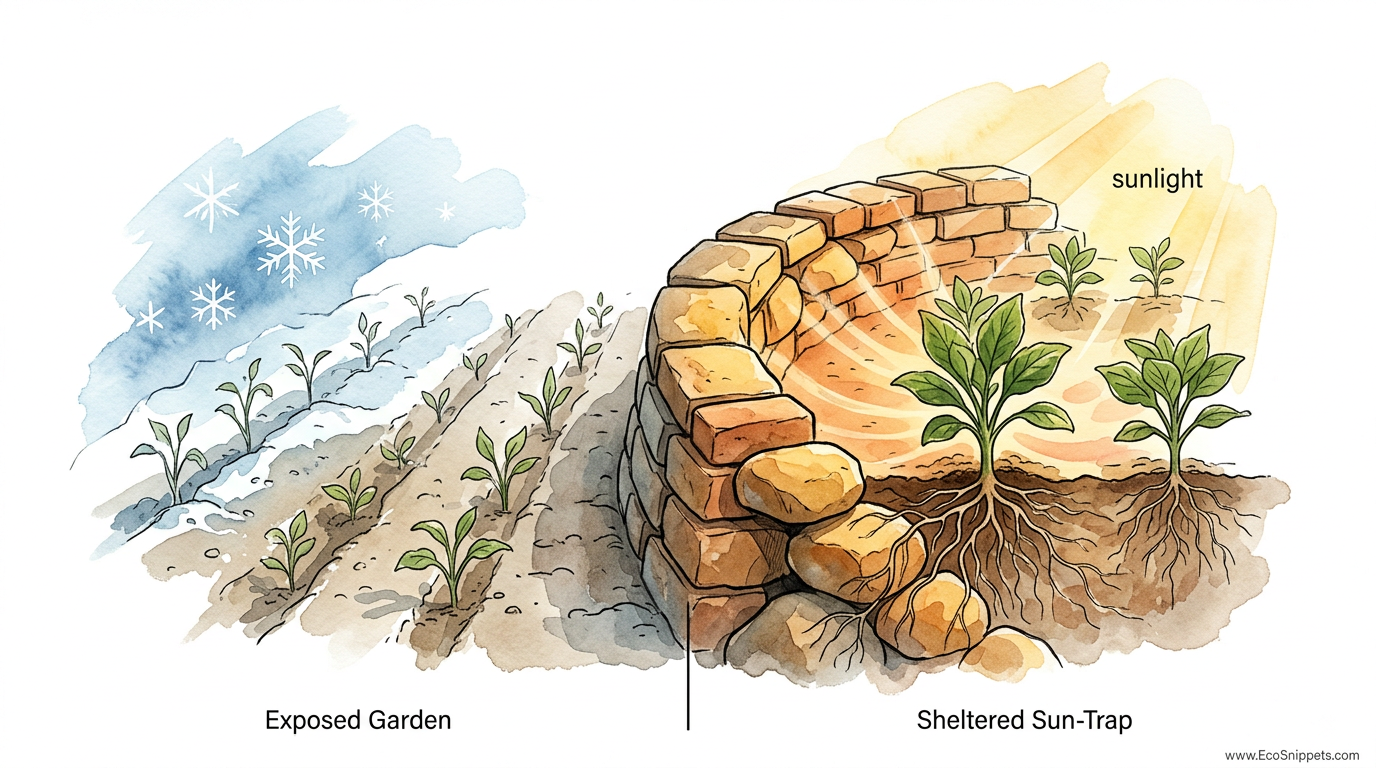
This process is what prevents a light frost from turning your garden into a graveyard of black, shriveled leaves. While the ambient air might dip to 30 degrees Fahrenheit, the air immediately surrounding a massive stone wall or a series of water barrels can remain significantly warmer. This small buffer, often between 5 and 10 degrees, is frequently the difference between a total crop failure and a continued harvest.
Real-world applications of thermal mass are everywhere if you know how to look. Urban areas are famously warmer than the surrounding countryside because of the massive amount of concrete and asphalt—this is known as the “urban heat island” effect. In a garden, we replicate this on a smaller, more beneficial scale. We use stone borders, heavy masonry walls, or even deep ponds to act as our heat sinks. These materials do not create heat; they simply manage the heat that the sun provides for free every single day.
Designing the Ultimate Sun-Trap
The most effective way to utilize thermal mass is to pair it with a specific shape known as a sun-trap. This is typically a horseshoe or U-shaped design that faces the equator—south in the Northern Hemisphere and north in the Southern Hemisphere. The objective is to capture as much solar radiation as possible while simultaneously shielding the plants from the dominant cold winds.
The back of the horseshoe should be composed of your densest materials. This might be a tall stone wall, a steep earthen berm, or a thick, evergreen hedge. These structures serve two purposes: they block the wind and they provide the surface area needed to absorb heat. As the sun moves across the sky, its rays hit the interior of this U-shape, and the heat becomes trapped. Because the wind is blocked, that warm air doesn’t blow away, creating a pocket of still, warm air that can be noticeably different from the rest of the property.
Orientation is the most critical factor in this design. A sun-trap that faces the wrong direction will actually create a “cold sink,” where shadows linger and frost settles. You must observe the path of the sun during the winter months, when it sits lowest on the horizon. Your sun-trap should be positioned so that the interior receives maximum light during those precious few hours of winter daylight. This ensures that your thermal batteries are fully charged before the long, cold night begins.
Material Selection and Specific Heat Capacity
Not all materials are created equal when it comes to storing heat. Scientists use a measurement called “Specific Heat Capacity” to determine how much energy a substance can hold. Water is the undisputed king of thermal mass in the garden. It has a specific heat capacity that is significantly higher than stone, brick, or concrete. One gallon of water can hold roughly two and a half times more heat than a similar volume of concrete.
Stone and brick are still excellent choices because of their density and durability. Granite and basalt are particularly effective because they are dark and heavy, allowing them to absorb more light and hold it for longer periods. Earth itself, especially if it is moist, serves as a decent thermal battery. Dry soil acts more like an insulator, while damp soil acts as a conductor and storage medium. This is why a well-watered garden often survives a frost better than a dry one.
Windbreaks and Shelterbelts
A sun-trap is only as good as its ability to block the wind. Cold wind is the enemy of thermal mass because it carries away the warm air that your stones are trying to radiate. High-speed gusts can “strip” the heat off a surface faster than it can be replaced. Therefore, the outer perimeter of your sun-trap should feature some form of windbreak.
Living windbreaks, such as hedges or rows of trees, are often superior to solid walls because they “filter” the wind rather than just blocking it. A solid wall can create turbulent eddies on the leeward side, which can actually damage plants. A dense hedge of hazel, hawthorn, or yew slows the wind down to a gentle breeze, preserving the warmth of the microclimate while still allowing for necessary air circulation. This prevents the air from becoming stagnant, which can lead to fungal issues and mold.
The Measurable Benefits of Site Hacking
Implementing these designs provides a level of security that no store-bought gadget can match. The most immediate benefit is the extension of your growing season. In many temperate climates, a well-designed sun-trap can add three to four weeks to the beginning of the spring and another month to the end of the fall. This allows you to grow long-season crops like sweet potatoes or certain varieties of corn that would otherwise never ripen in your zone.
Higher yields are a natural byproduct of a warmer microclimate. Plants that are not stressed by cold nights can put more energy into fruit production and root development. You will find that peppers grow larger, tomatoes ripen faster, and even hardy greens like kale will stay sweet and tender much longer into the winter. The thermal stability provided by mass also reduces “transplant shock” in the spring, as the soil temperature remains more consistent throughout the night.
Resilience is perhaps the most important benefit for the self-reliant practitioner. When the power goes out or the supply chain breaks, you cannot rely on electric heaters to save your food supply. A garden designed with thermal mass is a passive system. It requires no maintenance, no fuel, and no repairs. It is a permanent upgrade to your land that will continue to provide a warmer, more productive environment for decades to come.
Challenges and Common Pitfalls
The most frequent mistake gardeners make is ignoring the issue of summer overheating. A design that is perfect for trapping heat in February can become a blast furnace in July. Without proper ventilation or deciduous shading, a sun-trap can actually cook your plants during a summer heatwave. The solution is to use “living shade,” such as planting a tall, leafy annual or a deciduous tree on the sunward side that provides shade in the summer but drops its leaves to let the sun through in the winter.
Poor drainage is another silent killer of sun-traps. Many people build their traps in low-lying areas of their property because they are naturally sheltered. However, cold air is denser than warm air and flows downhill like water, settling in the lowest spots. This is known as a “frost pocket.” If your sun-trap is located at the bottom of a hill without a way for the cold air to “drain” out, you will actually be creating a colder environment rather than a warmer one. Always ensure there is a gap at the lowest point of your design to allow cold air to flow away.
Neglecting the sheer weight and labor involved in moving thermal mass is a practical challenge. A single 55-gallon drum of water weighs over 450 pounds. A stone wall requires hundreds of individual rocks and significant physical effort to construct. Many beginners start projects that are too ambitious and abandon them halfway through. It is better to start small, perhaps with a single “thermal niche” for one or two prized plants, and expand your design as you see the results.
When Thermal Mass May Not Be Ideal
Thermal mass is a stabilizer, not a magic heater. It works best in climates that have a significant “diurnal swing”—meaning it is sunny and warm during the day but cold at night. In places with persistent cloud cover or “socks-in” fog that lasts for weeks, the thermal mass never has the opportunity to “charge” from the sun. In these environments, you are better off focusing on insulation and greenhouses rather than heavy stone or water features.
Extremely cold, sub-zero climates also push the limits of what passive thermal mass can achieve. While a stone wall might keep a garden 10 degrees warmer, that doesn’t help much if the ambient temperature is minus 20 degrees. In these “deep freeze” regions, thermal mass must be integrated with more intensive structures, such as “sun-trap pits” or walipinis (underground greenhouses), where the earth’s internal temperature of 50 degrees provides the baseline warmth.
Coastal regions with high humidity often find that thermal mass is less effective because the moist air itself already acts as a stabilizer. If your local climate doesn’t experience sharp temperature drops at night, the addition of more mass will have a negligible effect. Similarly, if you have a very small, shaded yard with no direct southern exposure, you lack the fuel (sunlight) to make the battery (mass) work.
Comparing Passive Heat Sources
Selecting the right material for your site depends on your budget, available space, and the specific needs of your plants. Use the following table to understand the trade-offs between the most common thermal mass materials.
| Material | Heat Storage Capacity | Cost | Longevity | Primary Drawback |
|---|---|---|---|---|
| Water (Barrels/Ponds) | Highest (Best efficiency) | Low (if using salvaged drums) | Moderate (plastic degrades) | Risk of freezing and bursting |
| Stone / Boulders | Moderate | High (if purchased) | Infinite | Extremely heavy to move |
| Brick / Concrete | Moderate | Moderate | Very High | Often high “embodied energy” |
| Compacted Earth (Berms) | Low to Moderate | Very Low | High (if stabilized) | Takes up a large footprint |
Practical Tips for Immediate Results
Start by identifying the warmest spots on your property. These are usually near the foundation of your house or against a south-facing fence. You can enhance these spots today by placing dark-colored objects around your most sensitive plants. A simple black five-gallon bucket filled with water and placed on the north side of a pepper plant will act as a miniature heat sink, protecting the roots and stems from early autumn chills.
Paint your thermal mass objects black to maximize absorption. A white or light-colored stone will reflect a large portion of the sun’s energy back into space. A dark gray or black stone, however, will soak up that energy like a sponge. This is a simple, effective way to increase the efficiency of your system by up to 35 percent without adding any extra material.
Place your thermal mass within one to three feet of your plants. The radiant heat from a stone wall or water barrel drops off quickly as you move away from it. To get the maximum benefit, your vegetables should be practically hugging the heat source. This also creates a wind-still zone where the air is trapped between the plant and the mass, further insulating the crop.
Advanced Considerations: The Pineapple Pit
If you want to push the boundaries of what is possible, look to the “pineapple pits” of 18th-century Europe. Gardeners in cold, damp England were able to grow tropical pineapples by using a combination of thermal mass and active biological heating. They dug deep trenches and filled the outer chambers with fresh horse manure. As the manure decomposed, it generated significant heat, which was conducted through hollow brick walls into the central growing area.
This technique, combined with glass glazing to trap the sun’s rays, created a tropical microclimate in the middle of a British winter. While you may not need to grow pineapples, the principle of using decomposing organic matter—like a large compost pile—as a secondary heat source for your sun-trap is a powerful strategy. Placing a hot compost bin inside the U-shape of your sun-trap provides a “baseload” of heat that functions even on cloudy days when the sun isn’t shining.
Integrating thermal mass into a greenhouse is the ultimate expression of this science. Instead of using a propane heater, line the northern wall of your greenhouse with black-painted water barrels. This creates a “thermal bank” that absorbs the excessive daytime heat of the greenhouse—preventing your plants from wilting—and releases it at night to prevent freezing. This “passive solar” approach is the gold standard for sustainable, year-round food production.
Real-World Scenario: The Late Season Tomato
Consider a gardener in Zone 5 who typically loses their tomato plants to the first frost in late September. By building a simple horseshoe-shaped wall of dry-stacked stone around their tomato patch and painting the interior of the wall a dark color, they can fundamentally change the outcome. On a clear September night when the temperature hits 28 degrees, the stones, which have been soaking in the sun all day, will begin to breathe out heat.
The air inside that stone horseshoe might stay at 35 degrees, well above the freezing point. The tomato plants continue to photosynthesize and ripen fruit. While the rest of the neighborhood is pulling up dead vines, this gardener is still harvesting fresh, sun-warmed tomatoes in mid-October. This isn’t a miracle; it is the calculated application of permaculture physics. It is the result of working with the landscape rather than trying to overpower it.
Final Thoughts
Mastering the use of thermal mass and sun-traps is about more than just gardening; it is about developing a deep, ancestral connection to your land. It requires you to stop looking at your yard as a flat, uniform space and start seeing it as a complex landscape of energy flows. You become a steward of sunlight, a keeper of warmth, and a designer of resilience.
The beauty of these systems is their permanence. Once you have moved the stones and placed the water barrels, the sun does the rest of the work. You are no longer tethered to a power grid or a wallet full of cash to keep your garden thriving. You have built a biological engine that runs on the most abundant resource in the solar system.
Begin by observing. Watch where the frost melts. Feel the warmth of a sun-baked rock in the evening. Take these small lessons from nature and apply them with the grit of a pioneer. Your future self, standing in a warm, productive garden while the rest of the world is shivering, will thank you for the effort you put in today.
