How To Become More Self-Sufficient Without Starting a Full-Blown Farm…
Want to start preserving your harvest, making your own soap, or building a backyard root cellar — but not sure where to begin? “Homesteading Advice” gives you instant lifetime access to 35+ practical homesteading books on food preservation, veggie gardening, DIY natural cleaning products (save over $250 per year with this skill alone), brewing, off-grid energy, and a whole lot more…
Click Here To Check It Out Now!
The Ancient Art of Pollarding: Turning Trees Into a Perennial Factory
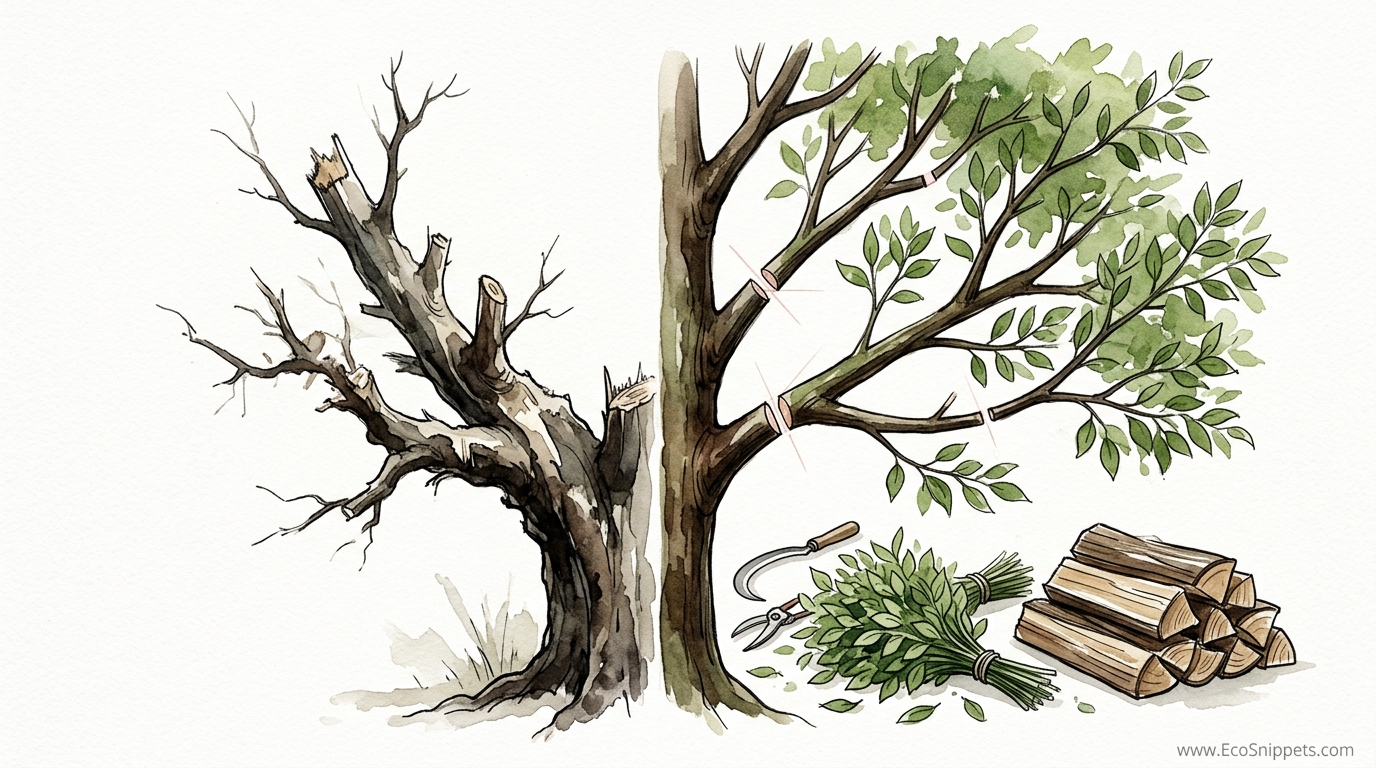
Most people ‘top’ a tree to kill its height, but the pros ‘pollard’ to create an infinite supply of free lumber. Tree topping is a crime against nature that leads to rot and disease. But the ancient art of pollarding uses strategic cuts to encourage the tree to produce ‘harvestable’ poles. It’s the difference between a dying eyesore and a perennial factory for garden stakes, firewood, and animal fodder.
Our ancestors didn’t look at a forest and see only timber to be felled. They saw a working landscape that could provide for generations without ever losing a single trunk. This was the wisdom of the commoner—a way to extract the lifeblood of the woods while keeping the heart of the forest beating. Today, we call it agroforestry, but to the pioneer with a sharp axe and a hungry herd, it was simply survival.
Learning to pollard is about shifting your perspective from consumption to stewardship. It is the practice of working with a tree’s natural urge to regrow, turning that vigor into a predictable, cyclical harvest. Whether you are looking for high-protein feed for your goats or a steady supply of seasoned firewood, the pollard is your most reliable ally on the homestead.
Pruning Trees For Fodder And Fuel
Pollarding is a traditional management system where the upper branches of a tree are removed back to the main trunk or a few scaffold limbs. This encourages a dense head of new, straight shoots to emerge from the cut points. Unlike felling, which ends the tree’s life, pollarding resets the clock, keeping the tree in a state of perpetual youth.
This practice traces its roots back to the Roman Empire and flourished across Medieval Europe. Historically, land was divided between the wealthy who owned the tall timber and the commoners who held the “right of estover.” This right allowed ordinary people to lop branches for fuel and fodder. By cutting the tree above the “browse line”—usually six to ten feet up—farmers ensured that the succulent new growth remained out of reach from hungry cattle and deer.
The result of decades or centuries of this treatment is a tree with a thick, gnarly “knuckle” or “bolling” at the top of the trunk. This swelling becomes a powerhouse of energy, storing carbohydrates and dormant buds. Every few years, the pioneer returns to harvest the “crop” of poles, leaving the knuckle intact to sprout again. It is a system of sustainable extraction that turns a single tree into a lifetime resource.
In the modern context, pollarding serves as a bridge between wild nature and the controlled homestead. It allows you to grow large-species trees like Willow, Ash, or Oak in confined spaces. Instead of letting a tree become a liability that might crush a fence or house, you keep it small, productive, and structurally sound.
The Mechanics of the Pollard: How to Do It
Starting a pollard requires patience and a plan. You cannot simply walk up to a fifty-year-old Oak and lop off its head; that is topping, and it will likely kill the tree. Successful pollarding begins when the tree is young, typically between three and ten years of age, once it has reached the height where you want the harvest to occur.
The first step is selecting your “framework.” Identify three to five main branches that will form the structural skeleton of your pollard. In late winter or very early spring, while the tree is still dormant, cut these branches back to the desired height. These first cuts are the most critical, as they determine where the future knuckles will form.
Use sharp, sterilized tools to ensure clean wounds. For smaller branches, a pair of bypass loppers works well, but larger limbs require a pruning saw. Always use the “three-cut method” to prevent the bark from stripping down the trunk. Make an undercut a few inches from the final point, followed by a top cut further out to remove the weight, and finally, a clean finishing cut just outside the branch collar.
Once the initial framework is established, the tree will respond with a flush of “epicormic” growth. These are the long, straight shoots that you will eventually harvest. Depending on your goals—fodder, garden stakes, or firewood—you will let these shoots grow for two to fifteen years before cutting them all back to the same knuckle.
Consistency is the secret to a healthy pollard. Once you establish a cutting cycle, stick to it. Every time you return to the tree, you must cut the new growth back to within a fraction of an inch of the previous cut. Never cut into the knuckle itself. The knuckle is the tree’s defensive shield, filled with callus tissue that prevents rot from entering the main trunk.
The Harvest: Practical Benefits of the Perpetual Factory
The most immediate benefit of a pollard is the production of “tree hay” or fodder. In times of drought when pasture grasses turn brown and brittle, trees remain green. Their deep root systems tap into subsoil moisture and minerals that grasses cannot reach. Leaves from Willow, Ash, and Mulberry are packed with protein, minerals, and tannins that improve livestock health and digestion.
Harvesting for fodder typically happens in mid-summer when the nutritional value is highest. These leafy branches can be fed fresh to goats, sheep, and cattle, or dried in “sheaves” to be stored for winter. This “air meadow” provides a high-quality supplement that can reduce your reliance on expensive commercial grain and hay.
For the woodworker and gardener, pollarding provides a steady stream of straight, uniform poles. Willow and Hazel shoots are perfect for weaving baskets, hurdles, and “living” fences. Ash poles are prized for tool handles and garden stakes because of their strength and flexibility. Because you are harvesting juvenile wood, it is often easier to work and split than mature timber.
Firewood production is another major advantage. By managing a rotation of pollards, a homesteader can harvest small-diameter logs that dry much faster than split cordwood. These 3-to-5-inch diameter limbs are the perfect size for “rocket mass heaters” or small wood stoves. Because the tree remains standing, you never have to deal with the heavy labor of felling, skidding, and bucking massive trunks.
Beyond the physical harvest, pollarding keeps trees alive longer. Some of the oldest trees in Europe are ancient pollards that have outlived their unmanaged cousins by centuries. The regular removal of weight reduces the risk of wind-throw and limb failure during storms. It keeps the tree in a vigorous, “juvenile” state that is more resilient to pests and diseases.
Challenges and Common Mistakes
The greatest danger to a pollard is the “one and done” mentality. Many people treat pollarding as a way to fix a tree that has grown too large, only to forget about it for a decade. If the new shoots are allowed to grow too large, they become weakly attached to the knuckle. These “over-mature” limbs can break off in high winds, tearing the knuckle and leaving the tree vulnerable to rot.
Another frequent error is pollarding at the wrong time of year. Cutting in the autumn can be disastrous. Fungal spores are most active in the fall, and the tree is entering a period where it cannot actively seal over its wounds. Always aim for the window of late winter, before the sap begins to flow. The only exception is if you are harvesting summer fodder, which should only be done on healthy, established trees.
Species selection is often overlooked. Not every tree can handle the stress of heavy pruning. Conifers, with very few exceptions like Yew, do not have the ability to sprout from old wood. If you cut the top off a Pine or Spruce, you have effectively killed it or permanently stunted it. Stick to deciduous hardwoods that are known “resprouters” like Willow, Poplar, Linden, and Oak.
Neglecting tool hygiene can spread disease across your entire homestead. If you move from a diseased tree to a healthy one without cleaning your saw, you are inviting disaster. A simple spray of 70% isopropyl alcohol or a 10% bleach solution between trees is enough to keep your “factory” running cleanly.
Limitations: When to Put the Saw Away
Pollarding is a labor-intensive commitment. It is not a “low-maintenance” landscaping choice. If you are not prepared to return to the tree every few years for the rest of its life, you should not start the process. An abandoned pollard is often more dangerous than a wild tree because of the structural weaknesses at the knuckles.
Environmental constraints also play a role. Trees in extremely arid climates or those already stressed by severe drought may not have the energy reserves to recover from a heavy pollard. The process requires a certain amount of metabolic vigor. If a tree is already showing signs of crown dieback or fungal shelf growth on the trunk, it is too late to begin a management cycle.
Urban constraints can sometimes make pollarding difficult. While it is a great way to manage size, the “knobby” look of a dormant pollard is not to everyone’s aesthetic taste. In some homeowner associations or municipalities, the sight of a pollarded tree in winter might be mistaken for a dead or “mutilated” tree, leading to potential fines or disputes.
Mutilation vs. Harvest: Topping vs. Pollarding
It is vital to distinguish between the destructive practice of tree topping and the regenerative art of pollarding. Topping is an act of desperation often performed by untrained laborers to reduce the height of a mature tree. Pollarding is a deliberate, lifelong management system. The table below highlights the critical differences between the two.
| Feature | Topping (Mutilation) | Pollarding (Harvest) |
|---|---|---|
| Tree Age at Start | Mature, often overgrown | Young, usually 3-10 years |
| Cut Location | Indiscriminate, between nodes | Strategic, at the branch collar |
| Regrowth Quality | Weak “suckers,” prone to breaking | Strong, vigorous poles |
| Long-term Health | Leads to rot, decay, and death | Extends lifespan, promotes vigor |
| Purpose | Temporary size reduction | Sustainable harvest of wood/fodder |
| Maintenance | Often ignored after first cut | Regular, cyclical pruning |
Topping creates massive wounds that the tree cannot “compartmentalize.” These open gashes allow wood-decay fungi to eat into the heartwood, turning the tree into a hollow shell. Pollarding, because it starts small and focuses on the knuckle, allows the tree to create a permanent seal that keeps the trunk solid and healthy for centuries.
Practical Tips for the Modern Pioneer
Success with pollarding comes down to the details of your technique and your timing. If you are looking to maximize your yield, consider these best practices for your working forest.
- Mark your cycle: Use a homestead journal to track which trees were cut and when. A 3-year cycle for fodder and a 7-to-10-year cycle for firewood is a good baseline.
- Protect the knuckle: When you harvest, leave about half an inch of the previous year’s growth. This ensures you don’t nick the permanent “bolling” and disturb the tree’s defensive callus.
- Thin the shoots: In the first year after a heavy cut, the tree might produce dozens of tiny shoots. Go through in late summer and snap off the weakest ones by hand, leaving only the strongest to grow into poles.
- Watch the sap: For species like Maple or Birch, spring pruning can cause excessive “bleeding.” Pollard these in mid-summer or late winter to avoid stressing the tree.
- Feed the soil: Pollarding removes a lot of nutrients from the site. Every time you harvest, consider top-dressing the area around the tree with compost or well-rotted manure to replenish the soil.
Sharpness is your best friend. A dull saw tears the cambium layer, which is the living tissue just under the bark. A ragged cut takes longer to heal and provides more nooks and crannies for insects to hide. Invest in a high-quality Japanese pull-saw for precision work on your pollard heads.
Advanced Considerations: Silvopasture and Carbon
For those looking to take their homestead to the next level, pollarding is a key component of “silvopasture”—the integration of trees and livestock. By planting rows of pollarded trees in your pastures, you create a multi-story grazing system. The trees provide shade for the animals, which reduces heat stress and improves weight gain, while the livestock provide manure to fertilize the trees.
This system is also a powerhouse for carbon sequestration. Unlike a forest that eventually reaches an equilibrium, a pollarded system is constantly in a state of rapid regrowth. Young shoots pull carbon from the atmosphere much faster than old-growth wood. By harvesting and using the wood—whether as charcoal, biochar, or building material—you are effectively “mining” carbon and storing it on your land.
Consider the “medicinal” value of your trees as well. Willow bark and leaves contain salicin, the natural precursor to aspirin. When livestock have access to pollarded Willow, they often self-medicate for minor pains or parasites. Tannins found in Oak and Ash leaves can also help reduce the worm load in small ruminants like goats and sheep.
Scenario: The 5-Tree Willow Cycle
Imagine you have a small homestead with five White Willows planted along a damp fence line. To create a perpetual firewood and fodder system, you start a staggered pollarding rotation. In year one, you pollard Tree A. It produces a massive flush of new growth. In year two, you pollard Tree B. By year five, you have a rotating harvest.
Every summer, you cut a few leafy branches from the tree that is in its second year of growth to feed your goats during the August dry spell. Every winter, you harvest the 5-year-old poles from the designated tree in the rotation. These poles, roughly 3 inches thick and 12 feet long, are easily bucked into stove-lengths with a hand saw. From just five managed trees, you have created a system that provides 20% of your winter kindling and a critical emergency feed source, all without ever starting a chainsaw or killing a single tree.
This “small wood” economy was the backbone of rural life for thousands of years. It requires no fossil fuels, no heavy machinery, and no external inputs. It only requires a sharp blade and an understanding of the rhythm of the seasons. This is the true meaning of pioneer self-reliance—the ability to live off the “interest” of the land without ever touching the “capital.”
Final Thoughts
Pollarding is more than just a pruning technique; it is a philosophy of abundance. It teaches us that nature is not something to be conquered or left entirely alone, but something to be partnered with. When we pollard, we are participating in an ancient dialogue between humans and the living world, ensuring that our needs are met while the landscape remains vibrant and healthy.
The transition from a consumer of wood to a producer of wood starts with that first strategic cut on a young sapling. It may feel drastic at first to remove the crown of a beautiful tree, but within weeks, you will see the explosion of life that follows. You are not killing a tree; you are waking up a factory. That factory will continue to produce for you, your children, and perhaps even your grandchildren.
Start small. Plant a few Willows or a Mulberry in a corner of your yard. Practice your cuts, learn the timing of your local climate, and watch how the tree responds. As you gain confidence, you can expand this system to provide for more of your homestead’s needs. The wisdom of the ancients is still written in the bark and buds of our trees—we only need the grit to pick up the saw and begin the harvest.
