How To Become More Self-Sufficient Without Starting a Full-Blown Farm…
Want to start preserving your harvest, making your own soap, or building a backyard root cellar — but not sure where to begin? “Homesteading Advice” gives you instant lifetime access to 35+ practical homesteading books on food preservation, veggie gardening, DIY natural cleaning products (save over $250 per year with this skill alone), brewing, off-grid energy, and a whole lot more…
Click Here To Check It Out Now!
The very plant you’ve been trying to kill could be the most effective security system on your property. Most homeowners see invasive blackberries as a never-ending war of thorns. In the world of permaculture, we don’t fight the thorns—we direct them. Weaving these ‘nuisance’ plants into a structured trellis allows you to transform a property-choking weed into an impenetrable, edible security fence that feeds you while it protects you.
Homesteading is often a battle against the elements, but true self-reliance comes from turning your biggest problems into your most robust solutions. When an invasive species like the Himalayan blackberry arrives, it usually brings a headache of tangled vines and scratched shins. This aggressive growth is exactly what makes it a perfect candidate for a “Living Fortress.” Instead of spending years and hundreds of dollars on herbicides or heavy machinery to clear the land, you can harness that biological energy to create a boundary that no intruder—human or animal—would dare cross.
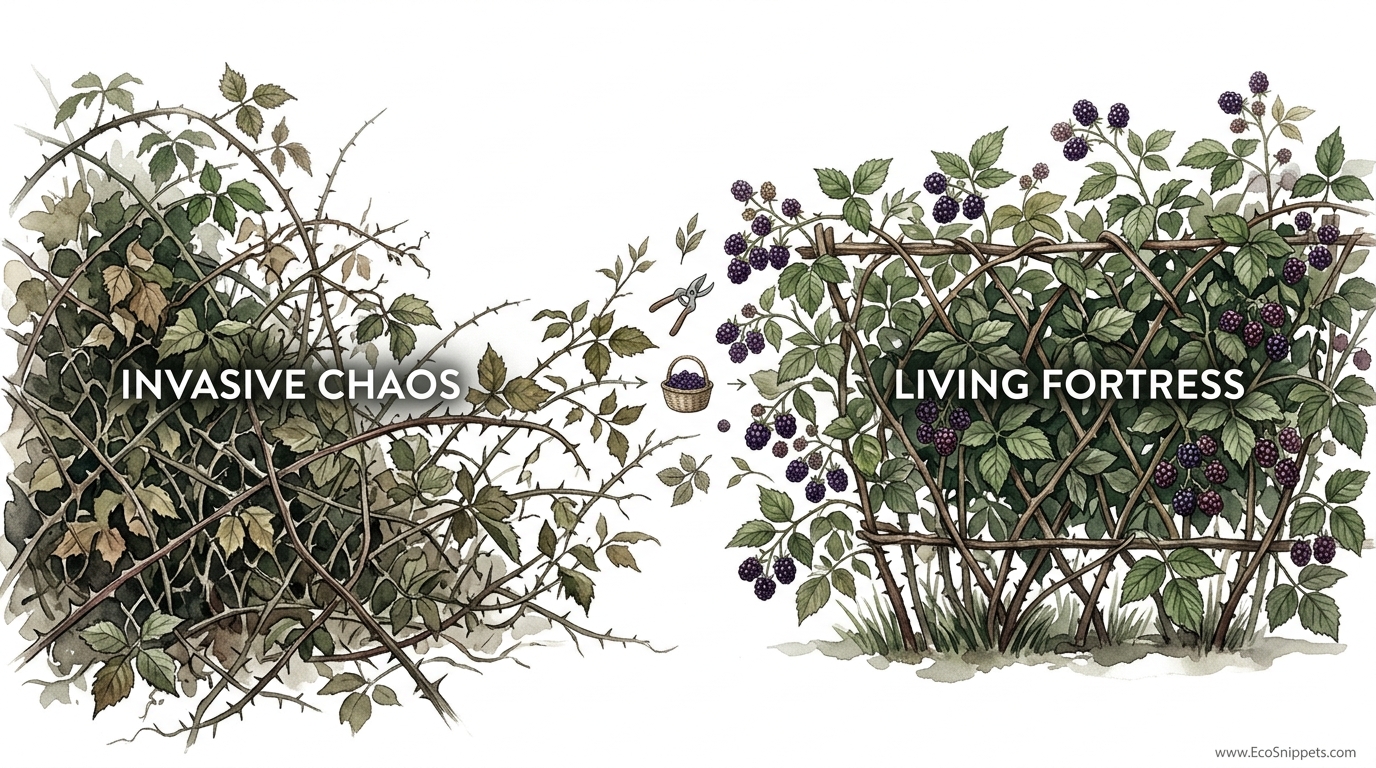
Setting up a living fence requires a shift in perspective. You are moving from a state of INVASIVE CHAOS to a LIVING FORTRESS. This approach treats the land not as a blank slate to be conquered, but as a partner to be guided. Using the natural resilience of the blackberry, you can build a structure that provides food security and physical security simultaneously.
Turning Nuisance Brambles Into A Homestead Asset
Blackberries are often categorized as a “noxious weed” in many regions, particularly the Himalayan (Rubus armeniacus) and Evergreen (Rubus laciniatus) varieties [1.14, 1.22]. These plants are defined by their incredible vigor. A single cane can grow up to 40 feet in a season, and a single plant can dominate a six-square-yard area in less than two years [1.14, 1.18]. In a standard landscape, this is a disaster. On a homestead, this is free building material that grows itself.
A Living Fortress is essentially an engineered hedge. Unlike a static wooden fence that begins to rot the moment you install it, a living fence is a dynamic system. It repairs itself, thickens over time, and adapts to its environment [1.24]. These structures have been used for centuries across Europe and Asia, where farmers “laid” hedges to keep livestock in and predators out [1.25]. By applying these ancestral techniques to the robust invasive blackberry, you create a barrier that is “horse-high, bull-strong, and hog-tight” [1.25].
This system works because the blackberry is naturally designed to colonize edges. It thrives in the transition zones between forests and fields. By providing a trellis, you are simply giving the plant a vertical path to follow rather than letting it sprawl across your pasture. This keeps the fruit within reach, the thorns at a distance, and your property line secure.
Designing the Living Fortress Framework
Success begins with a solid foundation. You cannot simply let the blackberries grow wild and call it a fence; that is just a thicket. A true living fortress requires a structural trellis to guide the canes and ensure the barrier remains dense at the bottom and controlled at the top.
Most practitioners prefer a heavy-duty T-post and wire system. Because mature blackberry canes are heavy and the wind caught by a dense hedge can be significant, the framework must be rock-solid.
- Select the species: If you already have Himalayan or Evergreen blackberries on-site, use them. They are far more aggressive and thorny than native trailing varieties, making them superior for security [1.14].
- Identify the line: Choose a location with full sun. Blackberries will grow in shade, but they won’t produce the dense growth or high fruit yields needed for a true fortress [1.4, 1.13].
- Spacing: Space your primary plants or root cuttings about 2 to 4 feet apart. This ensures that as they grow, the canes will quickly overlap and weave together [1.20, 1.25].
Avoid planting directly on a property line if you have neighbors who prefer manicured lawns. Blackberries spread via underground rhizomes and tip-rooting [1.14]. Give yourself a 4-to-5-foot “mow zone” on either side of the fence to keep the fortress from invading territory where it isn’t wanted [1.20].
Constructing the Framework Step-by-Step
The most effective design for a security fence is the “V-Trellis” or a reinforced “I-Trellis.” These systems allow you to separate the fruiting canes from the new growth, making maintenance easier while maximizing the density of the thorn barrier [1.2, 1.5].
1. Installing the Posts
Drive heavy-duty steel T-posts or 4×4 pressure-treated timber posts into the ground every 10 to 12 feet. For a security fence, ensure the posts stand at least 6 feet high above the ground. If you are using timber, bury the posts 2 feet deep and secure them with gravel or concrete [1.3].
2. Stringing the High-Tensile Wire
Run at least three rows of 12.5-gauge high-tensile wire between the posts. The first wire should be 2 feet from the ground to prevent small animals from squeezing under. The second should be at 4 feet, and the final wire at 6 feet [1.2, 1.5]. Use wire strainers and turnbuckles to keep the lines taut; a sagging wire will lead to a collapsed hedge [1.3, 1.5].
3. Preparing the Soil
Blackberries are not picky, but they thrive in soil high in carbon. Mulching with woodchips or well-rotted hay provides the fungal-dominant environment they love [1.4]. This also helps suppress competing grasses during the establishment phase.
Training the Thorns: The Weaving Process
The secret to a “living fortress” is the weaving. Left alone, blackberries will arch toward the ground and root at the tips, creating a messy, low-level mound [1.14]. To build a wall, you must manually train the canes.
New canes (primocanes) emerge in the spring. They are flexible and lack lateral branches initially. As they reach the height of your wires, gently zip-tie or use twine to secure them horizontally along the wire rather than letting them grow vertically [1.2, 1.5].
Once a cane is horizontal, its apical dominance is broken, and it will begin to sprout lateral “fruiting” branches along its entire length. This is how you create a “wall of thorns” rather than a few isolated stalks. Weave these laterals into the wires, crossing them with canes from neighboring plants. This creates a mesh similar to chain-link, but with three-inch thorns and delicious fruit.
If you want the fence to become truly impenetrable, use a technique called “layering.” Take the tip of a long cane and pin it to the ground at the base of the next post. It will take root and create a new plant, further thickening the base of your fence [1.14, 1.20].
The Permaculture Guild: Friends of the Fortress
A blackberry fence is more effective when integrated into a “guild”—a group of plants that support each other. In a permaculture system, we want to stack functions [1.12, 1.25].
Comfrey is an excellent understory companion. Its large leaves shade the soil, reducing the need for weeding, and its deep taproot brings up nutrients that the blackberries can use [1.4]. Additionally, comfrey provides “chop and drop” mulch for the berries.
Nitrogen-fixers like Siberian Pea Shrub or Autumn Olive (where not invasive) can be planted near the hedge. While blackberries aren’t nitrogen-fixers themselves, they benefit immensely from the nutrient boost provided by nearby legumes [1.13, 1.25].
Tall Canopy Trees like White Oak or Mulberry can be spaced every 30 feet within the hedge line. The blackberries will protect the young trees from deer browsing, and once mature, the trees provide shade and additional food sources [1.10, 1.13].
Benefits of the Berry Barricade
Choosing a living fortress over a traditional fence offers several measurable advantages.
- Unbeatable Cost: Traditional fencing can cost between $15 and $40 per linear foot [1.15]. A living fence costs only the price of a few T-posts and wire. The plants themselves are often free or easily propagated from cuttings [1.16, 1.25].
- Longevity: While a wooden fence might last 15 years, a well-managed blackberry hedge can live for a century [1.25]. It is a legacy project for your land.
- Self-Repair: If a tree falls on a wire fence, the fence is broken. If a tree falls on a blackberry hedge, the blackberries simply grow over the tree, incorporating it into the barrier.
- Ecosystem Services: The hedge provides nesting habitat for beneficial birds and forage for pollinators [1.6, 1.21].
- Visual Privacy: The dense foliage provides a year-round visual screen and acts as a significant wind and noise buffer [1.6, 1.15, 1.21].
Challenges and Common Pitfalls
The very traits that make blackberries good for security—aggression and resilience—make them a challenge to manage. The most common mistake is the “set it and forget it” mentality.
Aggressive Spread: Birds eat the berries and drop seeds everywhere. You will find “volunteer” blackberries popping up in your garden beds and forest edges [1.18]. You must be prepared to mow or pull these seedlings annually.
The Thorns: Working with Himalayan blackberries is physically demanding. Without heavy-duty leather gloves, a canvas coat, and eye protection, you will be shredded. These thorns are backward-curved and designed to hook into flesh and clothing.
Neighbor Relations: If your fortress starts “walking” into the neighbor’s yard, you are looking at a legal liability. Always maintain a clear, mown buffer zone at least 4 feet wide on the exterior of your fence [1.20, 1.23].
Limitations and Environmental Constraints
A living fortress is not a universal solution. It requires specific conditions to be effective and responsible.
- Climate: Blackberries require a certain number of chilling hours to fruit and thrive [1.2]. In extremely arid or tropical climates, they may struggle without significant irrigation.
- Sunlight: In deep shade, the canes become spindly and the thorns less dense. A security fence in the shade will be easy to push through.
- Local Regulations: Some jurisdictions have strict “Noxious Weed” laws that may legally require you to eradicate invasive blackberries. Always check your local ordinances before encouraging their growth [1.14, 1.23].
- Containment: If your property is adjacent to a pristine native wilderness, introducing or encouraging invasive blackberries is ecologically irresponsible. Stick to native species in those sensitive areas.
Comparing Living Fortresses vs. Traditional Fencing
| Factor | Traditional Wood/Wire | Living Fortress (Blackberry) |
|---|---|---|
| Upfront Cost | High ($1,500 – $4,000 per 100ft) | Low ($100 – $300 for wire/posts) |
| Lifespan | 10 – 20 years | 100+ years (with care) |
| Maintenance | Staining, replacing rotted posts | Annual pruning and weaving |
| Security Level | Can be climbed or cut | Climb-proof; self-healing |
| Production | None | Gallons of berries annually |
Practical Tips and Best Practices
If you want your fortress to be both beautiful and effective, follow these homestead-tested tips:
- The 45-Degree Cut: When pruning canes to encourage lateral growth, always cut at a 45-degree angle. This prevents water from pooling on the cut end, which can lead to disease.
- Separate the Ages: Blackberries are biennial. The canes grow the first year (primocanes) and fruit the second year (floricanes). Training the new green canes to the top wire and the fruiting canes to the middle wire makes harvesting and pruning much faster [1.2, 1.3].
- Winter Pruning: Once the fruiting canes die back in late fall, cut them out completely. This prevents the hedge from becoming a fire hazard and makes room for the next generation of thorns [1.3, 1.8].
- Use Heavy Mulch: Apply at least 6 to 12 inches of woodchip mulch at the base. This keeps the roots cool and moist, leading to thicker, more formidable canes [1.4, 1.16].
Advanced Strategy: Multi-Species Hedges
Serious practitioners often move beyond monocultures. To create a hedge that is even more resilient, mix your blackberries with other “pioneer-grit” plants.
Osage Orange is a classic choice. In four years, it creates a fence that is “horse-high and bull-strong” [1.25]. Its wood is the hardest in North America and rot-resistant. Interplanting blackberries among Osage Orange or Hawthorn creates a multi-layered defense. The trees provide the structural “bones,” while the blackberries act as the “barbed wire” that fills in every gap [1.25].
Adding Rugosa Rose into the mix provides additional thorns and vitamin-C-rich rose hips. This diversity ensures that if a specific pest or disease hits one species, the entire fence doesn’t fail. It also provides a longer blooming period for pollinators and a more varied harvest for your pantry [1.12, 1.25].
Scenario: The Perimeter Protection
Imagine a homestead with a 200-foot border facing a public road. A traditional chain-link fence would be an eyesore and cost thousands. Instead, the homesteader installs T-posts and three strands of high-tensile wire. They transplant 50 root crowns of Himalayan blackberry from a nearby ditch.
In year one, the plants establish. The homesteader mows a 5-foot strip between the road and the fence to prevent the berries from encroaching on public space. By year three, the canes have been woven into a 6-foot-high wall. From the road, it looks like a lush green hedge. Anyone attempting to push through it would find themselves entangled in thousands of recurved thorns. Meanwhile, the homesteader harvests 40 gallons of berries, enough for jam, wine, and fresh eating all winter. The “nuisance” has become a guardian.
Final Thoughts
Transforming invasive blackberries into a living fortress is the ultimate expression of the permaculture principle: “The problem is the solution.” It requires work, persistence, and a healthy respect for the thorn, but the reward is a permanent, productive, and impenetrable boundary that no machine can match.
By choosing biological growth over industrial materials, you are building a system that becomes stronger as it ages. You are moving from the chaotic frustration of a weed-choked property to the disciplined security of a managed homestead.
Begin small. Choose one section of your perimeter this season. Drive your posts, string your wire, and start weaving. You will soon find that the very plant you once hated is the one that provides your greatest sense of security and abundance. Experiment with different companions and weaving patterns, and watch as your living fortress takes root and grows into a legacy.
