How To Become More Self-Sufficient Without Starting a Full-Blown Farm…
Want to start preserving your harvest, making your own soap, or building a backyard root cellar — but not sure where to begin? “Homesteading Advice” gives you instant lifetime access to 35+ practical homesteading books on food preservation, veggie gardening, DIY natural cleaning products (save over $250 per year with this skill alone), brewing, off-grid energy, and a whole lot more…
Click Here To Check It Out Now!
What if the solution to your livestock’s health wasn’t found in a syringe, but in the presence of a different animal? Nature never raises a single species in a vacuum. In the ‘Urban’ model of farming, we separate animals and use chemicals to fix the resulting health problems. In a ‘Wild’ integrated model, cows act as biological vacuums, eating the parasites that would otherwise kill your sheep. Stop buying expensive poisons and start building a resilient, multi-species shield for your homestead.
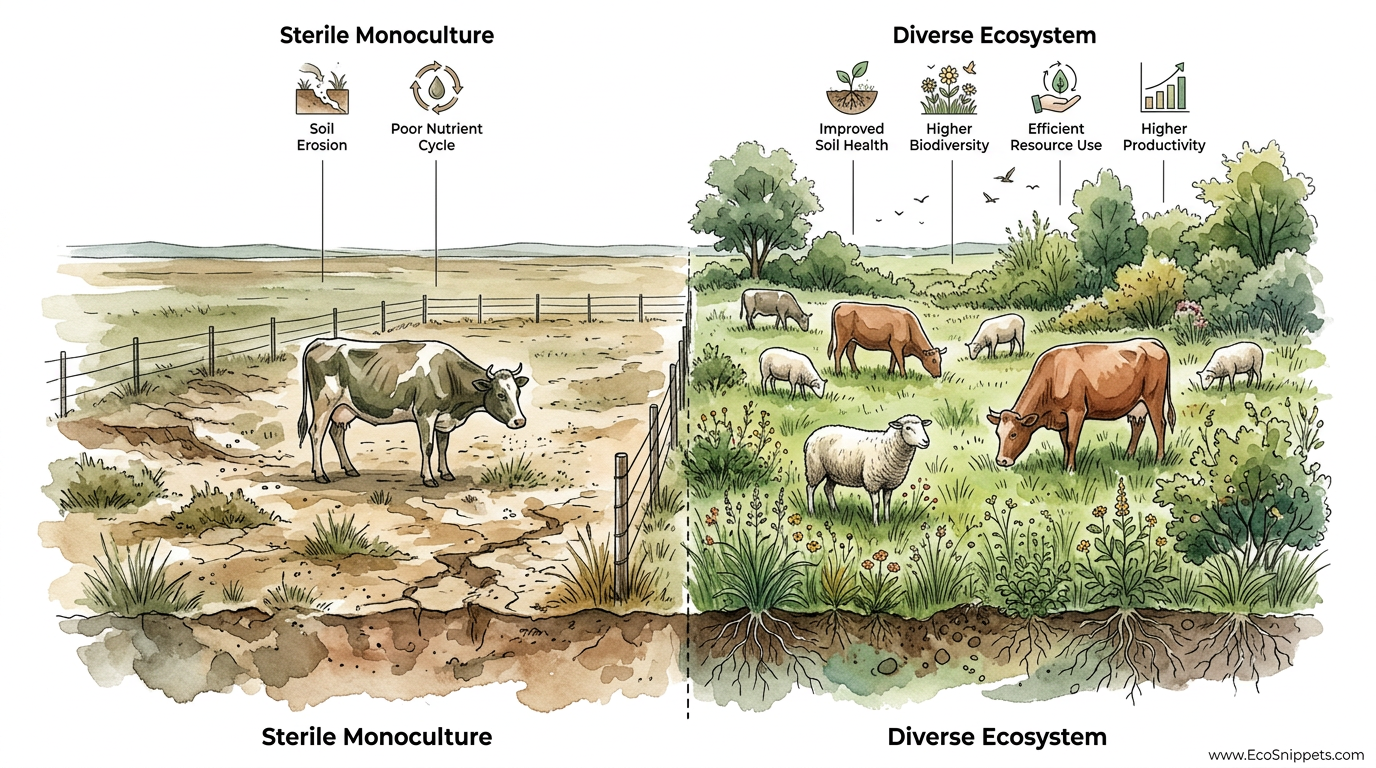
For generations, the modern agricultural complex has taught us to keep our animals in tidy, isolated boxes. We put cattle in one field and sheep in another, creating a sterile monoculture that invites disease. When you isolate a single species, you concentrate their specific waste and their specific parasites, leading to a downward spiral of chemical dependency.
True resilience comes from diversity. When you look back at the old ways—the pioneer grit that settled the land—you see a different story. Farmers didn’t have the luxury of expensive dewormers or specialized chemical fertilizers. They relied on the synergistic relationship between different types of livestock to keep the land productive and the animals healthy.
This guide will walk you through the practical steps of integrating your flock and your herd. You will learn how to leverage the “biological vacuum” effect, optimize your pasture utilization, and create a self-sustaining ecosystem that thrives without constant human intervention.
Benefits Of Grazing Sheep And Cattle Together
Grazing sheep and cattle together, often called multi-species grazing, is the practice of allowing two or more types of livestock to share the same pasture at the same time or in a close sequence. This method mimics the natural movements of wild herbivores across diverse landscapes. In nature, you rarely see a vast plain occupied by only one type of grazer; instead, you find a complex mix of browsers and grazers working in tandem.
Cattle and sheep are the perfect partners because they have complementary grazing habits and different biological responses to internal parasites. Cattle are “bulk grazers.” They use their tongues to wrap around tall grasses and pull them into their mouths. They aren’t particularly picky and will happily mow down the high, coarse forage that sheep often find unpalatable.
Sheep, on the other hand, are “selective grazers.” They have split upper lips that allow them to nibble close to the ground and pick out specific broadleaf weeds (forbs) and clover that cattle might overlook. This difference in “mouth-architecture” means that when you run both species together, they utilize the entire sward of grass more evenly than either species could do alone.
The real magic, however, lies in the “biological vacuum” effect. Most internal parasites are host-specific. The worms that plague sheep, such as the deadly Barber’s Pole worm (Haemonchus contortus), generally cannot survive inside the digestive tract of a cow. When a cow grazes a pasture infested with sheep parasite larvae, it “hoovers” them up. The larvae are destroyed by the cow’s immune system or simply fail to mature in the alien environment of the bovine gut. This breaks the parasite’s life cycle and leaves a cleaner pasture for your sheep.
Improved Pasture Composition
Cattle tend to avoid the grass growing around their own dung patches, leading to “rank” spots in a pasture that go to waste. Sheep have no such qualms about cattle dung and will graze right up to the edge of it. Conversely, cattle will graze near sheep dung. This cross-species acceptance leads to a much more uniform grazing pattern, preventing the patchy, uneven growth seen in single-species systems.
Weed Control Without Chemicals
Many plants that cattle find offensive or even toxic are high-protein snacks for sheep. Leafy spurge, tansy ragwort, and various types of thistle can take over a cattle-only pasture. Sheep will actively seek these out. By integrating sheep, you turn a weed problem into a lamb-growing opportunity, reducing the need for expensive herbicides that poison the soil and water.
How It Works: The Mechanics of Integrated Grazing
Implementing this system requires a shift in how you think about your land. You aren’t just managing animals; you are managing an ecosystem. There are two primary ways to structure your multi-species grazing: the “Flerd” (simultaneous grazing) and the “Leader-Follower” (sequential grazing) models.
The Flerd Model (Simultaneous Grazing)
A “flerd” is a bonded group where the sheep and cattle are run as a single unit. This requires a bit of work on the front end to bond the animals, but once established, it is the most efficient way to manage livestock. The sheep typically stay in the middle of the cattle herd, using the larger animals as a living shield against predators like coyotes or stray dogs.
Bonding usually involves keeping young lambs and calves together in a small area for several weeks until they become accustomed to each other’s presence. Once they view each other as part of the same social group, they will graze, move, and rest together. This model maximizes the “biological vacuum” effect because the cattle are constantly cleaning the pasture as the sheep graze alongside them.
The Leader-Follower Model (Sequential Grazing)
If bonding animals seems too complex, the leader-follower model is an excellent alternative. In this system, you move one species into a fresh paddock first, let them take the “cream” of the forage, and then move them out. Immediately afterward, you move the second species in to “clean up” the remaining grass.
Usually, the species with the highest nutritional needs goes first. If you are finishing lambs, they might lead, followed by dry cows. Alternatively, if you are focusing on parasite control, you might send the cattle in first to mow down the tall grass and vacuum up larvae, followed by the sheep who can then safely access the shorter, more nutritious regrowth.
Stocking Ratios and Carrying Capacity
One of the most surprising benefits of this system is that it often increases the overall carrying capacity of your land by 10% to 25%. Because sheep and cattle eat different plants and different parts of the same plant, you can often add one or two sheep for every cow without significantly increasing the pressure on your grass.
A common rule of thumb for beginners is a 1:1 ratio (one ewe per cow). As you become more experienced and your pasture health improves, you might find that your land can support a ratio of 2 or 3 sheep per cow. Always monitor your grass height and soil health; if you see bare ground or declining animal condition, you have overstepped your land’s current capacity.
Advantages Of Multi-Species Systems
The move toward integrated grazing isn’t just about nostalgia; it’s about the bottom line and the long-term health of your homestead. The advantages are measurable in pounds of meat produced, reduced vet bills, and increased soil fertility.
Economic Resilience
Diversifying your livestock means diversifying your income. If the price of beef drops, your wool or lamb sales can bridge the gap. By producing more total pounds of meat per acre through better forage utilization, you are making your land more profitable without purchasing more acreage.
Reduced Parasite Loads
Chemical dewormers are failing. Parasites are developing resistance at an alarming rate, leaving many sheep farmers with few options. Multi-species grazing is a biological solution to a biological problem. Research shows that sheep grazed with cattle have significantly lower fecal egg counts. This reduces the need for “pour-ons” and oral drenching, saving you money and keeping chemicals out of your food chain.
Soil Health and Fertility
Different animals distribute manure differently. Cattle drop large, concentrated “pats,” while sheep distribute small, nutrient-dense pellets across a wider area. This combination provides a more balanced return of nutrients to the soil. Furthermore, the different hoof actions of sheep and cattle—cattle with their heavy, compacting hooves and sheep with their smaller, sharper hooves—help to break up the soil surface in different ways, encouraging diverse seed germination.
Challenges and Common Mistakes
While the benefits are clear, you cannot simply throw sheep and cattle into a field and hope for the best. There are specific hurdles you must clear to ensure the safety and health of both species.
Fencing Frustrations
The most common mistake is assuming that cattle fencing will hold sheep. It won’t. Cattle are generally contained by two or three strands of barbed wire or a single high-tensile electric wire. Sheep are much more persistent and smaller. They will walk right under standard cattle wire.
To successfully graze both, you usually need to upgrade to woven wire (field fence) or add more strands of high-tensile electric wire closer to the ground. A five-strand electric fence with the bottom wire at 6 inches is often the minimum required to keep sheep in and predators out.
Mineral Toxicity (The Copper Problem)
This is a critical error that can be fatal. Cattle require significant amounts of copper in their mineral mix to thrive. Sheep, however, are highly sensitive to copper. If sheep consume cattle minerals for an extended period, the copper builds up in their liver until it reaches a toxic level, causing a sudden and often fatal hemolytic crisis.
You must manage mineral feeding carefully. If co-grazing, many farmers use a “sheep-safe” mineral for everyone and then provide supplemental copper to the cattle in a way the sheep cannot access, such as via high-hanging mineral feeders or specific cattle-only “creep” areas.
Temperament and Aggression
Not all cows like sheep. Some cattle can be aggressive, especially during calving season or around water troughs and feed bunks. If you have an older cow that is known for being “bossy,” she may injure or kill a sheep. It is vital to cull aggressive animals from a multi-species system and to ensure that sheep have “escape routes” or their own dedicated space around shared resources.
Limitations and Constraints
Integrated grazing is a powerful tool, but it is not a silver bullet for every environment or situation. Understanding the boundaries of this method will save you from unnecessary heartache.
Shared Parasites and Diseases
While most parasites are host-specific, there are exceptions. The stomach worm Trichostrongylus axei can infect both sheep and cattle. Additionally, certain diseases like Malignant Catarrhal Fever (MCF) can be carried by sheep without symptoms but are fatal to certain breeds of cattle and bison. If you are working with specialized or highly sensitive breeds, consult with a veterinarian before mixing them.
Environmental Impact in Wet Conditions
In areas with high rainfall or heavy clay soils, running both species can increase the risk of soil compaction and “pugging” (deep hoof ruts). Sheep are lighter on the land, but cattle can do significant damage when the ground is saturated. In a multi-species system, the total animal impact is higher, meaning you must be even more diligent about moving animals off wet ground to prevent destroying the pasture structure.
Handling Facility Mismatches
A chute designed for a 1,200-pound steer is useless for a 150-pound ewe. If you integrate sheep into a cattle-centric operation, you will need to invest in or build separate handling facilities. Sheep require smaller alleys, lower gates, and different sorting setups. Trying to work sheep through cattle equipment is a recipe for broken legs and frustrated farmers.
Comparison of Grazing Habits
Understanding the fundamental differences between these two animals is key to managing them as a team. The following table highlights why they work so well together.
| Feature | Cattle (The Bulk Grazer) | Sheep (The Selective Grazer) |
|---|---|---|
| Primary Forage | Tall, coarse grasses | Short grasses, forbs, and weeds |
| Grazing Height | 4 to 10 inches | 1 to 4 inches |
| Mouth Action | Wrap with tongue (pulling) | Nibble with split lip (clipping) |
| Parasite Risk | Moderate (Older cows are resistant) | High (Very susceptible) |
| Predator Risk | Low | High |
Practical Tips for Success
Starting a multi-species grazing program is an exercise in observation and adaptation. Use these best practices to smooth the transition for both your animals and your land.
- Use Hair Sheep if Possible: If you are primarily a cattle producer, consider hair sheep breeds like Katahdins or Dorpers. They do not require shearing, which simplifies management, and they are generally more parasite-resistant than wool breeds.
- Design Water Access for Everyone: Sheep cannot always reach over high-walled cattle tanks. Provide a low-profile watering system or a “stepped” approach so that sheep can drink safely without the risk of being pushed into a deep tank.
- Electric Training: Ensure both species are 100% “boundary trained” to electric fencing before turning them out into large pastures. A sheep that doesn’t respect a hot wire will lead your cattle through it.
- The “Creep” Gate: Use a creep gate—an opening large enough for a sheep but too small for a cow—to allow sheep access to high-quality “safe” areas or specialized minerals. This gives the sheep a sanctuary if the cattle become too pushy.
- Start Small: Don’t try to manage a massive “flerd” on day one. Start with a small group of 5-10 sheep alongside your cattle to learn their dynamics and test your fencing.
Advanced Considerations: Tuning the Ecosystem
Once you have mastered the basics, you can begin to fine-tune your stocking density to optimize soil carbon sequestration and pasture health. Advanced practitioners often use “Mob Grazing” techniques within a multi-species framework. This involves moving a very high density of animals—both sheep and cattle—onto a small piece of land for a very short period (12 to 24 hours).
The intense hoof action tramples a large portion of the forage into the soil, creating a thick layer of mulch that feeds the soil microbes and retains moisture. The animals are then moved to a fresh paddock and the original area is given a long rest period (60 to 90 days). This long rest is essential for breaking the parasite cycle, as most larvae will die before a host returns to the field.
You should also consider the “Nutritional Ladder.” In a sequential grazing system, the animals with the highest metabolic demand—such as lactating ewes or growing steers—should always have access to the highest quality forage first. Monitoring the Brix levels (sugar content) of your grass can help you decide exactly when to move each group to maximize weight gain.
Example Scenario: The 100-Acre Homestead
Imagine a 100-acre farm that currently supports 40 head of beef cattle. The farmer is struggling with thistle infestations and high dewormer costs. By implementing a multi-species system, the farmer decides to add 60 Katahdin hair sheep to the operation.
Using a leader-follower system, the farmer moves the cattle through 5-acre paddocks every 3 days. The cattle eat the top 4 inches of the lush orchardgrass and clover. As soon as the cattle move out, the sheep move in for 2 days. The sheep focus on the thistle heads, the regrowth at the base of the grass, and the weeds the cattle ignored.
After one season, the farmer notices that the thistle population has decreased by 70% without a single drop of herbicide. The sheep have “cleaned” the pasture of cattle-specific parasites, and the cattle have vacuumed up the sheep’s worm larvae. The result is a 15% increase in total meat production from the same 100 acres, with a 50% reduction in chemical inputs.
Final Thoughts
Building a multi-species shield for your homestead is about more than just efficiency; it is about returning to a model of farming that respects the complexity of the natural world. By allowing sheep and cattle to work together, you are creating a self-regulating system that rewards you with healthier animals and more productive land.
The transition requires a willingness to invest in better fencing and a commitment to observing the subtle interactions between your animals. However, the payoff—a resilient, chemical-free, and profitable homestead—is well worth the effort.
Take the first step by assessing your current fencing and looking for a small group of sheep to trial. As you watch the “biological vacuum” in action, you will realize that the best solutions are often the ones that nature has been practicing for millennia. Start where you are, use what you have, and let the wisdom of the herd guide you back to a more integrated, resilient way of life.
